"la vera storia di ogni giorno della Sicilia antica... delle tante città e dei numerosi siti...non è nei tretradrammi da tesaurizzazione, lordi del sangue dei mercenari con cui venivano pagati o dei saccheggiatori che irrompevano e stupravano per derubarli...ma nelle litre, negli oboli e in tutte le frazioni minori, monete regine dell'agorà e dei suoi commerci, nummi per tutti i luoghi e per tutti i giorni."
"the true everyday story of ancient Sicily... of the many cities and numerous sites... is not in the tetradrachms for hoarding, filthy with the blood of the mercenaries who were paid with them or the looters who burst in and raped to steal them... but in the litrae, obols, and all the smaller fractions, coins that were queens of the agora and its commerce, nummi for all places and all days."
— piakos, lamoneta.it forum, July 15, 2009
As 2025 draws to a close, it's time to reflect on the exceptional coins that have joined the collection this year. From the exquisite octopus litrae of Syracuse to the powerful facing heads of Larissa, and from the youthful Herakles of minor Sicilian mints like Kephaloidion and Longane to the rare issues of Piakos and Stiela, each piece tells a story of artistic mastery and historical significance. This selection represents not just aesthetic beauty, but also remarkable rarity, die artistry, and the connections between ancient Mediterranean mints.
I could have easily made this entire list octopus coins—or just Arethusa heads—but I limited Syracuse to four pieces. This left room for the Herakles issues from minor Sicilian mints, nymphs from obscure settlements, and the facing heads of Larissa.
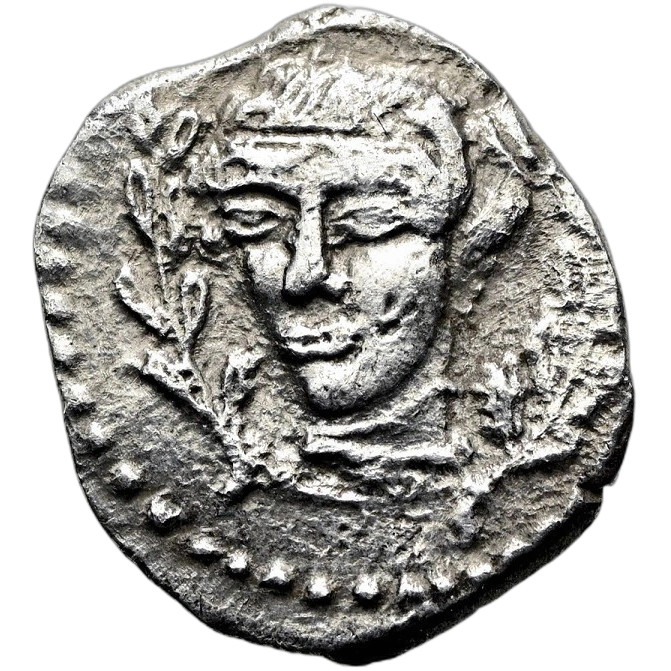
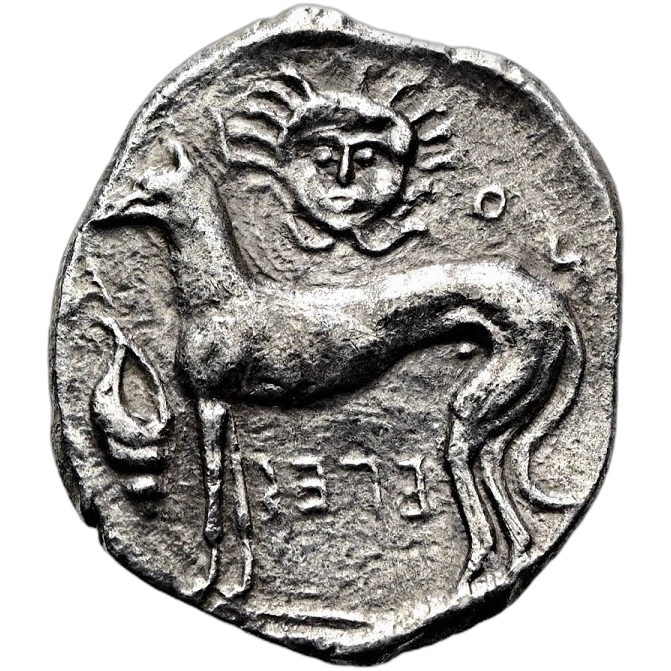
10. Segesta Litra – Nymph Aigeste / Hunting Dog
Collection of the author - view coin page
Segesta, the great Elymian city of northwestern Sicily, produced coinage of distinctive character that reflected its unique cultural heritage. The heads of the eponymous figure on Segesta's coinage are almost all copied from prototypes on the coinage of Syracuse, but not this one. This litra features Aigeste in an original composition, her head framed between two olive branches, a motif that speaks to the agricultural wealth of the region. Whether Aigeste should be called a nymph or a heroine remains debated; the sources are inconsistent, though her role as the city's eponymous protectress is clear. The engraving lacks the refined elegance of Syracusan or Larissan facing heads; the features are somewhat flat and provincial. Yet this rougher quality gives the coin its own charm, a reminder that not every ancient mint had access to master die cutters.
The reverse presents a hunting dog standing right, a type closely associated with Segesta's coinage. The hound may represent the river Krimisos, who according to local legend took the form of a dog to seduce the Trojan woman Segesta, mother of the city's founder Aigestes. The dog itself is likely a Cirneco dell'Etna, an ancient Sicilian breed still found on the island today.1 Above the dog appears a Gorgoneion, that ancient apotropaic device meant to ward off evil, while a murex shell sits in the field before the hound. The murex was the source of the precious Tyrian purple dye, and its presence here may reference trade connections or local production of this valuable commodity.
Segesta's mythology intertwined Greek and local Elymian traditions. According to legend, the city was founded by Trojan refugees, and the Segestans claimed kinship with Rome through their shared Trojan ancestry. This coin, struck 405–400 BCE, was produced in the aftermath of Segesta's fateful decision to invite Carthaginian intervention against their rival Selinus. In 409 BCE, Carthage responded by destroying Selinus and Himera, reshaping the political landscape of Sicily and leaving Segesta ascendant among the western Sicilian cities.
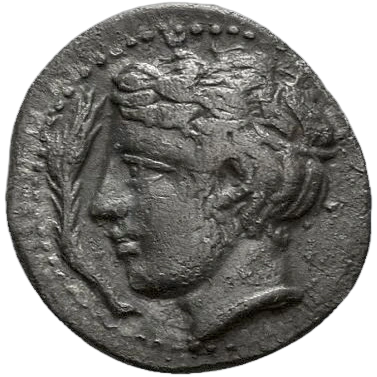
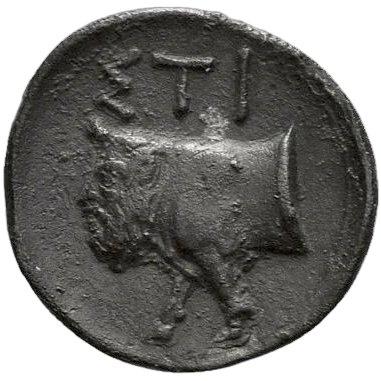
9. Stiela Litra – Apollo / Man-headed Bull
Collection of the author - view coin page
Stiela (or Styella, as identified by Stephanus of Byzantium2) was a fortress of Megara located near the river Alabon, which flows into the Megarian Gulf. Though Gelon destroyed Megara in 483 BCE, the survival of a stronghold in Dionysius's service is plausible. Its strategic location beside a river crossing between Syracuse and Katane made it valuable territory.
The obverse features a laureate head to left, with an aquatic branch in the field. Though commonly identified as a river god, Mirone (1926) argued this is more likely Apollo, noting the close stylistic similarity to contemporary laureate Apollo heads from Katane by the "Master of the Leaf" and the engraver Herakleidas.3 The head lacks typical river god characteristics such as horns, bull ears, or a river name in the nominative case. The aquatic branch may be Ceratophyllum demersum, a submerged aquatic plant endemic to Sicily. The reverse presents the forepart of a man-headed bull to left, with ΣΤΙ (Stiela) in the legend, representing a local river deity in theriomorphic form.
Dating to 405 BCE, this piece comes from "The Collection of Greek Coins of a Man in Love with Art."
8. Kephaloidion Litra – Youthful Herakles / Bull
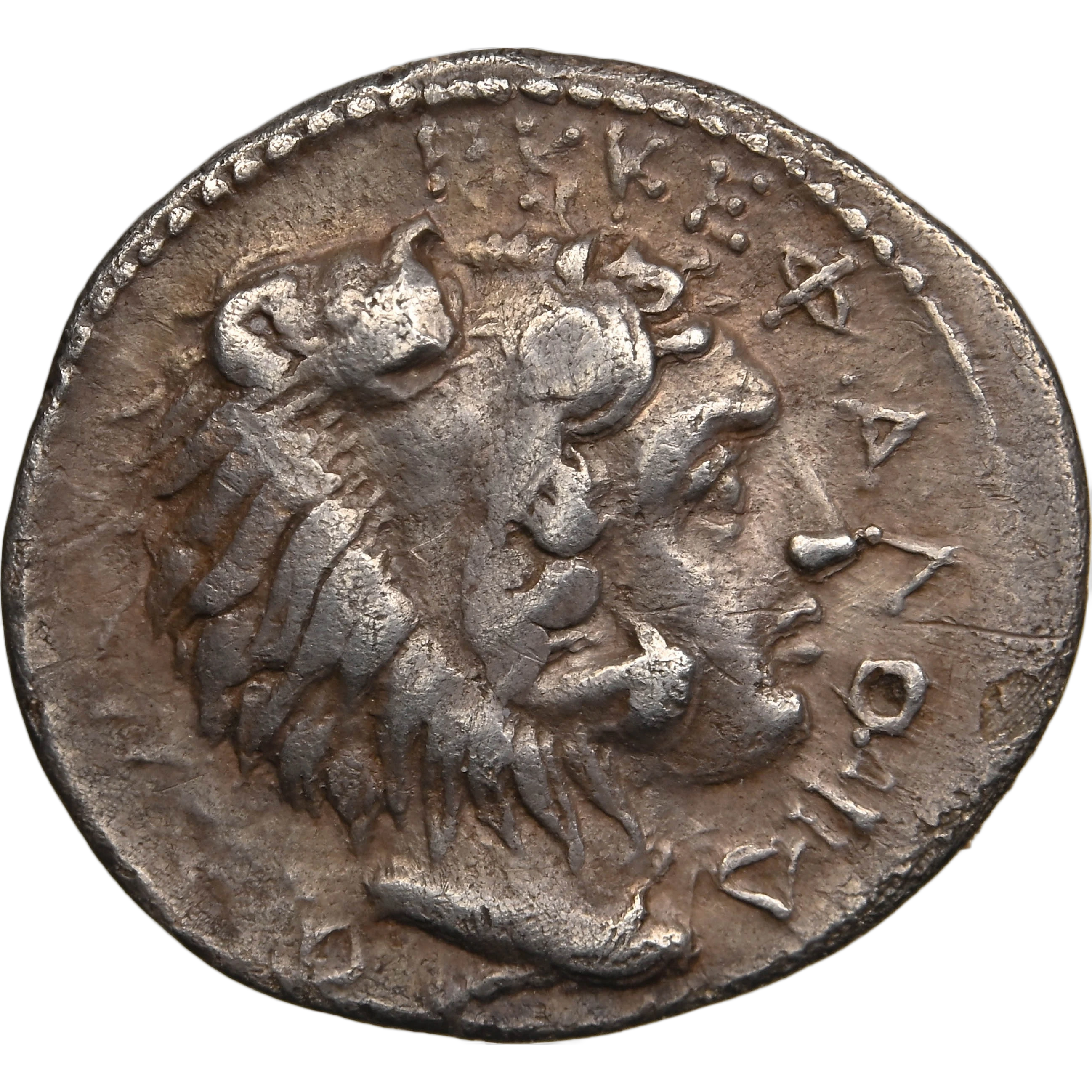
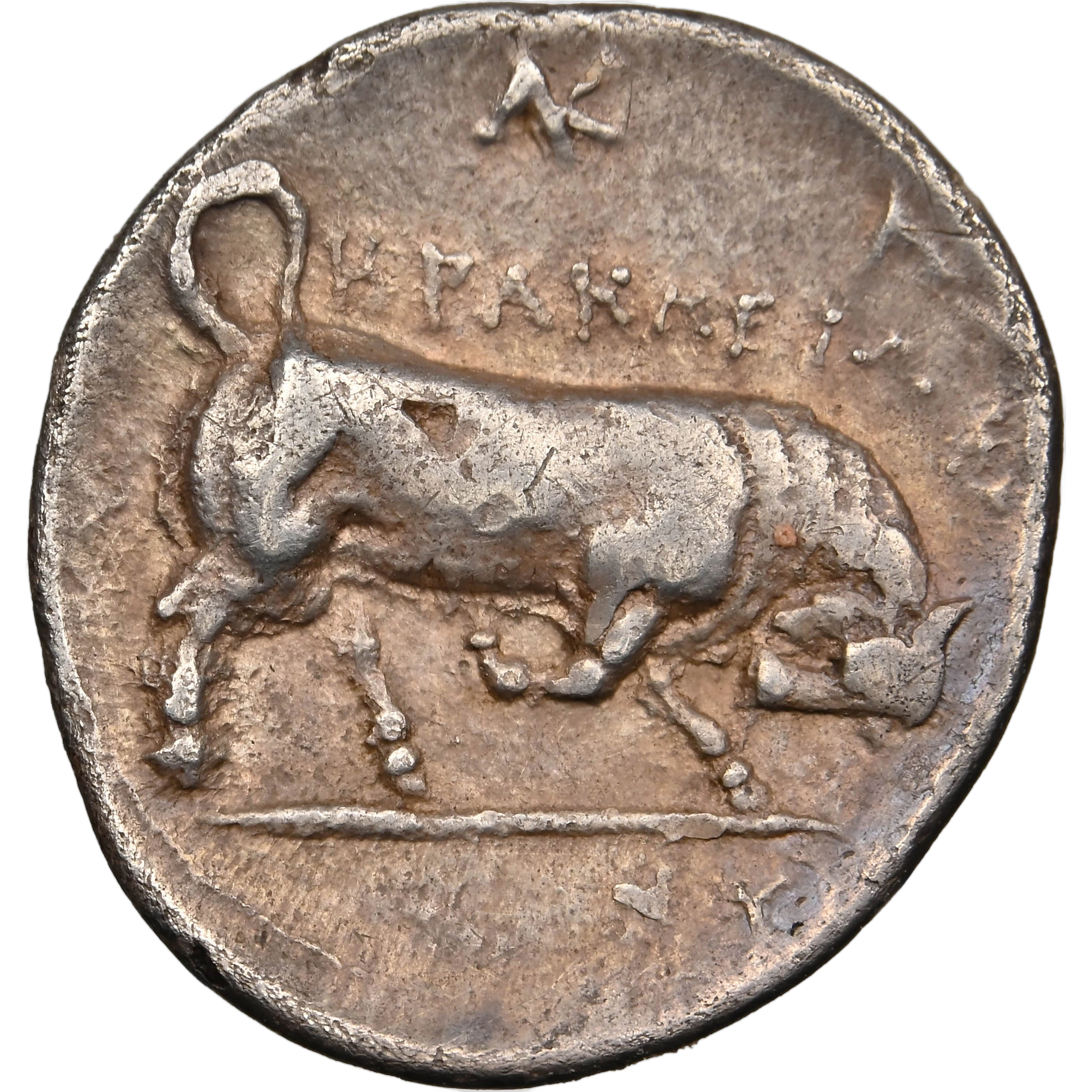
Collection of the author - view coin page
Kephaloidion (also Cephaloedium, modern Cefalù) on Sicily's northern coast produced limited coinage during the 4th century BCE. This piece is very rare, with only four examples of this variant cited by Campana, and has been certified by NGC as Choice VF 5/5 3/5.
This litra bears witness to demographic engineering under Dionysius I. When Kephaloidion fell to the Carthaginians in 409 BCE, it likely served as a mint under the Punic name "Rash Melkarth" (meaning "foothills of Herakles").4 Following Dionysius's treacherous capture of the city according to Diodorus,5 Lucanian mercenaries from Herakleia seized control, transforming it into a mercenary settlement. There is a striking coincidence: settlers from a city named for Herakles found themselves occupying a place the Carthaginians had already named for the same hero. The dual legend system—ΕΚ ΚΕΦΑΛΟΙΔΙΟΥ ("from Kephaloidion") on the obverse and ΗΡΑΚΛΕΩΤΑΝ ("of the Herakleians") on the reverse—documents this population replacement: "Herakleians living at Kephaloidion."6 Far from representing peaceful sympoliteia, these dual legends functioned as numismatic signatures of mercenary occupation, paralleling similar Campanian issues at Entella and Nakone.
The obverse presents youthful Herakles wearing his lionskin headdress, reflecting both the settlers' origins (Herakleia in Lucania) and the hero's exceptional prominence in Sicilian religious life.7 The reverse shows a bull butting right with an ΑΚ monogram above. The butting-bull typology derives from Thurioi staters via Katane's post-403 BCE issues, revealing the southern Italian mercenary origins through borrowed iconography.
Struck post-400 BCE during the transitional period 405–390 BCE, this litra materializes Diodorus's narrative of systematic demographic engineering across eastern Sicily under Dionysius I's hegemony.8
7. Piakos Litra – Nymph / Bull & Fish
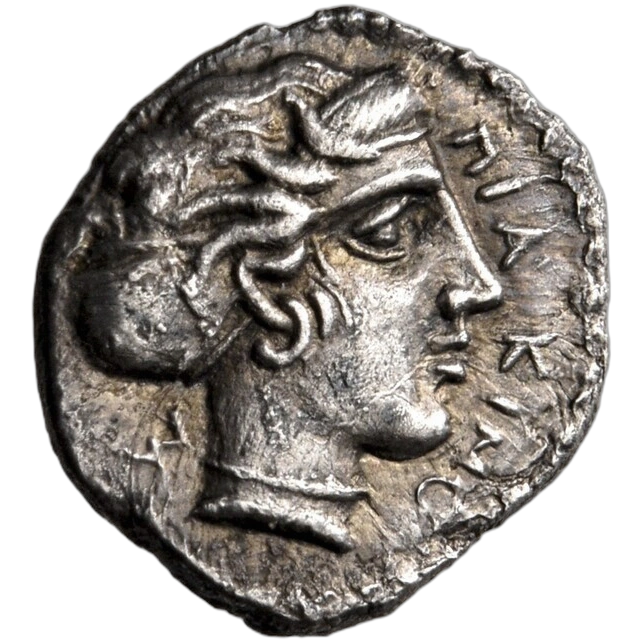
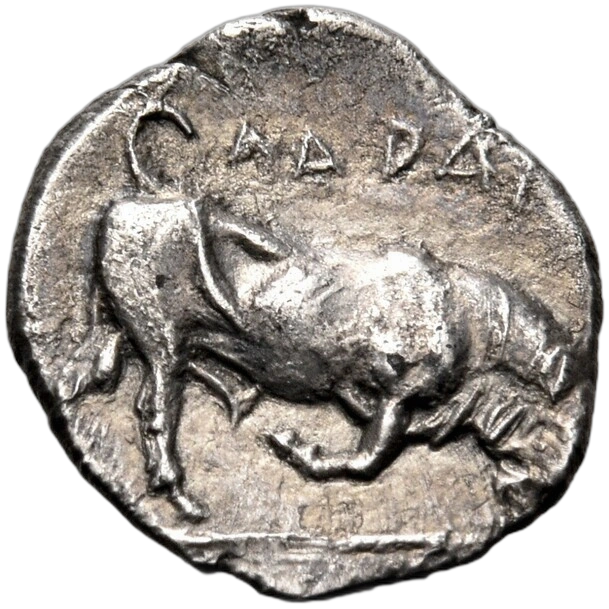
Collection of the author - view coin page
This is a very rare Sicilian litra, featuring a nymph whose identity we simply don't know. Almost nothing is known about Piakos either. It produced very little coinage. The earliest issue is a bronze hemilitron depicting a hound attacking a stag, attributed to the "Maestro della foglia" (Master of the Leaf), the same die engraver responsible for Katane's Apollo types.
The reverse legend ΑΔΡΑΝΟΣ has been misread since Jenkins first published this series in 1962, when he interpreted it as evidence for sympoliteia with the polis Adranon.9 But this interpretation fails on epigraphic grounds. Sicilian Classical ethnics appear in the genitive (later Timoleontic issues correctly display ΑΔΡΑΝΙΤΑΝ), while the masculine singular ΑΔΡΑΝΟΣ can only reference the Sikel deity Adranos, not the polis. The deity presided over a famous sanctuary near Mendolito/Paternò-Civita, protected by guardian dogs that could distinguish friend from foe.10 So this litra doesn't document political union but religious devotion. Piakos was invoking the powerful Sikel deity whose sanctuary dominated the region.
The obverse shows a nymph right, wearing ampyx, sphendone, spiral earring, and plain necklace. Stylistically similar to the Arethusas of the Period of the Signing Artists. The reverse presents a bull butting right with fish in exergue, copied from Katane's post-403 BCE innovations. Die-engraving characteristics suggest connections between the butting-bull coinages of Katane, Kephaloidion, and Piakos.
Struck 403–390 BCE, this tiny litra captures a moment when indigenous Sikel communities invoked their traditional deities while adopting Greek numismatic innovations during Sicily's most violent period of demographic upheaval.8
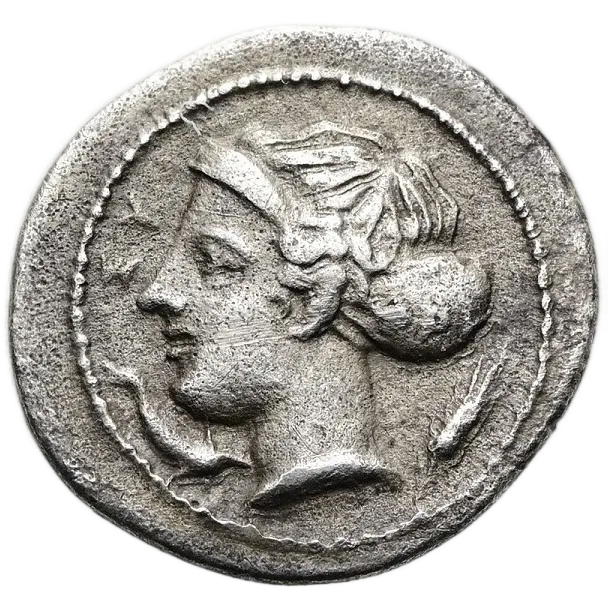
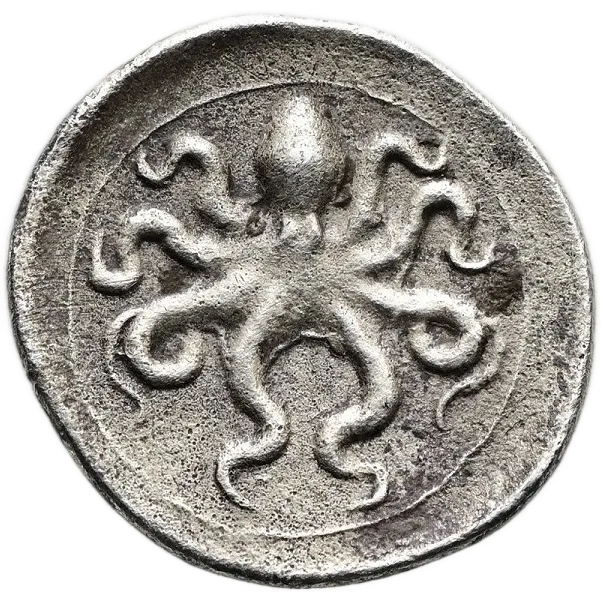
6. Syracuse Litra – Arethusa / Octopus (Phrygillos)
Collection of the author - view coin page
This litra bears the signature ΦΡY (ΦΡΥΓΙΛΛΟΣ) on Arethusa's sphendone, identifying it as the work of the engraver Phrygillos.11 One of approximately twenty known examples, it remains strikingly beautiful despite its simpler style.
The obverse features Arethusa's head to left, adorned with earring, necklace, ampyx and sphendone. A dolphin appears beneath her chin, with an ear of barley in the right field. The minimal ethnic ΣΥ (Syracuse) completes the design. The presence of both the grain ear and dolphin disproves R. Holloway's theory of parallel "dolphin" and "grain-ear" ateliers12.
The reverse octopus is noteworthy for its simpler design: unlike the more common Syracusan octopus type where the front two tentacles are entangled, this specimen shows a clearer, more naturalistic arrangement.
The dating is uncertain but generally placed within 410–400 BCE during the Second Democracy. Unlike the Eukleidas signed litra, this Arethusa head and octopus style are not repeated on other known dies, making it difficult to establish a precise chronological sequence.
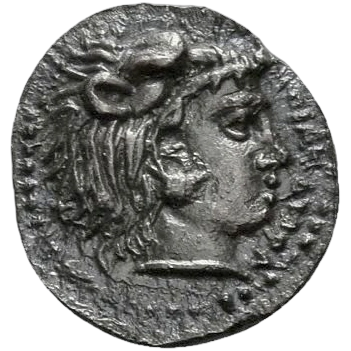
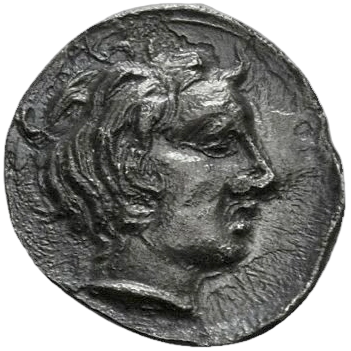
5. Longane Litra – Young Herakles / River God
Collection of the author - view coin page
Longane, a small Sikel settlement in northeastern Sicily whose site has been identified a few kilometers from Castroreale (ME), near the villages of Rodi and Milici, about 7 km from the coast, produced a limited coinage of exceptional quality during the late 5th century BCE.
The obverse presents the head of young Herakles to right, wearing his characteristic lion-skin headdress. The treatment is fresh and vigorous, capturing the hero's youth rather than the mature, bearded warrior often depicted. While we lack specific documentation for Longane's choice of Herakles as their civic type, the hero's exceptional prominence in Sicilian religious life (discussed in coin #10) suggests similar motivations may have been at work in this small Sikel community. The reverse shows the head of a young river-god to right, identified by the small horns on his head, representing the Longanus (also known as Longanos or Loitanus), a river in northeastern Sicily on the Mylaean plain near which the settlement of Longane was situated. The Longanus would later gain historical significance as the site where the Mamertines suffered a dramatic defeat by Hiero II of Syracuse around 269 BCE, as recorded by Polybius13.
This litra is rare and in unusually fine condition for the issue, displaying old cabinet tone and extremely fine surfaces. Struck 420–400 BCE and acquired from "The Collection of Greek Coins of a Man in Love with Art."
4. Syracuse Litra – Arethusa / Octopus (Right-facing, Helix Earring)
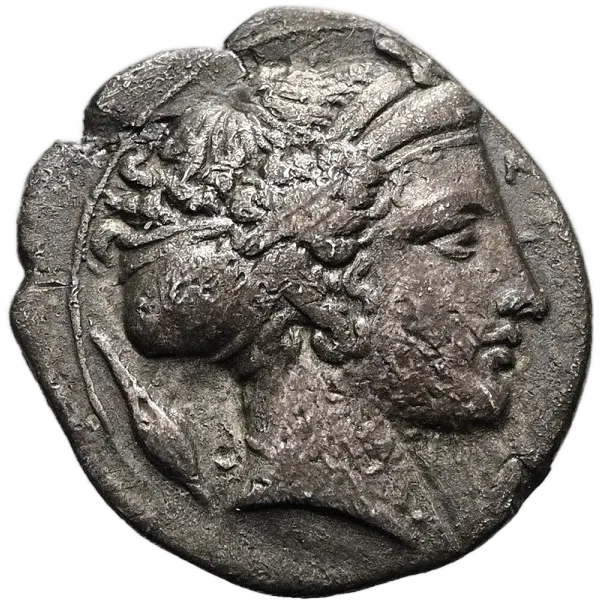
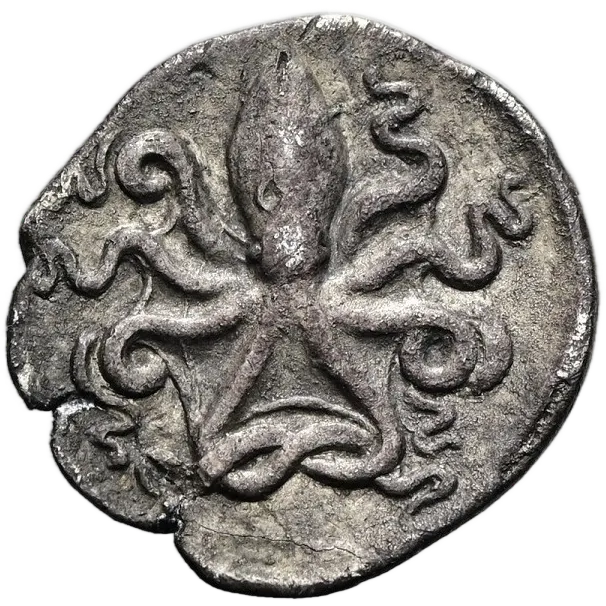
Collection of the author - view coin page
One of only four known examples (three in private hands), this litra stands out for its distinctive right-facing Arethusa, a rare orientation that sets it apart from the vast majority of Syracusan octopus litrae. The die is unsigned but often attributed to Eukleidas based on stylistic analysis.
The obverse features the head of Arethusa right, wearing a helix earring (a spiral shell-shaped ornament), necklace, ampyx and sphendone. A barley grain appears in the left field, with the ethnic ΣΥΡΑ (Syracuse) completing the design. The combination of right-facing orientation and helix earring makes this die immediately recognizable among Syracusan fractional silver.
The reverse displays the Type 3 or "Classical" octopus as classified by Denyse Berend14, the final and most refined of the three standard octopus types used in Syracusan coinage. Elegantly rendered despite the small flan, this design represents the culmination of the octopus motif's evolution.
Dating to 405–400 BCE during the reign of Dionysios I, this piece exemplifies the variety and creativity within Syracusan coinage.
3. Syracuse Litra – Arethusa / Octopus (Triple-Pendant Earring)
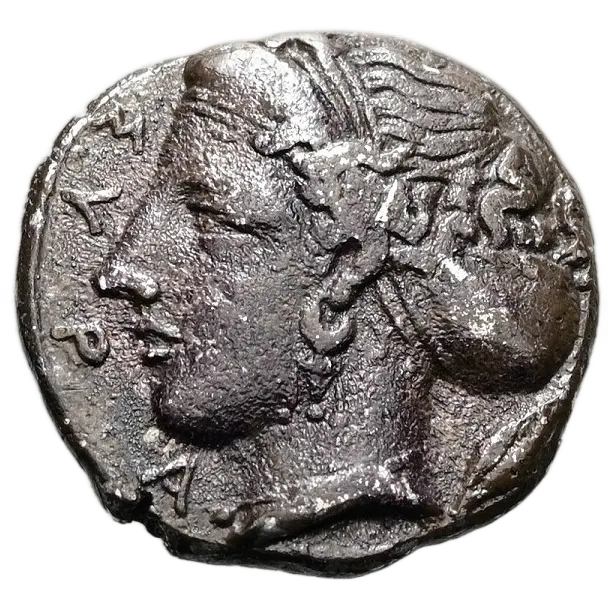
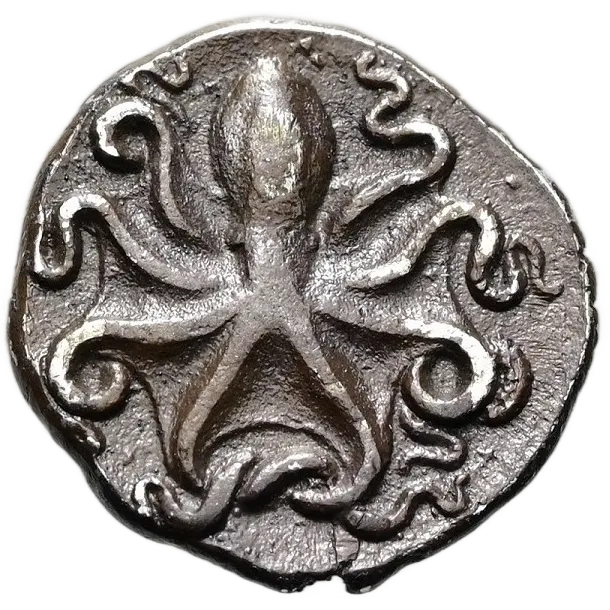
Collection of the author - view coin page
One of only four known examples, this litra presents an unsigned die often attributed to Eukleidas. While no known specimens preserve the EV signature on the ampyx, stylistic analysis suggests the dies were engraved by the same master who signed other Syracusan litrae. What makes this piece particularly significant is that it represents the first Arethusa to combine the triple-pendant earring with the sphendone. The triple-pendant earring had appeared earlier on the tetradrachms R38-R40, but those issues depicted Arethusa with her head tilted forward and hair simply tied in a knot, a very different composition.
This piece shares a particularly close relationship with the tetradrachm die R48, both featuring the identical triple-pendant earring with a distinctive circular base connecting the three pendants. This circular base design marks a very specific and apparently brief artistic phase. All subsequent issues from R49 onward switched to a rectangular base instead. Lederer, in his foundational 1913 study, established the principle that fractional coinage should be dated after their larger denomination counterparts, a view that many subsequent numismatists have followed.15 However, given how quickly the circular-base style was abandoned, I'm inclined to place this litra before R48, making it potentially the prototype for the entire female figure wearing sphendone + triple-earring tradition.
The reverse displays the Type 3 "Classical" octopus14, crisply rendered despite the coin's small size. Dating to 405–400 BCE, this piece represents the high point of Syracusan fractional silver coinage. At 0.87 grams, it was struck at the proper weight standard of 0.872 g as established by Boehringer16. The vast majority of Sicilian litrae were struck underweight, but this exceptional piece, likely due to its extraordinary artistic quality, was given the care to meet the correct weight.
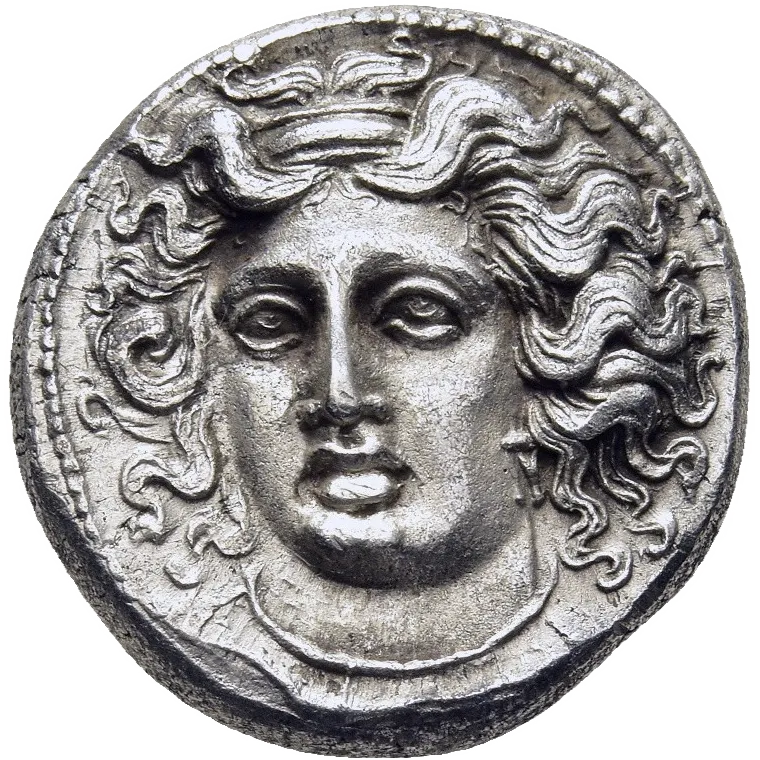
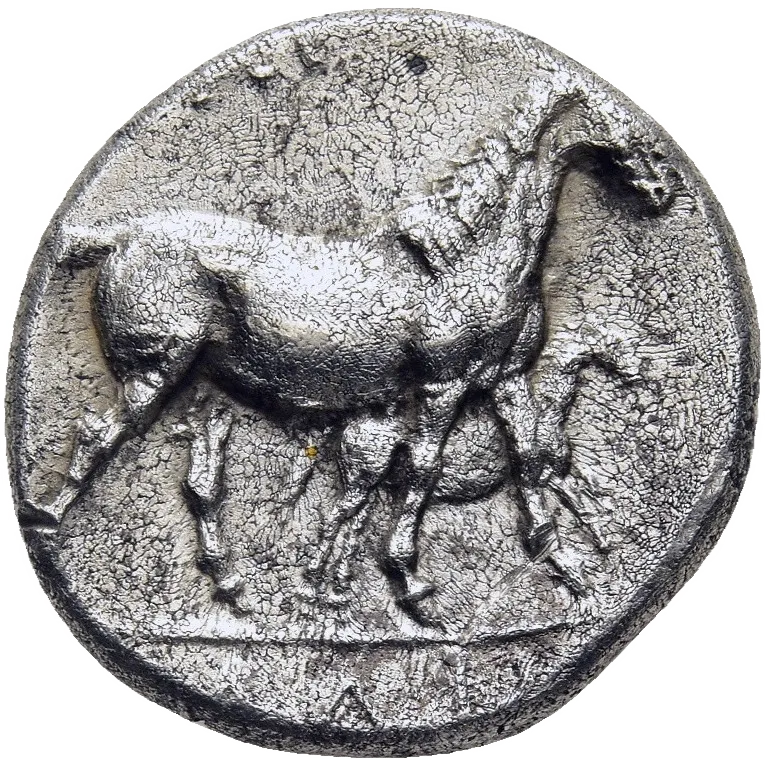
2. Larissa Drachm – Nymph Larissa / Mare and Foal
Collection of the author - view coin page
If there is a single coin that rivals the facing Arethusa heads of Syracuse, it is the facing nymph Larissa from Thessaly. This obverse die (O22) is, in my opinion, by far one of the best, perhaps even comparable to Kimon's celebrated facing head Arethusa. While I will never afford Kimon's Arethusa (the linked example sold for 2.3 million CHF), this Larissa comes remarkably close.
The obverse presents the nymph in three-quarter facing view, turned slightly to the left. She wears an ampyx, simple necklace, and triple-pendant earring, all executed with remarkable precision. Her serene eyes gaze outward with quiet composure, while her hair cascades in wild, wind-tossed waves that frame her face like rays of the sun. The engraver has captured a moment of stillness, a nymph frozen in silver, her beauty unmarred by two and a half millennia.
The reverse features the characteristic mare and foal design, a civic type that references Larissa's renowned horse-breeding tradition. The legend is split with ΣΑΙΩΝ above and ΛΑΡΙ below, reading together as ΛΑΡΙΣΑΙΩΝ (of the Larissaeans).
The dies of Lorber's Series 6 represent the pinnacle of Larissan coinage, produced during the city's flourishing period of 390–360 BCE. This is, without question, the most beautiful coin in my collection, though it must settle for second place behind my beloved octopus.
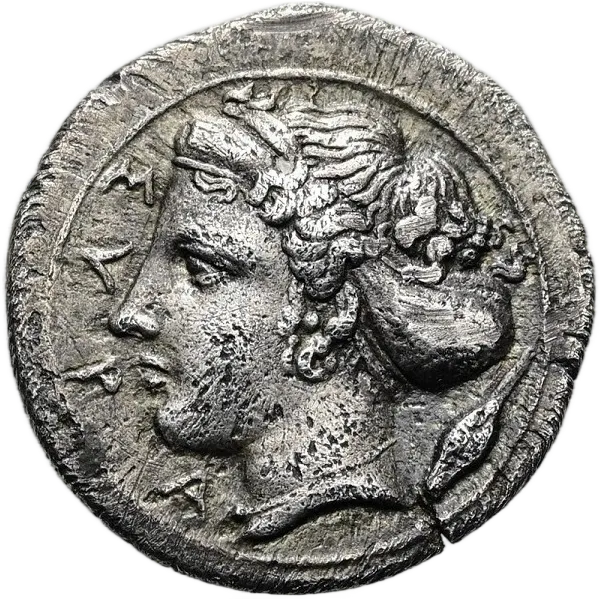
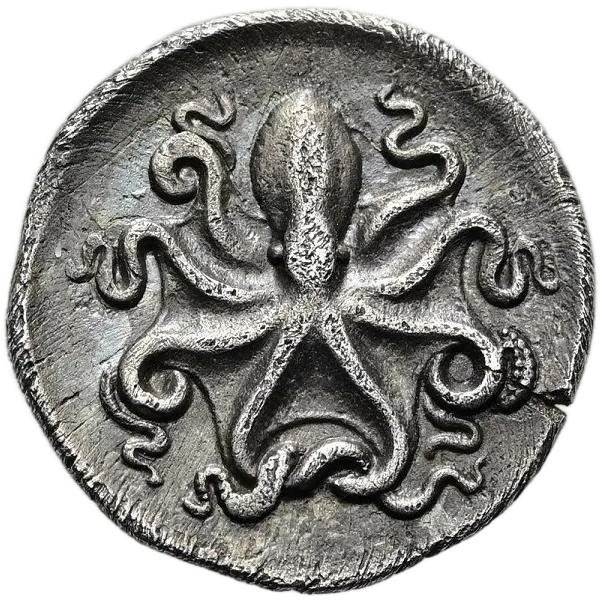
1. Syracuse Litra – Arethusa / Octopus (Eukleidas)
Collection of the author - view coin page
The octopus litrae of Syracuse represent some of the most charming and artistic fractional coinage of the ancient world. What elevates this piece to the number one position is the engraver's signature E[V] on Arethusa's ampyx, attributed to the master die cutter Eukleidas (though some debate whether it could be Euainetos). While the V is not readily visible on this specimen at first glance, the high points of the letter are discernible under magnification. The signature is more clearly preserved on the Boston MFA specimen 406, which provides useful comparison.
The attribution to Eukleidas is strengthened by comparison with the tetradrachm reverse Tudeer R58, which bears his full signature and features a nearly identical Arethusa with similar helix earring and simple necklace with pendant. Eukleidas is also likely the anonymous master of R46 and R47, which similarly resemble this litra. The sphendone may have been adorned with stars, though wear makes this difficult to confirm.
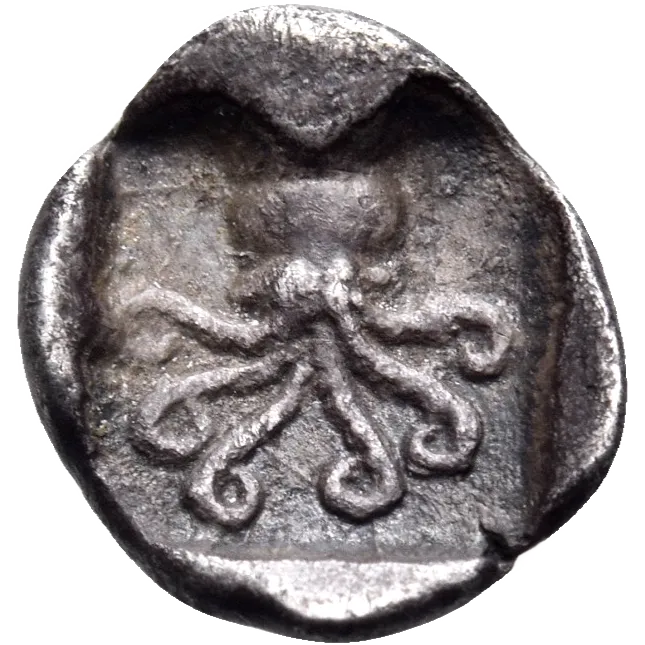
The reverse displays the Type 3 "Classical" octopus14, and while humble in size, captures the creature's characteristic form with remarkable economy of design. Even the tiny suckers along the tentacles are visible on this already diminutive coin—a testament to the engraver's precision.
This example stands out as one of only seven known specimens from this particular die combination, and remarkably, one of only three preserving any visible remnants of the signature, making it exceptionally rare. Struck during the reign of Dionysios I (405–400 BCE), these litrae emerged during a period of intense artistic achievement in Syracusan coinage, when the city employed the finest die engravers of the Greek world. At 0.87 grams, this litra was struck at the proper weight standard of 0.872 g as established by Boehringer16. The vast majority of Sicilian litrae were struck underweight, but this masterpiece, with its signed die and exceptional artistry, was given the care to meet the correct weight.
Honorable Mentions
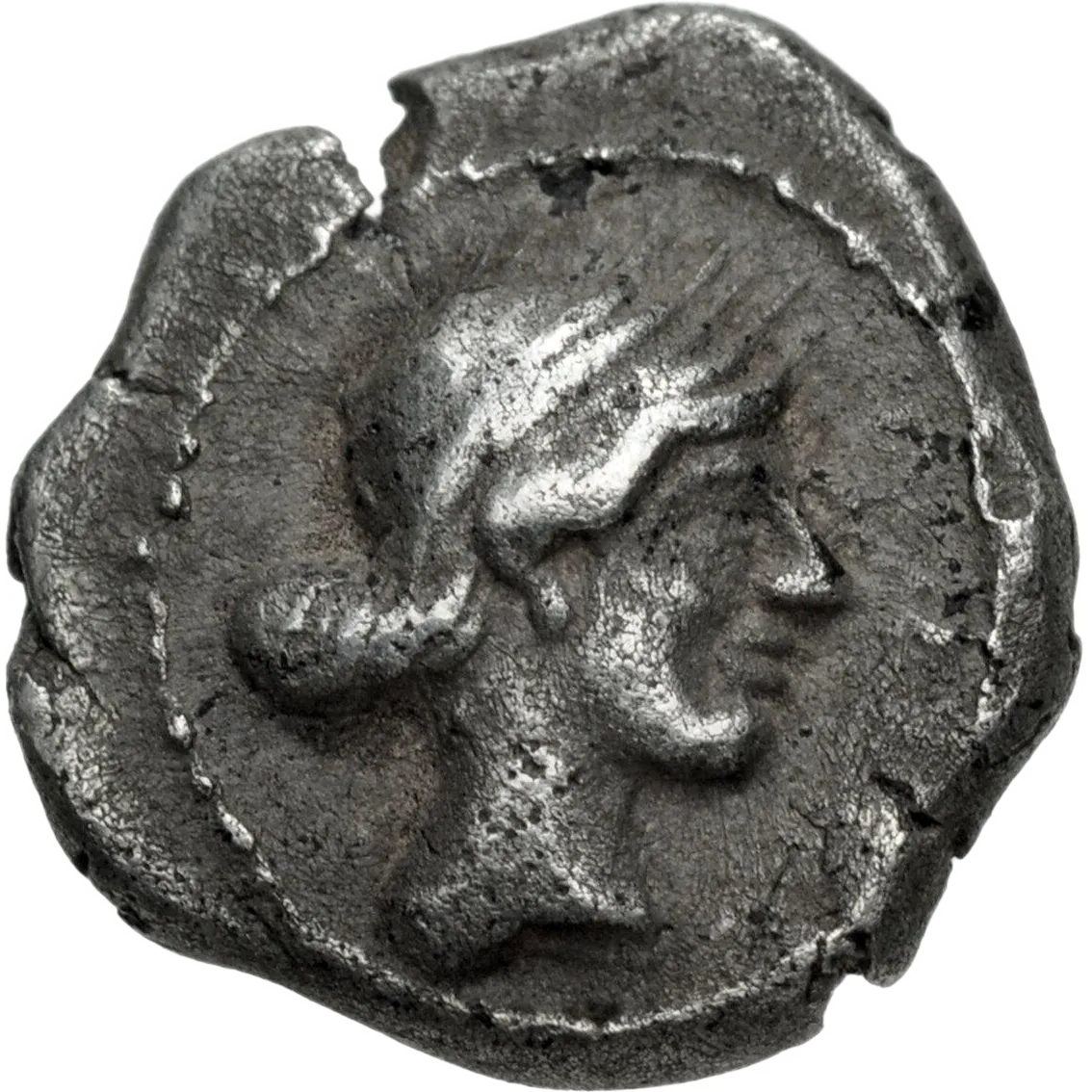
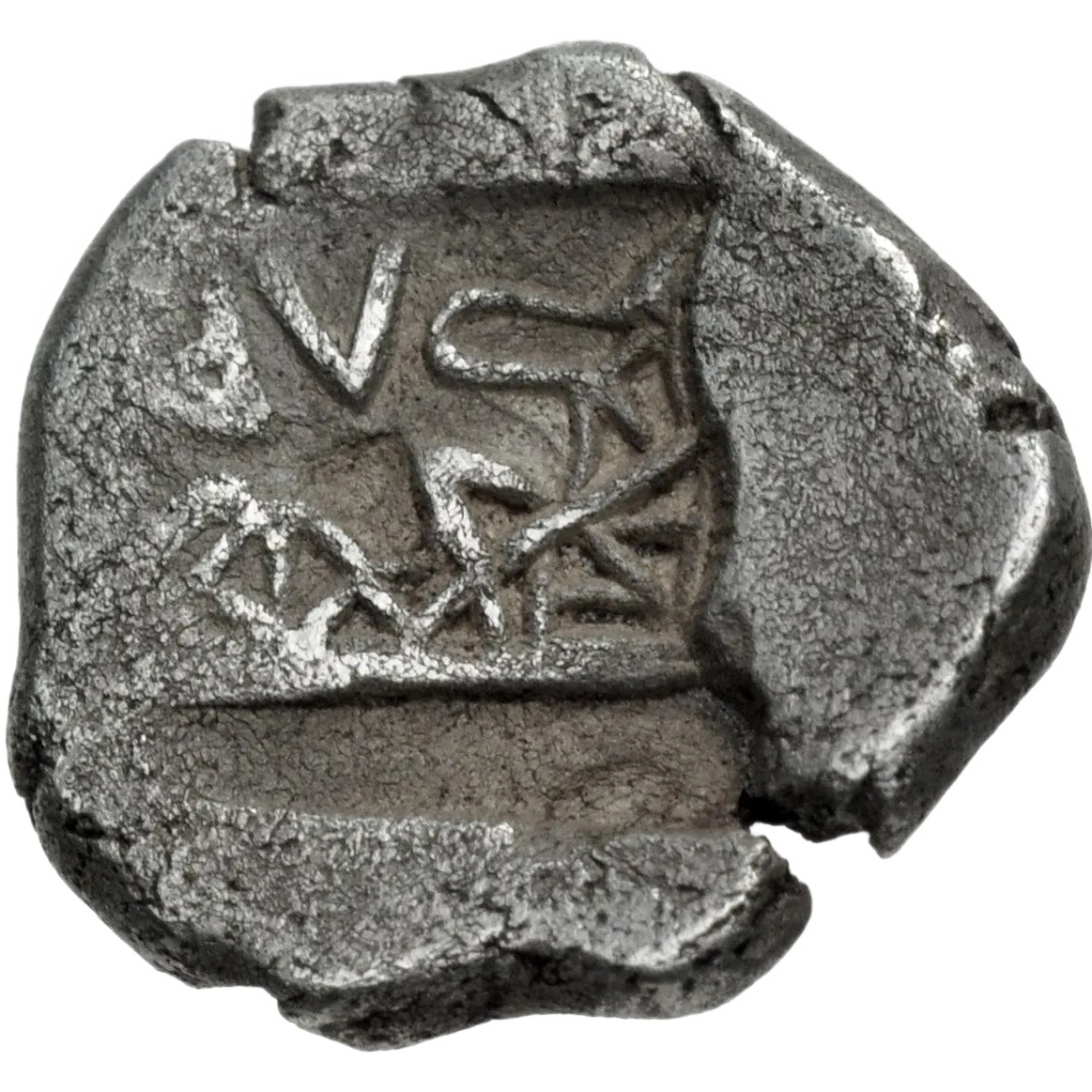
Larissa Obol – Nymph Larissa / Jason's Sandal
Collection of the author - view coin page
This early Larissan obol takes us back to the origins of the city's coinage following the Persian Wars, presenting a depiction of the eponymous nymph before the dominance of Arethusa in Greek numismatic art. The reverse type, Jason's sandal within an incuse square, carries profound mythological and historical significance.
According to legend, Jason, banished by his usurper half-uncle Pelias (king of Iolcatis in Thessaly), lost a sandal while assisting Hera across a river. A prophecy had foretold that Pelias would be destroyed by a man wearing one sandal, and so Jason's missing footwear became a symbol of destiny and retribution. But why would Larissa choose Jason's sandal when Jason himself was not Larissan and the myth doesn't directly involve the city? Herodotus provides the answer: he describes the "Medean affairs"17 (really referring to the Persian Wars) as originating from Jason's abduction of Medea18. After victory in the Second Persian War, Jason's sandal was chosen as a symbol of triumph for Larissa's first coinage issue.
The obverse shows the nymph Larissa to right, her hair bound with a ribbon and tied at the back. This is a simpler, more archaic style than the elaborate facing heads of later issues. The ethnic ΛΑ (La[rissa]) appears upside down on the reverse, a quirk of the die cutting.
Dating to 479–460 BCE, this obol represents some of the earliest silver coinage of Thessaly, struck in the immediate aftermath of Greece's victories over Persia.
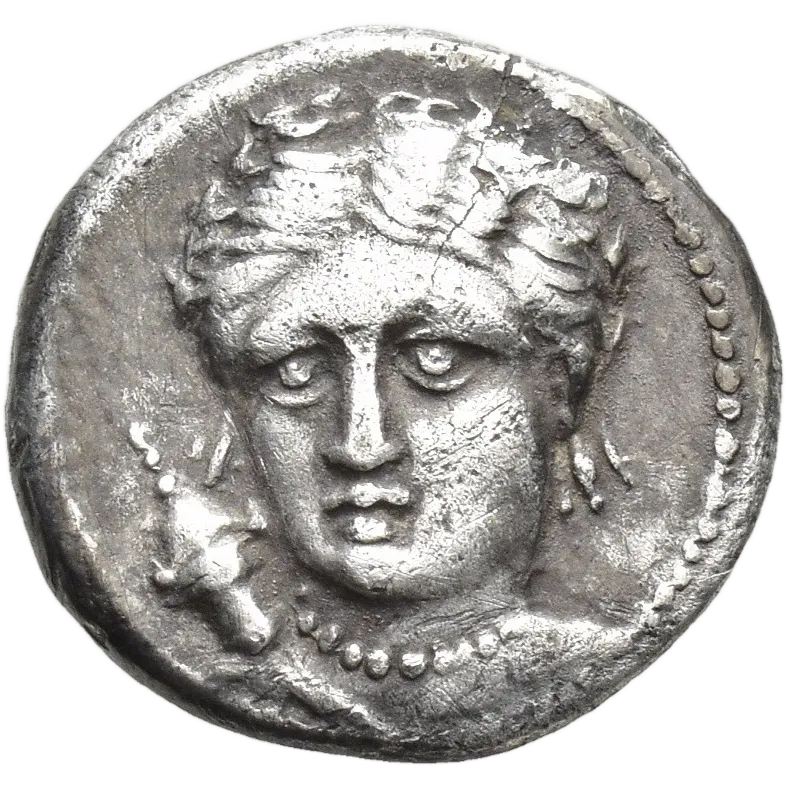
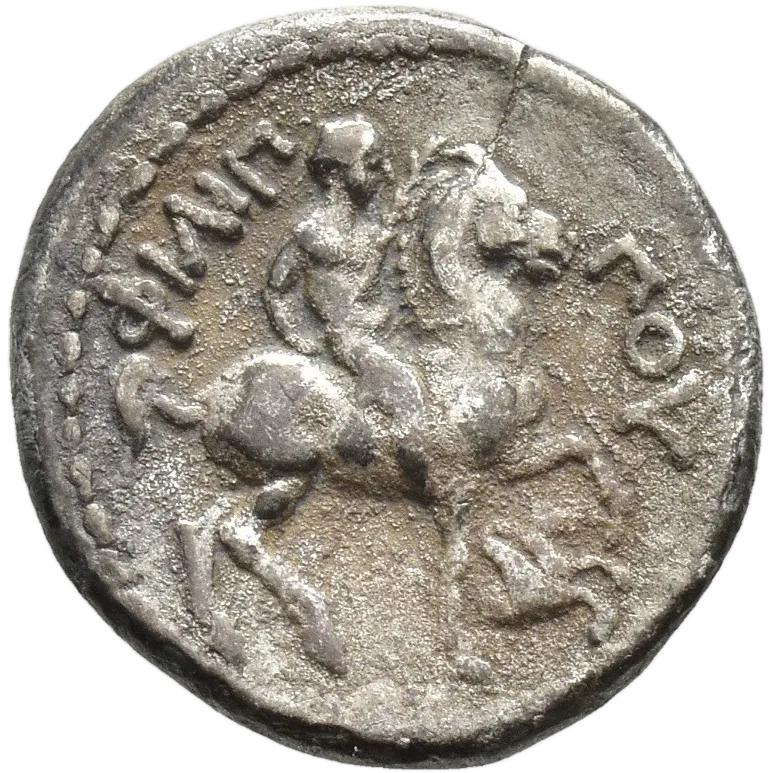
Amphipolis – Facing Artemis / Youth Riding Horse
Collection of the author - view coin page
Produced during the lifetime of Philip II, this piece from Amphipolis shows the spread of facing head portraiture beyond Syracuse and Larissa. While Amphipolis typically featured facing heads of Apollo, this coin presents Artemis, goddess of the hunt. The type derives from the coinage of Orthagoria, a Thracian city founded by Philip II during his campaigns in the 340s–330s BCE.
The artistic influence flows from Orthagoria to Amphipolis. Orthagoria, located near cape Serrhion in Thrace and populated with Macedonian settlers, pioneered the facing head Artemis on its silver coinage. Philip II's rare silver fractions adopted these Orthagorian obverse types, and the design spread to the royal mint at Amphipolis.
This particular die is especially fierce with rugged hair and piercing eyes. She wears the classic triple-pendant earring, a fashion popularized by Syracuse's Arethusa but adopted across the Greek world. The quiver behind her shoulder identifies her as Artemis, while the beaded necklace adds feminine adornment. The reverse shows a nude youth riding horse to right, holding reins in left hand and a victory palm in right. The forepart of Pegasos appears in the field.
Struck 348–342 BCE at Amphipolis during the period when Philip was transforming Macedonia into the dominant power of the Greek world. The facing Artemis type serves as numismatic evidence of Philip's Thracian conquests and his strategic integration of newly-founded settlements into the Macedonian monetary system.
Syracuse Obol – Arethusa / Wheel ("Demareteion" Series)
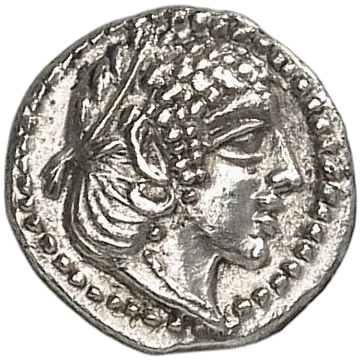
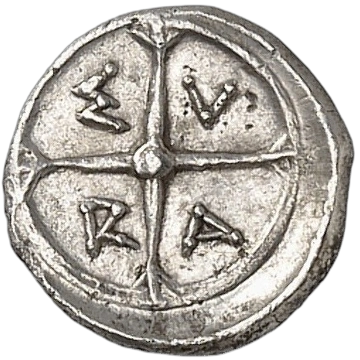
Collection of the author - view coin page
This obol belongs to the Series XIIe "Demareteion" issues, contemporary with the famous dekadrachms that command astronomical prices at auction. While I will never afford a Demareteion dekadrachm, this obol represents the same extraordinary moment in Syracusan history. The dies share the distinctive olive wreath iconography commemorating Syracuse's democratic revolution.
The olive laurel wreath adorning Arethusa's head replaces the traditional pearl taenia of earlier issues. The wreath symbolizes victory, but not the victory at Himera in 480 BCE as traditionally believed. As I explore in my article The Obols of Syracuse, orthographic evidence and overstrike analysis suggest these coins actually celebrate Syracuse's expulsion of the xenoi (foreign mercenaries) and the establishment of democratic government following Thrasybulus's overthrow in 466 BCE.
The reverse introduces the ethnic letters Σ-V-R-Α within the wheel's quarters, an innovation that was copied by the nearby mint of Aitna and provides crucial evidence for the revised chronology. Dating to 466–461 BCE, this tiny coin documents both monetary evolution and political revolution, serving as a miniature monument to Syracuse's democratic rebirth.
Conclusion
These ten coins span three centuries and multiple regions of the Greek world, yet they share common threads: exceptional artistry, historical significance, and the enduring appeal of facing heads and local iconography. From the master signatures of Eukleidas and Phrygillos to the charming anonymity of minor mint die cutters, each piece reveals the skill and creativity of ancient engravers.
The year 2025 brought together Syracusan octopi, Larissan nymphs, and rare issues from obscure Sicilian settlements like Piakos, Stiela, and Longane. This collection represents not just numismatic value, but the diversity and artistry of ancient Greek monetary production. As we move into 2026, these coins will continue to inspire and delight, reminding us why we collect these small masterpieces of ancient art.
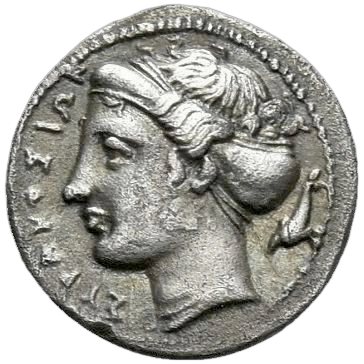
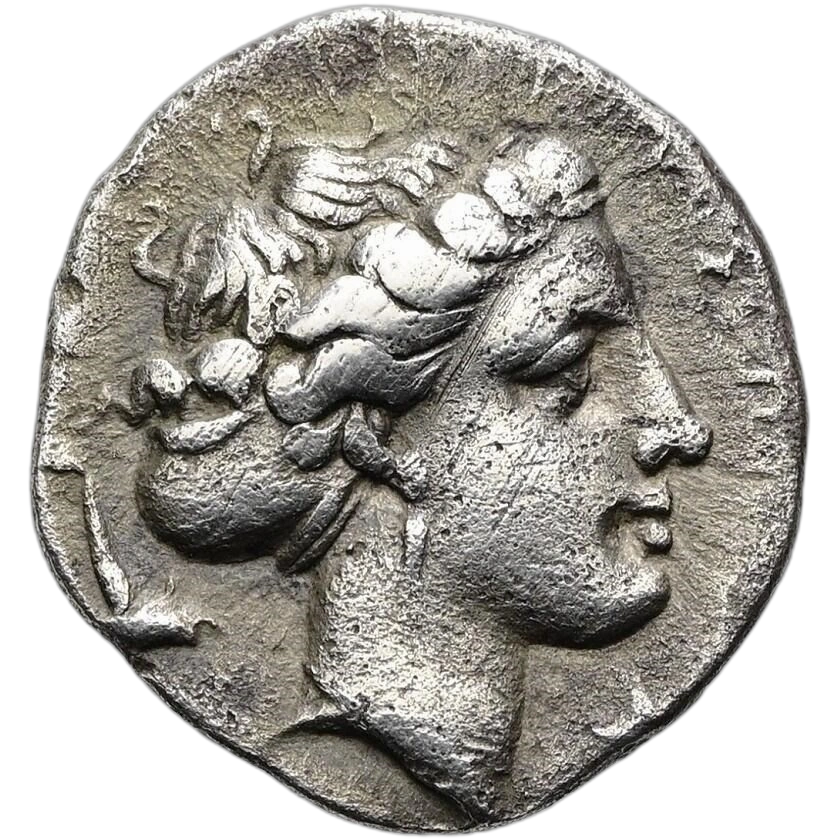
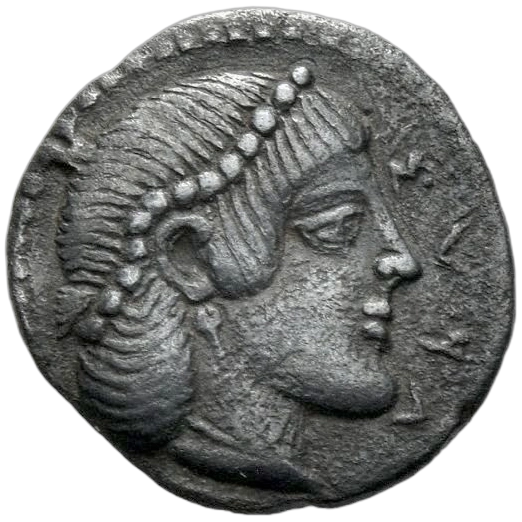
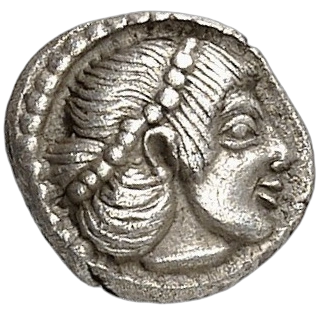
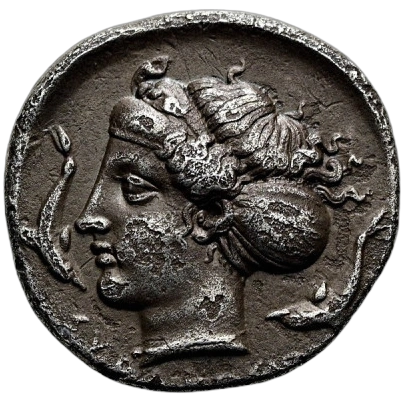
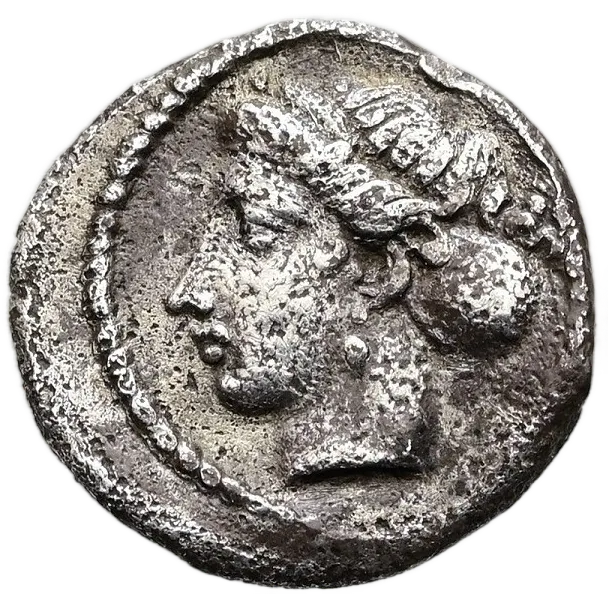
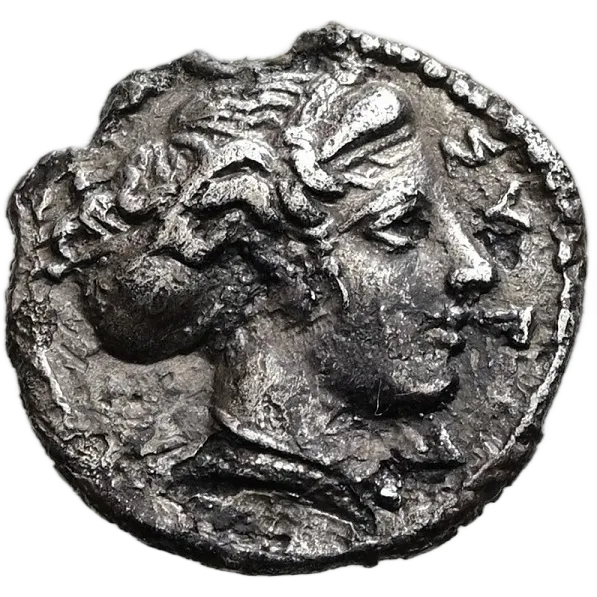
Bonus: Top Ten Twelve Arethusas
I really do love Arethusa.
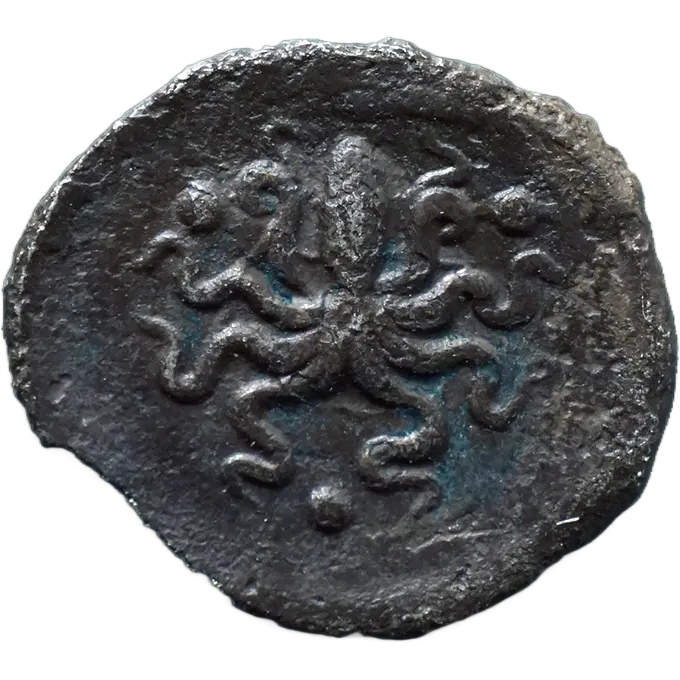
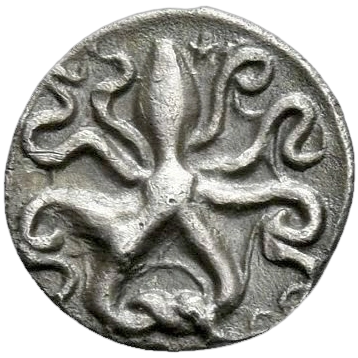
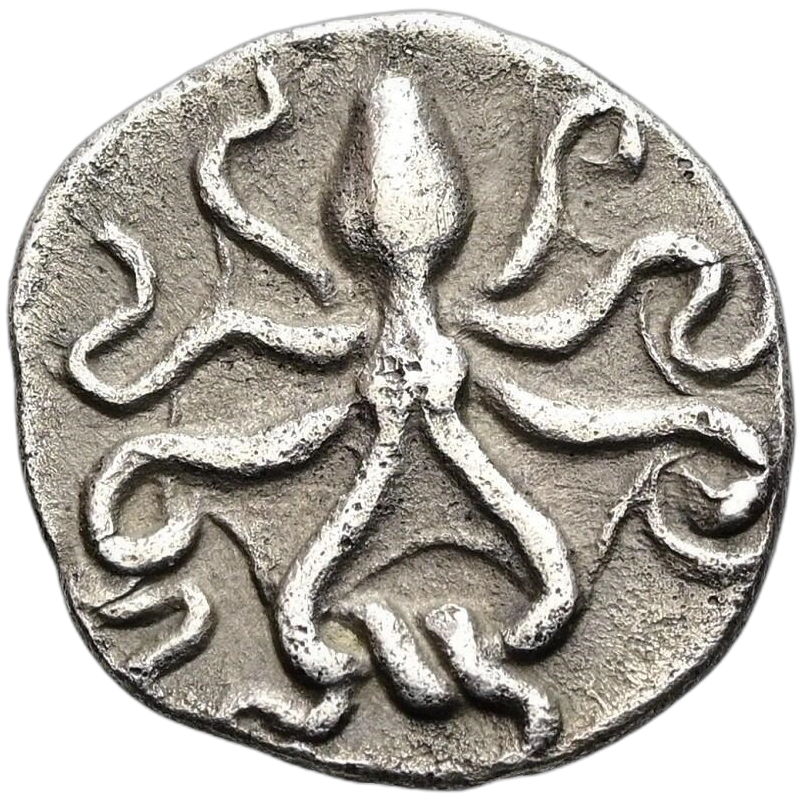
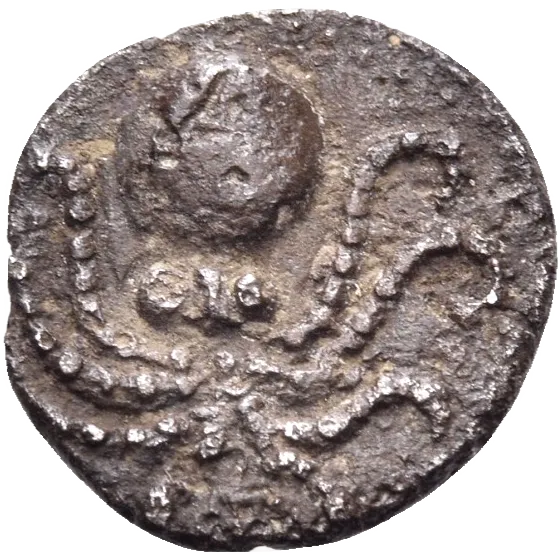
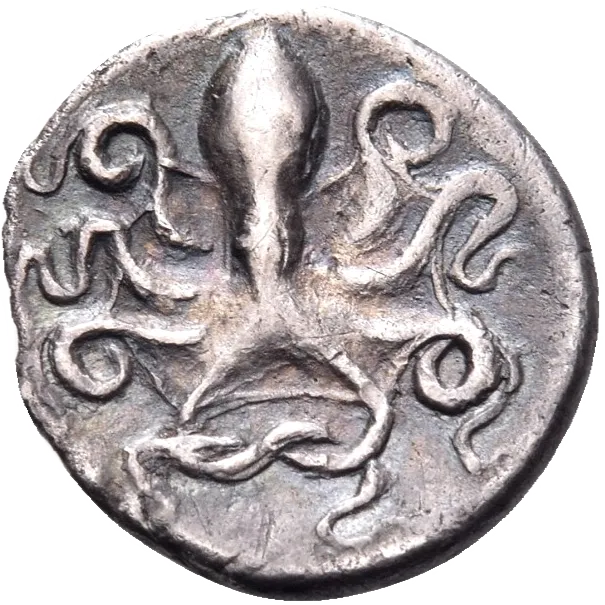
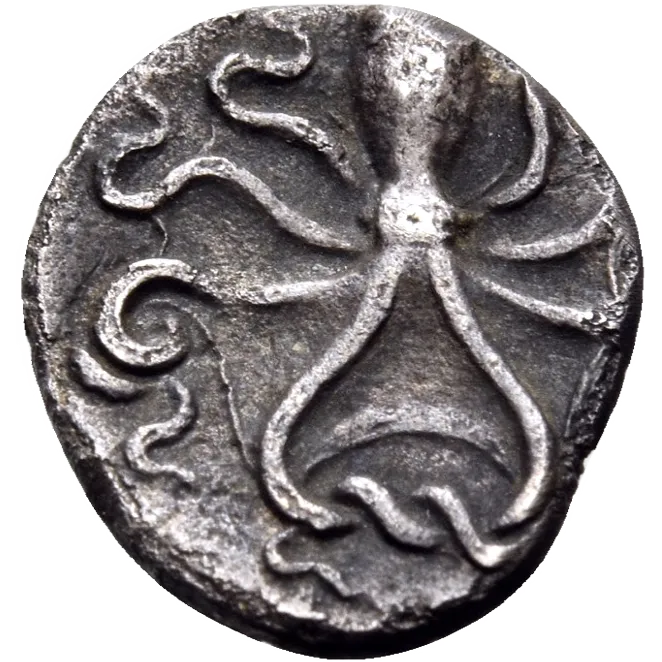
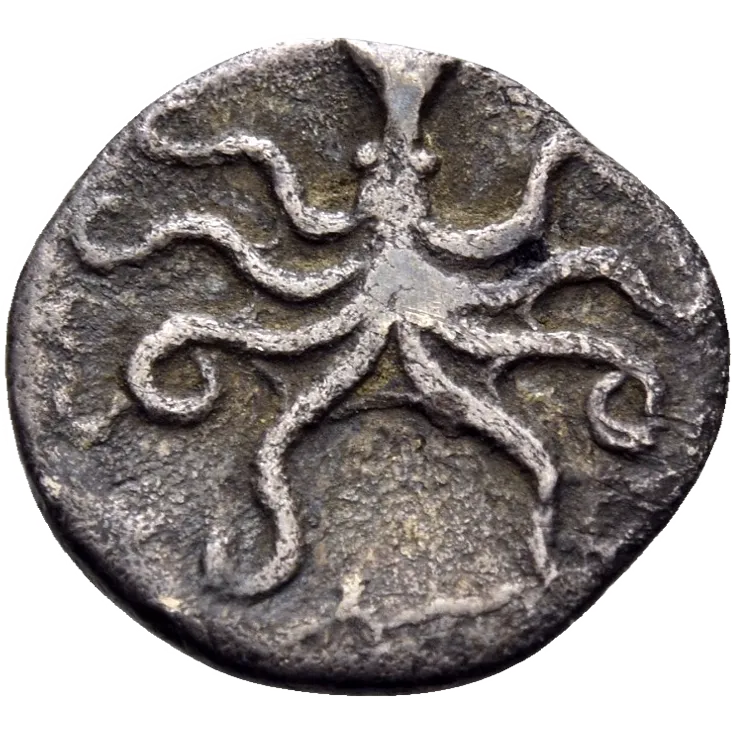
Bonus: Top Ten Twelve Octopuses
But not more than I love octopus.
Footnotes
G. Manganaro, "Il cane cirneco, Aigestes e Aktaion: realtà antiche e moderne in documenti letterari, figurativi e numismatici," Quaderni catanesi di studi antichi e medievali 3 (2004), pp. 47-59.
↩Stephanus of Byzantium, Ethnica s.v. Στύελλα. Stephanus identifies Stiela (Στύελλα) as a fortress (φρούριον) in Sicily near Megara, located near the Megarian Gulf. The ethnic demonym is given as Στυελλῖνος or Ἐντελλῖνος. Available at Internet Archive.
↩Alberto Campana, "Sicilia: Stiela (440/430 e 413/405 a.C.)," Monete Antiche 57 (May/June 2011), pp. 3-21.
↩The Phoenician god Melqart was identified with the Greek Herakles from at least the 7th century BCE. Herodotus, Histories 2.44: Καὶ θέλων δὲ τούτων πέρι σαφές τι εἰδέναι ἐξ ὧν οἷόν τε ἦν, ἔπλευσα καὶ ἐς Τύρον τῆς Φοινίκης, πυνθανόμενος αὐτόθι εἶναι ἱρὸν Ἡρακλέος ἅγιον ("Wishing to know something clear about these matters, insofar as possible, I sailed to Tyre in Phoenicia, learning that there was a holy sanctuary of Herakles there"). Herodotus found the temple richly adorned with two pillars, one of gold and one of emerald, and the priests told him the sanctuary was as old as Tyre itself.
↩Diodorus Siculus, Bibliotheca Historica 14.78: Μετὰ δὲ ταῦτα εἰς τὴν τῶν Σικελῶν χώραν πλεονάκις στρατεύσας Μέναινον μὲν καὶ Μοργαντῖνον εἷλε, πρὸς Ἄγυριν δὲ τὸν Ἀγυριναίων τύραννον καὶ Δάμωνα τὸν δυναστεύοντα Κεντοριπίνων, ἔτι δ´ Ἑρβιταίους τε καὶ Ἀσσωρίνους συνθήκας ἐποιήσατο· παρέλαβε δὲ διὰ προδοσίας Κεφαλοίδιον καὶ Σολοῦντα καὶ τὴν Ἔνναν ("After this, making multiple campaigns into the land of the Sikels, he took Menainon and Morgantion, and made treaties with Agyris the tyrant of the Agyrinaeans and Damon who ruled the Kentoripinians, and also with the Herbitaeans and the Assorineans; and he took through treachery Kephaloidion and Solous and Enna"). The phrase διὰ προδοσίας (through treachery/betrayal) distinguishes Dionysius's capture of Kephaloidion from his military conquests and diplomatic agreements with other Sikel communities. Greek text available at Remacle.
↩S. Consolo-Langher, "Contributo alla Storia dell'antica Monetazione Bronzea in Sicilia" (Messina, 1961). Consolo-Langher's interpretation of the dual ethnics as "Herakleotai dwelling at Kephaloidion" establishes that ΗΡΑΚΛΕΩΤΑΝ designates not a deity but the mercenary settlers' ethnic identity.
↩Herakles worship in Sicily held exceptional religious prominence compared to mainland Greece. At Syracuse, the annual festival at the Cyane fountain honored Persephone with bull sacrifices. Diodorus Siculus 5.2.3: ταύτην τὴν θυσίαν καταδείξαντος Ἡρακλέους καθ´ ὃν καιρὸν τὰς Γηρυόνου βοῦς ἐλαύνων περιῆλθε πᾶσαν Σικελίαν ("this sacrifice was commanded by Herakles when he drove Geryon's cattle through all Sicily"). At Agyrium, Herakles received honors equal to the Olympian gods through festivals and sacrifices. Diodorus Siculus 4.24.1: Ἐν ταύτῃ γὰρ τιμηθεὶς ἐπ´ ἴσης τοῖς Ὀλυμπίοις θεοῖς πανηγύρεσι καὶ θυσίαις λαμπραῖς, καίπερ κατὰ τοὺς ἔμπροσθεν χρόνους οὐδεμίαν θυσίαν προσδεχόμενος, τότε πρώτως συνευδόκησε, τοῦ δαιμονίου τὴν ἀθανασίαν αὐτῷ προσημαίνοντος ("For here he was honored on equal terms with the Olympian gods with festivals and splendid sacrifices, and although in earlier times he accepted no sacrifice, on this occasion he consented for the first time, as the deity was giving intimations to him of his coming immortality"). Greek text available at Remacle. These cults demonstrate Herakles' role as an active divine protector in Sicilian religious practice.
↩Spencer Pope, "New Coin Types in Late Fifth-Century Sicily," in: Koine: Mediterranean Studies in Honor of R. Ross Holloway, ed. by Derek B. Counts and Anthony S. Tuck (Oxford: Oxbow Books, 2009), pp. 131-137. Pope's analysis demonstrates that dual ethnics and the butting-bull reverse type functioned as numismatic signatures of mercenary occupation rather than indicators of peaceful sympoliteia, documenting forced population transfers during Dionysius I's establishment of eastern Sicilian hegemony.
↩Aelian, De Natura Animalium 11.20: ἐν Σικελίᾳ Ἀδρανός ἐστι πόλις, ὡς λέγει Νυμφόδωρος, καὶ ἐν τῇ πόλει ταύτῃ Ἀδρανοῦ νεώς, ἐπιχωρίου δαίμονος: πάνυ δὲ ἐναργῆ φησιν εἶναι τοῦτον. [...] κύνες εἰσὶν ἱεροί, καὶ οἵδε θεραπευτῆρες αὐτοῦ καὶ λατρεύοντές οἱ, ὑπεραίροντες τὸ κάλλος τοὺς Μολοττοὺς κύνας καὶ σὺν τούτῳ καὶ τὸ μέγεθος, χιλίων οὐ μείους τὸν ἀριθμόν. οὐκοῦν οὗτοι μεθ᾽ ἡμέραν μὲν αἰκάλλουσί τε καὶ σαίνουσι τοὺς ἐς τὸν νεὼν καὶ τὸ ἄλσος παριόντας, εἴτε εἶεν ξένοι εἴτε ἐπιχώριοι: νύκτωρ δὲ τοὺς μεθύοντας ἤδη καὶ σφαλλομένους κατὰ τὴν ὁδὸν οἳ δὲ πομπῶν δίκην καὶ ἡγεμόνων μάλα εὐμενῶς ἄγουσι ("In Sicily there is a city Adranos, as Nymphodorus says, and in this city a temple of Adranos, a local deity, who is said to be very manifest. [...] There are sacred dogs, attendants and worshippers of the god, surpassing the Molossian hounds in beauty and also in size, no fewer than a thousand in number. These by day fawn upon and caress those who enter the temple and the grove, whether they be strangers or natives; but by night they escort those already drunk and stumbling on the road, leading them very kindly like guides"). Available at Perseus Digital Library.
↩The signature ΦΡY on the sphendone is an abbreviated form of the engraver's full name ΦΡΥΓΙΛΛΟΣ. The complete full name signature can be seen on another specimen: Fritz Rudolf Künker Auction 433, Lot 6308 - 10 November 2025.
↩R.R. Holloway, "La struttura delle emissioni di Siracusa nel periodo dei 'Signierende Kunstler'," in: Annali dell'Istituto Italiano di Numismatica Vol. 23 (Rome, 1977), pp. 41-48.
↩Polybius, Histories 1.9.7. Polybius describes how Hiero II, after organizing and training the citizen forces of Syracuse, led them out and engaged the enemy (Mamertines) in the Mylaean plain near the river called Longanus. Making a strong rout of them and capturing their leaders alive, he broke the daring of the barbarians. Available at Perseus Digital Library.
↩Denyse Bérend, "Histoire de Poulpes," in: Kraay-Mørkholm Essays. Numismatic Studies in Memory of C.M. Kraay and O. Mørkholm, ed. by G. Le Rider, R.G. Jenkins, N.M. Waggoner, U. Westermark (Louvain-la-Neuve, 1989), pp. 23-28.
↩Philipp Lederer, "Syrakusisches Kleingeld im 5. Jahrhundert v. Chr.," in: Berliner Münzblätter, ed. by Emil Bahfeldt (Berlin: Deutsche Numismatische Gesellschaft, 1913), pp. 493-495, 517-523, 542-548, 563-572.
↩Christof Boehringer, "Bronze - Silber - Gold: Überlegungen zu den Nominalen einiger sizilianischer Goldmünzen," in: Revue Belge de Numismatique et de Sigillographie Vol. CXLV (Brussels: La Société royale de numismatique de Belgique, 1999), pp. 49-59. Available at numisbel.be.
↩The Greeks commonly used the terms "Medes" and "Persians" interchangeably, referring to the Persian Wars as "the Medean affairs" (τὰ Μηδικὰ, ta Mēdika). The Medes and Persians were closely related peoples, and the Medes held a similar status to the Persians within the Achaemenid Empire, making up a large part of its ruling class. Herodotus himself uses the phrase μετὰ τὰ Μηδικὰ (meta ta Mēdika, "after the Median affairs") when describing events following the Persian Wars (Histories 9.64). Available at Internet Archive.
↩Herodotus, Histories 1.2-3. According to the Persian account recorded by Herodotus, Greeks sailed to Colchis and abducted Medea, the king's daughter. When the Colchian king demanded reparation, the Greeks refused, citing that they had received none for the earlier abduction of Io. This chain of mythological abductions (Io → Europa → Medea → Helen) ultimately led to the Trojan War and established the foundation for Greek-Persian enmity in Persian historical memory. Notably, Medea was considered the patron goddess of the Medes, strengthening the symbolic connection between Jason's myth and the Persian Wars. Available at Perseus Digital Library.
↩