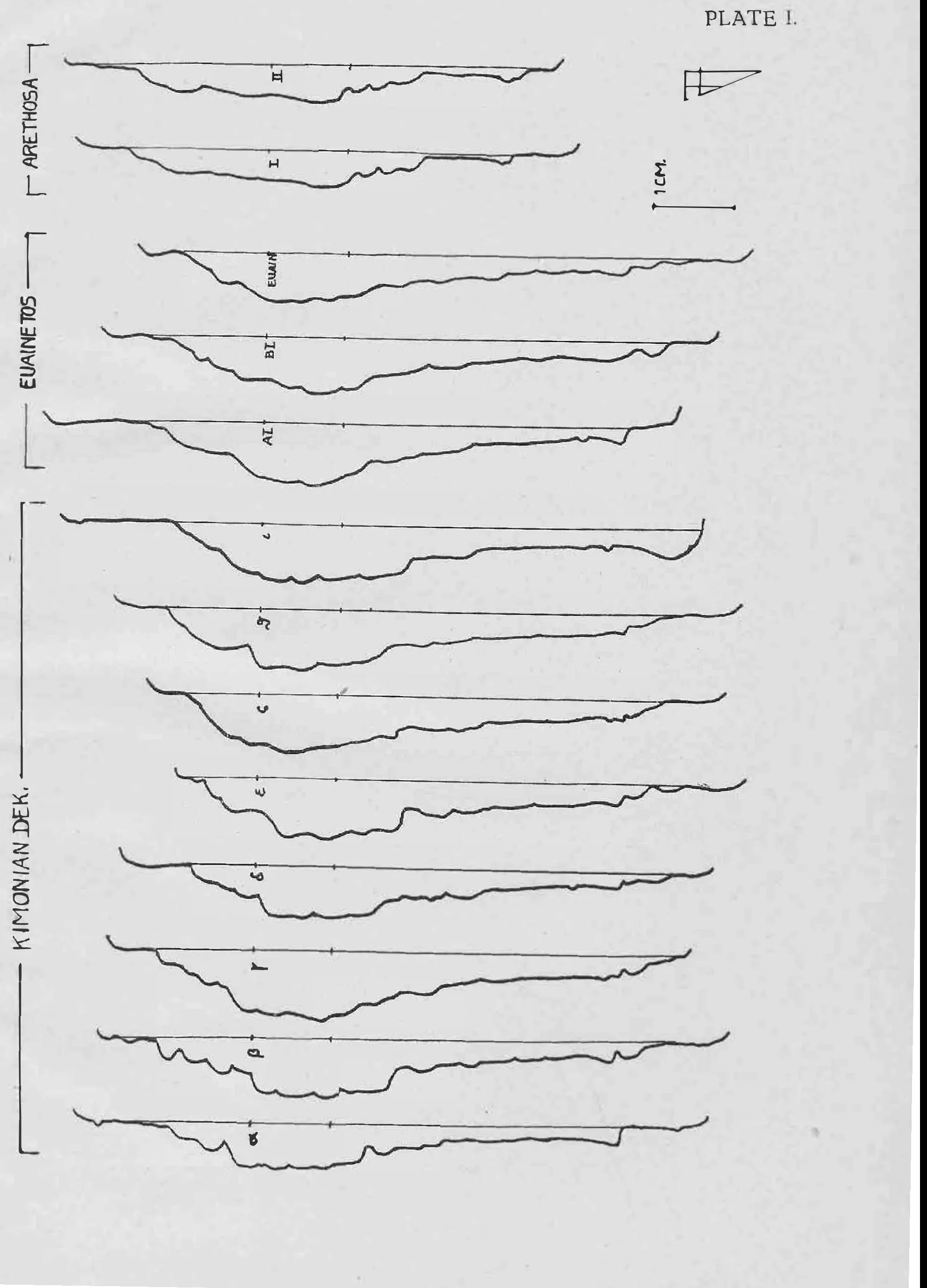
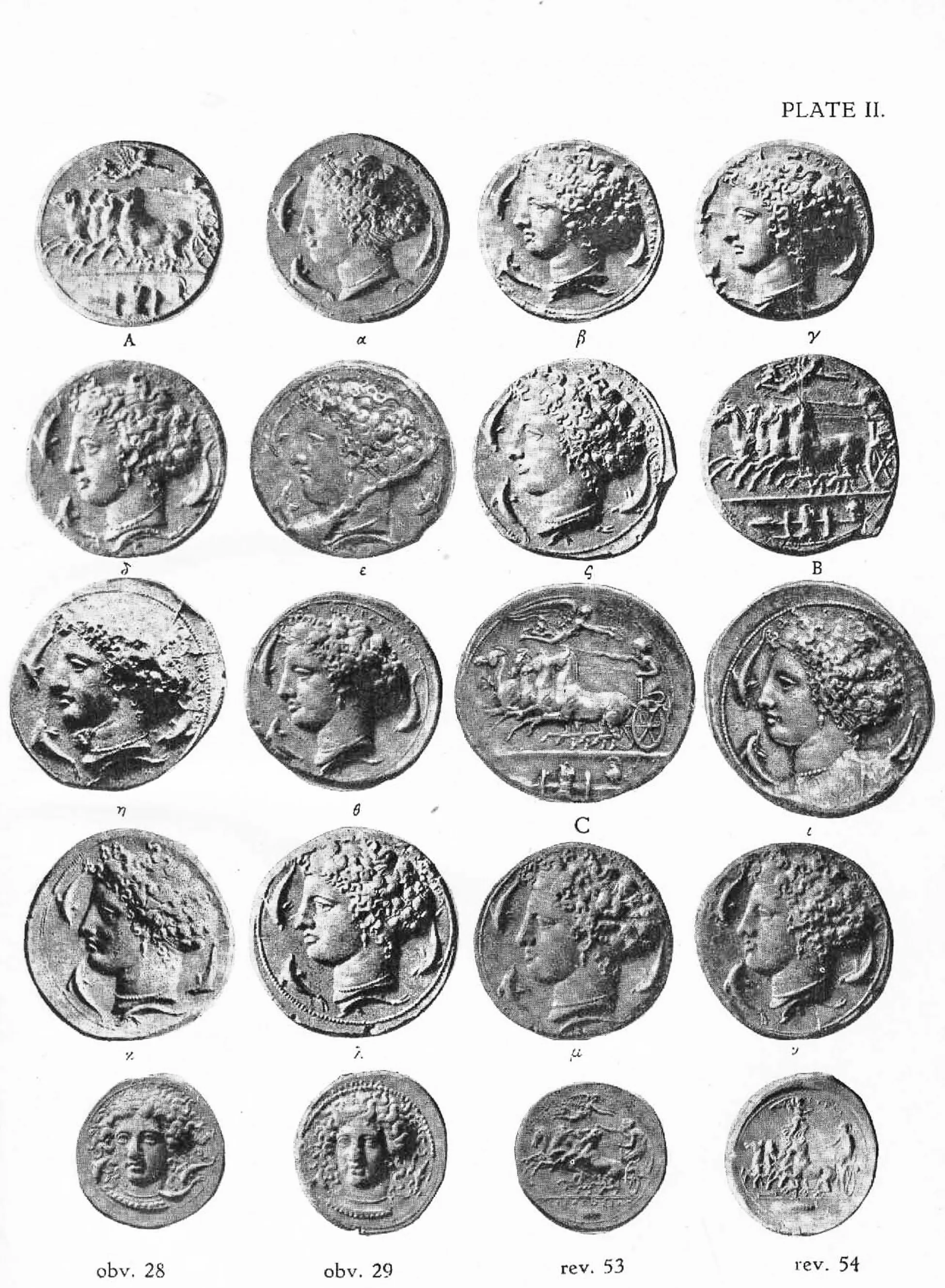
The dekadrachms that Kimon engraved for Syracuse, with the racing quadriga and a panoply of armour on one side and the head of Arethusa in her hair-net on the other, are the companion series to the dekadrachms of Euainetos. J. H. Jongkees's The Kimonian Dekadrachms: A Contribution to Sicilian Numismatics (1941) revised and enlarged Regling's 1914 list into a catalogue of 152 specimens from three chariot dies and thirteen head dies, and went on to argue that only the first dies are Kimon's own work, the rest being copies that carry his signature. That argument grew into a study of false signatures throughout Greek coinage and vase-painting. The illustrated catalog of the die combinations is available as a companion resource.
Table of Contents
[p. 1]When in 1914 Regling studied the Kimonian dekadrachms he could not collect extensive material due to the outbreak of the World-war; yet he was of opinion that the available data were sufficient to attain the end in view. However, the desirability of a new treatment of these capital pieces is evident, especially if we pay attention to the fact that Regling could only give a summary treatment of the subject. When in 1938 I began to collect the data I could hope to reach a fuller and more certain result under more favourable circumstances. This time, too, the outbreak of war has made it impossible to complete the material. That nevertheless I have proceeded to this work is because I have about twice as much material at my disposal as Regling (152 pieces against 87), and because in spite of this increase of data the arrangement of the dies by Regling has appeared perfectly correct and complete. My catalogue of the Kimonian dekadrachms is therefore only to be considered as a revised and enlarged edition of Regling's list.
The present catalogue is preceded by a note in which a few improvements of the usual method are proposed. The catalogue is followed by the usual observations; those regarding the absolute chronology did not seem satisfactory without a revision of the chronology of the Syracusan coinage of 415–400 b.c. A satisfactory treatment of an important phenomenon — that of false signatures — which is in evidence with these dekadrachms, seemed only possible if other instances both with regard to coins and other works of Greek art were also treated; this naturally led me to an examination of the phenomenon in general. The result is that the treatment of this question has developed into a part of the work that has become a rather detached portion side by side with the first part. I do not know which of the two will be considered to be the essential part; in the one case I apologize for the lengthy discursion, in the other for the lengthy introduction, and in both cases for the somewhat heterogeneous composition of the book.
After the Monnaies grecques by Imhoof (1883) and the catalogue of Greek coins of the Academy in Amsterdam by Boissevain (1912) the present work is the first book on a subject of Greek numismatics that has appeared in Holland since the modern study of this science. The apparent lack of interest has for its parallel a lack of aids and appliances: the numismatic literature is anything but complete in our libraries. To mention an example, most catalogues of large private collections or collections that were formerly private are absent in Holland. In quoting these works I draw upon notes made during a stay in Berlin in 1938, when I certainly expected that I [p. 2]should be able to check these references on a future visit to London[1]: for the moment I am unable to correct any inaccuracies and incompletenesses.
If circumstances have prevented me from utilizing the available data to the full, yet I have made high demands upon the helpfulness of many people. The following gentlemen provided me with casts of the coins which are in their custody, and wherever necessary gave me further information: M. Jean Babelon of the Cabinet des Médailles, Paris; Prof. A. Cameron and Prof. E. J. P. Raven of the University of Aberdeen; Dr. L. D. Caskey of the Boston Museum of Fine Arts; L. M. Clarke and Dr. F. M. Heichelheim of the Fitzwilliam Museum, Cambridge; Prof. G. Cultrera (Museo Nazionale in Syracuse); Dr. A. E. Glauning (Staatl. Münzsammlung, Munich); E. Holzmair of the Vienna Bundessammlung; Prof. J. Liegle of the Staatliche Münzsammlung, Berlin; His Excellency Prof. A. Maiuri (Mus. Naz., Naples); Prof. Giorgio Nicodemi (Soprintendente Capo, Milan); Racov of the Hermitage, Leningrad; Miss Gisela Richter of the Metropolitan Mus.; Miss Anne S. Robertson of the Hunterian Museum, Glasgow; Dr. Sigurd Schulz of the Thorvaldsen Museum, Copenhagen; and the Curator of the Historisches Museum, Basle. Miss M. E. H. Lloyd, Mr. A. Gallatin, and M. R. Jameson sent me casts from pieces of their collections through the kind intermediary of Mr. E. S. G. Robinson, Mr. S. P. Noe, and M. J. Babelon. The casts promised by Baron Pennisi were apparently lost due to the state of war. According to the communications of Dr. Galster, Dr. Helpf, J. G. Milne, S. P. Noe, A. Peloggi, Camillo Serafini, Dr. R. Wegeli and Dr. Winlandt there are no pieces by Kimon in the following musea: Numismatic Collection, Copenhagen; Staatliche Münzsammlung, Dresden; Balliol Coll., Cambridge; the collection of the late Dr. E. P. Robinson, Newport R.I.; Mus. Comunale of Catanzaro; the Vatican; Bernisches Historisches Museum, and the Badisches Landesmuseum. In the Penningkabinet, the Hague, too, whose Director Dr. M. A. Evelein always received me with great helpfulness, there are no coins by Kimon. — I here tender my sincere thanks to all these persons, as also to Mr. J. Schulman, Amsterdam, who kindly gave me the freedom of his library.
To my Father, whose expert knowledge as a mechanical engineer stood me in good stead in the chapters on technique, I also owe the apparatus with which the profiles of Plate I could be taken. I thank Dr. G. van Hoorn and above all my teacher, Prof. C. W. Vollgraff, for their continual support and help.
In conclusion I express a wish that the following pages may be worthy of the assistance I have received from so many sides.
J. H. Jongkees.
[p. 3]
- AA
- Archäologischer Anzeiger.
- AJA
- American Journal of Archaeology.
- AM
- Athenische Mitteilungen.
- Amtl. Ber.
- Amtliche Berichte aus den Kgl. Museen (Berlin).
- Ann. d. Num.
- Annuaire de la Société Française de Numismatique.
- Arch. Eph.
- Archaiologike Ephemeris.
- AV
- J. D. Beazley Attische Vasenmaler (1925).
- BdA
- Bollettino d'Arte.
- Berl. Mbll.
- Berliner Münzblätter.
- bf.
- black-figured.
- BM
- British Museum (Catalogue).
- BMC
- British Museum Catalogue of Greek Coins.
- BM Guide
- B. V. Head Guide to the Coins of the Ancients (1881).
- Boll. Napol.
- Bollettino del Circolo Numismatico Napoletano.
- BPhW
- Berliner Philologische Wochenschrift.
- Bull. Ant. Besch.
- Bulletin van de Vereeniging tot Bevordering der Kennis van de Antieke Beschaving.
- CVA
- Corpus Vasorum Antiquorum.
- FR
- A. Furtwängler — K. Reichhold Die griechische Vasenmalerei.
- Fw
- A. Furtwängler Beschreibung der Vasensammlung der Kgl. Museen (1886).
- JdI
- Jahrbuch des Deutschen Archäologischen Instituts.
- JHS
- Journal of Hellenic Studies.
- JIAN
- Journal International de Numismatique Archéologique.
- MaK
- K. Regling Die antike Münze als Kunstwerk (1924).
- MuZ
- E. Pfuhl Malerei und Zeichnung der Griechen (1923).
- Nav.
- L. Naville (and J. Hirsch) Auction-Catalogues since 1920.
- NC
- Numismatic Chronicle.
- Num Circ
- Numismatic Circular (Spink & Son).
- NdSc
- Notizie degli Scavi.
- NNM
- Numismatic Notes and Monographs.
- Nom.
- Nomisma.
- RA
- Revue Archéologique.
- RBN
- Revue Belge de Numismatique.
- RE
- Pauly-Wissowa Real-Encyclopaedie des klassischen Altertums.
- REA
- Revue des Etudes Anciennes.
- REG
- Revue des Etudes Grecques.
- rf.
- red-figured.
- RM
- Römische Mitteilungen.
- RN
- Revue Numismatique.
- Syll.
- Sylloge Nummorum Graecorum (ed. E. S. G. Robinson).
- VA
- J. D. Beazley Attic Vases in America (1918).
- ZfN
- Zeitschrift für Numismatik.
[p. 4]
- E. Babelon Les Monnaies grecques (Coll. Payot. 1921).
- E. Boehringer Die Münzen von Syrakus (1929).
- A. du Chastel de la Howardries Syracuse, ses monnaies — au point de vue artistique (1898).
- G. de Ciccio Aurei Siracusani di Cimone e Eveneto (1922), cited after Boll. Napol. 1922.
- A. J. Evans Syracusan „Medallions“ and their Engravers (1892), cited after NC 1891.
- L. Forrer Notes sur les signatures de graveurs sur les monnaies grecques (1906), cited after RBN 1904 and 1905.
- E. A. Freeman History of Sicily (1891).
- J. Friedlaender—A. von Sallet Das Kgl. Münzkabinet1 1873,2 1877.
- A. Gallatin Syracusan Dekadrachms of the Euainetos Type (1930).
- P. Gardner Types of Greek Coins (1887).
- W. Giesecke Sicilia Numismatica (1924).
- B. V. Head On the Chronological Sequence of the Coins of Syracuse (1874), cited after NC 1874.
- — Historia Nummorum2 (1911).
- G. F. Hill Coins of Ancient Sicily (1903).
- — L'Art dans les monnaies grecques (1927; English edition: Select Greek Coins).
- — Guide to the Principal Coins of the Greeks and Romans (1932).
- M. Hirmer Die schönsten Griechenmünzen Siziliens (Insel-Bücherei 1940).
- F. Imhoof Blumer Monnaies grecques Verhandelingen Kon. Akad. Amsterdam. Letteren XIV 1883.
- L. M. Lanckoronski Schönes Geld der alten Welt (1935).
- L. und M. — Das griechische Antlitz in Meisterwerken der Münzkunst Albae Vigiliae 3, 1940.
- K. Lange Götter Griechenlands Bilderhefte antiker Kunst VII 1941.
- Ph. Lederer Die Tetradrachmenprägung von Segesta Thesis Munich 1910.
- G. Macdonald Coin Types (1905).
- — The Evolution of Coinage (1916).
- H. Marcel, H. Bouchot, E. Babelon La Bibliothèque Nationale I (1907).
- S. P. Noe The Coinage of Metapontum II NNM 47, 1931.
- — Thurian Di-Staters NNM 71, 1935.
- — Bibliography of Greek Coin Hoards2 NNM 78, 1937.
- R. Stuart Poole, B. V. Head, P. Gardner BMC Sicily (1876).
- K. Regling Terina 66. Berl. Winckelmannsprogr. 1906.
- — Dekadrachmen des Kimon Amtl. Ber. 1914/5, 3–11.
- — Die antike Münze als Kunstwerk (1924).
- G. E. Rizzo Saggi preliminari su l'Arte della Moneta nella Sicilia Greca (1938), cited after BdA 1937.
- C. T. Seltman Greek Coins (1933).
- L. O. Tudeer Die Tetradrachmenprägung von Syrakus in der Periode der signierenden Künstler (1913), reprinted from ZfN 1913.
- J. Ward Greek Coins and their Parent Cities (1902).
- R. Weil Die Künstlerinschriften der sicilischen Münzen 44. Berl. Winckelmannsprogr. 1884.
- [E. S. G. Robinson] The Newnham Davis Coins in the Wilson Collection of Classical Antiquities, Marischal Coll., Aberdeen Syll. I 2, 1936.
- Catalogue of the Collection of Greek Coins of the Earl of Ashburnham Sotheby, May 1895.
- Münzhandlung Basel Vente 4: Monnaies grecques du Prince W(aldeck, Arolsen), du Cte. C. de B etc. Oct. 1935.
- Collection Clarence S. Bement, monnaies grecques I Nav. VI 1923.
- [p. 5]F. Sherman Benson Collection of Greek Coins Sotheby Feb. 1909.
- Collection Billoin, médailles grecques autonomes Vente Paris, March 1886.
- Catalogue of the Sir Edward Bunbury Collection of Greek Coins I, Sotheby, June 1896.
- [E. S. G. Robinson] The E. Spencer Churchill Collection Syll. I 1, 1931.
- Collection Max. Collignon Vente Paris 1917.
- Aug. Delbeke Collection Sotheby, April 1907.
- Catalogue of Greek Coins of a well-known Archaeologist and Traveller (A. J. Evans) Sotheby, Jan. 1898.
- J. Hirsch (Munich) XVI Dec. 1906: Griechische Münzen zweier Amateure und eines bedeutenden ausländischen Münzkabinets.
XXXII Nov. 1912: Griechische Münzen vorzugsweise von Sicilien.
XXXIII Nov. 1913: Antike Münzen von Baron Friedrich von Schennis, eines bekannten englischen Archaeologen. - G. Macdonald Catalogue of the Greek Coins in the Hunterian Collection, University of Glasgow I (1899).
- R. Jameson Collection R. Jameson, monnaies grecques antiques I (1913), III (1924).
- Sammlung Geheimrat von Kaufmann, Antike Münzen L. Hamburger, May 1929.
- Lake Price Collection Sotheby, Apr. 1880.
- E. S. G. Robinson Catalogue of Ancient Greek Coins collected by Godfrey Locker-Lampson (1924).
- W. M. Leake Numismata Hellenica: a Catalogue of Greek Coins collected by W. M. Leake.
- [E. S. G. Robinson] The Lloyd Collection Syll. II (1933–7).
- — The Lockett Collection Syll. III 1 (1938).
- R. Stuart Poole, B. V. Head, P. Gardner BMC Sicily, London (1876).
- J. Babelon Bibliothèque Nationale. Catalogue de la Collection de Luynes. Monnaies grecques (1924).
- S. W. Grose Catalogue of the McClean Collection of Greek Coins I (1923).
- [G. Fiorelli] Catalogo del Museo Nazionale di Napoli. Medagliere I: Monete greche (1870).
- The Montagu Collection of Coins, Cat. of the Greek Series I Sotheby, March 1896.
- H. de Nanteuil Collection de monnaies grecques (1925).
- Naville (Ars Classica) IV 1922: Monnaies grecques antiques du Grand-Duc Alexandre Michaïlowitch, etc.
V 1923: Monnaies grecques antiques, doubles du British Museum, etc.
X 1925: Collections d'un grand industriel décédé, du baron Alexandre de Petrowicz, etc.
XII 1926: Collections de B. Bissen, J. Wertheim, etc.
XIII 1928: Collections du Cav. Roberto Allatini, du Capt. Spencer Churchill, etc.
XIV 1929: Collection du Capt. E. G. Spencer Churchill.
XV 1930: Collections de deux amateurs récemment décédés, du Prof. A. M. Woodward.
XVI 1933: Collections de R. de St.-Marceaux, W. Carr, E. G. Spencer Churchill, A. Colegate, W. Lamb.
XVII 1934: Collections de R. Burrage, etc. - Collection Martinetti-Nervegna, Sambon and Canessa, Rome, Nov. 1907.
- Collection G. P(icard), Sambon, Paris, March 1923.
- Monnaies grecques du Prof. S. Pozzi Nav. I 1920.
- Sammlung Theodor Prowe, Egger 1912.
- Hochbedeutende Sammlung griechischer Münzen eines bekannten Archäologen (Rhousopoulos) Hirsch XIII 1905.
- [G. Fiorelli] Cataloghi del Museo Nazionale di Napoli. Collezione Santangelo. Monete greche. (1866).
- L. Müller Description des monnaies antiques du Musée Thorvaldsen (1851).
- [p. 6]Hochbedeutende Sammlung griechischer Münzen vorzugsweise von Sicilia, aus altem Besitz (M. Virzi) Hirsch XXXII 1912.
- G. F. Hill Catalogue of the Author's Collection in: J. Ward Greek Coins (1902).
- K. Regling Die griechischen Münzen der Sammlung Warren (1906).
- L. Forrer Catalogue of the Coll. formed by Sir Hermann Weber I (1922).
- Sammlung Consul Ed. Weber, Hirsch XXI 1908.
[p. 7]The present catalogue is of the usual type; the system of numbering is the same which Seltman applied to the coins of Olympia, and which was also recommended by Regling[2]. This is in fact the clearest and simplest system, and hardly deviates from Regling's method in his treatment of the dekadrachms. — I have, however, to account for some of the innovations applied here:
1. I have arranged the specimens of which I had casts or good reproductions before me under each number (combination of dies) in chronological order. This gives us a better insight into the origin and the growth of die-injuries, makes us ascertain any irregularities (e.g. interchange of dies) at once, and enables the reader to check the correctness of the arrangement more easily. Besides it is possible that this arrangement, if connected with the die-position, may teach us something about the manner in which coins were struck: probably the pieces which were struck the one after the other during the same working-hours will also display the same die-position. — The coins which I have been unable to compare in this way have been placed at the end of each number under a line.
2. Here was at the same time an opportunity of distinguishing different “hands” that struck the coins. It is obvious that each labourer has his own way of striking: the one may strike forcefully, the other feebly, a third in a slovenly way, while others again appear to work carefully. In the present study the observation of such phenomena has enabled me to draw important conclusions in the field of chronology; in other works, too, it might be useful to pay attention to this. In connection with this I mention in the catalogue, whenever this is possible, the greatest diameter of the coin, and also the diameter of the border which surrounds every type.
3. The characterization of the relief, which will be found in the description of the dies, is not only based on direct observation, but also on measurings. For this purpose an apparatus has been made, in which a row of ordinary pins, close to each other (to this end the heads were removed), can be vertically clamped between two pieces of metal; when the apparatus has been placed over the coin (or the cast), the [p. 8]pins are dropped, so that the points come to rest on the coin in a straight line; next the pins are clamped again. Then the points of the pins indicate the relief of the coin along the line chosen; by putting the apparatus in an epidiascope and projecting it on a screen we can draw the result more easily and accurately. Such an apparatus cannot be perfectly accurate because there is of course a distance between the points of the pins which is tantamount to the diametre of a pin; by means of the apparatus I used I obtained seven fixed points per centimetre. The profiles of some dies obtained in this way have been reproduced on Plate I; as far as the dekadrachms are concerned the profiles were always taken from the vertical axis (ear, ear-drop) and in the case of the Arethosa-tetradrachms vertically over the middle of the nose.
The dates given here will be accounted for towards the end of the chapter on absolute chronology. — The terms “fracture, dent, crack, corrosion” will be explained in the chapter on technique. — The horses are numbered from left to right.
412 b.c.
View dies →1. A Border of very fine dots, d. 34,5 mm. — The horses have short necks, long bodies; the muscles of the shoulders are heavily modelled; eight hindlegs and seven forelegs; the head of the first horse is very erect; on the breast of the fourth horse a vein is visible. The driver wears a sleeveless chiton, whose folds have been rendered by lightly undulating parallels; the short hairs flutter in the wind, just like those of Nike, who wreathes him. Nike is draped, only the arms and the right leg are bare. Kentron ends past Nike's right knee. — The reins: the upper rein runs to the l. end of the bit of the fourth horse; the second rein to that of the third horse; the third runs before the neck of the third and second horses on to the l. end of the bit of the fourth horse, to the r. end of which the fourth rein extends. — Beyond the border the following parts of the type project: first hoof of first horse, tip of the tail of the fourth horse; the r. chariot-wheel likewise interrupts the border. — The exergual-line is a heavy cornice which, diminishing in height, projects on either side some mm. beyond the border; on the upper side of this cornice on the l.: ΚΙΜΩΝ. In the exergue, on a scalariform repositorium[3], a panoply: helmet, greaves, shield, cuirass (three-quarters to r.); on the lower step: ΑΘΛΑ.
α Border of fine dots, heavier than on A, diam. 33,5 mm; diam. of die 36,5 mm. — [p. 9]The head is slanting forward. Full round chin; face very lightly modelled; brows and neck-ring not indicated; necklace of small beads. The hair has been engraved extremely delicately; hairs and three locks under the lower band of the hair-net; one lock behind the ear. Ampyx grows broader at the forehead; along the lower side it has been trimmed with one ribbon, along the upper side with two; knot in the upper ribbon; ΚΙ/Μ embroidered on the ampyx. The ear-drop has the shape of a hanging calyx; the hole in the lobe of the ear is visible; shallow auricle. — The dolphins are tall and slender, with short tails, and showing little liveliness; a dolphin becomes visible at the back out of the truncation. — To the r., above: ΣΥΡΑΚΟΣΙΩΝ, beginning at the vertical axis of the type, and ending immediately before the tail of the dolphin r. below. A comparatively low relief[4].
| Obv. | Rev. | Diam. | Wt. | Abr. | D-p. | Bibliography. |
|---|---|---|---|---|---|---|
| a E. G. SPENCER CHURCHILL. Uninjured, double-struck. | Small fracture between the lips; double-struck. | 39 | 43,25 | n.w. | [5]Syll. 55; Heseltine, Hastings, Northwick; Hill L'Art 51, 1 (obv.). | |
| b ABERDEEN. Slight injury at fourth neck, near rein; double-struck. | Injury at Ω; four times struck. | 39 | 43,13 | n.w. | Syll. 72; Davis, J. Sambon (Sotheby, May 1870, 223), Dupré 147. — Regling 1a. | |
| c NEW-YORK. Beginning of dent behind head of first horse. | — | 35 | 42,61 | s.w. | Ward 290 and front.; Evans; found at Sta. Maria. — Regling 1 h (Ward Gr. C. 210 “engraved in his (Evans') book” is incorrect). — Regling 1 h. | |
| d UNKNOWN.— | Double-struck. | 36 | 42,73 | s.w. | — | Bement 509; Sir H. Weber 1611, W. Webster (1883)[6]. |
| e UNKNOWN. Dent from Nike's elbow downwards. | Double-struck. | 38 | 40,62 | s.w. | — | Nav. XVI 761; Davis (1864). |
| [p. 10]f C. S. GULBENKIAN.? | Corrosion underneath against chin. | — | — | s.w. | — | Hill L'Art 26, 1 (rev.). |
| g BERLIN. Fracture under fourth head, corrosion on neck of first horse and behind helmet. | Corrosion against root of the nose. Double-struck. | 36 | — | s.w. | Inv. 311/1901; Hirmer Die schönsten Griechenm. 36 (obv. enl.). — Regling 1 b (fig. 1). | |
| h UNKNOWN. Double-struck. | — | 36 | — | s.w. | — | Du Chastel pl. 12, 141; Evans NC 1891 pl. 9,5; RBN pl. 4, 10, p. 131. — Regling 1 d. |
| i M. E. H. LLOYD. Slight dents on hindquarters of fourth horse. | — | 34 | 43,19 | s.w. | Syll. 1409. | |
| j UNKNOWN. Dent behind fourth head. | — | 34 | — (cleaned) | r.w. | — | Picard 343; place not quite certain. |
| k C. R. LOCKETT. Beginning of dent at angle of neck of 4th. horse. | — | 34 | 43,30 | s.w. | Syll. 987; Churchill, L. Lampson 92, Pozzi 609, Virzi. | |
| l R. JAMESON. Very slight corrosion l. under exergual-line. (Pl. II). | Slight injury at upper eyelid; corrosion on cheek. (Pl. II). | 35 | 43,49 | s.w. | Cat. 1834 with add.; Virzi; from Noto 1908; Regling MaK 581. — Regling 1 e. | |
| m A. PENNISI.? | Double-struck. | — | — | s.w. | — | Hirmer Die schönsten Griechenm. 37 (rev.); place uncertain. |
| n PARIS.— | — | 37 | 43,32 | n.w. | Luynes 1244; Dupré (not NC 1891 pl. 9,5); Marcel-Babelon Bibl. Nat. I 89 l. below. | |
| o BRUSSELS. Corrosion under ex.-line near chariot-wheel. | — | — | — | s.w.? | — | Giesecke Sic. Num. pl. 14, 4; place not quite certain. |
| p SYRACUSE— | — | 36 | 42,50 | s.w. | — | Inv. 5696. |
| q GLASGOW. A few slight dents behind 4th. neck; very slight corrosion; double-struck. | Injury at r. end of truncation. | 37 | 43,16 | n.w. | Hunter 63 (no reproduction!). | |
| r LENINGRAD. Slight corrosion. | — | 34 | 43,05 | s.w.? | Inv. 4285/16; place uncertain. | |
| [p. 11]s LONDON.— | Larger fracture on upper eyelid. | 34 | 43,23 | v.s.w. | — | BMC 200; Hill Princ. Coins pl. 17, 65; NC 1874 pl. 4, 6; Hill Sicily fr. 1 (rev.); head-piece Num. Circ. — Regling 1 f. Place uncertain. |
| t UNKNOWN.— | — | — | — | — | — | Canessa, Dec. 1907, 358. — Regling 1 c. |
| u UNKNOWN.— | — | — | — | — | — | Sotheby, May 1900, 152, Hamburger 1894, 219. — Regling 1 g. |
411 b.c.
View dies →2. A Described under No. 1.
β Border of dots as on α, diam. 34 mm; diam. of die 35 mm. — The head is erect. Full chin, but drawn inwards; face modelled at nose and mouth only; neck-ring indicated. Auricle very deep; eyebrow and eyelash indicated. Necklace of small beads. Hair has been less delicately engraved. Hairs and three locks below the lower band of the hair-net; one lock behind the ear. The ampyx is narrower and without cut, and is provided with one ribbon on either side; no knot nor any embroidery. The ear-drop has the shape of a smooth bunch; the hole in the lobe of the ear is visible. — The dolphins have short tails and show little liveliness; the dolphin placed against the truncation is inscribed: ΚΙΜΩΝ. — To the r., beginning at the crown and extending to the dorsal fin of the r. dolphin: ΣΥΡΑΚΟΣΙΩΝ. — The relief steeply rises at the hair above the ear.
| Obv. | Rev. | Diam. | Wt. | Abr. | D-p. | Bibliography. |
|---|---|---|---|---|---|---|
| a R. JAMESON. Vide No. 1 r. | Uninjured. | 36 | 43,33 | n.w. | Cat. III 1922. | |
| b CAMBRIDGE. Heavier corrosion l. under exergual-line. | — | 35 | 42,49 | w. | — | General collection; “doubtful”[7]. |
| c BASLE (cleaned). | — | 36 | 40,83 | w. | Inv. 1908/764; place uncertain[8]. | |
| [p. 12]d PARIS.— | Dent from angle of neck to dolphin r. below; horizontal crack r. of eye; injury at lower lip; double-struck. | 36 | 43,22 | s.w. | Luynes 1242; Dupré (reference to NC 1891 pl. 10, 8 is wrong). | |
| e LONDON. Slight crack between breast and foreleg of first horse. | — (Pl. II). | 36 | 43,36 | n.w. | — | BMC 201; BM Guide2 25, 29. Gardner Types VI 21 and 25; Weil Künstlerinschr. III 9; NC 1874 IV 7; RBN 1905, 137; Hill Sicily fr. 3 (rev.); Macdonald Coin-Types III 14 (obv), Evol. of Coin. fr. 2; Seltman Gr. C. 23, 6. — Regling 2 a. |
411 b.c.
View dies →3. A Described under No. 1.
γ Border of fine dots, diam. 34 mm; diam. of die 38 mm. — The head is erect. Full chin, but drawn inwards; corners of mouth drawn downwards. Slightly modelled at nose and mouth; neck-ring. Deep auricle; eyebrow has been rendered. Hairs and three locks under the lower band of the hair-net; one lock behind the ear. The ampyx does not show any cut, and has been trimmed by one ribbon on either side; no knot; on the ampyx a Κ has been embroidered. The ear-drop has the shape of a smooth bunch; the hole in the lobe of the ear is visible. — The dolphins, with somewhat longer tails than on α and β, show considerable liveliness; on the one below the truncation: ΚΙΜΩΝ. — To the r., above, beginning at the lock of hair, which is about the vertical axis, and ending immediately before the tail of the dolphin r. below: ΣΥΡΑΚΟΣΙΩ. — The relief is as on β.
| Obv. | Rev. | Diam. | Wt. | Abr. | D-p. | Bibliography. |
|---|---|---|---|---|---|---|
| a LONDON.? | Slight dent against forehead; vertical capillary crack across the eye; three times struck. | 37 | 42,93 | n.w. | — | BMC 202; Hill L'Art 26, 2 (rev.). — Regling 3 n. |
| b UNKNOWN.— | Beginning of crack over ampyx. | 36 | 43,39 | n.w. | — | Egger 45, 380. — Regling 3 e. |
| [p. 13]c BERLIN. Dent on head of first horse; double-struck. | Fracture in auricle; corrosion in front against neck; injury below truncation. | 35 | 43,05 | s.w. | Löbbecke (1906); Sallet-Regling3 22; Regling MaK 582 (rev.). — Regling 3 a[9]. | |
| d BOSTON— | Double-struck. | 34 | 43,36 | s.w. | Warren 355. — Regling 3 r[9]. | |
| e GLASGOW— | — | 34 | 42,61 | l.w. | Hunter 64. — Regling 3 f[9]. | |
| f PARIS. Double-struck. | — | 35 | 43,00 | w. | Inv. 1362[9]. | |
| g PARIS. Double-struck. | — | 34 × 38 | 43,15 | s.w. | Luynes 1243; Marcel-Babelon Bibl. Nat. I 89 middle below; du Chastel 142[9]. | |
| h UNKNOWN.— | — | 35 | 40,97 (obv. not so well preserved) | v.s.w. | — | Bourgey, Dec. 1932, 104; Jameson 819; Feuardent, June 1913, 126; Delbeke 63; Sambon, March 1902, 518. — Regling 3 m[9]. |
| i UNKNOWN.— | — | 35 | 42,90 | v.s.w. | — | Du Chastel coll.; du Chastel pl. 12, 142; Holm Gesch. Sic. III pl. 5, 8 (rev.); RBN 1905, 138 and pl. 4, 11. — Regling 3 d[9]. |
| j UNKNOWN— | — | 37 | 43,36 | s.w. | — | Nav. XVII 236[9]. |
| k CAMBRIDGE. Double-struck. | Capillary crack extends to ampyx; double-struck. | 35 | 42,73 | s.w. | MacClean 2734. | |
| l UNKNOWN.— | — | 34 × 40 | 43,28 | v.s.w. | Pozzi 610. | |
| m SYRACUSE. Dent in front against neck of first horse. | Injury against forehead; dent from root of nose to dolphin l. above; second capillary crack at ampyx. | 36 | 42,20 | l.w. | Inv. 5695. | |
| n R. C. LOCKETT— | Three times struck. | 35 | 42,54 | s.w. | Syll. 988. | |
| o NEW-YORK. Heavier corrosion. | Double-struck. | 35 | 43,21 | v.s.w. | — | Ward 291 and front;. Ashburnham 52. — Regling 3 q[10]. |
| [p. 14]p PARIS.— | Slipped in striking. | 35 | 43,40 | s.w. | — | Inv. 1361; RN 1913, 12 No. 173[11]. |
| q A. GALLATIN.— | — (Pl. II). | 33 | 45,29 | v.s.w. | Nav. XIII 334; Bement 511; Virzi 307. — Regling 3 k[11]. | |
| r UNKNOWN.— | Not centred. | 37 (35) | 42,80 (42,27) | l.w. | — | Nav. V 1111; BMC 203; R. Payne-Knight. — Regling 3 o[11]. |
| s UNKNOWN.— | — | 34 | 43,27 | s.w. | Nav. XII 948[11]. | |
| t UNKNOWN.— | — | 34 | 43,17 | v.s.w. | — | Nav. XIII 335[11]. |
| u UNKNOWN.— | — | 34 | — | s.w. | — | NC 1912 pl. 4,15 (rev.)[11]. |
| v UNKNOWN Heavy corrosion. | — | 35 | 43,30 | v.s.w. | — | Nav. XVI 764; Nav. XV 380. |
| w UNKNOWN.— | Capillary crack across eye much broader; similar cracks in hair above ear, and across tail of dolphin l. below. | 34 | 43,43 | v.s.w. | — | Virzi 308. — Regling 3 l. |
| x UNKNOWN.— | — | — | — | — | — | Blanchet Monn. gr. pl. 8, 2 (rev.). — Regling 3 b. A Paris specimen? |
| y UNKNOWN.— | — | — | — | — | — | Bunbury 412; Benson 344. — Regling 3 c. |
| z UNKNOWN.— | — | — | — | — | — | Hirsch XII 78. — Regling 3 g. |
| aa UNKNOWN.— | — | 34,5 | 41,08 | s.w. | — | Hirsch XVIII 2282. — Regling 3 h. |
| ab UNKNOWN.— | — | — | — | — | — | Hirsch XXVI 101. — Regling 3 i. |
| ac UNKNOWN.— | — | 35 | 43,29 | — | — | L. Lampson 93. |
| ad UNKNOWN.— | — | 33 | 43,34 | — | — | Sir H. Weber 1612; G. R. Smith; Northwick? |
| ae UNKNOWN.— | — | — | — | — | — | Num. Circ IV 1561, 3 (not from Sta. Maria). — Regling 3 p. |
| af UNKNOWN.— | — | — | — | v.s.w. | — | Feuardent, Artiste franç. 1913, 126. |
[p. 15]411 or 410 b.c.
View dies →4. A Vide sub No. 1.
δ Border of fine dots; diam. 33 mm; diam. of die unknown. — The head is erect. The upper and the lower jaw are drawn backwards. The face is hardly modelled; heavy eyelids, lower eyelid strongly curved; no eyebrow; deep auricle. Neck-ring very slightly indicated; necklace of ten big beads. — The hair has been delicately engraved; hairs and three locks below the lower band of the hair-net; lock behind the ear; the hair at the temple has been indicated. The ampyx does not show cut or embroidery, and has been trimmed by a ribbon on either side; no knot. The ear-drop has the shape of a smooth bunch; the hole in the lobe of the ear visible. — The dolphins are rather lively; on the one placed against the truncation: ΚΙΜΩΝ. — To the r., above, beginning at the hair-lock, which lies near the vertical axis, and ending immediately before the tail of the dolphin r. below: ΣΥΡΑΚΟΣΙΩ. — The relief is comparatively low, and does not show the same treatment as on β and γ; it gives a gentler and more vivid impression.
| Obv. | Rev. | Diam. | Wt. | Abr. | D-p. | Bibliography. |
|---|---|---|---|---|---|---|
| a UNKNOWN.— | Injury near and on the first Σ; slight injury between neck and dolphin l. below. (Pl. II). | 35 | 42,56 | l.w. | — | Egger, Nov. 1913, 381; Montagu (1896) 152. — Regling 4 a. |
| b MUNICH.— | Fracture between truncation and dolphin below. | 34 | 42,97 | l.w. | Hirmer Die schönsten Griechenm. 40 (rev. enl.). | |
| c UNKNOWN.— | — | — | — | — | — | Sambon, March 1902, 519. — Regling 4 b. |
| d UNKNOWN.— | — | 34 | — | s.w. | Collignon 113; identical with c? |
410 or 411 b.c.
View dies →5. A Vide sub No. 1.
ε Border of fine dots, diam. 32,5 mm; diam. of die about the same. — The head is erect. Full chin, somewhat drawn backwards; the face is hardly modelled; no eyebrow; large auricle; neck-ring rather slightly indicated. Necklace of small beads. The hair has been delicately engraved; no hairs, but only two thin locks below the lower band of the hair-net; a lock behind the ear; the hair at the temple has been indicated. The ampyx [p. 16]shows some amount of cut and has been trimmed by a ribbon on either side; no knot, nor any embroidery. The ear-drop has the shape of a smooth bunch; the hole in the lobe of the ear has been indicated. — The dolphins are slender and tall, and have rather long tails; the lower dolphins touch each other; the one below the truncation is inscribed: ΚΙΜΩΝ. — To the right, beginning before the crown: ΣΥΡΑΚΟΣ-ΙΩΝ, interrupted by the tail of the dolphin on the r.; the last letters are between dolphin and border. — The relief is high, but less strongly graded.
| Obv. | Rev. | Diam. | Wt. | Abr. | D-p. | Bibliography. |
|---|---|---|---|---|---|---|
| a CAMBRIDGE. Considerable corrosion. | Slight dent askance on neck; double-struck. | 36 | 42,21 | l.w. | General Coll.; Nav. V 1110. (“BMC 200” is wrong). | |
| b BERLIN.— | Dent somewhat deeper. | 33 | 43,23 | v.s.w. | Löbbecke (1906). — Regling 5 b. | |
| c UNKNOWN.— | Capillary crack in front of neck; slight dent against nose. | 30 | 43,32 | l.w. | Nav. XVI 763; Churchill Syll. 56; Nav. XII 947; Hirsch 33, 461. — Regling 5 f. | |
| d R. JAMESON. Injury between chariot-wheels. | — | 32 | 43,38 | v.s.w. | Cat. III 1920; Virzi 306; from Noto 1908. — Regling 5 e. | |
| e UNKNOWN.— | Dent on neck larger; capillary crack on either side longer; fracture in ear. | 31,5 × 34 | 43,48 | v.s.w. | Basel, Vte 4, 515; Seaby 2, 236; Simon 1126; Nav. XIII 333; Virzi 305. — Regling 5 d. | |
| f BERLIN.— | Capillary crack and dent joined; crack across band of hairnet; fracture in the eye. | 34 | 42,92 | l.w. | Imhoof (1900). — Regling 5 a (fig. 3). | |
| g CAMBRIDGE.— | Capillary crack extends to across dolphin l. below; double-struck. | 33 | 43,06 | s.w. | Leake Coll.; Leake Num. Hell. suppl. p. 172, 6. | |
| h NAPLES.— | Large crack on neck, which extends along back of head to the border, and ends in front of neck in a large triangular fracture. (Pl. II). | 34 | 43,27 | l.w. | Fiorelli Santangelo 8521. | |
| i UNKNOWN.— | — | 36 | 42,25 (injured) | l.w. | — | Cons. Weber 689; Delbeke 62. — Regling 5c. |
[p. 17]410 b.c.
View dies →6. A Vide sub No. 1.
ζ Border of fine dots, diam. 34 mm; diam. of die about the same. — Full chin, drawn backwards; the face is hardly modelled; eyebrow has been rendered. Neck-ring clearly indicated; necklace of small beads. The hair has been delicately engraved; some hairs, which are hardly visible, and three locks below the lower band of the hair-net; one lock behind the ear. The ampyx is broad, without cut, trimmed by a ribbon on either side; no knot; on the ampyx ΚΙ has been embroidered. The ear-drop is oval; no hole in the lobe of the ear. — The dolphins are short and thick, and have long tails; no signature. — To the r., beginning just before the crown: ΣΥΡΑΚΟΣΙ (dolphin's tail) ΩΝ. — The relief is rather high.
| Obv. | Rev. | Diam. | Wt. | Abr. | D-p. | Bibliography. |
|---|---|---|---|---|---|---|
| a UNKNOWN (cleaned) | Beginning of crack at belly of dolphin r. above; fracture between truncation and dolphin below. | 34 | 42,38 | w. | Ratto, May 1912, 501. — Regling 6 b[12]. | |
| b BOSTON.— | Dent from angle of neck to breast-fin of dolphin r. below; fracture between the lips; beginning of a crack against forehead. | 35 | 42,61 | l.w. | Warren 356. — Regling 6 c[12]. | |
| c PARIS.— | — | 34 | 42,90 | w. | Inv. 1363[12]. | |
| d A. GALLATIN.— | Three times struck; slipped. | 34 | — | s.w. | [12]. | |
| e UNKNOWN.— | — | 34 | 43,45 | s.w. | — | Nav. XII 949; Hirsch 33, 462. — Regling 6 a[12]. |
410 b.c.
View dies →7. B Border of very fine dots, diam. 34,5 mm. — The horses have slenderer and longer necks; the head of the first horse is not so very erect; heavy bodies; the muscles of the shoulders less pronounced; eight hindlegs and seven forelegs. The charioteer wears a long sleeveless chiton, whose folds have been rendered by vertical lines (but [p. 18]less carefully than on A). Whether the thick hair flutters in the wind is not to be seen. Nike's hair is moved by the wind; besides the arms and the r. leg, the r. shoulder and breast are also bare. The bottom of the chariot has hardly been indicated; kentron ends past Nike's knee. — Reins: the topmost rein runs to the left end of the bit of the fourth horse; the second rein to that of the third horse, the third runs in front of the neck of the third horse on to the left end of the bit of the second horse; the two reins, which have been indicated at the head of the first horse, have only one corresponding rein in the driver's hand. — The following parts of the type project beyond the border: both forelegs of the first horse, the tips of Nike's wings, the tail of the fourth horse; here, too, the chariot-wheel seems to coalesce partly with the border. — The exergual-line is a less heavy cornice, which extends as far as the border without projecting beyond it. The exergue is the same as on A, but less high.
ζ Vide sub No. 6.
| Obv. | Rev. | Diam. | Wt. | Abr. | D-p. | Bibliography. |
|---|---|---|---|---|---|---|
| a UNKNOWN. Uninjured. | Beginning of a crack on belly of dolphin l. above. | 35 | 43,07 | n.w. | — | Egger, Nov. 1913, 382. — Regling 7 b. |
| b CAMBRIDGE. Injury on exergual-line; double-struck. | Beginning of crack on r. end of truncation; double-struck. | 33 | 41,24 | c.w. | McClean 2733; place not quite certain. | |
| c UNKNOWN. Corrosion in l. chariot-wheel. | Capillary crack from hair-net to pectoral fin of dolphin r. below. | 34 | 43,30 | n.w. | — | Bement 512; Virzi 310. — Regling 7 e. |
| d UNKNOWN. Beginning of injury in angle of neck of fourth horse. | — | 35 | 43,16 | l.w. | — | Nav. XVI 765; Nav. IV 362. |
| e VIENNA— | — | 35 | 39,20 | l.w. | — | Badly preserved; place uncertain. |
| f M. E. H. LLOYD— | — | 34 | 42,99 | s.w. | Syll. 1410. | |
| g BRUSSELS— | Not centred. | 34 | — | l.w. | — | Giesecke Sic. Num. pl. 13, 9. |
| h LONDON.—(Pl. II). | — (Pl. II). | 37 | 43,34 | n.w. | NC 1928, 4, 4; Allatini; Virzi 309; Hill Princ. Coins pl. 17, 66; Die Antike 1931 pl. 30, 2. — Regling 7 d. | |
| i UNKNOWN.— | — | 35 | 43,38 | l.w. | — | Nav. XV 381; Woodward (Oxf. 1931) 31; Virzi 311; Egger 1906, 183. — Regling 7 f. |
| [p. 19]j BERLIN. Very slight corrosion. | — | 35 | 43,15 | s.w. | Inv. 122/1913; Virzi 312. — Regling 7 a (fig. 4). | |
| k UNKNOWN. Double-struck. | Double-struck. | 34 | 43,35 | s.w. | — | Nav. XVI 766; Nav. XIII 336. |
| l H. DE NANTEUIL— | — | — | 43,12 | — | Cat. 357; from Noto 1908. | |
| m UNKNOWN.— | Double-struck. | 33 | 41,33 (injured) | r.w. | Rhousopoulos 432. — Regling 7 c. |
410 b.c.
View dies →8. B Vide sub No. 7.
η Border of fine dots, diam. 34 mm; diam. of die 38 mm. — The head is erect. Chin drawn backwards; face unmodelled; no eyebrow. Neck-ring is vaguely indicated; necklace of small beads. The hair is rather delicately engraved; some hairs and three locks below the lower band of the hair-net; one lock behind the ear; hair at the temple. The ampyx is broad, trimmed at the bottom by a ribbon, at the top no ribbon to be seen; no embroidery, no knot. Ear-drop in the shape of a smooth bunch; the hole in the lobe of the ear has been indicated; the auricle is shallow (or broken?). — The dolphins are rather short, and have long tails. — To the r., beginning just to the r. of the crown, and extending along dolphin's back to the dorsal fin: ΣΥΡ (curl of hair) ΑΚΟΣΙΩΝ. — The relief is less steep.
| Obv. | Rev. | Diam. | Wt. | Abr. | D-p. | Bibliography. |
|---|---|---|---|---|---|---|
| a UNKNOWN.— | Seems to be uninjured. | — | — | l.w.? | — | Buchenau Grundr. d. Münzk. I 19; place uncertain. |
| b BOSTON.— | Slight injury in the angle of the chin, and below truncation in front of dolphin's head; fracture between truncation and dolphin below; dent on 4th bead of neck-lace. | 34 | 43,09 | l.w. | Inv. 03.945. | |
| c BERLIN. A little more corrosion. | Injury in angle of chin more extended along neck; capillary crack from ampyx to tail of dolphin l. above. | 33 | — | l.w. | Inv. 1018/1893. — Regling 8a. | |
| [p. 20]d UNKNOWN.— | Larger injury below front of truncation. | 34 | 43,28 | l.w. | — | Virzi 314. — Regling 8 d. |
| e COPENHAGEN. Double-struck. | Considerable fracture in angle of chin; slight injury at head of dolphin l. below; three times struck. | 35 | 42,91 | l.w. | Thorvaldsen 178, 1306. | |
| f BERLIN.— | Injury on head of dolphin l. below larger. | 33 | — | l.w. | Löbbecke (1906); N Circ IV 1561, 2; from Sta. Maria. — Regling 8 b. | |
| g UNKNOWN. Heavier corrosion. | Crack from tail of dolphin l. above, askance across ampyx (ramification to the border), and across the head; crack in hair above the ear; three cracks radially from the back of the head to the border; capillary cracks at the temple. (Pl. II). | 35 × 39 | 43,23 | v.s.w. | — | Seaby 2, 237; Simon 1127; Nav. XII 950. |
| h UNKNOWN.— | A piece of the die has cracked off in the hair above the ear[13]. | 34 | 43,04 | l.w. | — | Nav. X 305; Pozzi 611. |
| i UNKNOWN. Double-struck. | Cracks across ampyx, hair, and tail of dolphin r. below. | — | 43,20 | n.w. | Nervegna 769. — Regling 8 e. Belongs to the surroundings of g. | |
| j UNKNOWN.— | — | — | — | — | — | “Im Handel” Regling 8 c. |
409 b.c.
View dies →9. B Vide sub No. 7.
θ Border of fine dots, diam. 34 mm; diam. of die 36 mm. — The head is erect, the chin is not drawn backwards. The face little modelled; no eyebrow; neck-ring vaguely [p. 21]indicated; deep auricle. Necklace of small beads. The hair has not been very delicately engraved; no hair at the temple. The hairs and three locks below the lower band of the hair-net have been clearly indicated; one lock behind the ear. The ampyx is broad, without cut, and has been trimmed by a ribbon on either side; no embroidery and no knot. Ear-drop is oval; hole in the lobe of the ear is visible. — The dolphins are rather short, and have long tails. — To the r. above, beginning at the r. of the vertical axis and ending just before the dolphin's tail, in small letters: ΣΥΡΑΚΟΣΙΩΝ.
| Obv. | Rev. | Diam. | Wt. | Abr. | D-p. | Bibliography. |
|---|---|---|---|---|---|---|
| a UNKNOWN. Considerable corrosion. | — | 37 | 43,25 | s.w. | — | Nav. IV 360; Hirsch 33, 463; Virzi 315. — Regling 9 i. |
| b R. C. LOCKETT.— | Fracture below truncation. | 38 | 42,41 | l,w. | Syll. 989; Pozzi 612. | |
| c R. JAMESON. Double-struck. | — | 38 | 42,89 | v.s.w. | Cat. I 820; Duruflé. — Regling 9 k. | |
| d UNKNOWN— | — | 35 | 43,27 | r.w. | — | Nav. XIII 338; Nav. V 1113. |
| e UNKNOWN.— | Double-struck. | 37 | — | l.w. | — | Du Chastel pl. 12, 143; RBN 1905 pl. 4, 12. — Regling 9 d. |
| f UNKNOWN.— | Fracture in auricle; not centred. | 39 | 43,21 | r.w. | Nav. IV 361. | |
| g BERLIN (cleaned). | — | 38 | 40,22 | l.w. | Inv. 7439; Friedlaender-v. Sallet1 422, 2602. — Regling 9 a. | |
| h UNKNOWN.— | Injury from r. end of truncation to dolphin below. | 35 | 42,95 | r.w. | — | J. Schulman (The Hague), May 1938, 95. |
| i UNKNOWN.— | — | 38 | 43,09 | r.w. | Prowe (1912) 424; Egger, Dec. 1906, 186. — Regling 9 g. | |
| j MUNICH.— | Beginning of capillary crack askance across forehead. | 39 | 43,32 | r.w. | Lanckoronski Antlitz 61. | |
| k UNKNOWN.— | Crack across forehead extends to injury against forehead. | 36 | 43,11 | r.w. | — | Nav. XVI 767. |
| l PALERMO.— | Double-struck. | 37 | — | r.w. | — | NdSc 1888 pl. 17, 21, p. 300, 53; from Contessa; place uncertain. |
| [p. 22]m MILAN (filed off). | Capillary crack at tail of dolphin l. below, injury at back of neck. (Pl. II). | 38 | 40,35 | l.w. | — | Coll. Braidense. |
| n MILAN. Double-struck. | Slipped and double-struck. | 37 | 43,25 | r.w. | Coll. Braidense. | |
| o VIENNA— | — | 37 | 42,75 | w. | Place uncertain[14]. | |
| p LONDON— | — | 39 | 43,25 | — | — | BMC 206. — Regling 9 m. |
| q LONDON.— | — | 40 | 43,06 | — | — | BMC 205 (reference in Nav. V 1112 is wrong). — Regling 9 l. |
| r UNKNOWN.— | — | — | — | — | — | Berlin; Löbbecke (1906). — Regling 9 b |
| s UNKNOWN— | — | — | — | — | — | Hirsch 7, 133. — Regling 9 h. |
| t UNKNOWN— | — | — | — | — | — | Egger 1906, 184. — Regling 9 e. |
| u UNKNOWN.— | — | — | — | — | — | Feuardent, May 1910, 211; Egger 1906, 185. — Regling 9 f. |
| v UNKNOWN.— | — | — | — | — | — | Canessa, Dec. 1907, 359. — Regling 9 c. |
409 or 408 b.c.
View dies →10. C Border of very fine dots, diam. 34,5 mm. — The horses are bigger and have long, heavy necks; the muscles of the shoulders have not been so strongly modelled; eight hindlegs and seven forelegs. The charioteer wears a long sleeveless chiton, which is fluttering in the wind below; the folds have been indicated by vertical lines. The driver's hair is fluttering in the wind, contrary to Nike's, who is entirely draped except arms and r. leg; kentron ends before Nike's knee. Bottom of chariot has been indicated. The two topmost reins run to the head of the fourth horse; however, both of them have been [p. 23]drawn in front of the head, where they join. Next comes a group of four reins, of which the two lowest extend along the front of the neck of the third horse on to the heads of the third and the second horse; the other two reins ought to run towards the first horse, but the direction does no tally. — Beyond the border there is no projecting part of the type, but the tip of Nike's wing and the forelegs of the first horse interrupt the border. — The exergual-line is a not very heavy cornice, which projects beyond the border on either side. The exergue is the same as that of A and B. but the repositorium is slanting if compared with the exergual-line.
ι Border of fine dots, diam. 34 mm; diam. of die 41 mm. — The head is erect; the chin is not drawn backwards. Face slightly modelled; eyebrow and neck-ring have been indicated; necklace of small beads. The hair has been delicately cut; no hair at the temple. No hairs below the lower hand of the hair-ned, but three locks; a lock behind the ear. The ampyx is rather broad, without cut, without a knot or any embroidery, but it has been trimmed by a ribbon on either side. The ear-drop has the shape of a smooth bunch; the hole in the lobe of the ear has been indicated. — The dolphins (so far as they are visible) are tall and slender, and have long tails. — To the r., beginning in front of the crown and extending to the dolphin's tail: ΣΥΡΑΚΟΣΙΩΝ. The relief is not so steep.
| Obv. | Rev. | Diam. | Wt. | Abr. | D-p. | Bibliography. |
|---|---|---|---|---|---|---|
| a R. JAMESON. Triangular dent in front of the neck of the first horse; very slight corrosion below the reins, on the exergual-line, and behind the helmet. At the forelegs of first horse the type is not struck-up owing to fracture of rev.-die. | Large fracture from tail of dolphin l. below, across the neck on to third lock of hair in the neck, and to head of dolphin r. below. Near the eye a horizontal capillary crack, which is continued by a fracture that runs vertically through the ear, and as a capillary crack along the band of the net; fracture between the lips. | 36 | 43,64 | n.w. | Cat. III 1921; Egger, Nov. 1913, 384. — Regling 10 a. | |
| b NAPLES. Corrosion below reins has spread; dent in front of neck of first horse has spread horizontally. Struck like a. (Pl. II). | — (Pl. II). | 39 | 43,20 | n.w. | Fiorelli Medagliere 5111. | |
| [p. 24]c CAMBRIDGE. Left end of exergual-line and exergue not struck-up. | Crack has spread a little in the neck and below. | 35 | 42,92 | l.w. | McClean 2732; G. R. Smith 481; NC 1916 pl. 4, 11. | |
| d UNKNOWN. At the r. end of exergue not struck-up. | Capillary crack near the eye has become a fracture. Not centred; double-struck. | 38 | 43,19 | s.w. | Basel, Vte. 4, 514; Arolsen; Berl. Mbll. I 133. | |
| e PARIS. Nike and upper part of charioteer not struck-up. | The large fracture has, with a considerable crack, spread through the band of the hair-net, through the net on to the border near the tail of dolphin r. below. The part of the die enclosed thereby has sunk 0,5 mm. | 36 | 43,25 | v.s.w. | Inv. 1364; RN 1913, 12 No. 174 (the die-identity given is wrong). — Regling 10 e. | |
| f UNKNOWN. On the l. not struck-up. | Fracture and sagging have proceeded; not centred. | 35 | — | l.w. | Collignon 114. | |
| g UNKNOWN. Left half of exergue not struck-up. | Sagging is greater. | 35 × 38 | 42,88 | s.w. | Virzi 316. — Regling 10 b. | |
| h LONDON. Nike and upper half of charioteer not struck-up. | Now the second part has also entirely broken off. | 36 | 42,96 | s.w. | NC 1913, 260; Egger, Nov. 1912, 152; Boehringer Münzen v. Syr. pl. 30 Z 5 (rev.). — Regling 10 d. | |
| i M. E. H. LLOYD. Dent in front of neck of first horse has a triangular shape. Nike's wings not struck-up. | Capillary crack from lower lip to tail of dolphin l. below; not centred. | 36 | 43,36 | s.w. | Syll. 1411; Pozzi 613; Virzi 317. — Regling 10 c. | |
| j UNKNOWN.— | Injury on tail of dolphin r. below? | — | — | — | — | Feuardent, May 1910, 212; Sotheby, May 1900, 153 (according to Grose NC 1916, 114 not identical) — Regling 10 f. |
| k UNKNOWN.— | — | — | — | — | — | N Circ IV 1560,1[15]; from Sta. Maria. — Regling 10 g. |
[p. 25]408 b.c.
View dies →11. C Vide sub No. 10.
κ Broad border of fine dots, diam. 33,5 mm?; diam. of die probably 36,5 mm. — The head is erect. Profile above the nose arched, chin pushed forward. Face slightly modelled; no eyebrow; neck-ring hardly indicated. Necklace of small beads. Hairs and three locks below the lower band of hair-net (rendered perspectively); one lock behind the ear. Some amount of cut in the ampyx, which has been trimmed by a ribbon on either side; no knot, nor any embroidery. The ear-drop has the shape of a drawn-out smooth bunch; the hole in the lobe of the ear is visible. — The dolphins are tall and slender, they have long tails. — To the r., beginning at the lock of hair, which marks the axis, on to the dolphin's tail: ΣΥΡΑΚΟΣΙΩΝ.
| Obv. | Rev. | Diam. | Wt. | Abr. | D-p. | Bibliography. |
|---|---|---|---|---|---|---|
| a UNKNOWN— | Uninjured. | 37 | — | l.w. | — | RBN 1905, 134. — Regling 11 b. |
| b UNKNOWN— | Injury between truncation and head of dolphin below; fracture below truncation. | 35 | — | l.w. | Du Chastel pl. 16, 143. — Regling 11 a. | |
| c EMMET. Corrosion between forelegs and hindlegs. | Injury on neck; double-struck. | 38 | 43,49 | l.w. | — | Seltman Gr. Coins pl. 24, 1; Nav. XIII 337; Nav. V 1112 (not BMC 205); Hirsch 34, 196. — Regling 11 c. |
| d LONDON— | — | 35 | 42,88 | — | — | BMC 204. — Regling 11 d. |
| e UNKNOWN.— | — | — | — | — | — | Lake Price 246; Whitehead 8. — Regling 11 e. |
| f UNKNOWN.— | — | — | — | — | — | Sotheby, May 1900, 151; Hamburger 1894, 220. — Regling 11 f. |
| g UNKNOWN.— | — | — | — | — | — | Regling 11 g “unbekannte Sammlung”. |
408 of 407 b.c.
View dies →12. C Vide sub No. 10.
λ Rather broad border of fine dots, diam. 33 mm; diam. of die 36 mm. — The head is slanting backward. The face is not modelled; neck-ring vaguely indicated, and the [p. 26]larynx, too, has been rendered. The necklace has small beads. No hair at the temple; hairs and three locks (rather rough) below the lower band of the hair-net; one lock behind the ear. The broad ampyx has a ribbon on either side; no knot, nor any embroidery. The ear-drop is oval; the hole in the lobe of the ear is visible. Deep auricle; in front of the lobe of the ear: — The dolphins are rather short, but have long tails. — To the r., beginning just in front of the crown and ending immediately before the dolphin's tail: ΣΥΡΑΚ (lock of hair) ΟΣΙΩ. — Rather low relief.
| Obv. | Rev. | Diam. | Wt. | Abr. | D-p. | Bibliography. |
|---|---|---|---|---|---|---|
| a SYRACUSE. Injuries below 5th foreleg, on 1st hindleg, and near Nike's knee. Heavier corrosion below the reins. | Slight dent vertically across tail of dolphin r. below; fracture below truncation. | 36 | 42,40 (injured) | l.w. | Inv. 5697[16]. | |
| b UNKNOWN— | — (Pl. II). | 36 | 43,40 | s.w. | — | Bement 510; Virzi 313 — Regling 12 e[16]. |
| c UNKNOWN. Double-struck. | — | 36,5 | 43,54 | s.w. | — | Egger, Nov. 1913, 385. — Regling 12 c[16]. |
| d UNKNOWN— | Double-struck. | 38 | 42,74 | s.w. | Egger, Nov. 1912, 151. — Regling 12 b[16]. | |
| e NEW-YORK. Injury at Nike's knee larger. | — | 36,5 | 42,25 (corroded) | s.w. | Ward 292[17]; Evans (1898) 105; from Sta. Maria. — Regling 12 g and h. | |
| f PARIS.— | — | 37 | 43,32 | l.w. | Luynes 1241; Dupré, Luynes Choix VIII 5, 6; du Chastel pl. 12, 141; NC 1891 pl. 10, 1; RBN 1905, 133; Hill Sicily fr. 2; Babelon Monn. gr. 97. — Regling 12 d and f. | |
| g UNKNOWN.— | — | — | — | — | — | Billoin (1886) 234. — 12a. |
407 b.c.
View dies →13. C Vide sub No. 10.
μ Rather broad border of fine dots, diam. 34 mm?; diam. of die uncertain. — The [p. 27]head is erect. The face, with chin pushed forward, has not been modelled; no eyebrow; neck-ring indicated; necklace of small beads; deep auricle. No hair at the temple; there are no hairs below the band of the hair-net, but there are three locks; no lock behind the ear. The broad ampyx without cut has been trimmed by a ribbon on either side; no knot, nor any embroidery. The ear-drop has the shape of a smooth bunch. — The dolphins are rather short, and have long tails. — To the r., beginning at the lock of hair, which marks the axis, and ending before the dolphin's tail. ΣΥΡΑΚΟ[ΣΙΩ]Ν.
| Obv. | Rev. | Diam. | Wt. | Abr. | D-p. | Bibliography. |
|---|---|---|---|---|---|---|
| a BERLIN. More corrosion near the chariot. | Double-struck. | 38 | 42,45 (corroded) | l.w. | Inv. 568/1872; Friedlaender-v. Sallet 1421, 2603. — Regling 13 a. | |
| b UNKNOWN. Slight corrosion in exergue. | Dent on nose, and before the chin; capillary cracks at head and tail of dolphin l. above. (Pl. II). | 33 | 43,24 | s.w. | — | Nav. XVI 762; Nav. XIV 136; Churchill, Syll. 57; Nav. XIII 339 (Allatini); Egger, Nov. 1913, 383. — Regling 13 b. |
407 b.c.
View dies →14. C Vide sub No. 10.
ν Rather broad border of fine dots, diam. 33 mm; diam. of die uncertain. — The head is erect; the heavy chin has been pushed forward very much. Face not modelled; the eyebrow has not been indicated, the neck-ring has; necklace of small beads. Below the net-band there are no hairs, but three locks; one lock behind the ear. The broad ampyx without cut has been trimmed by two ribbons; no knot, nor any embroidery. The ear-drop has the shape of a smooth bunch. — The dolphins are short and lively, they have long tails; the head of the dolphin l. below, nearly touches the chin. — To the r., beginning at the lock, which lies to the r. of the vertical axis, down to dolphin's tail: ΣΥΡΑΚΟΣΙ.
| Obv. | Rev. | Diam. | Wt. | Abr. | D-p. | Bibliography. |
|---|---|---|---|---|---|---|
| a UNKNOWN. Considerable corrosion. | Fractures below truncation and between the lips. | 37 | 42,39 | l.w. | F. F. Kraus Braunschweiger Münzverkehr 2 (1928) 309. | |
| b BERLIN (Badly preserved). | — | 35 | — | l.w. | Löbbecke (1906). — Regling 14 b. | |
| [p. 28]c UNKNOWN.— | Crack below lower dolphin (Pl. II). | 35,5 | 43,47 | n.w. | Egger, Nov. 1913, 386. — Regling 14 c. | |
| d H. DE NANTEUIL.— | — | — | 42,05 | — | Cat. 356[18]; Benson 345. — Regling 14 a. |
[p. 29]In the preceding pages 152 specimens have been catalogued from 3 obverse- and 13 reverse-dies; that is to say that on an average 50,7 specimens with the same obverse and 11,7 with the same reverse have been mentioned. In order to enable the reader to compare the figures I mention that in Terina (Regling) the averages run: 12 for the obv. and 7 for the rev., with the tetradrachms of Syracuse (Tudeer) 19 and 9,5, for the Syracusan pieces before the flourishing period (Boehringer) 8,32 and 5,94, for Metapontum in the fifth and fourth centuries (Noe II, all the denominations) 8,2 and 5,8, for Ambracia (Ravel) 7,95 and 4,9, in Elis (Seltman) 6,5 and 3,5, for the distaters of Thurium (Noe) 5,0 and 3,4; the Agrigentine dekadrachms hold the low record with 3,0 and 2,0. The numbers for the dekadrachms of Euainetos are 17 and 9,5.
The extraordinarily great number of the dekadrachms of Kimon that have been preserved is not the result of excessive production, for on the contrary these large dies that have been cut deep must have been much more fragile than the smaller ones for tetradrachms. However, we have a similar phenomenon when we compare the number of preserved tetradrachms with that of smaller denominations, such as litrae. Although these were pre-eminently used in the town, they are far less numerous in our collections than the larger pieces.
This may be partly the result of chance, which leaves the small coins unobserved in the earth, but it would seem that the principal cause is that the fractions were regularly withdrawn from circulation and were melted down, whereas the larger pieces, which were less subject to abrasion, remained in circulation for a longer period, and accordingly ran a greater risk of being lost, or were not even withdrawn systematically at all. Besides, people always knew how to appreciate beautiful coins, and in particular the Syracusan dekadrachms. This is not only evident from the many imitations, but also from the probability that these pieces were collected as objects of art[19]. The fact that so few Agrigentine dekadrachms are known is probably either chance or a result of the destruction of the town in 406, when the inhabitants had to leave behind [p. 30]their goods and presumably more often than not their money, too; in this case the coins will probably have been melted down.
There have been, naturally, many counterfeits in circulation of these costly coins, which have been highly valued for many centuries[20]. Most of them, however, are immediately to be recognised as such, because it is difficult to imitate pieces of these special qualities, and further also because cast imitations easily betray their origin. But it may be useful to mention here two excellent counterfeits, which may not be unique.
In the Naples museum there are various counterfeits: according to the communication of the Museum Nos. 5112 and 5113 of the five specimens of the Medagliere mentioned by Fiorelli are false, and, as appears from a cast, No. 5110, too, is a struck counterfeit[21]. Of the other pieces that are at Naples, only Med. 5111 and Santangelo 8521 have been mentioned as genuine in our catalogue, as Med. 5109 and Sant. 8520[22] cannot be authentic either. Both reverses would have to be grouped under γ, and would be excellent specimens thereof. The obverse of Med. 5109, however, does show the dents on the head of the first horse and in the angle of the neck of the fourth, the injuries on the hind-quarters of the fourth horse and behind the helmet, but the cuirass is placed three-quarters to the left, the reins run entirely differently. Nike seems to lack her wings, and the horses' hoofs could apparently only reach the bottom, because the exergual-line which for the matter of that is curved, was raised in that place; the chariot does not call for any observations. The obverse of Sant. 8520 shows the same, only the injuries that characterize A are lacking, and while traces of reins, which had the course of the reins of Med. 5109, are still visible, a few rough reins of a different course have been cut additionally. Here the Nike has a set of poor wings, and she holds the wreath in such a way that we see it as a circle, as on the dekadrachms by Euainetos; the horses' heads, too, are rather poor and have been touched up roughly. The chariot now appears to have thin wheels, such as do not occur on the three dies ABC.
It would seem that an excellent forger has made the models of these dies, and that here we have before us two dies, each touched up separately, and that by hands of very different ability.
[p. 31]All the dies catalogued in Chapter I show considerable or slight injuries. Five kinds are to be distinguished: 1) cracks, 2) fractures, 3) dents, 4) corrosion, 5) other injuries.
1. Capillary cracks arise due to internal strains causing the metal of the die to crack. These strains may be due to various causes, or to a combination of causes: there may be casting-strains in the die, and strains may have arisen as a result of hammering (vide infra). These (latent) strains are already present in the die before it is put into use, and do not manifest themselves before a considerable time has elapsed, as a result of the circumstance that the metal gets tired through prolonged use and frequent heating and cooling. However, the striking of coins itself, too, causes strains, in the first place of course by means of upward pressure (with the reverse-die), but also by means of lateral pressure in the hollow of the engraving, which pressure will be greater as the relief is higher and steeper. Therefore these capillary cracks are especially in evidence on the heads of our coins, and as roughly speaking the engraving on the dekadrachm-dies is the same and is subjected to a similar treatment, sometimes also in parallel places: a horizontal crack beside the eye is shown by β and ι; γ has a vertical capillary crack across the eye, while α shows its beginning; θ and η have cracks askance across the ampyx and the forehead; capillary cracks across the band of the hair-net, too, such as are shown by ε and ι, belong to this group, even though they are only in evidence in connection with injuries of a different nature. For fractures may cause new strains in the die, which in their turn may result in new cracks. As is shown by βγθη and ι these capillary cracks gradually broaden into considerable cracks.
2. What is called “fracture” in the catalogue is of far greater frequency; by this term I understand the injury that arises when a piece of metal that sticks out upwards within the die breaks off due to natural weakness; this need not take place when the die is used, but may also be the result of knocking, falling etc. As the same weak ridges, etc. occur on almost all the reverse-dies, the number of similar fractures is great: fracture between the lips: αθιν, between truncation and the dolphin below it: γδζηθκλν, in the auricle: γεζ(η?)θι. A fracture, and that one of formidable measure, is that of ι, where i.a. as a result of cracks, circa a quarter of the die has been broken away.
[p. 32]3. The dents are always oblong, they mostly resemble stripes; further their place is perfectly irregular, although a dent occurs only once in the engraving itself (ε). They also occur frequently on other dies, but as far as I see exclusively in the plane of the background, not in the engraving[23]. Such a dent in the die points to a weak spot with an air-bubble in the metal. These bubbles may obtain an irregular shape, because in rising in the liquid metal they have, near the surface, where the metal is less liquid due to cooling down, to conquer greater resistance, and are as it were flattened up against the tougher layers[24]. Air-bubbles of the characteristic form of stripes as pointed out have, however, obtained their shape by the hammering of the metal; this is proved by the fact that they are almost exclusively visible in the background-plane of the coin, i.e. in the outer surface of the die, or in other words in the hammered exterior of the metal.
When such a bubble is situated close below the surface of the die, there is a weak spot, for as a result of repeated use the thin skin of metal concealing the bubble will bend and thus cause a dent in the surface of the die. When the hollow of the bubble is slight nothing else will happen, but if it is great the metal skin will finally crack on the weakest spot. This phenomenon is to be seen in ε where, as chance would have it, there was an air-bubble of great measures under the neck; this crack develops into capillary cracks on either side, while these finally cause a considerable crack and a fracture.
4. Corrosion occurs nearly exclusively on the three obverse-dies; the only reverse showing slight corrosion is α. This kind of injury does not arise because the dies are affected by moisture in the course of a long period of inactivity, for if this were the case we should see the corrosion grow stronger by jumps; we can, on the contrary, state that the corrosion gradually spreads as the dies are used. This is caused by the circumstance that the dies are heating while they are used. For the heavy edges that are sometimes visible round the reverse as well as the fact that cracks in the edges of the coins are exceptional, clearly prove that the silver was struck in a hot condition[25]. If the metal of the obverse-die were quite homogeneous the corrosion would take place in a purely uniform way (in layers); the irregular, granular corrosion evidently points to imperfect alloy and to impurity of the metal. Especially with B the corrosion is very irregular.
[p. 33]This corrosion is not in evidence before some time has elapsed. This is not only proved by the history of the three obverse-dies, but also by the circumstance that the reverses — with the exception of α — do not show the phenomenon; because the dies of these were not mounted in a table, and also because of the deeper engraving, they were far weaker, so that they did not live long enough to be affected by this injury; again, the reverse-die will probably have been heated more than the obverse, which was surrounded by air. From this it follows that the exception (α) has been in use for a longer time than the other reverse-dies, as also appears from the number of preserved specimens, and that nearly without showing any other injuries than very slight symptoms of corrosion. The material of this die was apparently considerably better than that of the others[26]. Likewise the numbers of preserved specimens point to the fact that A was of better material than B and C. Yet all these dies have no doubt been in use for a fairly long time; since iron will show corrosion already early under such circumstances, it follows that a more precious metal, i.e. bronze, has been used in making the dies.
5. Under the heading “other injuries” there appears a remarkable die-injury: in the course of its career (from 3 m onward) there appears with γ on the coin a dent in the forehead-line, coupled with a slight elevation of the background-plane of the coin immediately in front of it. That is to say that due to a push or something like it against the sound edge which impresses the forehead-line on the coin, a dent has arisen in it, while the metal that was thus pushed away escaped over the engraving and in doing this caused an impression in the line of the forehead when the coin was struck. The fact that in this case a piece of metal did not crack off, but bent, points to the circumstance that the metal was not so very brittle.
Summarizing the knowledge of the dies gathered from these injuries, we obtain the following image: the dies are made of bronze, apparently of a hard kind, but not very brittle[27]. The latter quality not only appears from the injury mentioned above sub 5, but also from the fact that the capillary crack across the eye of the same die γ grows only very slowly (cf. the progress of the corrosion of A during the same time). The same crack also proves, like the other capillary cracks and the edges of the fractures, that the bronze was hard. Hardness and a certain degree of elasticity may very well go together; hard bronze of to-day has an elasticity of 5–10 %.
The way in which the bronze became hard can only partly be read from the coins. [p. 34]For the hardness is greatly dependent on the alloy used. The only die of the classical period that has been preserved[28] is made of bronze, consisting of 69,85 % copper and 22,51 % tin[29]. This in itself means a bronze of passable hardness, but perhaps phosphorus has been put in the alloy. For phosphorus is an excellent means of hardening bronze, while it is mostly burnt away by great heat and need not leave a trace behind. Seeing that traces of phosphorus have been found in ancient bronzes[30] we may assume that in this instance, too, phosphorus has been used.
When in the melting-pot the desired alloy had been obtained (no doubt together with a few other undesired elements), the piece of metal into which the die had to be cut was cast; this piece no doubt had approximately the form of a cylinder. Of this the lower part at least was made harder by hammering (the shape of the air-bubbles is an indication of this[31]), not until then was the engraving of the type begun. For this was not cast in its rough form from a patrix, because in that case hammering would not have been possible any more, and also because the air-bubbles in the form of stripes are only found in the part influenced by hammering (up to a few mm below the surface).
After these observations about the metal of which the dies were made, a few words may be said regarding the manner in which the coins were struck. As is known the bullion was cast in a spherical shape at Syracuse, and this blank was struck into a coin after it had been heated[32]. The edges left by the seam between the two halves of the mould, and also the remnants of the metal from the feeders and the junction canals, which remnants have not always been sufficiently cut off, clearly show the state of things. Now it is generally assumed that the spherical blank was first flattened with a hammer, and after that put between the dies. This, however, would have an inverted [p. 35]effect; for in that case a type of such a high relief as that of the dekadrachms could not be fully struck up. However, by concentrating, before the striking, as much bullion as possible in that place between the dies where much metal was necessary in order to give the desired thickness to the coin, the success of the coin was ensured: the possibility of this is greatest when the bullion has a spherical shape[33]. But the spherical shape cannot have been pure, for such a flan in a soft condition cannot be handled with tongs without the tongs leaving traces. I think I recognise these traces in the flattenings which some coins show locally on either side, not only at Syracuse, but in very many towns[34]. These parts flattened by the tongs, got no or a slight impression of the die, in the same way as the pieces of No. 10 only have a weakly impressed part on the obverse as a result of the great fracture of ι. With the primitive electrum coins of Ionia the tongs were not held vertically (i.e. hingeing in a vertical direction) but horizontally.
If after the heating, the silver spherical flan had had to wait a moment for its treatment, the exterior would have cooled down a little and thus become less soft. During the striking folds often arose, such as may often be seen on Syracusan and other Sicilian coins[35], notably on several of the Arethosa-tetradrachms[36]. These folds have wrongly been taken for traces of overstriking[37]. Another result of striking when the metal is too cold is that in the edges of the coins cracks arise which go inward radially[38]: the two symptoms of striking when the metal is too cold also occur combined[39].
It is evident that coins of the size and of such a high relief as the dekadrachms had needed several hammer-blows to assume the types. If with other coins there are traces of two blows, we have here at least four cases (2a, 3an, 6d) where three blows, and one case (1b) where four blows could be discerned. It is worth noting that the obverse-die ι with its great fracture underneath is usually put on the silver in such a [p. 36]way that the effect of the fracture is visible as little as possible; it appears that the die was badly centred on purpose.
The position which the dies hold with regard to each other is not fixed, as was to be expected. Yet, enabled by the chronological arrangement of the several specimens, we may make the following observation: we sometimes find the same die-position with a few successive coins. This is the case with 1 kl (perhaps also with ij?), with 5 cd, 6 bc, perhaps with 12 a–d, with 12 ef, 14 a–c. In all these cases the time-interval between the pieces is very slight (as appears from the injuries of the dies), and frequently it can hardly be established. A clear instance, however, is afforded by No. 10, where a fortuitous coincidence has enabled us to establish the direction of the dies with each specimen, and where the condition of the fracture is a clear indication of the time-interval between them. The first three specimens 10 a–c may have been struck very shortly after each other, for the injury in front of the neck of the first horse, which is no doubt due to an air-bubble, may become larger from specimen to specimen until the whole air-bubble has disappeared; besides, the great fracture on the reverse will probably cause further cracking and crumbling off of the die. Therefore it is quite possible that these three pieces have been struck within a lapse of a few hours, during which time a hundred coins or a little more may have been produced. As it is probable that the workman who strikes the coins holds the obverse-die in the same position in his hand or in the tongs throughout the worktime, we need not be surprised to find that these three pieces 10 a–c show the same die-position. A little farther, at 10 fg, exactly the same observation may be made, for here, too, the progress of the cracks is extremely slight; the same is the case with 10 hi. The cases mentioned previously may have the same cause.
This gives us an impression of the life of the dies, and also of the number of copies struck. It cannot possibly have been very great. For corrosion will have arisen fairly soon, and the progress of fractures like that of ι will also have taken place rather rapidly; the die gets a heavy hammer-blow three or four times every time when a coin is struck, and this happens while probably some sixty specimens are struck per hour. We would fix the output of an upper (reverse-) die at c. 3000 specimens, of which about 10 pieces on an average have been collected here. The original output of the dekadrachms of this group would then have amounted to from c. 30.000 to 40.000 pieces, and the number of preserved coins would represent from about 0,3 to 0,5 % of these, which is no doubt a high percentage[40].
Further some remarks may be made about the size of the coins. The averages of [p. 37]the diameters of the coins are for No. 1 (16 pieces) 35,7; 2 (5 pieces) 35,8; 3 (25 pieces) 35,0; 4 (3 pieces) 34,3; 5 (9 pieces) 33,4; 6 (5 pieces) 34,2; 7 (12 pieces) 34,5; 8 (7 pieces) 34,3; 9 (16 pieces) 37,5; 10 (9 pieces) 36,4; 11 (4 pieces) 36,2; 12 (6 pieces) 36,7; 13 (2 pieces) 35,5; 14 (3 pieces) 35,8; the general average (for 122 pieces) is 35,45. Of these figures a graphical representation might be given, but as the diameter of the types inclusive of the border of the reverse is variable (the obverse always measures 34,5 mm.), it is only natural that the sizes of the coins, too, are different. Therefore it is better to take into consideration the difference between the size of the coin and of the type of the coin; we here give a graphical representation of this. The figures are consecutively: 2,2; 1,8; 1,0; 1,3; 0,9; 0,2; 0,5; 0,3; 3,5; 2,4; 2,7?; 3,7; 1,5?; 2,8; the general average is 1,84[41].
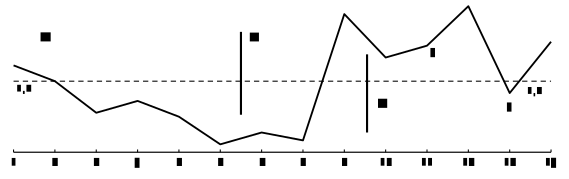
The graph is surprising: first we see the line of differences lie above the general average for α, to reach the average (1,8) already at β, and then reach a lower and lower level. The difference remains low and continues to be so down to the last reverse, which is connected with B (θ), where it suddenly rises (3,5) to remain high from there onward. In this connection it must be remembered that the figures for κ and μ are not reliable, due to uncertainty about the size of the type.
What is the upshot of all this? — The size of the coin, or more accurately: the difference between the size of the coin and of the type depends, as we are only speaking of dekadrachms, on the softness of the metal, and on the force with which the striking was done. A consideration of the coins, however, convinces us that the consistency of the silver cannot have varied noticeably; as it is, the cracks that arose due to striking when [p. 38]the metal was too cold happen to occur with the large pieces[42]. Consequently the graph given is that of the force with which the striking was done. This force naturally varies from individual to individual, but in the main remains constant with every individual. Thus we clearly see two “hands” show up in our graph: one that has struck the numbers 1 (or 2)–8, and one that has struck 9–14.
[p. 39]The question what the order of the 3 obv.- and the 13 rev.-dies of the dekadrachms is, resolves itself into the question what place we must give to C and the dies ι–ν coupled with it. For the other numbers 1–9 are connected by die-interlinking, and the regular progress of the die-injuries proves that they have in fact been used in the order shown by the catalogue. The only lacuna in the chain is after the end of B with which θ, too, disappears from the stage, whereupon C appears immediately with the new die ι. We are confronted with the question whether C + ι come immediately after B + θ or whether we have to assume a second anvil and have to imagine C in use simultaneously with A or B or with both. Regling[43] assumed the former by expressing his expectation that C coupled with θ was sure to turn up. Of course this is mere guess-work and by no means suited for a sound chronological foundation; besides θ was already too much damaged to be used for any considerable time.
Nevertheless Regling was right, for at the end of the preceding chapter this question was really answered, when it was shown by means of a graph that one “hand” had struck the coins 1–8, and another Nos. 9–14; this second “hand” therefore connects 9 (with B) with the following numbers, which have C as their obverse. This view is corroborated by the condition of the dies. The discontinuance of the issue of the dekadrachms of this group is of course based on a decree, probably of the municipal authorities; anyhow this decree will certainly not have been the result of the condition of the dies. Therefore it is obvious to expect that the last dies have not been entirely used up. This is indeed the case with C and ν, while with every certainty we can derive from the specimens of No. 9 that B was only withdrawn due to its extremely bad condition; θ, too, had already incurred a fatal injury. — The chronological order of the coins such as they have been arranged in the catalogue can therefore be considered as absolutely certain.
As regards the metrological things worth knowing we may also be brief. The weight [p. 40]of the dekadrachms does not vary during the period of issue, and the image given by the “frequency-table”[44] does not offer any difficulties. Leaving the low weights[45] on one side, which for the matter of that have arisen due to injury and wear, we obtain the following figures, calculating from 43,00 gr. onwards.
| 43,00 | gr. | : | 2 | pieces | 43,25 | gr. | : | 12 | pieces | 43,50 | gr. | : | 3 | pieces |
| 5 | — | : | 6 | — | 30 | — | : | 11 | — | 5 | — | : | 1 | — |
| 10 | — | : | 4 | — | 5 | — | : | 8 | — | 60 | — | : | 0 | — |
| 5 | — | : | 6 | — | 40 | — | : | 5 | — | 5 | — | : | 1 | — |
| 20 | — | : | 7 | — | 5 | — | : | 3 | — | 70 | — | : | 0 | — |
The highest point lies in between 43,25 and 43,30 gr., which together included 20 % of all the coins whose weight was known; it appears that the normal weight is 43,27 gr. This differs only 0,39 gr. or 0,89% from the theoretical weight of the Attic-Euboeic dekadrachm: 43,66 gr.[46]. This will probably be the result of the very slight wear of most pieces; in normal cases the difference will no doubt be the average of 1% assumed by Hill[47].
Of the hoards, that of Contessa[48], near the old Entella, may be mentioned first. For the greater part the coins were immediately published by Salinas[49]. Besides two 5th cent. Athenian tetradrachms, which were in an excellent condition, and tetradrachms of many towns of Sicily, there belonged to this hoard 22 Syracusan tetradrachms and 4 dekadrachms: three of the Euainetos-type, which show hardly any wear (two with signature and △), and one of the Kimon-type, which is rather worn (No. 9 l). The hoard has rightly been dated by Evans at the end of the fifth century[50]. The wear of the dekadrachms seems to show that some time must have elapsed between the issue of No. 9 of the Kimon-type and the above-mentioned specimens of the Euainetos-class; this tallies with the dates proposed in the present work: 409 and 407. The fact that the two Athenian tetradrachms have been preserved well proves that they had not been in circulation for a long time. The hoard can be dated at 406, the more so in view of the excellent condition of the Punic coins.
In 1890 an important hoard was found near Santa Maria di Licodia, the old Aetna. [p. 41]It seems that this find was divided into two parts: the greater part (67 dekadrachms and 13 tetradrachms) was published by Evans[51], while a group of 14 dekadrachms was put on the market later on[52]. These groups together (distinguished as I and II) include the following coins:
These coins amount to 872 drs.; therefore it is not impossible that the “Pegasi” were 14 in number and made the sum total 900 drs. As this considerable amount must have been hidden circa 380[56], it does not provide any indications of chronology; only the relations of the numbers are interesting.
No doubt it is the same hoard which is mentioned by Noe under the heading “Catania 1889”; the figures are not correct, but the “amateur anglais bien connu” is to be recognised as also the “type nouveau”[57]; Evans had seen the coins in Catania.
In 1896 6 Syracusan dekadrachms were found near Canicattini, together with 74 tetradrachms of other Sicilian towns and of Carthage (Noe 198): the latter coins were probably issued from 410 onward. For the rest it is unknown whether among the dekadrachms there were also pieces of the Kimon-class.
[p. 42]Two hoards of Avola call for our attention (those of 1888, Noe 108, date from the 4th century): the hoard of 1891 (Noe 109) contained some 2000 silver coins of the sixth and fifth centuries; the view that they came from the retreating Athenian army is tempting, but uncertain[58]; but we may certainly date the hoard not far from 413. Of greater importance, however, was the capital hoard of gold coins (of 1914, Noe 110), consisting of 100 pieces of 100 litrae, 100 pentekontalitrae, 100 darics and apparently 100 more gold coins. I presume that the concealment of this capital, as also the hoards of Noto and perhaps also those of Falconara and Avola 1891, are connected with the Assinarian games, if they actually were held on the Assinaros. The hoard will have to be dated c. 410.
The above-mentioned hoard of Falconara, which is situated near Noto, does not offer anything certain that might be of any importance; besides Sicilian coins Athenian pieces were found (Noe 409).
Noto, however, has yielded more. A hoard, which is lacking in Noe, was found in 1908, and has apparently been incorporated in the Virzi collection, at least partly; this collection must have been of legendary wealth. From it some pieces have passed over to the Jameson and de Nanteuil collections. I only mention the Kimonian dekadrachms Nos. 1 l, 5 d, 7 l (Jameson 1834, 1920; de Nanteuil 357) and the Arethosa-tetradrachm Jameson 1835. I remember that other Syracusan coins, too, were mentioned as coming from this hoard, but as I have no access to the catalogues at the moment, any further investigation is impossible.
Another hoard, very modest but perhaps important, is also lacking in Noe. In examining the Siculic sepulchres in Plemmyrion near Syracuse Orsi perceived that these tombs had been opened towards the end of the fifth century and had been used as mass-grave for the slain; he associated this with the battle in the harbour of 413, when the Athenians left their dead unburied, so that the Syracusans had to get rid of the corpses as well as they could in the hurry. In a letter Orsi mentions a Syracusan bronze coin found among the corpses[59], but in his report he does not refer to it any more[60], so that this date, which might have been important, has got lost.
In a Sicilian hoard of 1916 (Noe 977) there occurs one Syracusan dekadrachm. Since the hoard has been deposited in the Syracusan museum, and the three pieces of the Kimon-type described above have consecutive inventory-numbers, it is probable that a coin of the Euainetos-type is concerned.
[p. 43]I have been unable to obtain any further particulars regarding the hoard of Naro in 1925 (Noe 728), where 26 dekadrachms and 60 tetradrachms of Syracuse were found together with two Agrigentine dekadrachms[61]. It is not impossible that this treasure was hidden after the fall of Agrigentum in 406; Naro lies about twenty kilometres east of the town. At Campobello di Licata, which lies about 30 kilometres east of Agrigentum, a hoard was found which contained Syracusan tetradrachms of Phrygillos and Eukleidas, the latter with the head of Pallas (Noe 195); this may likewise belong to that year, when the Agrigentines fled from their city in easterly direction.
[p. 44]Turning to absolute chronology, we may on the one hand refer to the studies of Evans and take 412 as the starting-point for the dekadrachms, but on the other hand we are confronted with difficulties when we put the question until what time the issue of the dekadrachms of the Kimon-type was continued. However, it seems better to treat this question later on, and only to point out here that Evans was no doubt right when he put forward that the pentekontalitra of Kimon must have been struck for the first time on the occasion of the first Assinarian games of 412: that the ἆθλα refer to the Assinarian games is not doubted by any one, and the Siculo-Punic coins, which combine the copies of α and of the quadriga by Euth. of 413[62], prove that the beginning of the series of the dekadrachms should be put near 413[63]. This date will be corroborated in various other ways.
In order to give a proper estimation of the dekadrachms, and also in view of the subsequent chapters, it is, however, desirable to give a clear image of the history of Syracusan coinage in the years after the victory over the Athenians. In doing this we need the tetradrachms as the backbone of absolute chronology.
In my opinion Tudeer has unsatisfactorily arranged the series of this period. For his period II (according to him 413–399) is not formed by one continuous chain fixed by die-combinations, but by a number of short series, which cannot be arranged in a mechanical way, but ought to be arranged on the ground of reasoning. They are the following:
| A | obv. 15 Euth. | rev. 26, 28 Eumenes, 29 Phrygillos. |
| B | obv. 16–19 (head) Phrygillos | rev. 30–34 (chariot) Euarchidas. |
| C | obv. 20 (chariot) | rev. 35 (head) Eukleidas. |
| [p. 45]D | obv. 21 | rev. 36–40 (Pallas) Eukleidas. |
| E | obv. 22 | rev. 41–43 (“Large head”). |
| F | obv. 23 | rev. 44 (Kora). |
| G | obv. 24 | rev. 45 IM. |
| H | obv. 25–27 | rev. 42, 46–52 (“Large head” l., Parme). |
| I | obv. 28–29 (head) | rev. 53–54 (chariot) Kimon's Arethosa. |
| J | obv. 30–31 (chariot) | rev. 55–57 (head). |
| K | obv. 32 | rev. 58–59 Eukleidas. |
That A was struck immediately after the war has been sufficiently proved, in my opinion, by Tudeer p. 280 sq.: the winged charioteer[64] indicates a victory, the Sicilian Skylla seizing a fish no doubt refers to a sea-battle; the only imaginable reason of this is the battle in the harbour. To this may be added the material argument that this series is connected with the preceding one by rev. 26[65]. This series A is connected with B by the activity of Phrygillos (rev. 29, obv. 16–19), as also by the aphlaston, which has been placed in Nike's hand, and which must bear on the battle in the harbour just like the obv. by Euth., where it also occurs[66]. With this B series the ear of corn appears for the first time in the exergue; therefore it is self-evident that we treat the above-mentioned series B–K, all of which show this symbol, in one group.
In series B we see on rev. 30 the horses very lively. If for a moment we consider the heads only we shall see that with the first horse (from the left) the head forms an acute angle with the neck, that the second and the fourth horse looks round, while the third raises its head. This is the same on rev. 31 and rev. 32; on rev. 33 the engraver makes an unsuccessful attempt to make the heads that are looking round look at us, in strong fore-shortening, but on rev. 34 the fourth horse, too, puts its head forward. A tendency towards greater regularity and rest is to be observed, which tendency is far more in evidence in the horses' legs: at first (rev. 30) there is a confused cluster of legs, but gradually there arrives order, and finally the hindlegs of rev. 34 have already that uniform attitude which later engravers can apparently drop only with great difficulty and little success. However, when we recognise in the heads a further step to monotony (series E sq.), because the third horse, too, keeps its head low and no longer [p. 46]raises it, we may consider this as a (provisional) final point in the development of the horses. But there remain intermediary phases: first there is D[67] (the third head is lifted up), next comes C[68], where it is true the third head is lifted up, but no longer so high as first. From B to C these three series (BDC) form a close group due to the representation on the chariot-side: a female auriga with a torch in her hand; rev. 34 where Nike carries a wreath only forms the transition from rev. 33 to obv. 21, and rev. 35 (Series C) introduces the head-type of the following series.
Again, as series E with the “large head” to the right, links up with H (with the “large head” to the left), it seems advisable to remove F and G from between them, and to place F (with the Kora-head) before E: for one thing this is necessary because there is no room for it elsewhere, but secondly because the attitude of the horses seems to point to this place in the series. The close connection of E and H is confirmed by rev. 42, which is used in both series. Tudeer p. 171 was unable to notice in obv. 42 any injuries that betrayed the chronological relation between E and H, but it stands to reason to group the “large heads” together and to keep the order EH. J and K group themselves with H automatically, but in reverse order. For whereas obv. 30 and 31 of J return to former models (two horses looking round), obv. 32 has kept the scheme of H. It is true that this might be countered by the fact that obv. 33 shows the same scheme, but in that case a much stronger argument, of a material nature, may be put forward, viz. the fact [p. 47]that rev. 57 (of J) also occurs coupled with obv. 34 of the next group and thus places J at the end of this group. Therefore the order becomes EHKJ.
Apart from Kimon's Arethosa (series I) the tetradrachm by IM (series G) has been left out of consideration so far.
The tetradrachm by IM has always been a crux because of its isolated position. It was mostly given a late date: Head placed it ten or twenty years after the other coins of the flourishing period and thought that the fight between lion and bull represented in the exergue might be connected with Acanthus[69]; Weil does not give a date, but places the coin entirely at the end[70]; Evans, however, compared the head with that of Kimon's first dekadrachm and his conclusion was: pre-Dionysian (c. 409)[71], whereas Holm placed it between 400 and 368[72]. Du Chastel gave a very late date[73], but Forrer[74] gave very wide limits (406–345). Tudeer does not know what to do with the coin, but hesitatingly places it after the Kora-coin (series F) because he thinks he can observe stylistic agreements in the heads[75]; on the other hand he refers, like many predecessors, to the hemidrachm which is signed IM and KIM, and to the agreement of the quadriga by IM with that by Euainetos in Katana; the group of lion and bull he leaves unexplained[76]. Seltman gives a later date to the coin and dates it shortly before 387, while he points out that the bronze of that time bears a copy of the head by IM; he interprets the group in the exergue as an allusion to the Italic war of Dionysios[77], in which the bull, as had always been the case, was meant as the device of Italy; on the bronze mentioned, too, there is a bull[78]. With regard to this the remark may be made that the head of the bronze coin[79] does not show any fluttering hairs, as is the case with that of IM, and that it wears ears of corn in its hair, in other words that it is only a modification of the head of Euainetos' dekadrachm, which is only reminiscent of IM as regards the treatment of part of the coiffure; further the bronze is dated in the time of Timoleon by Giesecke, while Robinson ascribed it to Agathokles[80]. — The explanation [p. 48]of the group in the exergue given by Giesecke is certainly attractive, but cannot be decisive for the dating without further support. If we relinquish the idea that the bull represents Italy (the combination of lion and bull is after all the most current one[81]), it will become possible to think of other victories. The defeat of Carthage is out of the question because the lion is exactly the Carthagenian device and appears as such on the Demareteia; the victory over the Athenians remains therefore as a possibility. It follows that this group of lion and bull can only corroborate a date that has been obtained in another way.
When we consider the quadriga we shall notice that the attitude of the heads answers to the scheme of rev. 34 of series B; the legs, however, are far more lively and are reminiscent of rev. 30. It is noteworthy that the horses of IM have lost the ground under their hoofs and are raised; to a less extent this also occurs with rev. 30 and nearly all the following quadriga's, just as on the dekadrachms of Euainetos. Though the horses make us think of series B, the head is closely related, as was already remarked by Evans, with that of the first dekadrachm of Kimon: the heavy and full chin, the treatment of the lips, the hair where, however, the hairs freely flutter backwards instead of being kept together by a net, and the treatment of the coiffure in inconspicuous locks showing a lively undulation, all this reminds us of the head of the first dekadrachm of Kimon; it is, however, the rather strongly pronounced attitude[82] of the head and the angle made by head and neck that cause this head to resemble that of α rather much. Therefore both obverse and reverse give the coin a place shortly after 413, in the neighbourhood of B; accordingly the group of lion and bull can only refer to the defeat of the Athenians[83]. But this coin cannot lay claim to a place in the series AB etc., for the series were continuous and the tetradrachm of IM would break the continuity. Therefore we have to assume a second anvil for G.
This tetradrachm has been discussed at some length, not only because of its own, very great merits, but also because it will have to play an important part in the chronology of the Syracusan coins. It will already have to play a part in dating series I, and conversely its place will be supported by the date of I.
In dating I our starting-point is the die-sequence obtained in Appendix I; therefore we [p. 49]only take the first pair of dies, obv. 28 and rev. 53, into consideration in fixing the date. It is true, the chariot does not have an accurate parallel in the series BDC, but while the attitude of the heads would lead us to obv. 22 (E), one look suffices to convince us that an exclusively formal (and partial) agreement does not mean anything here. For the great liveliness of the horses, the absolute absence of monotony rather causes us to look at the beginning of B. This leads us to the immediate neighbourhood of G, and now the agreement of the quadriga's of G and I appears to be striking: not only is there an agreement between the horses in many respects, but the typical attitude of the charioteer, too, is the same; again, nowhere does the driver occur who, bending forward, exerts himself to soothe the horses and urge them on to greater speed. That the two engravers, both of them excellent artists, with a personality of their own, gave evidence of their own individuality, the one by displaying a certain monumentality though observing the natural relations, the other, Kimon, by evincing a subtle delicacy, is exactly what we might expect. The position at rev. 30 is corroborated by the fact that both rev. 54 and rev. 31–33, which must be contemporary, are the only instances where the head of the driver is rendered three-quarters facing. Finally there is a third exceptional circumstance in which the specimens agree, for both in B and in I the heads are placed on the obverse. This dating obtains very material support because the very numerous imitations of Kimon's Arethosa give a terminus ante quem: as Evans pointed out the Arethosa was copied on coins of Kamarina, which was abandoned in 405, and of Himera, which was wiped out as early as 409[84]. Consequently the Arethosa dates from before 409, as in fact we suspected on the ground of its style, and it passes on this date to the tetradrachm of IM, which as we have seen was closely connected with the Arethosa. This construction is finally crowned by the hemidrachm, whose obverse bears the signature KIM, and whose reverse bears the signature IM.
The chariot of this fine coin is related to the chariot of the two tetradrachms mentioned: the head of the first horse nearly makes a right angle with the neck and runs parallel to the fourth head, the second head is kept downward with an acute angle, while the third is raised high, as is the case with B and G; the legs of the horses are very lively and, just as with G, they do not touch the ground. Nike shows great resemblance to that of G and is almost entirely like it. An entirely new attitude is shown by the charioteer, who, leaning backwards, is here pulling the reins with might and main, apparently in order to make the horses stop after the victory. In a similar way as on rev. 53 here, too, the wind causes the garment of the driver to wave, which has been treated in [p. 50]exactly the same way as Kimon treated it on rev. 53; the chariot is a replica of that on rev. 53. The head on the obverse is of quite a different nature from the heads which we find on the larger pieces; it has something very fine and delicate contrary to the broad head of IM's tetradrachm; in particular the pointed nose is striking. The hair has been treated in about the same way as on G, but here the engraver could only render it in few large locks due to limited space; here, too, the wind is blowing through the hair. The neck-ring has been clearly indicated on both heads by IM. The engraving is, as far as I can judge[85], very fine on the obverse and on the reverse, probably even finer on the chariot-side than on the head-side. In fact the obverse signed KIM breathes entirely the same spirit as the first reverse of Kimon's Arethosa, although influences of IM are noticeable; the head signed IM is also reminiscent of the large head by IM, but displays a fine freshness that is not be found in G; probably IM has here imitated the subtle nature of Kimon's work.
If the preceding considerations give us a right to place this hemidrachm immediately after the tetradrachms of the two artists, this dating becomes even more probable when we notice a pilos in the exergue, an “abbreviation” of the type of the defeated Segesta[86]. This modest piece by two of the best engravers, too, is reminiscent of the victory of 413.
From what has been said above with regard to the tetradrachms of IM and of Kimon and concerning their hemidrachm it follows that IM worked on another anvil than that which was used for the current series; for the same reason we may assume the same thing for the Arethosa-tetradrachm. Seeing that a close relation could be established between the two artists, it is only natural to assume that the two of them had a separate “atelier”. The activity of both of them falls in the early years after 413.
Now the gold coins should be given their place. Giesecke[87] rightly distinguishes two series of Syracusan gold coins, the first of which consists of the famous 100-litra piece with the head of Arethusa and Herakles, struggling with the Nemeian lion, the 50-litra piece (male head l. // jumping horse), a 20-litra piece and a 10-litra one, with [p. 51]a head of Herakles and a mill-sail incuse, and with a head of Athena with about the same reverse respectively. As has been recognised for a long time the head of Arethusa is closely related to the heads which also served Kimon as models for his dekadrachms; the gold coin, however, is clearly younger than these tetradrachms and suggests approximately the time of Kimon's first pentekontalitra, i.e. immediately after 413. Seltman[88], who gives a later date to this gold coin, too, interprets the struggling group of the reverse as an allusion to the victory over Carthage. This representation would no doubt be suitable, but it might also bear upon the victory of 413. Mrs. Baldwin has indeed interpreted it in this way[89], referring to the rôle played by Herakles at the defeat of the Athenians: before the decisive battle the Athenians had to abandon their camp at the sanctuary of Herakles[90], on this very day the Syracusans celebrated a festival in honour of Herakles[91], and soothsayers pointed out Herakles' example in the defensive battle; οἱ μάντεις τοῖς Συρακουσίοις ἀπήγγειλαν ἐκ τῶν ἱερῶν λαμπρότητα καὶ νίκην, μὴ καταρχομένοις μάχης, ἀλλ' ἀμυνομένοις, καὶ γὰρ τὸν Ἡρακλέα πάντων κρατεῖν ἀμυνόμενον καὶ προεπιχειρούμενον[92].
The group does indeed depict these words. In this way the head of Herakles on the 20-litra piece may also be explained. The juvenile male head on the 50-litra piece is called Assinaros; the manner in which it has been represented is suitable for a river-god, but there is no indication by which he is to be recognised as such with certainty. The horse jumping with loose rein is interpreted as a symbol of liberation; the horse, as an “abbreviation” of the quadriga, is thus said to be the Syracusan device[93]; but this explanation, however attractive or even probable it may be, is not borne out by any sound argument. The appearance of the head of Athena is unusual for Syracuse; the gold coin, which is a little younger, will probably copy this head, however, and further it occurs on the tetradrachm by Eukleidas (in series D). The only explanation that seems plausible, that now that the other gods had been honoured Athena, too, should have her turn[94], does not explain anything. It seems to me that the head on the gold coin bears great resemblance to the head of Athena on the coins [p. 52]of Thurium, which had left the side of Athens in 413 and had joined the side of Syracuse since that time[95]; elsewhere, too, we find relations between these towns. In this case the Pallas-head by Eukleidas would have to be explained differently. Of the types of the first series of gold coins there are then left two reverses, which are reminiscent of the types of the oldest Syracusan silver coins[96]: a mill-sail incuse with a head in the centre or with a wheel, the type of the old obol. The bronze of this period also bears the mill-sail incuse and the chariot-wheel[97]; to this belongs the bronze with the signature of Phrygillos, who worked at the tetradrachms immediately after 413. — All this places this first series of gold coins in the years immediately after the Athenian defeat, as has been generally accepted for the matter of that. The contemporary gold coins of Gela[98] depict the ΣΟΣΙΟΛΙΣ, who wreathes the man-headed bull, the device of Gela, on a tetradrachm, apparently of the same date[99]; Gela was the ally of Syracuse in the war against Athens.
There is another point to which I would draw the attention: just as in the series B and I of the tetradrachms, the head is on the obverse of these gold coins, too. With gold coins this may be expected more readily, for these small pieces follow the tradition of the silver fractions for a considerable part[100], which fractions had the head on the obverse as early as the archaic period. As the nearly simultaneous appearance of the heads on the lower die is something abnormal with the series B and I of the tetradrachms, which practice was soon given up, it may be safely assumed, in my opinion, that this practice was copied from the gold coins; the beginning of the first series of gold coins is then put at the time of series A of the tetradrachms, i.e. in 413. Next it may be supposed that, once he had got the idea of placing the head on the obverse, Kimon would also have done this with his dekadrachms; since this is not the case the Arethosa comes after his dekadrachm, for the latter is a contemporary of the first gold coins (413/2). For the same reason it may then be assumed that G comes before I, that is to say that for the chariot of his Arethosa Kimon was partly dependent on IM, who worked in the same atelier as himself. That IM's tetradrachm is among the first of the [p. 53]series is proved by the retrograde inscription, which is probably the result of want of practice to engrave coin-dies. The same trace of unwontednes is in evidence with some gold 100-litra pieces, where first ΥΣ was cut (to be read from the interior), which was afterwards changed into ΣΧΡΑΚΟΣΙΩΝ (sic; to be read from the exterior[101]).
The second series of gold coins of Syracuse[102], which is more modest both as to size and as to the extent of issue, is of a later date: the largest piece, to the value of 20 litra (i.e. a tetradrachm), shows a copy of the head which IM cut for series G of the tetradrachms; the trident of the reverse may refer to the successful activity of the Syracusan squadron in the Aegean Sea in the years 412 and 411[103]; the observation should be made that the Skylla on the die of Euth. also bears a trident. Next we see the head of Athena again on a 10-litra piece with the aegis on the reverse; in this connection the observation may be made that the Athena of Eukleidas, too, bears a Gorgoneion in her necklace[104], and that as an “abbreviation” of the aegis. The smallest denomination, a drachm worth five litrae, displays a head of Arethusa with a sepia on the reverse, ordinary types, which also occur on the small silver fractions of this period. Here, however, stylistic agreement places the head near to that in the mill-sail incuse of the 20-litra piece of the preceding series, which in its turn justifies the date of shortly after 413. Therefore the difference in time between the issue of the two series cannot have been so great, even though the 100-litra pieces use up about two dozen obv.-dies and the pentekontalitra about five[105]: the former was begun in 413 and seems to have been issued very quickly[106], the second series will probably have followed in 411 at the latest (because of the trident); the gold coins of Agrigentum corroborate this date[107].
[p. 54]Thus far the difficulties were not great, but it has appeared that the two series of gold coins have been struck according to different standards of value between gold and silver: for the former it was 15 : 1, for the latter 13 : 1[108]. This would mean that meanwhile gold had become cheaper with respect to silver, i.e. that either gold had become less rare or that silver had become scarcer, or a combination of these two cases. The former possibility, that there was more gold specie, is certainly not the case: by far the richest issue of gold coins was the Syracusan one, which had the rate of exchange 15 : 1; after that the second series came, which must only have required a fraction of the gold that was necessary for the first series, both as a result of the size of the coins and as a result of the extent of issue. Parallel with the first series there is an issue of three nominals in Gela (of 30, 20, and 15 litrae), which are rare and will accordingly have been struck in a small number, and a 20-litra piece of Kamarina[109], which is extremely rare. Parallel to the second Syracusan series there is only the rather rare 20-litra piece of Agrigentum[110]. The issue of gold coins was therefore extraordinarily abundant immediately after 413, to be reduced shortly afterwards at a lower rate of exchange and next to be stopped altogether. This observation would rather lead us to fix the price of gold at the time when the first series was issued lower than at the time of the second series, but for the circumstance that the coining of silver, too, was extraordinarily abundant immediately after 413 (i.e. simultaneous with the first series of gold coins): by the side of the anvil for making the current series, a second atelier was temporarily employed in Syracuse, as we have seen, and besides there was the issue of two series of dekadrachms. Elsewhere in Sicily coinage was also abundant in this period, and Agrigentum, too, issued dekadrachms. — How are we to reconcile these data?
The war demanded extensive issue of money, especially for paying the mercenary troops; due to the fact that Syracuse was deprived of a regular supply of silver as a result of the blockade it had to depend on its stocks: we see that the dies in use in 415 struck the silver there was hurriedly; but it was not much, for during the war no new dies were made[111]. For the rest the town had to depend on the older or foreign [p. 55]silver coins, or to contract debts: χρημάτων γὰρ ἀπορίᾳ αὐτοὺς (sc. τοὺς Συρακοσίους) ἐκτρυχώσειν, … καὶ χρήμασι γὰρ αὐτοὺς ξενοτροφοῦντας καὶ ἐν περιπολίοις ἅμα ἀναλίσκοντας καὶ ναυτικὸν πολὺ ἔτι ἐνιαυτὸν ἤδη βόσκοντας τὰ μὲν ἀπορεῖν, τὰ δ' ἔτι ἀμηχανήσειν· δισχίλιά τε γὰρ τάλαντα ἤδη ἀνηλωκέναι καὶ ἔτι πολλὰ προσοφείλειν, ἤν τε καὶ ὁτιοῦν ἐκλίπωσι τῆς νῦν παρασκευῆς τῷ μὴ διδόναι τροφήν, φθερεῖσθαι αὐτῶν τὰ πράγματα[112]. I would also connect the tetradrachm of Leontini with this, which bears a countermark with ΣΥΡΑ[113].
When Plemmyrion was conquered the Athenian military chest fell into the hands of the Syracusans, but it was probably not well-stocked, seeing that the Athenians had already asked for a replenishment of the chest[114]. Next followed the defeat of Eurymedon together with the ships carrying money; it is not stated whether the Syracusans captured anything[115]. The great booty was not obtained before the retreat of the besiegers, when the Athenians had to leave all behind, and no doubt the military chest, too[116]. Further we find the statement that after the six hundred men had been made prisoners in the garden of Polyzelos four shields with ἀργύριον could be collected; this was certainly not the military chest, as Evans asserts, but the personal property of the Athenians. Evans has calculated that the sum total amounted to about 333.333 drachms[117], but I suppose that among this ἀργύριον there will also have been gold and silver ornaments. The chest captured near Syracuse will probably have yielded most silver for striking coins.
Whether any silver was found in Sicily itself is unknown[118], and Cary's hypothesis that the towns bought the metal necessary for coinage from Carthage is certainly attractive[119]. If this is right the Syracusan purchases of silver during the war and immediately after it will hardly if at all have been possible, for the products with [p. 56]which it paid (in the first place corn) will of course have been scarce in the town, But even if there were silver-mines near Syracuse, their exploitation would have been disorganized during the war: the galleries would partly have caved in, the slaves would have run away just like those of Laurium after 413[120], and Nicias, as an owner of silver-mines in Laurium and on that account an expert to a certain degree, would certainly have paid attention to this source of income for the Syracusans. It would certainly have taken some years before the mines could be regularly exploited again. In fact we see the abundant issue of silver diminish after the second atelier (Kimon and IM's) had been closed down and after the end of the series of dekadrachms of the Kimon-type. This was, of course, partly the result of the fact that the very great demand of 413 had been met and the arrears had been worked off. But what about the gold coins?
Immediately after 413 we see a very abundant issue of gold coins, which lasted only a short time. As the Syracusans were not accustomed to gold money, this issue will considerably have increased the total amount of gold coins that were in circulation. This must have been accompanied by a fall in the price of gold. This fall, a result of too sudden and too abundant coinage[121] is in evidence in the rate of exchange 13 : 1, according to which the second series was issued. The rapid fall of the price of gold seems to me to be a result of the monetary policy which Syracuse was compelled to adopt because it was in great straits for means of payment[122]. — Two minor points still call for elucidation. The specie for this issue of gold coins will probably not have been imported, but come from the place whence the Athenians in 407/6 also fetched their gold specie: the temples; besides the ornaments of the captive Athenians will probably have yielded some gold. That this stock of gold was not drawn on during the siege need not be concluded from the absence of Syracusan gold coins of the time of the siege. For a great portion of the treasures of the temple may have consisted of coined gold, and circumstances were not such that re-coining would be advisable. I have arrived at this conclusion because coins of the first series of Syracusan gold have been found in both hoards that are known together with Persian darics (practically the only gold money of the period)[123].
[p. 57]Summarizing the above we may give the following image of the Syracusan coinage after 413:
In the spring of 413 Syracuse was in great straits for coined money, because coinage had become impossible due to the lack of specie; in that state of emergency the Syracusan authorities had perhaps recourse to Persian darics. When Plemmyrion had been conquered they obtained some coined Athenian silver, which was probably used again in this form, like the darics. When the Athenians had retreated after the battle in the harbour, the town got much specie at its disposal. In Syracuse an order was immediately given to Eumenes, who had been connected with the Mint for ten years (rev. 28), and to a novice, Euth. (obv. 15), to make dies for tetradrachms with an allusion to the decisive conquest by sea; a little later Phrygillos joined these two engravers (rev. 29). The first dies will probably have come into use in October or November 413. At the same time, however, an order had been given, in order to meet the great demand for coins, to issue a series of gold coins, and that on a large scale; the necessary specie was borrowed from the temples. This series, too, will probably have begun to appear at the end of 413.
Meanwhile the Athenian army had been annihilated about the middle of September, and impressed by this conquest the Syracusans resolved to institute the Assinarian games immediately after the return of their victorious countrymen[124]. It cannot have been much later that they intended to issue a second Demareteion, which at the same time could be connected with the games instituted just then, and which could help to make head against the scarcity of money. Since sufficient numbers must have been ready in September 413, the order will probably not have been given after the beginning of the year (rather at the end of 413), and that to Kimon and Euainetos[125]. The latter had already made his début at the Syracusan Mint three years previously, the former did so on this occasion, while his partner IM supplied the dies for the tetradrachm (G). After Kimon had cut the dies for the dekadrachm (A and α), he cut two for his Arethosa-tetradrachm (obv. 28 and rev. 53; therefore about the spring or the summer of 412), and subsequently he cut a pair for the hemidrachm together with IM.
These two artists co-operated, and the coins struck with their dies, too, were struck apart from the ordinary series. Therefore it is plausible to suppose that the two things went together, in other words that the striking of this money took place [p. 58]in this private business, to which it was no doubt given out by contract. The view, however, that the striking of coins was always performed by private people is refuted by the continuity of the Syracusan coinage during some decennia[126].
This separate atelier worked by the side of the official Mint, which will probably have begun with series B in the early years of 413. B may perhaps extend over one year and a half or two years, if we take into consideration a continual activity, and then there appears the Pallas-head by Eukleidas (obv. 21 and rev. 36; towards the end of 411[127]). We may fix the beginning of series C at about 410/09, F in 409/8; E will probably begin about 408/7[128] and series H, which follows it immediately (E and H together have four obverses), will probably not end before about 404/3[129]. The next series K and J[130] with their three obverses take us to 399, where Tudeer, too, and that on good grounds, fixed the end of this group[131]. It is remarkable that from series C onward Eukleidas repeatedly commences a series by cutting a model[132] for the engravers of inferior qualities who were employed by the Mint.
It is not difficult now, using the indications found in Appendix I, to give a place to the dekadrachms, too: the series of the Kimon-type run perfectly parallel with the issue of the Arethosa-tetradrachms and derive therefrom their date of 412–407. Although we cannot divide the series into six distinct groups, and cannot ascribe to each of these groups a definite year of issue, we can yet try to do so tentatively. There are two circumstances to support us: first that the dekadrachm No. 1, just like the first die-combination with the Arethosa-coins, fills one year alone, viz. the year 412; secondly that a new annual issue, viz. that of 409, begins with No. 9[133]. Consequently No. 1 falls in [p. 59]412; 2 and 3, which show striking stylistic similarity, will have to be placed in the year 411; perhaps 4 belongs here too. For the year 410 there are the numbers 5–8: the dies ε and η incurred a heavy injury rather soon, so that they will not have been used very long. Therefore the issue for the year 409 commences at No. 9; whether No. 10 has also to be placed in that year I would not venture to say. For 408 No. 10 may perhaps be considered, but certainly No. 11. Whether the first of the following three (No. 8) is to be placed in the year 408, or whether the three of them would have to be dated in 407, I am unable to settle.
For the sake of the scheme I have here assumed that every time an issue begins with a new die for the obv., but it is evident that this is not necessary. But it is obvious that a die which has come to be in a bad condition towards the end of an issue, will not have been replaced by a new die so easily as would have been the case in the middle of the work; for example, the dies η and ι, which I placed at the end of an issue, are still used when they are already full of cracks; but the same thing holds good for the obv. B with No. 9. With ε, too, the crack becomes large; ought Nos. 2–5 to be taken together? The doubt which has to continue here has been indicated in the catalogue. As the coins come nearer to the three points that are certain in my opinion: 412 beginning of the series, 409 beginning of No. 9, 407 end of the series, the dates can be given with a greater amount of certainty. If we may consider the number of specimens preserved and catalogued here as representative of the extent of the various issues, then a strong curtailment may be observed towards the end of the series, which need not surprise us in view of the events of 409 and 408.
The other series of dekadrachms, of the Euainetos-type, had no doubt also been struck from 412 onwards: the Kore-head perfectly matches the heads by Eumenes and by Phrygillos of 413/12[134]. For the further dating critics often cling to the Δ, which after some time appears with the heads, simultaneously with the disappearance of the signature, because they interpret this letter as an indication of the tenth anniversary of the festival. Gallatin[135], too, gives this interpretation of the letter. In this case these pieces would have to be dated at 403, after which the end of the series could be approximately dated[136]. Another current explanation of the Δ is to take it for the abbreviation of δεκάδραχμον[137], a very usual way to denote the value of a coin. If the objection is made that it would be peculiar for the mark of value not to appear till in the course of the series [p. 60]to disappear again soon, then I would refer to the analogous case of the later Syracusan electrum, where the pentedrachms only sporadically show a Π as a mark of value[138].
Although the appearance of the Δ does not provide any certainty, I think I have found a certain indication of chronology in the following circumstances. As Gallatin writes (p. 12), with the appearance of the Δ two changes take place: the signature disappears and — what is the principal thing here — the Nike of the Euainetos-type gives way to the Nike that occurs on the Kimonian dekadrachms. This may be thus accounted for in my opinion that the engraver who had worked at the dekadrachms of the Kimon-type until 407, starts cutting dies for those of the other series from that time onward; this change takes place in 407/6. Then the reins, too, are those of the Kimonian dies, and the hair shows the lively curls of the pseudo-Kimonian dekadrachms[139]. If this date should be correct, the Δ would have to be interpreted as a mark of value, when we bear in mind that Syracuse had engaged foreign mercenaries because of the menacing Carthaginian danger, who were not accustomed, naturally, to the dekadrachms, which were unknown in the rest of Greece.
These coins deserve special attention, because there are in connection with the arrangement of the two pairs of dies some difficulties, which were pointed out by Tudeer, p. 185 sq. without an attempt to solve them. First, however, I have to say that the material in casts or good reproductions that is at my disposal is limited; it includes: Tudeer No. 78 abdeh[140], 79 abcdf[141], 80 ace[142], 81 abcdfgh[143]. Besides I have at my disposal [p. 61]some specimens not mentioned by Tudeer (or mentioned under another heading): a piece of No. 79, on the market (Nav. XVII 237, v. Kaufmann 147), a specimen in the Jameson Coll. I 1835, Regling Münze als Kunstwerk 589 (rev.), and one in the Hermitage in Leningrad (inv. 4292/19b). There is further a piece of Tudeer No. 81 in the collection of the Neth. Academy of Sciences in Amsterdam (Boissevain Beschreibung der griech. autonomen Münzen etc. 48, 34) and one in the Lloyd collection 1394[144].
Tudeer rightly arrived at the conclusion that the die-sequence was not normal here, and that the dies were sometimes exchanged. If we arrange the coins in chronological order, as we have done with the dekadrachms, it will appear in what way this exchange has taken place.
If we begin with Tudeer No. 78 (obv. 28 with rev. 53) and pay attention to the condition of obv. 28, we get the following sequence: 78 d (slight injury in the hair to the right over the right eye; dent across the tail of the dolphin to the right, below), e (injury in the first lock of hair to the right of the neck; injury between neck and head of dolphin to the right, below); 79 i (a clearer dent across the tail of the dolphin; beginning of a fracture in the right corner of the mouth?), f (fracture in right corner of the mouth), a (the same fracture, but somewhat larger), Hermitage (also a fracture in the middle of the mouth), Nav. XVII 237 and d (fracture extends to left corner of the mouth), b (the same, but a little more extended; a large injury near the dolphin left below); 78 abh (injuries of upper eyelids). As regards the second obv.-die 29 the sequence becomes as follows: No. 80 comes first (a and e do not yet show a dent at the lower end of the chin, c shows the beginning of it) and next comes No. 81, of which all the heads show the dent[145]. If we call the three groups into which the pieces with obv. 28 can be divided: A (No. 78 de), B (No. 79 ifa, Hermitage, Nav. XVII 237, db), and C (No. 78 abh), and the two groups that were to be distinguished at the obv. 29: D (No. 80) and E (No. 81), then we know that A comes before B, B before C, and D before E. The rev. 53 confirms that A comes before C, as dents are visible in C on the back of the fourth horse, above the first raised hindleg, and also at the left-hand chariot-wheel, which dents do no yet occur with A. These dents, though of perceptibly slighter size, also occur on the reverses of D[146], ergo: A before C, D before C. The other rev. 54 incurs, in the [p. 62]course of its career, together with obv. 29 (i.e. in group E) a vertical injury[147] behind the charioteer (not yet in 81 abc); this dent occurs on all the specimens of group B, ergo: E before B. This fixes the sequence ADEBC, and the unexpected case arises that the same combination of dies (obv. 28 and rev. 53) begins and ends the series.
What conception are we to make of the way in which this series has been struck? — The fact is beyond doubt that, contrary to what Tudeer assumed on stylistic grounds, obv. 28 and rev. 53 formed the first pair of dies. After a number of coins had been struck with it, we see the obv., which is in an excellent condition, replaced by another obv. 29. For this is how we should put it, for the upper die 53 was not removed to another anvil; in that case we should have two anvils side by side and obtain two parallel series of coins. We could, on the contrary, establish with certainty that there is question of one series here. Why was obv. 28 temporarily given up? A reasonable ground is not to be found for this, therefore the cause will have to be ascribed to chance or to arbitrariness: a short or a long time after obv. 29 had been ready for use there was an opportunity which made it possible for the two dies to be exchanged. A little later about the same thing happens again: then rev. 53, which is not nearly worn, is replaced by rev. 54, not to return before the end of the series. An exchange of upper dies is not uncommon, however, and it was apt to occur; then the question arises: how is it that rev. 54 remains in use so long without a break (viz. throughout its whole career), while the obv. is sometimes exchanged? The second exchange of obv. is also unexpected, for obv. 29 is still in an excellent condition with the last-known piece of group E. It is true that it may be alleged that this is an argumentum e silentio and that obv. 29 in its later career with rev. 54 will as yet have incurred heavy injuries, but this would go against probability too much; for the pieces of E mentioned above show, as far as the obv. is concerned, a very slight progress of the only slight injury below the chin: is it to be believed that chance has caused 7 specimens to come down to us which had been struck very shortly after each other, and not a single one from the further course of the long career which was then no doubt in store for obv. 29? I think that we can eliminate such chance, especially because the same thing takes place a little later with the three other dies. When obv. 29 has been replaced by 28 a really serious fracture appears after some time, which causes a hole in front of the head of the left dolphin; the engravers remedy this by remodelling a dolphin's head on this fracture, so that the animal has obtained a lengthening-piece, and nearly looks like the result of double-striking. But obv. 28, too, is [p. 63]still in a very good condition when we see it in C for the last time. Likewise the two rev. 53 and 54 still enjoy excellent health on their leave-taking.
Can all this be chance? It is not to be believed. On the contrary, the course of this series seems to me to indicate that the manufacture of this kind of coins was stopped now and then: every time these dies were used for a short period to be put aside for some time afterwards; when a new issue of these coins was decided upon, one of the two obverse-dies and one of the two reverse-dies were quite arbitrarily chosen[148]; finally the series came to an end not because the dies were worn, but because it had been decided to stop the issue.
Therefore our conclusion is that this was an occasional coin. When we consider what periodic occasion comes in for the issue of these tetradrachms, and at the same time remember that this Arethosa was made by the engraver of the dekadrachm and was dated in the summer or the spring of 412[149], then it is obvious that the Arethosa, too, was issued every year on the occasion of the Assinarian games. Further it is to be observed that, exactly on the coins which were struck on the occasion of these games, the chariot is actually depicted full speed (as the attitude of the driver betrays), whereas elsewhere it had already lost its original agonic character, and had rather developed into a fossilized device.
If this conclusion is accepted, it follows that every specimen can be accurately dated: the first combination dates from the summer of 412, in the summer of 411 obv. 29 appears, in 410 the rev. 54 (these dies will no doubt have been made earlier, by way of reserve), and so on, until the last coins of the series were issued in 408 or 407. The reason why the issue was discontinued is clear when we bear in mind the exceedingly threatening events of those years: sumptuous occasional coins would have been out of place, and the games, too, will probably have been discontinued temporarily, or perhaps definitively.
It may be observed that rev. 54 with the driver looking round is exactly contemporary with the rev. 31–33, with which we have already compared rev. 54. Seeing that on good grounds we had arrived at the conclusion that Kimon and IM had a separate atelier, and that rev. 54 is closely connected with the dies that were cut in the Mint, we are justified in surmising that, now that Kimon's activity as an engraver ceased, no further coins were struck in his atelier, and the dies were removed [p. 64]to the ordinary Mint, were provided with a pair in reserve, and were from that time onward exclusively used for striking occasional coins. After the end of series B of the tetradrachms no interlinking with ordinary dies was possible, because contrary to the usual practice the head of the Arethosa was cut into the lower die.
As the final year of this series I have mentioned 408 or 407; counting the groups will lead us to 408, but still I think that the other year is to be preferred. For it seems that by mere chance[150] the same pair of dies was used in two consecutive years. Suspicion falls of course on the largest group: E i.e. Tudeer No. 81 (obv. 29 and rev. 54). When we arrange the coins chronologically we can indeed distinguish two parts: the pieces without any injury behind the charioteer are of normal size, and irregularly round as usual; in view of the numerous cracks in the edge and the folds they cannot have been struck while they were very hot. The second part of the group, with the injury behind the charioteer, consists of pieces of considerable size, larger than the normal tetradrachms. This characteristic is also shown by the next group B. Evidently a new, more powerful “hand” has set to work here, just as in the case of the dekadrachms. At the same time it may be perceived how the coins have been pressed into an oblong shape with apparent purpose[151]. On the analogy of the coins of Cyzicus and Elis I have explained this from the presence of the inscription ΑΡΕΘΟΣΑ above, beyond the border of the obv.[152]; as the whole of the type was thus elongated in one direction, our “second hand” who had not only more strength but also more love of his work, has made the coins, too, oblong in striking. Then arose the fracture in B in the left-hand dolphin; the injury was worked off as well as possible, but it remained ugly. Therefore the obverses of the following coins (C) are not centred: by putting the silver a little higher on the die an impression of the fracture was precluded[153]; but on that account the striking had to be less hard, for otherwise the fracture would become visible on the broad coin after all. We see the result: the coins have been struck less broad than those of the preceding groups, and the head has always been impressed remarkably low[154].
Just as we calculated the average of the difference between the diameter of the whole coin and the diameter of the type of the coin with regard to the dekadrachms, [p. 65]we can do it here too. We herewith give a graph showing these differences for each group (in the case of E for each part). The diameters of obv. 28 and 29 are the same
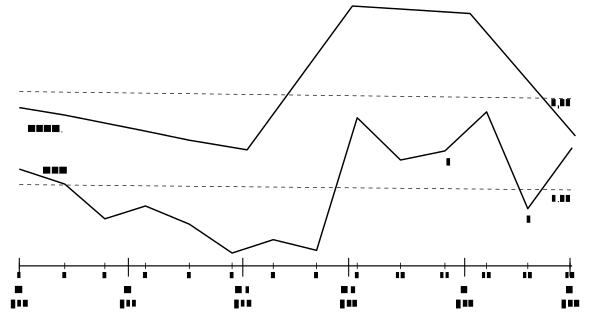
(24 mm.) as also of rev. 53 and 54; the differences are: for A 3,7 (3 pieces); for D 3,0 (4 pieces); for E1 2,6 (8 pieces); for E2 5,7 (3 pieces); for B 5,6 (8 pieces); for C 3,0 (3 pieces); the average of these 29 pieces is 3,96. The difference in “hand” seems to me to be sufficiently clear. — If we lay this graph on the graph which we made of the dekadrachms (the lower line in the figure), and assume that the series of dekadrachms and the series of tetradrachms are equally distributed over an equal period of time (which is a priori probable in the case of periodic issue of parallel series), we shall see that the “second hand” enters at the same time with both series. Seeing that it was to be expected that the two parallel series had been struck by the same hands[155], we are now justified in accepting as correct what was assumed for this graph, and to date the series of dekadrachms, too, in 412–407.
In connection with the weights a brief observation may be made: in applying the frequency-table we arrive at a weight of 17,25 grammes (6 of the 30 pieces), that is to say 0.21 gr. or 1,23 % below the theoretical weight, which is 17,464 gr. The dekadrachms were only 0,89 % below their theoretical weight, while Hill assumed as an average about 1 %[156]. The greater wear due to the high relief is clearly in evidence [p. 66]here, especially when we see that the pieces of 17,25 gr. (i.a. the Pennisi specimen) are nearly always in an excellent condition.
These capital pieces have always excited admiration and interest, especially because of their famous couple of eagles depicting the chorus of Aeschylus' Agamemnon 114 sq. faithfully. All this interest, however, has not yet led to a satisfactory interpretation of the types, nor has an accurate date been found; the one circumstance is connected with the other. A second question was added to this when Bernhart denied the authenticity of two[157] of the six specimens (the seventh is certainly false), after a former theory, which declared all of them to be false, had been refuted. Let us first discuss this last question.
It would be impossible in a small compass to examine all the arguments given by Bernhart; besides I have neither originals nor casts at my disposal, only the strongly enlarged reproductions given by Bernhart of each piece[158]. I only wish to remark that the author does not seem to recognize as such die-injuries consisting of dents in the form of stripes. For example, he takes such an injury on the obv. of D[159] for traces of over-striking, and when he again meets the same signs on another specimen (F) together with new injuries, he considers this to be a proof of his assertion that F was struck with a die that had been made mechanically from D. In actual fact they are of course products of the same die, which had meanwhile incurred more injuries. Further the criterion of genuineness that Bernhart (p. 34) uses to prove the authenticity of the rev. of E and B may be applied to the two supposed counterfeits: it is true the obv. of F does not show anything that does not occur with A, but this is the case with the obv. of G as against that of B and E (injury of the border above the [p. 67]driver's head). As regards the rev. of F, it is clearly to be seen that all the die-injuries occurring with D have somewhat progressed, whereas they have not yet progressed so far with G as with D (injury behind the nearer leg of the right-hand eagle). When Bernhart p. 35 sq. takes the capillary crack (of the die) behind the right-hand eagle on D for an accidental one that only occurs on one specimen, and when he considers the injuries of the die at the wing (DFG) in a similar way calling them “Unreinigkeiten”, he gives the impression to have forgotten for the moment that there are also die-injuries that can naturally occur on more than one coin. In agreement with Robinson[160] I cannot but consider the two specimens in question to be genuine. Besides it would not be like a thorough forger as supposed by Bernhart to put on the market his two very striking specimens at the same time; such things are usually done more cunningly.
The die-injuries allow of a chronological arrangement of the dies: coupled with the one obv.-die (U1) O1 and O3 are used consecutively (ADF), coupled with the other obverse U2: O2 and O3 (EBG) are used, while it can be stated that G was struck before D and F, which have O3 in common. In so far as the few specimens allow of a conclusion we may conclude that two anvils were used side by side, of which U2 was worn first, for which reason O3 passed on to U1[161]. Therefore it seems that the issue took place for a short period, but in great quantities.
When next we wish to establish the date of these coins the best method is to fix, by means of imitations and related representations[162], a certain space of time within which we have to look round. That the coins were struck before 406 follows from the fall of the town in that year and its destruction in the next.
In Gela there is a die, on which the same eagle flies up above the quadriga as on the Agrigentine dekadrachms[163]; as the bird with the crab in the exergue is the badge of Agrigentum, but is as unusual as inexplicable in Gela, Gela has copied this representation from the dekadrachms. However, the coins of this town have not yet been arranged chronologically, so that an accurate date of this tetradrachm of Gela cannot be given. But the die mentioned has an ear of corn in the exergue which Syracuse had from [p. 68]413–399, and the quadriga is an accurate copy of the rev. of the second Arethosa-tetradrachm (Tudeer rev. 54), which was struck in 411: the horses agree perfectly, just like the driver's attitude and the very special way in which he holds the reins; only his head has not been represented as turning round, as was the case in Syracuse.
In Messana there is as a symbol below the hare an eagle, which, sitting on a rock, devours a snake. In Elis the hare and the snake (once also a tortoise) regularly take their turns as a prey of the eagles, and in Agrigentum, too, the eagle with the snake occurs on earlier pieces[164] and on the gold coins that were issued at about the same time as the dekadrachms; besides, the flying eagle likewise carries a snake on the dekadrachms. Therefore it cannot be doubted that this symbol in Messana is based on an Agrigentine model. On the obv. of this Messanian coin the driver looks up, as an exception, at Nike, who has come to wreathe him. This peculiarity only returns, as far as I know, on two Syracusan dies of 413/2, by Euth. and by Euarchidas[165]. However, the last-mentioned die is in its turn closely related with the Agrigentine dekradrachm: apart from the attitude of the head, which Syracuse and Messana had in common, the charioteers of Syracuse and of Messana are nearly identical in attitude, while the drapery shows great resemblance: the large flowing folds behind the head and the rest of the drapery fluttering in the wind behind the back. The differences only lie in the attitude of the right arm, which in Syracuse had to be free for carrying a torch, and in the drapery of the legs which the charioteer in Syracuse wears, but which is absent in Agrigentum; in both cases the absence of the hand-rail of the chariot is characteristic[166]. Here, too, chance is out of the question.
The question now remains: did Syracuse take the capital pieces of Agrigentum as a model, or did this town imitate the Syracusan die according to the custom prevailing in Sicily? In this connection it is of importance to point out that some tetradrachms that belong to the Agrigentine dekadrachms[167] (though they are a little later) show a quadriga, which is driven by a Nike, a representation which was introduced in Syracuse by Euth. in 413 and was also imitated elsewhere in Sicily[168]; likewise the Nike, wreathing the driver, of Agrigentine tetradrachms, which were probably issued [p. 69]simultaneously with the dekadrachms[169], was derived from Syracuse. Therefore we cannot doubt but the dekadrachms come after the die of Euarchidas; but not long afterwards, as is shown by the Messanian coin and the piece of Gela mentioned just now, which also imitate Syracusan coins of 413/2, besides the dekadrachms. The other analogies we mentioned, all lie in the years 413/2: accordingly the dekadrachms will fall at this time or very shortly after it.
In fact the year 412 has been preferred, though under certain reserve, if one wished to date this coin[170]. That was because a connection was sought with the Olympic victory of the Agrigentine Exainetos. According to Diodorus he was received in state into his native town, escorted by three hundred chariots each drawn by two white horses[171]. If it is assumed that the dekadrachms were issued on the occasion of this event, the appearance of the quadriga obtains a meaning, and at the same time the type of the eagles devouring a hare is explained by the fact that the coins which were struck at Olympia on the occasion of the games showed about that time this form of the traditional type of Elis, be it with one eagle[172]. These coins have no doubt erected the greatest and most permanent monument for Exainetos that was ever bestowed on any citizen[173] as an Olympic victor: until the fall of the town in 406 the coins exclusively commemorate this event.
Such honour for an athlete sounds incredible to our ears, and this is the reason why this explanation has never been accepted. Now that we dated the issue about 412/1 on other grounds, this disbelief may be discarded, I think; but we are indeed confronted with the question why this Exainetos was honoured so exuberantly.
Agrigentum had allied with Athens in 422, but kept aloof during the invasion of 415: as late as 413, when the cause of the Syracusans was fairly favourable, it had not the courage to follow suit[174]. But the Athenians lose the battle in the harbour, beat a retreat and perish; in a fortnight Syracuse had gained the most brilliant victory that had been gained between Greeks. It is easy to imagine that Agrigentum, one of the “Great Powers” of Sicily, had cut a very poor figure in this matter. No wonder it was eager to jump at an Olympic victory as an opportunity of vying with Syracuse: Syracuse celebrated a victory, so did Agrigentum; Syracuse had dekadrachms, so had Agrigentum; [p. 70]the Syracusans could place a Nike on their coins, so could the Agrigentines! It was a matter of prestige, of rivalry between the two largest Greek towns of the island[175]. The further course of history shows the same striking difference between the two towns as there had existed between their motives: the Sybarite Agrigentum is overthrown after some years, whereas Syracuse wins the greatest power it has ever possessed.
This was rivalry in quantity, but it is easy to understand that Agrigentum would also try to equal Syracuse in quality. In this town half a dozen engravers worked c. 412, among whom there were the best engravers we know. But here it had become a tradition to produce fine coins, so that Syracuse itself had already some good engravers; besides one engraver, Phrygillos, seems to have come from Thurium. Syracuse had no doubt creamed the market, and, as the relations between it and Agrigentum were strained, it will certainly not have placed its own engravers at the disposal of Agrigentum, as it had done to Kamarina and Katana. How then was Agrigentum to get artists to vie with the Syracusan ones? It would have been easy to understand if critics had sought where the type, too, had come from: Olympia. Among the few engravers of Olympia known to us there is ΠΟ, who signs in 420 and in 416, but next disappears not to turn up again — if my supposition is right — before 405 as the sculptor Polykleitos II[176]. Now there is in Agrigentum, besides a tetradrachm with the signature ΜΥΡ[177], another on which Sambon and Evans read ΠΟΛΥ[178]; the former quite arbitrarily made this into the name of Polykleitos. Now Robinson reads ΠΟΛΥΚΡ[179]. The first four letters are indeed clearly legible on the reproductions (I have no other information at my disposal), while it seems probable that something follows, but, in spite of the fact that Robinson is an excellent judge of these matters, one might wonder whether the last letter in particular can be read with absolute certainty. As long as this way of reading has not been corroborated it does not seem to me to be improper to bear in mind the possibility that the former Olympic engraver and later sculptor Polykleitos has indeed signed this. The eagle-heads by ΠΟ in Olympia and by ΠΟΛΥ (ΚΡ?) in Agrigentum both show as characteristics a sharp hook in the beak, and an eye, which has been indicated by a sharp dot[180]. A signature has not yet been found on the dekadrachms[181], but they seem to me to be clearly by the same hand as the [p. 71]tetradrachm just mentioned; on these large pieces, too, the typical beak and the eyes are to be found[182].
Perhaps we can find another trace of Polykleitos' activity as a die-sinker in the West of the Greek world. Towards the end of the fifth century Terina succeeded in finding several excellent engravers: Phrygillos from Thurium and a little later Euainetos from Syracuse. Immediately after Phrygillos or simultaneously with him there is another engraver signing his genuine dies by Π[183]. In his excellent article on Terina Evans has convincingly shown that, whereas Phrygillos tended towards the picturesque, the types by Π had a distinctly sculptural character[184]. Further Evans has, after Milani, especially emphasized[185] and convincingly shown that the Nike with the spread wings, of which there are also some signed by Π[186], has been derived from the famous sitting Nike of Elis[187]. Here we see, shortly after the issue of the Agrigentine dekadrachms, the activity of an engraver in Terina, during a short period, who signs (the form of letter which Polykleitos always uses, but which is often dropped by his imitators in Terina), who further imitates a type of Elis and clearly shows a sculptural tendency. Would it not be possible that this engraver was Polykleitos, who after a short activity in Agrigentum[188], started cutting dies for Terina as Phrygillos had previously done and as Euainetos was to do later? As far as I see there is similarity between the [p. 72]treatment of the wings in Agrigentum and in Terina, but other points of similarity are difficult to find. On putting side by side the heads by Π in Terina and the head of Hera belonging to the rev. signed by ΠΟ[189], I fail to find anything to exclude or to corroborate an identification of the two engravers. Therefore this question remains unsettled. The signature ΠΟΛΥ, which occurs in Metapontum, is certainly several decennia younger and cannot be by the same engraver[190]. The gem inscribed ΠΟΛΥΚΛΕΙΤΟΥ is Augustean[191].
[p. 73]The discussion of the chronological questions has also enabled us to appreciate more fully the activity of the signing engravers. Here, however, I have to anticipate what I hope to prove in the following chapters, and to assume as a fact what is to be demonstrated there.
To the period whose numismatic chronology we have considered in the previous pages, belong nine engravers known to us by name: Eumenes, Euth., Phrygillos, Euarchidas, Kimon, IM, Euainetos, Eukleidas and Parme. I do not intend to deal with all of them. Of Eumenes one die only belongs to our period (Tudeer rev. 28; rev. 26 belongs to the preceding one); concerning Euarchidas enough may have to be said in due course[192]; IM has already been briefly discussed[193]. Parme, of whom we know only one die (Tudeer rev. 49), knows how to cut fine dolphins, it is true, but for the rest his work displays a moderate talent and a lack of originality. About Euth. little can be said. I shall not deal with these engravers. Eukleidas was lately the subject of a special monograph[194] and, although that article overlooks a considerable part of Eukleidas' oeuvre, is based on a number of serious misconceptions, and utilizes objectionable methods, I will not scrutinize this figure anew. For the matter of that Eukleidas does not deserve so much attention, for although he may be of quite noticeably better qualities than the common die-engravers of the Syracusan Mint, he certainly does not belong to the best of the then engravers. The most brilliant engravers are no doubt Kimon, Euainetos and Phrygillos (although the latter did not excel in Syracuse), and probably also IM. As to IM I refer to previous pages, while I will restrict myself here to the trio Phrygillos, Euainetos and Kimon.
[195][p. 74]With regard to this engraver I have to be brief, because a discussion of the many theories would occupy too much space in a study that is not exclusively concerned with Phrygillos. Therefore I will not attempt to build up his oeuvre from the available data, but state at once the conception I have of his activity, though not without pointing out a few phenomena intended to corroborate the correctness of my conception.
We meet the engraver in Thurium for the first time not long before 413, say circa 420. He is then cutting the head of Athena with the wreath round the helmet, in front of whose forehead the initial Φ has been placed; between the legs of the bull on the rev. there are the letters ΦΡΥ[196]. A similar specimen seems to me to be of a somewhat later date, but in this instance the bull has the initial Φ on its shoulder, and a bird between its legs[197]. Mirone is in agreement with many predecessors when he recognizes the bird as a finch[198], which probably bore the onomatopoeic name of φρυγίλος, a canting signature of Phrygillos[199]. Such canting signatures are on a par with canting types and badges, the existence of which is denied by no one[200]. Although such signatures are, naturally, difficult to recognize, yet instances of these may be cited, such as the skyphos or kotyle, which is depicted on a distater of the same Thurium[201] beside the shoulder of the Skylla, and the ῥάβδος as the signature of Rabirius on a Roman cornice[202]; maybe the 15th century seal-engraver Arnauld de Boymel (who called himself Arnt) signed by an eagle (D. arend[203]). If it is thought that here or on the following coins the bird is too big for a finch, it should be remembered that the natural proportions between type and symbol are not generally observed.
[p. 75]When — no doubt in 413, when Thurium was still on the side of Athens — Thurium issued its first distater[204], the only one with a wreath, the dies were not made by Phrygillos, though he was no doubt the most suitable engraver. When presently we meet Phrygillos in Syracuse (Tudeer rev. 29), this time signing in full, it appears that he was probably among the thousand men sent with Demosthenes by Thurium in 413. Having been taken prisoner, the Italiots were not dismissed from the quarries before circa May 413, and set to work[205]. It is possible that similar favours were bestowed on the engravers as on those prisoners who were able to recite verses of Euripides. This date tallies exactly with what we have found for the die (rev. 28 end of 413, consequently 29 beginning of 412).
Apparently Phrygillos had been out of practice for some time, and besides he had to conform to Syracusan tradition by copying the head cut by Eumenes (Tudeer rev. 28)[206]. On the top of that the hair of the goddess had to be loaded, here just as on rev. 28, with a perfect garden (ear of corn, poppy, oak-leaves; the acorn of 28 he left out), so that one is inclined to connive at the product being far from satisfactory. Yet it is unmistakeably the engraver of Thurium: the same treatment of the hair, the same eye, in which the iris has not been rendered (a peculiarity), and which on that account seems to goggle a little, the same slanting letters both in the signature and in the ethnikon[207]; among the few things that have been changed there are the lips, which have adopted the Syracusan type[208]. But Phrygillos also adopts the Syracusan eye, since in his subsequent head (Tudeer obv. 16) he also renders the iris; Tudeer does not describe the eye of obv. 17, but in obv. 18 and obv. 19[209] Phrygillos returns to his eye without an iris again. These heads have been signed ΦΡΥ (except obv. 17?) i.e. in the same way as the first-mentioned stater of Thurium. The series to which these coins belong leads us to the end of 411, consequently the activity of the engraver will probably have come to an end a little earlier, say the end of 412 or the beginning of 411.
In fact we meet Phrygillos in Thurium again shortly after 413, where it seems he at first cuts dies for the stater[210]. It is true, there is no signature with the head, but even an untrained eye will see that this is by the same hand which formerly cut the heads of [p. 76]Athena with the wreath and then signed Φ; the bull on the corresponding reverses is accompanied by the bird. The head bears a Skylla instead of the wreath. Noe[211] has rightly associated this change with the change in the attitude of the town, which as late as 413 sent auxiliary troops to the Athenians, but had fought on the side of Syracuse from 411 onward[212]. Just as the Syracusan coins of that time (the gold coins probably from 413/2 onward, the silver coins from 411 onward) portrayed the local goddess of Thurium[213], so Thurium adopted the Skylla, which Phrygillos had got to know in Syracuse on the die of Euth.; he reproduced it with the same short fluttering hairs and the same fin, where the dogs' heads emerge from the body. He has changed the attitude of the arms, because here Skylla had no fish to seize, and it reflects credit on his good taste that he has also left out the trident. Apparently Phrygillos had taken his model, i.e. a coin with the obv. of Euth., with him, for later engravers follow Euth. more closely: the trident re-appears, and Skylla grasps into the air. As far as the reproductions allow me to see, the eye on this stater seems to display the iris, but the lips seem to be of the Thurian type; the letters of the ethnikon have a slanting tendency.
Apart from the indication of the pupil and another type of lips Phrygillos had learned something else in Syracuse: the use of a stronger modelling. The staters with the wreath of Thurium had been kept in rather flat relief, the heads of Syracuse display modelling; the next Thurian stater, however, displays a flat relief again: what Phrygillos could do on dies for tetradrachms he could not do on those for didrachms[214]. But now he is going to make a distater in Thurium, too, and this distater displays a perfect command of a rich modelling[215]. This distater is a larger issue of the coin just mentioned, but this time also having the Φ slanting backwards above the forehead; the lips are again of the Syracusan type, and even with the Skylla the pupils of the eye have been indicated.
From four more towns coins of Phrygillos have come down to us: Terina, Pandosia, Velia and Heraclea. I do not know how to place these pieces in a chronological order, and therefore I shall just choose an order which is at least not impossible. In Terina two heads and one rev. demand our attention[216], apart from one rev. displaying a [p. 77]bird[217], all of them being signed by a Φ, slanting backwards, with the heads, this time behind in the angle of the neck[218]. We shall not enlarge on the heads[219], but the reverses show something new, a scene of such fine playfulness as we hardly expected from Phrygillos. Yet the grave distater of Thurium may be considered as a forerunner, seeing that it displays that very pretty Skylla, who seizes the stately crest with her hand. The two rev. of Terina, the one with the Φ and the one with the bird, have in common their vividness and the finely observed psychological moment. And they have something else in common: Phrygillos has never succeeded in making the hands of his miniature figures to scale, they are always too large and frequently they have been attached to arms that were too big. This characteristic is displayed by the Skylla as well as by the playing girls of Terina.
The Pan, too, which decorates the rev. of the well-known stater of Pandosia[220], has too large hands and two very big arms. The god taking a rest on a rock after the chase with his dog and with a herm opposite to him[221] fits in with the whole of picturesque scenes, where the girl on the amphora (γγ) of Terina also belonged; the fine treatment of the relief is the same. In this instance, however, the Φ stands upright in the field. The obv. shows something new again: the head of Hera Lakinia, seen in three-quarter view, which is of course an imitation of the Arethosa of Kimon issued when Phrygillos was working in Syracuse (412). The racemose ear-drop[222] resembles that of Phrygillos' last Syracusan heads, when he had relinquished the traditional hook-shaped type.
The coin of Velia, which displays a Φ in front of the neck of the head of the nymph[223] is usually dated too early; on the contrary the stater is placed by the coiffure of the head in the time when Euainetos worked for Terina, i.e. a few years after Phrygillos' activity for that town. Heraclea, too, may lay claim to the engraver, for here a slanting Φ occurs below the chin with a head of Herakles[224] while the lion of the rev. shows a resemblance to that of Velia. There are reasons to assume that the engraver cut a distater here, too, but if I am right a number of difficulties arise here which had [p. 78]better not be discussed as long as these pieces have not yet been arranged[225]. This, however, also applies to the towns mentioned just now: the coins of Terina have not yet been finally arranged, the staters of Thurium, Pandosia, Velia and Heraclea have not yet been studied. Therefore I could only give surmises.
Phrygillos therefore is an engraver who, coming from Thurium, worked in Syracuse as a prisoner of war perhaps, and afterwards in several towns of South Italy as an itinerary artist. This involved the disadvantage that every time he was confronted with new problems, which at first he was not always able to solve, but at the same time he thus becomes a many-sided lucid personality[226]. He is no doubt a brilliant engraver, one of the best engravers of the Greeks; his work bears witness to a subtle rest or to a subtle vividness, according to the requirements of the character of the coin; technically he is excellent in spite of some shortcomings. Besides it seems to me that, in a higher degree than any other engraver, he comes up to the level of the Attic art of Phidias[227], although afterwards he has a tendency towards the picturesque. His representations are certainly Italiote or Sicilian: if we pay attention to that which was probably left to the engraver's discretion, we recognize in the girl playing with her bird a scene that is of frequent occurrence in the neighbourhood of Meidias and especially also in South Italy[228], while the difficult representation of the amphora, too, which is seen askance on the rim and serves as a seat, seems to occur especially in Italy[229]. The type of the resting hunter is likewise found elsewhere in Magna Graecia, and a little later on in the same picturesque surroundings also in Arcadia, whence the mercenary troops came, who at the time could earn a decent sum of money in Italy and in Sicily. Evans associates the picturesque character of many South-Italic types of this period with Zeuxis' activity there; in fact one of the rare traces (because they are difficult to recognize) of the influence of painting may perhaps be recognized here[230].
If Phrygillos was a stranger working for Syracuse only for a short period, Euainetos [p. 79]can no doubt be considered as a Syracusan, although he, too, is among the most “international” die-engravers: besides on Syracusan coins we find his signature in Katana, Kamarina and Terina.
His work begins shortly before the Athenian attack (say 417), when he engraves an obv.[231] for a tetradrachm, of which a rev. is signed by Eukleidas. By the side of dies like those of Kimon and Euarchidas this chariot makes a good figure, but if we place it in its own period, Euainetos' importance becomes obvious. Previously the chariots cut by Eumenes had been used for many years[232]. It would be wrong to say that the originality of Eumenes' pioneer work should be praised because he was the first to depict all the four horses in a rearing attitude, for actually these types are barbarous monstrosities and technically inferior: if on the whole the heads had not been far better, all these products would no doubt have been assigned to the Punic part of Sicily. However, there can be no doubt but that, after those brilliant pieces of A and his group, Syracuse was satisfied with very inferior work as far as chariots are concerned. Therefore it is very striking when the first die of Euainetos suddenly leads us to the group of the best works. While the great liveliness of the horses' legs[233] and the rising line of the type will presently give way to greater quietude, we here already meet all the characteristics of Euainetos' chariot-sides: the horses have only seven forelegs and seven hindlegs, one of which is hardly visible; the heads of the last three horses (from the right) have been kept fairly parallel, with a rather acute angle on the neck, whereas the first horse raises its head. The right chariot-wheel facing us is as it were massive: there are no open spaces between the spokes. The Nike keeps her knees bent in an almost right angle, while the garment flutters fanwise only from the lower legs; in her wing, too, there is a right angle. The signature ΕΥΑΙΝΕΤΟ is on the exergual-line. — The same tendency to utilize angles is found again in the tails of the dolphins, which occur on Euainetos' first reverse-die; besides these dolphins are rather short[234] and smooth, in particular their dorsal fins are very graceful. The head itself is an imitation of the one which Eukleidas had just engraved (Tudeer rev. 23), but it has greater gracefulness and sternness; the upper lip is characteristic of Euainetos, who emphatically gives it the Syracusan form of a lying comma. The features round the eye have been very finely modelled, the curving of the forehead over the eye and the root of the nose is again characteristic of the engraver.
[p. 80]His second obv.[235] is more dignified than the first: whereas on obv. 12 the horses reared, they are running forward here; a horizontal line has appeared in the type. Yet this chariot does not give us an impression of an episode of the race itself; it rather seems that we have a victorious team before us riding a round of honour. The scheme of the heads and the legs of the horses is the same as on the preceding die; the horses themselves are heavier and shorter; the motif of the broken rein, too, already occurred with the preceding chariot. The chariot-wheel is disk-shaped again, the bearded charioteer has exactly the same attitude as his younger colleague of the last chariot; the Nike is entirely the same as the preceding one. Here it is more accentuated that none of the horses' legs touch the ground, which was already noticeable on the first die; this peculiar feature is adopted by other engravers and remains the fashion until the early part of the fourth century. This die, with its vigorous modelling and excellent proportions, is no doubt one of the very best made for Syracusan tetradrachms; in particular the way in which the tail of the fourth horse is led over the chariot-wheel to develop into the fluttering garment of the driver, is beautiful. This coin will be a model for Kimon in making his dekadrachms. It has been signed ΕΥΑΙΝΕΤΟ on the tablet carried by Nike.
With this die[236] the chariot of the Katanaian drachm is closely connected, whose rev. displays a little head with ΕΥΑΙ under it[237]. The small differences between the two chariots are sufficiently explained by the difference in size of the surfaces of the coin to be filled. The little head of Amenanos is looser and somewhat less stern than the head of Arethusa in Syracuse; a few animal elements are not lacking. This coin can only be dated immediately before or at 415, a date suggested by the Syracusan coins. There is no objection against this, for at first Katana declined the Athenian advances in 415, to take sides against Syracuse when a pressure was put upon it[238].
After the war Euainetos, like Kimon, comes to the fore with his dekadrachm. No doubt a competition was held, but we cannot know which of the two obtained the first prize. The fact that the dekadrachms of Euainetos enjoyed a far greater popularity in the Greek world can only be a result of the circumstance that this coin was still struck long after the end of the Kimon-series, and was used to pay Dionysios' mercenary troops and was thus put into circulation everywhere. The fact that Dionysios discontinued the series of the Kimon-type, but continued the issue of these coins of Euainetos is no doubt a result of the specifically Syracusan character of the former series, and the more Sicilian [p. 81]character of the latter; Dionysios will have had his object in view right from the beginning.
In short, it is only possible for us to guess how the Greeks reacted to the two coins; it is, however, certain that Euainetos, too, by making his dekadrachm, has left us a brilliant coin. As I intend to deal with it in detail further on, I only mention a few characteristic features here[239]: the attitude of the horses' heads, the disk-shaped chariot-wheel, the short, smooth, dolphins with their sharply bent tail, the lips, the arching of the forehead, all these are characteristic of Euainetos. But this head has a very fine and kindly character, announced already by the head of Katana by Euainetos, but which was not yet in evidence on the first head he made.
Just like Kimon, Euainetos, too, has the dies for a hemidrachm to engrave immediately after his dekadrachm[240]. In the exergue of the obverse there is an ear of corn, as is the case with the tetradrachm of this period, while the scheme of the representation belongs to the years immediately after 413 (the second horse turns his head round). The head is a repetition, of a somewhat kinder character it seems, of Euainetos' first head. It gives the impression to be an unpretentious coin, to which little care has been given. — That dies for gold 100-litra pieces have also been engraved by him, seems to me to be certain; it is more difficult to say which of these come from Euainetos[241].
One of the allies of Syracuse in the battle against Athens was Kamarina, which had its not very active assistance rewarded by Euainetos' name on one of its coins[242]. The river-god Hipparis, in three-quarter view, is an imitation of Kimon's Arethosa. Here Euainetos was confronted with the same difficulties as his colleague, and it is interesting to see how he has solved them, after Kimon had made such a masterpiece. On the whole this head is certainly not satisfactory, but the technical difficulties were greater, because the relief was not taken so high as in Syracuse. The eyes are distended, the forehead is somewhat arched, as was to be expected from Euainetos; his characteristic lips are now seen in front as a pursy mouth. The hair, too, is that which we already met with the Katanaian head in profile, but seen in front it looks tumbled; the perspective at the upper side of the head is not a success. With Kimon the truncation of the neck is a weak point, which has been remedied differently by different imitators; Euainetos has the neck (which bears the inscription ΕΥΑΙ) run downwards in lower and lower relief, he indi[p. 82]cates the two shoulders vaguely, but then has everything overcut by the heavy border. The result of this very original solution does not seem very satisfactory; the head and the neck do not really form a whole, they do not seem to belong together. The fishes, which are not dolphins in this instance, have not been united with the head into one whole by the engraver, which Kimon did achieve; they have been placed on either side of the head, but might just as well have been absent. Round the whole there runs the heavy border of conventional wave-motives; this is no doubt a suitable motive, but again it has not been made into one whole with the head. This, the uniting of all the parts of the type into one indissoluble whole, which has been so excellently done by Kimon, has not been achieved by Euainetos: head, fishes and border are three detached representations, which seem to have been brought together by mere chance. The second great difference is that this river-god seems to be a wild man, not only on account of his horns, but also due to his mane and distended eyes[243]; Kimon's Arethosa, on the contrary, gives evidence of extreme refinement free from any fierceness. — The rev. of this coin shows us the nymph Kamarina sailing on the back of a swan; the type occurs more in Kamarina, with variations, and as it is unsigned and makes it impossible for us to compare it with other coins of the engraver, owing to the special representation, it cannot be settled whether this side, too, is by Euainetos' hand.
I place the tetradrachm of Katana signed by Euainetos after the coin of Kamarina, because Euainetos cannot have worked for this town before the peace between Syracuse and Katana, in the spring of 409[244]. It may be considered as a kind of seal upon this peace-treaty that Katana had a coin made by a Syracusan engraver, and that one with the Syracusan chariot; the wreath in the hair of Apollo probably symbolizes the relief felt by the town after the peace with Syracuse, which was so much more powerful. If we date this coin at 409 or a little later, the piece of Kamarina will be a little older. This is, naturally, a surmise, which will remain a surmise as long as the series of coins of the two towns have not yet been finally arranged[245].
[p. 83]The obv. of this tetradrachm[246] is an imitation of the chariot which IM placed on his Syracusan tetradrachm (Tudeer obv. 24). Though the horses have lost monumentality, a greater liveliness, if possible, has come in its stead; the chariot is of smaller size, and the exergual-line was rightly made considerably heavier. But the Nike occupies more space; besides she was intended to be rendered three-quarters facing, but this attempt can certainly not be called successful: the legs and the lower body have remained entirely in profile, but the upper body is turned towards us and the head, too, is seen in front. This causes a difficult position for Nike, as she has to wreathe the driver, who is to the left of her, with her right hand, and holds out to us, who are on her right-hand side, the tablet with the signature ΕΥΑΙΝ with her left hand. Nor has Euainetos succeeded in obtaining perspective in the wings; therefore he has made them spread[247].
This attempt is characteristic of the time. For it seems that an attempt was made not to attach the representation to the plane of the coin, but detach it from it and cause it to move in the direction of the spectator. As full front views are not usually satisfactory (except as apotropaea), the representation was made to project askance from the surface of the coin. Perhaps Eumenes' quadriga's are instances of this, but his arrangement of the horses may also have been the result of his wish to show all the four horses; the chariot remains in profile. Euainetos on the contrary renders the chariot three-quarters in front (Tudeer obv. 12), which is imitated by all the later engravers. But the horses remain in profile, even though Euainetos' purpose was to have the whole team come outside. The engravers who came after him all tried to achieve this effect by means of artifices: the horses rear, the heads look round, or are rendered de face, having been foreshortened considerably, the front of the quadriga becomes broader, the foremost chariot-wheel projects in high relief, the driver looks round; all this is in vain, for the bodies of the horses always remain purely in profile. Perhaps Kimon has had the greatest success by turning the whole foremost part of the fourth horse towards us on his [p. 84]Arethosa-die (Tudeer rev. 53), but this, too, is only a partial success. On the second Arethosa-die (rev. 54) Nike's feet have been placed in such a way that she should come towards us in reason; but the engraver has not succeeded in making her do so. Heads like the Arethosa are also expressions of this tendency, and how readily these representations were accepted is proved by the numberless imitations on a small and on a large scale throughout the Greek world[248].
If the Nike was a very clear instance of this tendency, the quadriga, too, was obviously an attempt to achieve the effect meant, and that by placing the meta to the right. Once one notices this pole and sees the position of the chariot, one will indeed be inclined to get the impression that the chariot turns round the pole towards one, i.e. that it comes outside as it were out of the surface of the coin. But if one pays attention to the position of the nearest horse (the fourth from the left), it is clear that here, too, Euainetos has not succeeded in attaining his end.
The head of the rev.[249] no doubt represents Apollo, although just like the river-god just now he shows a distinct neck-ring; probably Euainetos has retained this by mistake from his Syracusan nymph-heads, where they are always indicated. The structure of the face is strongly reminiscent of Euainetos' first Syracusan head, but the hair or rather the coiffure is well-trimmed to a degree, and smacks of the hair-dresser. Again, the head has obtained a somewhat stiffer character, because head and neck have now been brought into one line and no longer form an angle. Further all the characteristics of Euainetos' heads are present here so that, even though the signature is lacking, this die can be ascribed to him with certainty.
The coin of Terina, which comes last in the series, is probably also the youngest, although no conclusive arguments can bear out this surmise[250]. The head of the obv., which is not signed, is closely related to the heads of the gold 100-litra pieces of Syracuse, some dies of which bear the signature ΕΥΑΙ, and may be ascribed to the engraver. This agreement might have made us ascribe all the gold coins to Euainetos if the difference in style between these Syracusan heads mutually were not too great, the nearest relations of the Terinaian head is one of the heads signed ΕΥΑΙ and an unsigned head[251] [p. 85]I merely mention these for completeness' sake, since I was not to deal with these gold coins. — The rev. with the sitting Nike (the upper body is turned three-quarters towards us) has been engraved in high relief, which is the highest in Terina, apart from that of the obv. It is true, this is quite in keeping with the tendency to detach the types from the plane of the coin, but it is contrary to Euainetos' usual treatment of the relief: as a rule he keeps the relief as low as possible, just like Kimon, with the dekadrachms for example lower than his imitators. This Nike is not perfectly satisfactory: it may be nearly perfect technically (only the hands are somewhat large), it seems to me to be of an academic coldness. Perhaps it is the memory of the fine and lively figures engraved by Phrygillos for Terina that makes the dignity of this Nike seem so cold. The power and the severity of treatment are entirely those of Euainetos' second Syracusan head.
Euainetos deserves his place in the foremost ranks of Greek die-engravers fully. He has not only left us some sublime pieces, but also pieces of a very different character: with that fine and filmy head of the dekadrachm he combined a very powerful chariot-side, thus strongly emphasizing the obverse of the coin. This head is free and supple, whereas the Apollo of Katana gives an impression of stiffness; this Apollo possesses a beautiful head of hair contrary to what the Hipparis of Kamarina wears; the simplicity of his first Syracusan head ultimately develops into the richly chiselled head in Terina, the imposing second quadriga ultimately develops into the restless chariot-side of the Katanaian tetradrachm. But still a number of slight features and a few general characteristics remain the same from beginning to end so as to make the personality of the engraver felt.
The relation between Euainetos and the Mint of Syracuse is clear: unlike Eumenes he was not permanently employed by the Mint, but obtained a few individual orders, which cover five years at most, with an interval of the two years of war. The fact that the work of Eumenes (who engraved a chariot-side in the old style (Tudeer obv. 13) even after Euainetos' first die) and that of Euainetos do not show the slightest mutual influence is also an indication that these two engravers were not in such close contact with each other as would be involved in working together in one atelier.
Whether Kimon was a Syracusan or was merely invited to work in Syracuse [p. 86]cannot be ascertained as far as I can see[252]: there is at least no reason for the latter supposition. Evans' theory that he was a native of Naples would anyhow have to be relegated to the land of fables, even if what he considers as a model of Kimon's Arethosa would not be considerably younger[253].
When Kimon engraves for the first time it is immediately as an engraver of the dekadrachm, consequently his work was highly appreciated. Whereas Euainetos engraved in the same period an entirely new head for this new denomination, Kimon chose the magnificent tetradrachm as a model, which Euainetos had made shortly before the war (Tudeer obv. 14 + rev. 24), and which had been struck and had been in circulation during the years of war. These types, with which reminiscences of the war were connected, were chosen by Kimon in order to immortalize the victory. The horses of the obv. are strongly reminiscent of those of Euainetos' tetradrachm; only the attitude of the heads is somewhat more differentiated, because the fourth horse, too, raises its head a little higher.
[p. 87]However, for the first time we see the chariot in the race itself now that new life has been infused into the agonic character of the type: not only do the horses give an impression of celerity due to their attitude and the proportions which are a little elongated in a horizontal direction, but the driver, too, is seen in the action of the race itself, bending forward as he does and stretching himself in order to urge on the hindmost horse to greater speed. This impression of speed is enhanced by the formal disequilibrium of the composition: it is true the vertical axis intersects the point which has been rendered as the main point by the treatment of the relief (the shoulder of the fourth horse; it is at the same time the point of intersection of the two axes), but when we compare what comes to the left and what to the right, it appears that the chariot with the driver has no counterbalance. The space in front of the horses, which is nearly entirely open, and the chariot, which is entirely pressed against the border give the spectator an impression of a movement from the compact to the free portion; a wall rendered immediately before the head of the first horse would destroy this impression[254]. Although formally there is no balance, the imagination of engraver and spectator does not see just a chariot, but sees at the same time the speed that causes the composition to be well-balanced; the representation has a strongly dynamic character[255].
Speed is also the characteristic feature of the Nike, who seems to shoot down from the sky in order to wreathe the driver; a comparison with the puppets suspended in the air, which Euainetos, too, still made on his tetradrachms, shows the entirely new and brilliant spirit which makes its appearance with Kimon. Especially with this Nike his gossamer engraving is to be admired; even the slightest details have been rendered gracefully and proportionately. The powerful quadriga is placed by Kimon on a heavy exergual-line, a true cornice, which is steep on top but the bottom of which rises gradually from the surface of the coin. In the exergue the prizes are displayed on a scalariform repository: the steps like the prizes themselves have been kept in rather low relief so as to lay full stress upon the horses. On the lower step the word ΑΘΛΑ is written, contrary to the dekadrachms of Euainetos himself. The whole type has been divided into three registers, of which the bottommost is distinctly separate from the others and holds a subordinate function; the middle register forms one whole because the kentron and the arm of the driver connects him with the horses. The Nike is not so distinctly separated [p. 88]from this middle register, because the kentron, whose line is continued by the lower leg of Nike, indicates as it were the path along which she is going to fly. This connects the driver and the Nike who wreathes him, though she has nothing to do with the horses.
The head of the rev., too, has been derived from Euainetos' tetradrachm. Apart from the fact that the hair-net replaces the opistophendone as does the signature the embroidery on the ampyx, two more remarkable changes have been made, however: the head inclines a little more forward and the locks of hair are moved backwards as if by the wind. In a smaller degree this was to be seen with Euainetos, but in this case a freer rendering of the hair wound round the sphendone might be assumed. With Kimon this is more striking. This horizontal position of the most conspicuous part of the coiffure gives the head a certain momentum, which is accentuated by the position of the head and by the angle made by neck and head. To this is added the graceful solution of the difficulties which the truncation of the neck always offers: here, too, the dolphin darting away from below the neck gives an impression of speed. It is as if the water-nymph Arethusa, supported by a dolphin, in a similar way as the Nike of Paionios has a flying eagle under her feet[256], is imagined as identical with the flying Nike. This is even more striking with the head on the tetradrachm of IM, which in many respects is closely related to Kimon's head. Of a later coin, whose head has the same position, Evans thought that it actually represented a flying Nike: “The earring in fact enables us to supply the wings”[257]; a fortiori this would have to hold good for these heads with their fluttering hair[258]. Yet I think that Nike should be left out of consideration: for the attitude of inclining forward in fact occurs, though in a smaller degree — Evans and Hill pointed this out — as early as heads of the transitional period[259], and of the flying hair there is a more modest model with Euainetos' pre-war tetradrachm, while a number of earlier heads displays an abundance of hairs standing on end like snakes[260]; besides a combination in image of a water-nymph — for this is indicated by the dolphin which supports the head, as appears from the analogous cases cited — moving forward in or on the water with a flying Nike would be foolish. The position of the head and the fluttering hairs have therefore a purely aesthetical meaning and are intended to take away the stiff character from the head, which it necessarily gets if [p. 89]separated from the trunk[261]. Here, too, there is a tendency to make dynamic types, while at the same time the flowing hairs render the running water. Kimon's head on the dekadrachm is no doubt one of the most beautiful expressions of this tendency. Extreme representations are given by Eukleidas, when he commences the fourth century with his head “with the flaming hairs”, and by the engravers who made the heads with the “snake-hair” (Tudeer rev. 7–11): these two border the period of the great artists who gave expression to the tendencies of the time in an inconspicuous way.
Of this tendency to make the head lively and also of the tendency to cause the type to project from the plane of the coin the Arethosa-head of Kimon is the most brilliant specimen. Both ends are attained by turning the face outwards: because Arethosa is looking at us a direct contact has been effected between her and the spectator; thus the image detaches itself from the plane of the coin. At the same time this contact supplies a type that is formally beautiful with an element of life, because something mutual has been introduced: we look at each other and no longer the spectator looks at a head which in its turn looks in the distance and ignores him. And just as in the case of the dekadrachms the treatment of the hair gave to the head that speed which was its characteristic feature, so this head, too, is surrounded by an aureole of short waving locks, which make us recognize the water-nymph better than the conventional wave-motive of Euainetos in Kamarina[262]. In these locks, which do not indicate waves but which are waves, the dolphins are playing[263]; Kimon has again the head supported by a dolphin whose head emerges to the left behind the neck[264], while the neck is overcut on the right-hand side by a dolphin.
The modelling of the face, of which Kimon probably had no models, is very light: the [p. 90]bone of the socket of the eye delicately arches over the eyes, the eyelids are modelled soberly, the folds along the nose and the mouth very gently, but everything is extremely delicate. The neck has been kept in very low relief and at the lower end is a simple necklace, and parallel to the latter there is a thinner line and a heavy line of dots, which has been placed on a band in higher relief. Evidently Kimon has seen that a heavy truncation was necessary to serve as a counterpoise for the head. His solution of the difficulty will probably not satisfy many people.
Actually the treatment of the truncation of the neck has always been a great difficulty. In olden times the neck ended in a heavy line of dots, but later on the solution was sought in the line of the truncation: in the course of the fifth century the truncation is concave, with a point at the front or at the back, or convex; sometimes the ends develop into horizontal points, or the truncation has the form of a bracket with a point in the middle, or the shape of a lying S; all the difficulties were frequently avoided by concealing the truncation under the hair. However, people had gradually got accustomed, as we are, to this unnatural way of representing things, so that the experiments with the truncation no longer aimed at obscuring something shocking, but at making an ugly line graceful. Kimon had just given, on his dekadrachms, the most graceful solution known to me, when he let himself in again for this difficulty by engraving the Arethosa. That he has not conquered this difficulty is shown by his attempt to use the dolphin after all; in the end he found nothing better than the primitive line of dots, a rather awkward element in the graceful type. We have already seen that Euainetos relinquished this truncation in Kamarina, and in doing so relinquished the counterpoise of the head, too, and that he replaced it by an indication of neck and shoulders ending in very low relief. In Syracuse Eukleidas replaces, with his head of Athena, the dots by a necklace of coarse beads, in Pandosia Phrygillos does the same thing with the head of Hera Lakinia; this solution, which was also imitated elsewhere, suffers from both evils at the same time: it does not procure a counterpoise of the head and is too coarse not to spoil the effect. Larissa in Thessaly displays three solutions: at first[265] the neck simply ends at the edge of the coin; circa 370 we find a shoulder rendered, as in Kamarina[266], and about the middle of the century we find a truncation with a point in the middle[267]. The last solution is not original, any more than the preceding one, for it occurs on a Punic imitation of the Arethosa[268], as also with the head of Athena engraved by Kleudoros in [p. 91]Velia[269]. In the first two cases we only see a decorative end of the neck, but Kleudoros indicates the arching of the breasts by the modelling and thus he not only gives a meaning to the course of this line, but also makes a heavier counterpoise of the head. This is indeed the ideal solution of the truncation, and is apparently an original one by Kleudoros. In Katana Herakleidas gives his truncations a rather irregular, undulating line[270], while Choirion has a straight truncation develop into a horizontal point on either side, as an indication of the shoulders[271]. The other very numerous instances mostly adopt the solutions mentioned here, or they cover the truncation with hair or with drapery.
On the rev. of the Arethosa-tetradrachm Kimon follows the Syracusan tradition by making the driver too big; on the dekadrachms the proportions were in agreement with reality. This is also a purely agonic type; the driver is even so much absorbed in soothing his horses that he does not see Nike flying towards him: there is not any connection between the middle register and Nike. Properly speaking the presence of the goddess of victory gives a strange impression, for it can hardly be imagined that victory will be gained with such a team of horses. In fact that speed which characterized the chariot-side of the dekadrachm is lacking here. The lines rise here, in so far as any lines can be discerned at all, for in the confused mass of heads and legs regularity has disappeared; a rising line is only visible in the bodies, which is accentuated by the centre of the type, which in its turn is in agreement with the highest point of the relief. This central point can be felt, but any horizontal or vertical axes have gone lost. — This reverse, which has been kept in an unusually low relief, is in fact of minor importance by the side of the head, to which our whole attention is directed; that the head is here placed on the obv. has been excellently expressed by Kimon by means of his treatment of the types[272].
Hill charges Kimon with his obvious virtuosity, and with regard to the dekadrachms in particular with the very heavy chin (“almost verging on doubleness”, he adds with polite reserve); further he thinks that the smaller suitability of the head represented three-quarters facing detracts from the merits of the engraver[273]. It is evident that Hill indeed mentions Kimon's weak point when in agreement with others he says in so many words that Kimon is a figure that stands at the beginning of the decline of Greek monetary art: a perfect command of technique, even a certain amount of virtuosity, by the side of a lack of severe power, which is apparent in looseness, especially of the features.
We will not dispute about the question whether one should try to drive the Arethosa [p. 92]from the throne of the most beautiful of coins, but when the practical suitability of a coin is sacrificed to its beauty, as is the case here and in Cyzicus and elsewhere[274], does it follow that the beauty of the coin decreases? And if the one quality is combined with the other due to confusion of ideas and suitability is taken for beauty, then I am afraid that all Greek coins are under sentence of death; and the same holds good for medals, for a medal is certainly not the most suitable means of commemorating persons or events. I think that Sir George, if he wishes to be consistent, must deem modern coins the acme of beauty, since they carry efficiency to extremes.
Is the requirement of dignity justified? Certainly, as far as modern coins are concerned, but to make this demand upon Greek coins goes too far: various series (Corinth, Terina, Tarentum) supply numerous types of which dignity is not a characteristic feature; to say nothing of the Dionysian representations. In Syracuse we even find sensational representations, such as a chariot of which a wheel breaks down, or a quadriga of which one of the reins is broken and is dragged along the ground.
Every critic may make whatever demands he wishes in deciding on his appreciation, and when Hill asserts[275] that the mediaeval coin is more satisfactory as a coin than the Greek one, I shall not quarrel with him; this implies at the same time that on the whole Greek types are not suitable for a medium of exchange, and not worth imitating for modern coins. But this has nothing to do with the beauty of the types: if I hang a picture of an Anatomical Lesson in a ball-room, it is out of place; but this does not detract from its value.
However, the question of our judgment on the work of Kimon is of secondary importance; it is more important to state that it was highly valued by the then Greeks: this is not only proved by the fact that the engraving of such important dies was immediately entrusted to Kimon, but also by the very frequent imitations of his Arethosa. Actually his work is conspicuous by a delicacy of engraving that is unequalled, and by a complete mastery of technique verging on virtuosity. To speak of mere virtuosity is to wrong the engraver, for, while the chariot of the tetradrachm might be qualified as a mere tour de force, the chariot of the dekadrachm has not a trace of an attempt at showing off technical ability, but it is the pearl of the series of quadriga's of the fifth century, in which all the difficulties have been solved, with a vigour and a speed such as no other engraver has succeeded in rendering. With the heads Kimon has found an ideal and significant solution for the truncation of the head in profile, such as Kleudoros was to find for the head de face. Again, with his second quadriga Kimon achieved better [p. 93]than any other engraver what was apparently the ideal of his time: detaching the type from the plane of the coin; he has fully achieved this with his Arethosa.
He has achieved something else with the Arethosa. With all the heads in profile there arises a contrast between the smooth face and the hair, which is, naturally, more richly modelled. This contrast threatens to break the balance of the composition, because the line of demarcation between the two parts lies along a slanting axis[276]. It seems that Euainetos wished to weaken the contrast by leaving the hair as simple and modest as possible, but when Kimon makes the texture of the hair very fine while modelling the face only weakly, he enhances the contrast. With the Arethosa this difficulty, too, has been solved at one blow, for now that eyes, nose and mouth break the surface the result is not only a stronger modelling of the face, but at the same time the contrast between the two halves of the image is converted into a contrast between the centre and the outside. By surrounding the face nearly entirely with hair, he causes a well-balanced composition to arise, and also a stronger concentration of the type. These are the two highest demands to be made upon a type, demands which only few Greek coins come up to: a well-balanced composition should prevent the attention from being drawn too much by one side of the type, and then a type may arise which distributes our attention over the whole surface; but a type which, being closed all round, makes us concentrate our attention on the centre[277], comes up to higher demands. The head of Arethosa fully comes up to these high demands, while the chariot on the reverse, which does not direct our attention to one point, but on the contrary distributes it fairly equally over the whole surface of the coin, clearly acts as a reverse on account of this and on account of the low relief, and thus emphasizes the head even more.
That Kimon has achieved the highest point of what was striven after in his time, seems to me to be certain; actually his work represents the acme of Greek coinage. Like every acme it bears the germs of decline: the weak modelling of the face, the occasional loose contours (e.g. of the chin[278]), these are features which are characteristic of the following century[279].
[p. 94]Upon the whole, I think, we have now obtained a fairly clear image of the activity of the signing die-engravers and of their position towards the Mint. The Mint had engravers of its own, who mostly had a good command of the technique, though they were not yet adepts, and who were able to produce very good work when they had a model to go by; they were upon the whole certainly not creative artists[280]. Among these engravers, who would now be called artisans, there was also Eumenes, even though he had the courage to immortalize his name; he was employed by the Mint from c. 425 to 413, unless there are unsigned dies by his hand. Since the time preceding the Athenian invasion it had, however, become a custom to order a good engraver from the town to engrave a prototype every time a new series was to begin; the engravers of the Mint provided the copies. These engravers were thus recognized as superior to the artisans of the Mint i.e. as artists, and among these there was in any case Eukleidas, who regularly supplied dies between about 418 and 399, at first probably also Euainetos, perhaps Euarchidas and later on probably Parme. When in 413 due to the scarcity of coined money many new dies had to be engraved and at the same time very highly valued artists were called upon for the special issues, a few ephemeral figures made their appearance: to Euainetos a dekadrachm was given, for the normal tetradrachm-series Euth. and Euarchidas were employed, and also the Thurian Phrygillos. Whether the first two also came from outside of Syracuse cannot be ascertained[281]; in any case they disappear as soon as there were sufficient dies (413/2). By the side of the Mint there was another atelier, that of Kimon and IM, which produced the festival series of 412 and also a tetradrachm and a hemidrachm. It seems that this was a private atelier, to which this series was put out by contract in view of the rush of business in the ordinary Mint; this atelier, too, worked for a short time only, and will probably have discontinued the work for the Mint in the autumn of 412 at the latest. When this great activity came to an end, the flourishing period of Syracusan monetary art, too, came to an end. It had only been a short period, and its end is not primarily due to a decline of that art, but to the inferior quality of the engravers working after Kimon, Euainetos, IM and others had finished their work.
[p. 95]Most of the die-engravers working in these years are ephemeral figures in the domain of monetary art; their normal occupation was not die-engraving. To the question from what quarters these artists can have come various replies may be given. If we lay stress on the engraving we shall think of the engravers of gems in the first place; if greater value is attached to metal-working then toreutai are preferred; and finally they may have been sculptors and similar artists for reasons of a more general nature. — In favour of the view that gem-engravers were employed to assist the die-engravers there is the fact that their method of work is nearly the same[282]. Besides it was usually pointed out that there is a gem bearing the name of Phrygillos[283]; it is true the letters of the name slant backwards, but we cannot know whether the engraver or the owner is indicated; the date is uncertain. A gem ascribed by Evans to Euainetos[284] is not signed. The only gem left is the one with the signature of Olympios, who was identified with the engraver ΟΛΤΜ of Arcadia[285]; the identification is exclusively based on the names, style and time have been ignored. Although a close connection between gem- and die-engravers is quite possible, there is no proof positive of this. — The meritorious engraver ΘΗΡΙ of Pheneos in Arcadia has been identified with Therikles, who is mentioned by Athenaeus as a famous potter[286]; this is only based on a partial agreement of the names. On the other hand it seems probable that the Olympic engravers ΔΑ and ΠΟ may be identified with the sculptors (of bronze images mostly) Daidalos and Polykleitos the Younger[287]. But these, too, remain isolated cases.
Finally the question may be put what was the relation between the work of the die-engraver and that of the toreutai. About this question there is more to be said. It has been mentioned in passing that Daidalos and Polykleitos, who probably were also coin-engravers, were especially makers of bronze images[288], so that they were conversant with metal-working, and that the same metal of which dies were made. Further we pointed out that in the atelier of Kimon and IM not only dies were engraved, but the coins were also struck there; here, too, metal-working (in this instance silver) is combined with die-engraving. According to Kluge the engraving of dies is entirely within the scope of bronze-working[289].
[p. 96]A person's achievements are valued most in the circles of colleagues. The achievements of the Syracusan coin-engravers are valued by other coin-engravers (for the lattter imitated them), but also by goldsmiths and toreutai. The heads on the lids of mirrors found in Vunitsa are strongly reminiscent of the Sicilian types, from which — as Miss Lamb rightly thinks — they have been derived[290]. It was easy to use the Arethosa on gold ornaments as an apotropaeic Gorgoneion[291], and it was continued to be used in this way until the first centuries of our era[292]. Though in this instance one might still think of chance, every doubt is removed when exactly the second three-quarter head of Syracuse, the Athena of Eukleidas, repeatedly returns, sometimes turned in full-front; the gold medallions of the Kertch are the most famous instances[293], but this head also frequently occurs on the gilt terracotta medallions and elsewhere[294]. Further it is known that there exists a number of earthen cups of Capuan make, imitations of silver cups, in which a dekadrachm of the Euainetos-type has been placed by way of medallion[295]; if Théodore Reinach's ingenious imagination has shown him the truth, literary tradition contains a distorted piece of information to say that the dekadrachms of Agrigentum were also used in this way[296]. Would it not likewise be possible that the mention of Kimon as a toreutes also refers to such cups, cups that is with a dekadrachm of the Kimon-type, or that this mention even means that signed cups by the die-engraver Kimon were also known, as may be suggested by Athenaeus' words[297]? — Be that as it may: the work of the Syracusan die-engravers, has, as far as we see, drawn the attention most if not exclusively in the circles of die-engravers, and gold- and silversmiths generally. Is this the [p. 97]interest of colleagues? This might be assumed[298], especially because there are two indications mentioned before tending that way. In the Middle Ages, too, the engravers of metal seals were as a rule goldsmiths[299].
[p. 98]In his study on the dekadrachms of Syracuse, written half a century ago, Sir Arthur Evans distinguished various groups of the series of the Kimon-type[300], viz. in chronological order: I (our No. 1), II (our Nos. 6–14), III A (our No. 2), and III B (our No. 3). In particular he emphasized the difference between I and the other groups: “The lower relief of the head of Arethusa on this coin (I), the incomparably finer engraving, and the truly exquisite elaboration of detail, stamp this at once as distinctly the earliest of Kimon's dekadrachms. It is evident, indeed, that some few years must have elapsed between this and his latest issue with the head of the same Nymph in bold relief — the proudest, and so far as its expression goes, the “modernest” of all Greek coin-types”[301].
Die-comparison, however, placed Evans' third group before his second, whereas the place of group I and the sequence of III A and B appeared to be correct. The differentiation between the groups III and II, which had been made on stylistic grounds only, became dubious. Therefore Regling distinguished between No. 1 and the rest: “Seine Bezeichnung (viz. of No. 1) als Vertreter einer besonderen Klasse ist aus stilistischen Gründen voll gerechtfertigt”, but the groups III and II “bilden für mein Auge vielmehr - - - - eine von Typus I deutlich geschiedene, aber in sich geschlossene Gruppe; was sie von I scheidet - - - - haben sie unter sich alle gemeinsam”[302]. Regling's division has generally been adopted. In the cataloque I have also distinguished these two groups and have indicated them by means of Roman figures, but have to point out that my division, like that of Evans and of Regling, exclusively refers to the reverses; the obverses of the coins will be discussed later. Attention will be drawn to the fact that the second group (Nos. 2–14) is not entirely homogeneous, but contains dies that are stylistically different. Nevertheless a glance at the Plate suffices to see that the similarities are far greater than the dissimilarities, but that α is clearly different from the other heads. In order to understand the nature of this difference we can compare α with γ, two dies between which [p. 99]there is only a very slight interval (for of β only exceedingly few specimens are known; γ will therefore have to be dated as early as 412/1), and an even slighter difference of style. Besides a comparison between these two dies has been facilitated because excellent enlargements of them have been published in pl. 26 of Hill's L'Art dans les Monnaies grecques.
The difference in time is as slight as the difference of style and workmanship is great. The position of the neck with respect to the head is striking: with α there is an angle, so that the face is upturned with respect to the neck, whereas with γ head and neck have been made on one vertical line, thus giving an impression of stiffness. Here the neck is nearly a cylinder, which becomes a little broader at the lower end; apart from the neck-ring, which has been clearly indicated (two rather hard grooves) this neck does not display the slightest modelling. The neck of α, however, becomes a little broader towards the top and is slightly curved in front; it has a slight arch and a very slight indication of the neck-ring; at the lower end the modelling is heavier. Besides the neck is shorter with α; with γ the long straight line indicating the back of the neck is especially annoying.
The transition from neck to face has been indicated by a sharp groove with γ, whereas with α it has been modelled far more gently. While α has a full and round chin, γ has an impossibly retreating chin. With α the lips have moderate measurements; the lower lip has the form of a lying comma, as is usual in Syracuse; the line of the mouth has the form of a lying S and goes upwards near the corner; the line of the mouth of γ is merely a curved line with the corner of the mouth drawn downwards; the lips are larger and harder. With γ the point of the nose is drawn downwards, the nostrils are large and heavily modelled, contrary to the nose of α. The line of the forehead of γ has a clear arch, α has a very slight arch. With γ there is along the nasal bone a ridge that gradually disappears downwards, which is absent on α; here the nose is flat. With γ the eye is consequently farther removed from the line of the forehead than with α, as a result of which the nose has become too broad and the expression somewhat sheepish. Whereas with γ this nose-ridge develops into the sharp eyebrow (also rendered as a relief-line), with α the line bordering the orbit does not arise before the root of the nose soon to become weaker. With α the relief over the eye rises towards the right until it reaches a culminating-point to the right above the eye and next diminishes in a downward direction; it is an indication of the bone of the forehead and the temple. This arch also occurs on γ, but there it has been modelled differently, in a less characteristic way.
The eye of γ is much larger than that of α, for whereas here it has a triangular shape, which is suitable for a head in profile, it has been elongated with γ in an unnatural way. [p. 100]Further the iris is seen almost entirely in front, contrary to α, so that we get the impression that the engraver of γ had not mastered the art of rendering an eye in profile and to a certain extent returned to the archaic eye. Whereas with α the iris (a dot within a circle, both in relief) lies against the nose in concurrence with the profile, with γ it lies against the upper eyelid, while besides the circle is slanting, so that it seems that Arethusa looks downward[303]. The engraver of γ has been misled by the fact that the lower eyelid is shorter than the upper eyelid, so that the line of the pupil should be oblique. If the iris is also in profile, as should be, it may be slanting, but this is impossible if the eye nearly looks at us, as is the case with γ. Therefore the eye of γ is a failure. — The face of α has an arch the culminating-point of which lies somewhere below the eye in one line with the nostrils; with γ this culminating-point has been placed further backwards and also lower, so that it has come to be near the muscles of the jaw. Whereas with α a light arch indicates the cheek-bone, with γ there is a dip in that place.
The ear of γ is larger than that of α and has been formed quite differently; the auricle is a great hollow here with a double helix, whereas with α the smaller and less deep auricle is divided into two parts, more or less in conformity with the natural form, the double helix has been less marked, while the form of the whole ear is smoother and more oblong, less “baroque”. The graceful ear-drop of α no longer occurs elsewhere; with the other heads the simple ear-ring is racemose[304].
I should like to compare the hair of the two heads lock for lock, but this would give reader and writer little pleasure; I can only request the reader to make the comparison between the two enlargements. It will be perceived then that almost every lock of α has a parallel with γ, but every time the difference of rendering is equally great: no matter whether the few loose locks at the crown are chosen, or the hairs at the temple, or the curl before the ear, every time we find with α a very fine and graceful lock and a larger, coarse, more “baroque” curl with γ. In this way γ has a wild and choppy sea of curls, and as if that were not enough, there are also locks over [p. 101]the forehead coming from under and over the ampyx and fluttering upwards like licking flames[305], while the inconspicuous hair on top of the head is also made into something wild, because the gentle undulation of the hair of α in that place has been pressed together within a far smaller compass. Thus the crown has been displaced and pushed backwards. A careful study of the hair of the two heads perhaps shows us the very great difference most clearly, a difference of fineness of engraving and a difference of true artistry. A mere comparison of the hairs of the neck appearing from under the hair-net makes this clear, but it is made clearest of all by the hair on top of the head: how the engraver of γ has marred that very fine hair undulating quietly, which covers the head of α like a crown of rays!
It is instructive to dwell for a while on the head-band. With γ the net at the back of the head is coarser than with α, but the band which borders the net at the lower end speaks volumes: with α this band has a definite shape, it is seen going along the back of the head, it is creased and folded; the band of γ might have been made of iron. Similarly the ampyx of α is tightened round the forehead, whose curve it follows; here, too, the band has a definite shape and becomes broader towards the middle. On γ the ampyx keeps the same breadth, though it is curved it does not follow the line of the forehead, it is not tightened round the forehead but seems to stand on it; here, too, the ampyx might have been a piece of iron.
But besides: not only under the ampyx is the line of the head visible with α but also under the hair behind it; the build of the head is clear, and just as the skull is felt under the hair, so also the arches in the face cause the bone of the forehead and the cheek-bone to be felt. With γ every indication of the bones of the face were lacking, as we have seen, but the hair is worse, for when, starting from the forehead, we try to follow the line of the skull, we arrive at an empty space as soon as we have passed the ampyx: behind the curls over the ampyx the head is no longer indicated. This head is no longer a head, but a wooden mask, filled on top with a mass of curls.
If we look for differences outside the head, the first thing that strikes us is that the brilliant solution of the truncation of α has been relinquished by γ, and replaced by that which Euainetos applied to his dekadrachms. But the form of the dolphins has also changed: with α they are long, elegant and smooth, and only slightly curved; with γ they are shorter, more curved and rather awkward. The dimensions of the head are larger with γ than with α; whereas with the former rising curls make attempts to reach the border of dots, the latter carefully leaves a free space between head and [p. 102]border. The upper line of the head, from forehead to the back of the head, follows the line of the border; the space in between is first taken up by the knot of the ampyx, and from the axis onward by the inscription, the letters of which are far finer and more modest than those of γ[306]. The dolphins lying with the upper outline of the head in a circle fill the rest of the space, while α keeps more space free in front of the head with the same intention with which a lacuna was left in front of the quadriga[307].
The enumeration of the differences between α and γ has been long, but far from complete, as may be confirmed by any one looking at the reproductions. Nor is completeness necessary to show the disparity between the two heads. Not only is the engraving of α incomparably much finer, but the mind that created this work was also finer. The wealth of locks of α is inconspicuous, whereas the engraver of γ utilized more and more locks and made a confused mass of them. The head of α is a well-constructed whole, to which the mask with the whig displayed by γ only bears a resemblance as far as externals go. Actually it is only externals that the two heads have in common, essentially they are poles apart. The mind that engraved the head of α could not produce a thing like γ. And is it likely that the same Kimon should have engraved the two heads within a short time, first α and at most a year later γ? These heads breathe a different spirit, and have been engraved by different hands: if α is by Kimon then γ is certainly not by him[308].
What applies to γ, is also applicable to nearly all the dies. There are certainly differences between these twelve heads mutually: β displays a somewhat finer and sharper engraving, the head of δ gives a more delicate impression, ε has a tendency to right angles, ζ on the contrary rather resembles γ, η displays a broad head, whereas θ and ι have been engraved in the style of γ again; the following dies κ–ν have a broad head, which tends to fill the whole surface of the coin, just like the late Roman [p. 103]portraits of the Emperors; several of these nymphs nearly got a boxer's face due to their massive appearance, a heavier arching of the forehead and the sometimes formidable chin; the technical qualities diminish towards the end of the series. So noticeable are the differences that a trained eye can distinguish at first sight the various dies, in spite of all their formal similarities, without paying attention to the slight material characteristics of each die: the most successful head, that of δ, is of a quite different character from that of κ for example. Is it likely that these heads, which sometimes breathe an entirely different spirit, should come from the same hand, and that this hand should be the same that engraved α? This seems to be impossible. On the contrary: if α was made by Kimon, β–ν were certainly not made by him, and if these twelve dies breathe a different spirit it is a result of the fact that they come from different copyists.
There are some other circumstances to bear out this conclusion. — If α is by Kimon himself, and the other dies by copyists, then it would be easy to understand that No. 1 has been struck better than the subsequent numbers. This is indeed the case, for No. 1 contains more beautiful, round coins, with excellently centred types and of sufficient size, than any other number. It may also be expected that the material of the die of α was of a better quality than that of the other dies. Actually the number of preserved specimens seems to point to it that the die was used for a long time, and the injuries displayed by the youngest specimen known to us are so slight that they are only discovered on close scrutiny[309]. What the state of things was with other dies is shown by the catalogue and the plate.
The inscriptions, too, are very instructive, for they show us the carelessness of the engravers who made β–ν. Whereas with α the ethnikon begins to the right of the axis and, following the border, fills the space equally with fine and inconspicuous letters as far as the tail of the right-hand dolphin, we find the inscription later on in large and rather coarse letters (as with γ) or in very small letters almost pushed away between head and border (with θ and λ). The place where the inscription begins varies; frequently the engraver had no room enough and had the end of the word go on along the right-hand dolphin, thus annoyingly doubling the space-filling (βεζ), or he simply omits the conclusion: Συρακοσιω with γδλ, Συρακοσι with ν. Is such carelessness to be expected from the engraver of α? The form of the letters, too, varies.
Finally the difference in relief is of importance. If we examine the relief of the dies β–ν, we shall see a high and convex relief with steep parts; it seems as if the engraver was not limited to any boundary-line and intended to make a sculptured [p. 104]relief. The profile across the longitudinal axis clearly shows the “baroque” elements of the first dies that come after α, which elements we already mentioned as characteristic of γ. Farther on in the series the relief has a tendency to become weaker. With α the engraver has kept the relief comparatively low, he has felt the limitation of a boundary-line and succeeded in rendering the wealth of locks of hair by other means than an ever rising relief. This is indeed the characteristic feature of a superior die-engraver that, without having the relief obtain unlimited height, he succeeds in giving the impression aimed at. The sections depicted on Plate I speak for themselves.
In every respect we can notice a contrast between α and the following dies: technically, in spirit, and in numerous details. Evans' admirable feeling for style made him place exactly α and βγ at the head and at the end of the series, for it seemed impossible to him that they followed each other immediately. Die-comparison, however, has established this sequence, but the exceedingly great difference of style and workmanship stands: α has been engraved with a full command of art and technique, the other dies attempt to obtain the same result with coarser means.
It is very difficult to judge the obverses, for they do not display such clear differences as the heads: we just notice a slight change in the attitude of the horses' heads, a somewhat different relation of the size of neck and body, the varying length of the kentron, and some more trifles. But there are enough points of difference to preclude the possibility of mechanical reproduction (by means of casting and additional engraving), or of the production from one patrix. If, just as with the head-sides, it is attempted to declare A to be Kimon's work, B and C to be the work of copyists, then a slight support is found in the somewhat inferior quality of B, and in the exergue of C, where the repository is slanting. The support given by the quality of the material of which the dies have been made is stronger: A appears to have been used much longer than B; C was perhaps put out of use before it was worn. The principal support, however, is the signature: A has been signed on the exergual-line ΚΙΜΩΝ (in minute letters), B and C have not been signed[310]. The signature tells us that A is by Kimon, and that B and C are by copyists, which is not contrary to what the dies themselves tell us. The fact that these copyists succeeded in imitating the chariot so [p. 105]excellently may probably thus be accounted for: engraving the quadriga was easier for the engravers of the Syracusan Mint due to the tradition of about a century than imitating such an exceptional head as α. In Carthage, too, for example, horses' heads are usually more successful than men's heads, and in Elis the eagles are far superior to the heads of Zeus and of Hera.
Now that the word signature has been introduced I ought to examine the strongest argument against what has been asserted above: of the heads attributed to copyists β–ζ have been signed, while the following dies do not bear a name. This is strange as it is: if all these dies had been made by Kimon, why would he have signed the first six, and not the specimens from B onward? A second query may be added: Why does the signature continually vary? With α there is the inscription ΚΙ/Μ on the ampyx, with β ΚΙΜΩΝ is inscribed on the dolphin, which is also the case with γδε, but with γ it is accompanied by a Κ on the ampyx; whereas ζ has only ΚΙ on the ampyx. Was Kimon such an inconstant man? — When we examine the method of signing we shall perceive that the three letters on the ampyx of α are very inconspicuous and at first sight simply seem to be some embroidery. After that there comes the full name in heavy, sometimes even awkward letters on the dolphin, and not yet satisfied with that γ places a formidable Κ on the ampyx. This awkward manner of signing is not that of the engraver of α, who placed his name in full on A in microscopic letters. These conspicuous and even obtrusive signatures have too much the character of advertising to be real signatures; especially the double signature of γ is a blatant advertisement[311]. We therefore distinguish two kinds of signatures, that of α and that of β–ζ, of which the second kind, which has the character of advertising, occurs on dies which we attributed to copyists. Accordingly these signatures do not clash with our hypothesis but corroborate it: they are false.
Coming to the parallel tetradrachm-series, and comparing Arethosa I (obv. 28 and rev. 53) and II (obv. 29 and rev. 54)[312], we find a similar phenomenon. Tudeer was unable to arrange the dies on the ground of die-comparison, and was therefore obliged to have recourse to stylistic considerations. As is easy to understand he then placed obv. 29 before 28, after first having preferred the inverse order, as appears from the numbering; it has been shown above, however, that 28 is the oldest obv. Further Tudeer adduced as an objective argument[313] that at first the letters ΣΙΩ [p. 106]were written on obv. 29 to the left, but that, when the engraver discovered that there would not be room for the ethnikon, these letters were made to disappear into the locks of hair and the snout of the dolphin as well as possible. That is to say that at 29 the engraver originally wished to follow tradition by placing the ethnikon near the head, but having gained experience he removed the inscription to the rev. at 28. Now it would have been very strange for the engraver to have begun in the middle of the ethnikon. Actually he has not done this, for the inscription is not ΣΙΩ (to be read from the interior), but ΣΥ retrograde and to be read from the exterior. The snout of the dolphin has nothing to do with this inscription. Accordingly the ethnikon evinces considerable clumsiness: the engraver was too hasty when he began to engrave the letters, and the inscription is retrograde. Besides ethnika that have to be read from the exterior are unusual with tetradrachms; as a rule they occur on the gold staters that must have been struck in 412/1.
This is not the only difference between the two heads. It is striking that on obv. 28 a dolphin's head appears from behind the truncation; the neck is also overcut by a dolphin. The four dolphins, in their graceful play through the locks of the nymph, form one whole with the head. On 29, where the engraver had not sufficient room for the animals, they can hardly be considered as elements of the type, as they occupy an insignificant place there; besides the right-hand dolphin is not connected with the head in any way and merely stands beside it. The form of the animals, too, is different: on 28 they are tall, smooth and graceful, on 29 on the contrary short and clumsy.
The truncations show small points of difference, but are unsatisfactory in both cases. With 28 the simple necklace over it is really round the neck, whereas on 29 it is represented as too little curved. Besides it accentuates the too great breadth of the neck, which is narrower with 28. On 29 the neck has been kept in very low relief and quite flat without any modelling; with 28 the neck-ring has been indicated in weak modelling and the relief rises from left to right to drop there a little more steeply. Consequently the neck of 29 has become a dead plane, which isolates the head too much; the angle between neck and head is a little too acute, more so than on 28.
The face of 29 is somewhat convex and puffed and displays hardly any modelling. On 28 the parts round the nose and the mouth have been treated more clearly and the cheek is also slightly modelled, while the cheekbone has a weak arch, which is absent on 29. The forehead of 28 is more markedly modelled, while in particular the bones of the forehead have been paid attention to; with 29 the forehead is more or less round. The eyes of 28 are more sunken than those of 29, where they seem to goggle; besides they are not on a level. The irises, which have been rendered less delicately than on 28, are placed too high and the form of the eyelids is less graceful.
[p. 107]The shape of the face is considerably different: with 28 it is long and narrow, becoming broader in an upward direction and marked by the slight arching over the eyes, with 29 it is broader and less tense, rather broader at the bottom than at the top, with a lower forehead. The treatment of the hair of 29 is coarser than that of 28; besides the hairs are kept together in locks, so that the two locks lying over the forehead across the ampyx look like little horns[314]. Again, the hair of 29 becomes rather poor towards the outside, and especially right-below there are bad gaps; on 28 on the other hand we see the locks getting thinner towards the outside, but there are no open spaces. With 29 the perspective at the upper side of the head is not quite successful, contrary to 28. The ampyx of 29 is too hard again and not round enough, besides it is too much pronounced (See pl. I). The heavy border of dots of the same die is annoying, contrary to the fine line of 28, which does not distract our attention from the centre. With 28 the inscription ΛΡΕΘΟΣΛ begins about the longitudinal axis of the type and has been written with distinct but inconspicuous letters. With 29 it is placed more to the left and therefore throws the whole out of balance as if it were a cocked hat; besides the letters are coarser here and become larger towards the right.
Here, too, there are numerous points of difference in matters of detail; together they show us a great difference in artistic ability. The engraver who knew how to model face and neck in this masterly style, how to render the hairs so delicately and how to create a type of which all the parts have been united into that graceful play which is in evidence on 28, cannot be the same person who engraved 29 a little later, a die no doubt evincing great skill, but certainly not made by the hand that engraved 28.
That the two reverses differ strongly from each other is clear to every one and was also noticed by Tudeer[315]. Therefore a few remarks will suffice. The difference in action is striking; the engraver of rev. 53 has succeeded in indicating the lines of the belly of four horses, whereas the horses of 54 are midway between those of rev. 33 and of 34. The exergual-line of rev. 53 is double and besides it has been made heavier by the ethnikon placed under it, which supports it as it were; the single line of 54 is certainly too light. The archaistic, walking Nike (she puts her feet on the horses' heads)[316] is a discordant note in the anything but archaistic type of rev. 54; besides it breaks the unity of the composition and causes a bad gap to arise on either side; a worse thing could not have been devised. The place of the inscription of rev. 54 is very bad; the form of the letters of the two dies is different. Nearly all that distinguishes the [p. 108]chariot and the driver of rev. 53 from the chariots of the usual series of tetradrachms of the time has disappeared with 54. However, the charioteer of 54 has the garment which is also worn by the driver of Kimon's dekadrachms, and besides he looks round during the race (his hair is fluttering in the wind); this is a pretty trait, which also occurs with rev. 31–33, although there the head is represented three-quarters to the left, whereas here it looks three-quarters to the right. Though the engraving of rev. 54 is fine, it does not equal the delicacy of 53. After all, the technical qualities of die 54 do not appear to be so high as those of 53, for whereas the latter has a broad surface, the edge of the die of 54 lies only 1 mm. outside the border of the type; besides die 54 soon incurs a few dents. The lucid and matchless treatment which characterizes the first Arethosa-tetradrachm is lacking with rev. 54, just as all those details which make 53 a small masterpiece; there is not a trace of composition with 54. It cannot be assumed that the same hand first engraved rev. 53 and next rev. 54.
On examining the obv. as well as the rev. we arrive at the conclusion that the engraver of Arethosa I cannot have engraved the dies of Arethosa II. How do the signatures read? Both obv. 28 and obv. 29 bear the signature ΚΙΜΩΝ on the ampyx. On the first die, however, these letters could be placed within a smaller compass than on obv. 29, and besides be engraved in the shape of a garland[317]; on 29 the letters are larger and have been written in a straight line. In the case of 29 the inability is in evidence of placing the name in a similar way as in 28; due to the larger size of letters and of ampyx the signature is conspicuous. On rev. 53 Kimon's name is written in full between the two exergual-lines; the shape of the letters agrees with that of obv. 28, and differs therefore from that of obv. 29. The other rev. does not bear a signature; but here something lies under the forelegs of the horses that is generally taken for a fallen meta[318]. Dressel knew better when he took it for a name-board[319], for on the Munich specimen (Tudeer No. 81g) the object can be recognized as a scroll, the obvious place for a signature[320]. But on the same specimen it is to be seen that there are not five letters, but five vertical lines[321]. Here we have the remarkable fact that the engraver wished to give the impression that the die was signed without placing a signature. The name which he did not write was not his own, of course. It is obvious that he intended to make us believe that this side was a signed work by Kimon.
[p. 109]In the above I have pointed out at the hand of numerous objective indications, that there exist two groups of dekadrachms, which cannot be by one hand, and of which the second group in its turn was made by various hands; from this it was concluded that the first group (A + α) is by Kimon, the second (B + β–ν) by copyists, and that the signatures occurring in the second group must be false. Further I pointed out that in the Arethosa-series, too, two groups are to be distinguished (obv. 28 + rev. 53 and obv. 29 + rev. 54), which cannot be by the same hand; the first group was obviously superior and laid most claim to attribution to Kimon, while the signatures occurring in II must be false; this was corroborated by the peculiar circumstance that rev. 54 displayed something that gave the impression, and was no doubt intended to give it, that it was a signature, without being one. Seeing that perfectly analogous phenomena could be discerned in each of the parallel series by Kimon, the two cases evidently support each other.
If all this is correct, then the dies attributed to Kimon himself must bear testimony to one hand and to one mind. That this is indeed the case was for the greater part shown in the chapter on the die-engravers. Therefore we here draw the reader's attention to just a few characteristics of Kimon's work. With both heads (i.e. α and obv. 28) we noticed a slight modelling of neck and face, and in particular the archings of the frontal bone were striking, where this bone develops into the temporal bone (this spot is called frontotemporale), and further the indication of the cheekbone. The course of the line of the mouth is the same with the two heads and is raised upwards at the corners of the mouth; the modelling of the features round the mouth is clear rather than sharp. The weak indication of the neck-ring was the same with both heads, just like the angle between head and neck. The treatment of the hair was also entirely the same; it was engraved dead sharp, but not hard, richly but not excessively. In both cases we see, at the edge of the forehead, a few little hairs that have escaped from the more compact locks. With both heads an attempt was made to solve the difficulty of the truncation by means of a dolphin; that this attempt was successful in one case and unsuccessful in the other is of no importance here. On both dies the dolphins have entirely the same characteristic, graceful form. With both heads all the elements of the type have been fully amalgamated; the composition is unsurpassed.
It is more difficult to compare the two chariot-sides, because they are unlike in character. Yet there are enough indications which suggest the same hand. Not only is the engraving equally fine and clear as with the heads, but the Nikes on the two chariot-sides, too, are perfectly similar[322]; this is the type that is characteristic of [p. 110]Kimon. Typical of him is also the position of the chariot-wheels close to each other; in the ordinary series, and also with Arethosa II, they are as a rule unnaturally wide apart. The treatment of the horses is the same, although the Arethosa-die is kept in much lower relief. Again, the preference of the heavy exergual-line is the same: with the dekadrachm it appeared to be a heavy cornice, on the tetradrachm it has been doubled and supported by the inscription.
If, with the dekadrachms that we took for pseudo-Kimonian, we found various ways of signing and different abbreviations, on these two coins Kimon signs the chariot-side by his full name on the exergual-line, the head-sides on the ampyx, in full whenever possible, but by the first three letters in the smaller space offered by the dekadrachm. He also signed the hemidrachm by these three letters, the signature being divided in the same way: ΚΙ—Μ, and in about the same place as the other chariot-sides[323]. Among the letters there are two whose forms are characteristic of Kimon: the Ω and the N. The former letter, with long horizontal hastae, and less high than the other letters, only occurs again in the ethnikon of rev. 54, besides on the pieces by Kimon himself (especially in the signature of rev. 53 the hastae are long). Kimon's N always has the form of a step: , except in the signature on the exergual-line of the dekadrachm (i.e. A), where there was no room for this form. On the obv. of Arethosa II this letter occurs in the signature, but the ethnikon of the rev. shows N; on the pseudo-Kimonian dekadrachms the form is mostly midway between and N, but in the signatures of βγδε and in the ethnikon of η it has the latter form. The long Σ is used by Kimon as well as by all his contemporaries. We see therefore that the one deviation from the rule by Kimon is caused by limited space, whereas the imitators copy the forms inconsistently, but on the whole with gradually diminishing faithfulness.
The two pairs of dies attributed to Kimon himself appear to form a homogeneous group with the obv. of the hemidrachm discussed previously. It only remains to consider in how far we can find the copyists again elsewhere, or where they belong. As far as the dekadrachms are concerned I am unable to find a point of contact with the ordinary series[324]. But it is easy to see that there is a connection between them and the parallel series of the dekadrachms of the Euainetos-type. The word ΛΘΛΛ at the bottom of the obv. occurring with Kimon right from the beginning, is at first lacking in the [p. 111]Euainetos-series; on the other hand we recognized the influence of the pieces of the other series when we noticed the position of the bottommost dolphin on the head-sides of the pseudo-Kimonian dekadrachms; the heads D I and II of the Euainetos-series have the same heavy chin as the last Kimonian dies, F I has the same stiffness. This mutual influence proves that the first pieces of the two series were contemporary. As far as is to be seen at present it seems to be possible that a separate group of engravers was employed for engraving the dekadrachm-dies, who have not left any noticeable traces in the series of the tetradrachms.
The Arethosa II gives something to go by. We have already seen that the unsuccessful retrograde inscription of the obv. was reminiscent of the ethnika of the gold staters, that the inscription had to be read from the exterior, contrary to the rule. The making of the dies for Arethosa II (at least for the obv.) was dated anterior to September 411, and the end of the first series of gold coins to which the staters belong was placed in 411. It is by no means impossible that an engraver, who was originally employed for the staters, was instructed to make a new Arethosa when his work was finished. — The rev., too, shows something to go by, for the archaistic Nike perfectly fits in with the time when further archaisms occur on the pieces of both series of gold money and on the bronze coins one of which was signed by Phrygillos; this leads us to c. 412/10. Further we saw that the scheme of the quadriga fits in entirely with the development of the chariot-sides of the ordinary tetradrachm-series, and that between rev. 33 and 34. These are the last reverse-dies of series B, the end of which was dated towards the close of 411; this is in keeping with the fact that the driver turns round farther than the goddess on rev. 31–33, and consequenly ought, as a more hazardous achievement, to be placed immediately after these[325]. Four or five different ways therefore lead us to 411 for both dies of Arethosa II. Further we see that the rev. entirely belongs to the ordinary series of tetradrachms. The conclusion is obvious that this copyist was among the engravers of the Mint, although I would not say that he is identical with the engraver of one of the tetradrachms mentioned[326]. Previously, we arrived, on other grounds, at the conclusion that Kimon's coins were struck in a separate atelier, while we see now that after the issue of 412 the Mint has the disposal of the dies and has a similar set made as a reserve; this was also noticeable from the manner of striking. Likewise the specimens of the first dekadrachm have been struck round and are large enough to encompass the whole of the type without leaving any [p. 112]annoying edges[327]. As we also pointed out before that the series ran exactly parallel, we can safely conclude that the dekadrachms Nos. 2–14, too, have been struck at the Mint and that the dies BC and β–ν have been engraved by engravers of the Mint. This makes it easy to understand that there is a mutual influence of the two series of dekadrachms after the first pieces. Just as Eukleidas every time supplied the model of a series, so also Kimon has supplied the models of his two agonic series: those of the dekadrachms and those of the Arethosa-tetradrachms. The copyists of Eukleidas (i.e. the ordinary engravers of the Mint) did not repeat his signature, but they did repeat that of Kimon, no doubt because Kimon was a more famous artist, and his name carried weight.
That Kimon was really celebrated is also shown by a singular coin, a Siculo-Punic tetradrachm[328]. It is an imitation of a Syracusan coin, just like many other pieces of the kind. An accurate model of the chariot-side would not be easy to find[329], but the head is a copy of the Arethusa with the “flaming hairs”, which series begins in or about 399 with a model engraved by Eukleidas[330]. This engraver signs on a scroll below the truncation. Instead of this signature the Punic coin has a distinct K with probably one or two more letters on the ampyx, which no doubt is intended as the signature of Kimon. This signature is false, and the Carthaginians placed it on the copy of Eukleidas' tetradrachm more than twelve years after Kimon's activity at the Syracusan Mint for no other reason than their intention to associate a famous name with their poor coin.
Salinas, too, has of course seen that these dies could not be by Kimon, and he thought that the Carthaginians had perhaps ordered the dies from Kimon in Syracuse, but that the artist fully occupied by his dekadrachms left this work for barbarians to assistants, but still placed his signature. It is evident that Salinas, too, thought of the possibility of a false signature, but for the rest his theory has for chronological reasons lost its base after the study of Syracusan coinage by Tudeer.
[p. 113]In the preceding chapter I have argued that most of the dies generally attributed to Kimon are not his, but were made by copyists, who at first used his signature and were thus guilty of forgery. Perhaps some readers will be inclined to repudiate this view alleging that such forgery has not yet appeared elsewhere and that, as long as there are no analogues the credibility of that one case is slight. — However, the next chapter will remind them of the fact that there were such questions in Greek vase-painting, and in the present chapter we shall enter into the question whether there are also other cases with regard to the coins.
The preceding chapter we concluded with an unambiguous and blunt case, where a Punic copy of a head by Eukleidas had been given the name of Kimon. A similar coin seems to me to be a didrachm with the types of Kamarina, but judging from the general aspect and a few details, it is a copy probably of Punic origin and struck after 406. According to Robinson we read below the head in profile of Hipparis the last letters of the signature [Ευαι]ΝΕ[331]. Now we know a didrachm of Kamarina, which is inscribed ΕΥΑΙ by Euainetos, but it displays a head three-quarters facing; a head in profile has been signed by Exakestidas[332], and a similar head though more in the style of Euainetos bears no name[333]. Be that as it may, we do not know the model of the presumably Punic imitation: head in profile with signature of Euainetos. Therefore the piece, like the Punic copy which we have met before, seems to bear a false signature for two reasons: first the coin is not an original, but an imitation of Kamarina, secondly the model is not by Euainetos either.
[p. 114]This is one kind of false signature that Euainetos has in common with Kimon, but no reader can have failed to notice that the dekadrachm-series of both of them also show similarity: both begin with signatures to remain unsigned from a certain moment onward; but with both series it may be observed that by far the greater part of the coins is rather uniform in style (this applies to signed as well as unsigned dies), but that the very first dies are clearly different from the others.
For with the dekadrachms of the Euainetos-type, too, the first die (AI, to restrict ourselves to the head-sides) is entirely different from the type that we usually meet on these pieces[334]. Here, too, the head is slanting forward, and head and neck form an angle, which gradually disappears with the subsequent dies, whereas, as appears from the ear-drop, the head comes to stand erect or even in a backward position. The forehead-nose line is more curved on AI than on the other dies, the nose is more pointed. The neck-ring, which has been indicated weakly on AI, disappears; the ear is formed differently, the ear-drop is narrower and longer, with a heavier middle part. The treatment of the hair differs slightly with many dies, but still AI is also different from the other dies in this respect; in particular the lock in front of the ear is striking, which in the case of AI fits in entirely with the coiffure, but shrinks on the subsequent dies and gets isolated. Nor has the engraver of AI hesitated to display the implantation of the hairs in the neck; the other dies cover it or render it rather naïvely by means of separate lines without any connection with the locks of hair. We recognize the powerful engraving of Euainetos in AI, where he does not allow any lines to fade, but marks each detail clearly: whereas the point of the leaf which hangs across the forehead is clearly marked off on the forehead of AI, it has elsewhere the tendency to become vague and coalesce with the face. The treatment of the relief is entirely different; with most heads we can hardly speak of modelling any longer. The engraving is finer in the case of AI than elsewhere. In short: on a closer examination, too, the difference between AI and the other head-sides appears to be just as great as it seemed at first sight: as the signed dies with the exception of AI (and BI) form a closed stylistic group with the unsigned ones, they must be false, but AI genuine[335].
This conclusion is borne out by the way of signing, for whereas AI has ΕΥΑΙΝΕΤΟΥ in small characters pressed between the lowest dolphin and the border, the other dies [p. 115]have the signature ΕΥΑΙΝΕ (an abbreviation which does not occur on other pieces by Euainetos) in a larger space and in somewhat bolder and noticeably heavier characters[336]. As regards the shape of the letters it appears that Euainetos always uses an N (only on Tudeer rev. 24 there is in the ethnikon), whereas the copyists sometimes put an . It is to be noticed that Euainetos, who signed his first rev. ΕΥΑΙΝΕΤΟ, now writes -ΟΥ for the ending, a not unusual inconsistency.
Therefore it would perhaps seem to be bold to declare the die BI false, which has not yet been discussed, and which lies between AI and the other dies. For with regard to the position of the head this die displays a greater resemblance to AI than its successors, and besides it has the signature in full and that with the ending -O. Let us premise that, if we consider BI to be false, its intermediate position in style may be the natural result of its intermediate position in chronology, for it stands to reason that the first copy is likely to resemble the model more than the subsequent copies. The ending can then be explained by the lack of space, which caused the engraver of BI to divide the signature into three parts; for the rest the letters are very noticeably larger than on AI, but the form of the N is the same.
The principal reason, however, why I would include BI among the false dies is the entirely different style. But in this respect BI also differs considerably from its successors, and shows the greatest resemblance to the contemporary dies β and γ of the Kimon-series. As is the case there, so here, too, the relief is anything but inconspicuous, it is too lively, “baroque”; here, too, the coiffure has become a confused mass. If we saw in the case of γ that the head was nothing but a mask with a mass of hair, in the case of BI, too, the forehead line appears not to have a continuation below the hair, unless it would have to make a right angle. Just as with the pseudo-Kimonian dies mentioned before, we here see the neck-ring rendered by two sharp grooves; indeed, the whole neck is the same. There are some more similarities to be noticed, whereas other comparisons cannot be made[337]. These similarities of style between BI and γ make me surmise that the two dies are by the same hand, which is a support of what is argued here, viz. that BI cannot have been made by Euainetos. But what I mentioned as similarities between BI and γ are as many dissimilarities between BI and AI. Besides BI has the head slanting forward in a smaller degree and has the angle between head and neck less marked. The dolphins, which on AI have the shape characteristic of Euainetos (small, strongly curved with a sharply bent tail), have lost these [p. 116]characteristics on BI. Finally BI has several characteristics in common with the subsequent dies: the lock in front of the ear has been isolated, the implantation of the hair in the neck is concealed, the engraving is less fine.
The obverses confront us with a difficult case: at first AI has been coupled with RI, next with RII, with which BI has also been coupled. Now RII is distinctly different from the subsequent obverses: the engraving is noticeably finer, especially the heads of the horses are better on RII than elsewhere. The reins have been rendered very delicately; the course of these reins on RII is good, whereas the four of them go along the front of all the horses on the subsequent dies[338]. The chariot-wheel is on RII, too, disk-shaped, as is always the case with Euainetos, although what is seen between the spokes is rendered on this disk; on several of the subsequent dies at least the wheel has not got the shape of a disk. With RII the Nike hovers over the horses at some distance, but later on she rests on the kentron of the driver, just as on the dies of the Kimon-series; whereas at first she had the small size that is also characteristic of Euainetos elsewhere, she gradually grows taller. Finally the heavy exergue of RII is striking, where, more clearly than anywhere else, the repository has the shape of a staircase; the lower step does not bear an inscription. Afterwards this part of the type becomes lighter, the staircase loses its characteristic trait, and the word ΑΘΛΑ appears, all this probably under the influence of Kimon's dekadrachms[339].
RII is so distinctly different from the subsequent dies that we would attribute it to Euainetos himself, contrary to the other chariot-sides, which must have been made by copyists[340]. This confronts us with the difficulty I referred to: is on that account RI also genuine, and has Euainetos cut two obv. and one rev.? If the unique specimen of RI were well-preserved it would not be so difficult to answer this question. But the circumstance that this coin has been struck three times and got some injuries makes our judgment uncertain. As far as the attitude of the figures goes, this die seems to be entirely similar to RII, but if the condition of the coin does not mislead me there is only a sketchy indication here of what on RII has been cut in the powerful relief that is customary with Euainetos. Should this impression be correct — a new specimen only could enable us to a better judgment — the most plausible solution would be that, after [p. 117]Euainetos had made the die for the rev., he lacked the time for cutting a good die for the obv.; in that case he would have hastily cut a provisional die, which would have been used while the real die RII was still in the making[341]. This hypothesis has the advantage of doing away with the unnatural state of things that the engraver would have cut two obv. and one rev. For a rev.-die is much sooner worn than an obv.-die, and an engraver will sooner have obtained the instruction to make two rev. and one obv.[342] than the contrary. However, it is impossible to judge this with certainty.
Thus we have arrived at the conclusion that of the whole of the rich series of dekadrachms of the Euainetos-type only RII and AI can be recognised as genuine, while the origin of RI remains uncertain; all the other dies, whether signed or not, are imitations. This series appears to be a perfect parallel to the series of dekadrachms of the Kimon-type: first one pair of dies by the engraver himself (in both cases with the head inclining forward), next a series of imitations by various hands (cf. C I, C XVI, C Y, D I) with false signatures, and finally unsigned imitations. The one case corroborates the other.
Just a remark about the gold 100-litra pieces of Syracuse, some of which seem to have the signature of Euainetos: ΕΥΑΙΝΕ, ΕΥΑΙ, and ΕΥΑ. The very diversity of signatures is suspicious, for it is a well-known fact that artists leave their signatures unchanged whenever possible, and as here the available space is equally great every time there is no reason for such inconstancy; it reminds us of the pseudo-Kimonian dekadrachms. The rev. on which the signature ΕΥΑΙΝΕ is to be read[343], which for the rest only occurs on the dekadrachms of pseudo-Euainetos, is stylistically closely related to the head-side BI of the dekadrachms, at least it does not betray the hand of Euainetos himself. Neither do the heads Ciccio pl. Nos. 17, 18, 21, 22, 23, and perhaps also 25, (inscribed ΕΥΑΙ) seem to me to belong to Euainetos, on account of the entirely different treatment of the relief. Nos. 19 and 20 (inscribed ΕΥΑΙ) perhaps breathe the spirit of the engraver, but No. 24 (inscribed ΕΥΑ) certainly breathes the spirit of the engraver, who likewise signs the coin with the closely related head in Terina by these three letters. — These are only surmises and impressions, for as long as no sequence of the dies has been established, a judgment is impossible. For: if we distinguish between genuine and false works of an artist, it is a condicio sine qua non that the genuine works [p. 118]come first in the chronological series: if this condition is not fulfilled, we have to abstain from a decision.
In our discussion about Phrygillos as a die-engraver we attributed to him two obv. and two rev.: R, S and αα, signed by the letter Φ, and γγ, unsigned but provided with a little bird and no doubt by the same engraver[344]. Between the two reverse-dies there is ββ, which has likewise been signed Φ, and which is generally attributed to Phrygillos. Wrongly, I think, for — to begin with the signature this time — the Φ lacks the characteristic trait of Phrygillos' signature: instead of reclining backwards it is rather slanting to the right. But this is not the principal thing, for the dies differ in so many respects that one is surprised that no one has as yet noticed this. We need only pay attention to the feet, the position of the legs, the drapery round the lower legs and especially the fluttering part of it; we should further consider the drapery round the hips, and the wings: the farther wing forms as it were an aureole behind the head of the Nike on αα and on γγ, whereas on ββ this wing seems to have been forgotten altogether; the difference in the treatment of the feathers is also great. The neck and the breast of αα are quite the same as those of γγ, but differ from the corresponding parts of ββ. A comparison between the two dies no doubt leads us to the conclusion that αα and γγ are by one engraver (i.e. Φ), but that ββ on the contrary is an imitation of αα, wherein the novelty of the model (playing with the ball) has been replaced by the older representation of Nike with the kerykeion; δδ and εε, which are bad copies of αα, follow αα with regard to a number of details (as also with regard to the ball), but they do not follow ββ, which one would expect if ββ had been made by the same engraver as αα. The situation seems to me to be clear: αα was made by Phrygillos, ββ is an imitation with a false signature, δδ and εε are unsigned copies; it is exactly the same company which we have already met a few times.
This conclusion is not only corroborated but even proved by an exceptional phenomenon. The signature of Phrygillos on αα is to the right of the right-hand leg of the chair, a little above the ground; this presently became the normal place of the signature in Terina. It was to be expected now that the Φ would appear in the same place on ββ. However, it is inscribed a little higher, but in the place where the Φ was inscribed on αα (this is at the same time the place where a subsequent engraver places his signature Π), a Π is clearly visible in spite of the efforts made to efface it. [p. 119]Consequently there was first the signature Π, which appeared to be wrong, and it was corrected into Φ. From this it follows incontestably that the Φ on this die is a false signature, but it does not prove anything with regard to the genuineness of the Π; this letter may be the copyist's own signature, but the man may also first have been mistaken about the name of the engraver whom he imitated.
The engraver I mentioned just now is a well-known figure in Terina, for more than 30 dies have been signed Π. He is also a difficult figure and I hesitate to mention him.
Regling has attributed all the dies inscribed Π to an engraver P--, but von Fritze and Gaebler rightly remarked that in this series of dies at least three hands could be discerned, and that, as far as the head-sides are concerned, one who cut X, AA, BB, CC, DD and HH (the last die is unsigned), another who engraved EE–GG (of which only EE is signed), while the three dies that are obviously the best T V W (signed) were made by one hand; the remaining three signed head-sides U Y Z seemed to these authors to have been made by other hands again[345]. This observation is correct, and what applied to the obv. also refers to the rev.: there can be no doubt but the dies inscribed Π have been cut by various hands. The preceding chapter has meanwhile taught us that it is not necessary that the example of the two authors must be followed and the conclusion be drawn that Π on that account cannot be a signature. That on the contrary the Π must necessarily be a signature can be concluded from the fact that it cannot be anything else: it cannot be a magistrate's symbol, because dies with and dies without a letter occur alternately; it is not a mark of value, because if it were, the Φ that also occurs on the staters would also have to be a mark of value; Φ and Π cannot be numbers of series, for in that case, too, the letters would have to occur in an unbroken series. On the other hand coins of Velia, Pandosia, Thurium and Heraclea show parallels of such a place of signatures, which for the matter of that are all by the same Φ, Phrygillos[346]. Evans has rightly stuck to his opinion that these letters are signatures, and he proposes to explain the differences in style, which he admits, in the following way: “It is quite possible that in this and in other cases where we have to deal with signatures on coins, the initial of a more well-known and artistic engraver may, under certain circumstances, have been attached to the work of subordinate [p. 120]die-sinkers in the same atelier, perhaps as a kind of official passport. The tendency to adopt such as procedure would be greatest in the later years of an engraver”[347]; this is about the same thing I have tried to show in the preceding chapter. The reply of von Fritze, who upbraids Evans vehemently, runs as follows: “Mit solchen Phantasieprodukten lässt sich natürlich alles nach Bedarf erklären oder ableugnen; da hört eben die wissenschaftliche Untersuchung auf und der Roman beginnt”, which is, for him, a rather lenient judgment[348].
The letter Π is therefore a signature, the dies signed in this manner are by different hands, so that all these signatures are false, except the chronologically first group. This first group T V W was recognised as obviously the best, consequently it was made by Π. This conclusion, which is not only based on my style criticism, but also on that of von Fritze, Gaebler and Evans, is further also borne out by the fact that the aforementioned three dies have the same form of (somewhat slanting, in imitation of the Φ), whereas U has the form (also slanting); the other dies have isosceles and retrograde pi's, with perhaps a few good imitations in between.
The difficulties referred to occur with the reverses. I shall not try to arrive at a result by means of investigation, for I doubt whether a fairly good result can be obtained now. For we cannot rely entirely on Regling's arrangement of the dies of Terina, because he appears to have committed some inaccuracies[349]. Such mistakes will exclusively or especially occur with the rev., because it is far more difficult to distinguish between these dies than between the obverses. Now Regling and his critics have remarked that in this period two anvils were used side by side in Terina[350]; this appears from the way in which the dies have been coupled: the loose rev.-dies have now been used on the one anvil, now again on the other. If under these circumstances an inaccuracy is committed, it may happen that these rev.-dies arrive at a spot far from their proper place in the sequence. Whereas an error in the treatment of the obv. is unlikely and in this case also undangerous, it may confuse the sequence altogether in the case of the rev. Here we have to assume, in order to be on the safe side, that it was impossible to fix a sequence. Consequently I cannot give a judgment supported by arguments, but exclusively a very personal impression.
[p. 121]It seems to me that ψ (obviously better than ω) is by the hand of P., although no signature is inscribed on the die. In this connection it should be remarked that ββ, which was copied on the model of αα (by Phrygillos), bears a great resemblance to ψ in details: the right arm with kerykeion, the drapery near the hips, the attitude of the whole upper body, the treatment of the wing, the broad base-line; no wonder then that the engraver of ββ inscribed the signature Π first! Of the subsequent dies ββ1, perhaps θθ, but more likely ιι seem to me to be by the hand of our engraver. Of most of the remaining dies the lack of independence and the inferiority of style are obvious at first sight; here, too, we find the isosceles and retrograde signature again. — Certainty can only be obtained by a new arrangement of the coins of Terina; the material collected by Regling is still available.
Of Thurium we have many dies (not yet arranged) bearing the name of ΜΟΛΟΣΣΟΣ, which is usually, and rightly, taken to be an artist's signature. Sidney Noe, however, thinks that this view should be given up, because the nineteen dies signed by this name display considerable stylistic differences[351]. This observation by Noe I will accept, because apparently he has more material at his disposal than I have, but his conclusion is not binding, on the contrary perfectly improbable, because the name has all the qualities of a signature, and a magistrate's name would be without an analogy for Thurium in this period. Noe also rejects the proof derived by others from a remarkable coin[352]. It is a subaerate stater, i.e. an ancient counterfeit from rough dies. These dies are yet clearly reminiscent of the work of Molossos (a compact, round head), but have a few deviations; the ethnikon runs ΘΟΥΠΙΩΝ, and below the bull there is the inscription ΜΟΛΟΣ[ΣΟ]Σ ΕΠ[Ο]Ε[Ι in the place where otherwise only Molossos' name is to be read. This coin cannot be put on one side merely on account of the fact that it is a counterfeit; on the contrary, it shows that the forger who had a coin by Molossos as a model looked upon Molossos as a die-engraver. There is not the slightest reason to assume that this forger, who no doubt lived in the same district and at the same time, was wrong; he only wished to make the counterfeit too beautiful.
This coin is a vulgar counterfeit made by a counterfeit coiner, and as such it is [p. 122]out of place in our argument that official issues may bear false signatures[353]. The piece has, however, only served here to prove that Molossos was indeed a die-engraver. If Noe's remark is correct, and dies of entirely different qualities have actually been signed by this name, this also provides a case in which official coins bear false signatures.
Aristoxenos appears as a repairer of at least one die in the Mint of Metapontum. When No. 418 obv. had incurred a considerable injury the die was deepened out and touched up (419 obv.), on which occasion the signature ΑΡΙΣΤ… was added to it[354]. Apparently the repairer's name was Aristoxenos, and he has signed a work which was not entirely his. The same phenomenon occurs with the obv. of 420 and 421, and in this case the hand of the repairer is easily recognised as Aristoxenos', but there is no signature[355].
After these dies there are some that have been cut entirely by the engraver and bear his name: ΑΡΙΣΤΟΞΕ or ΑΡΙΣΤΟ; we also know a coin of Heraclea with his signature[356]. These pieces are stylistically so homogeneous that we obtain a clear impression of Aristoxenos' style. When next we examine the series of Metapontum further, we find that 433/4 obv. and 435/6 obv. also bear his signature. Yet these dies, which are obvious imitations of 424/7 obv., betray an entirely different hand: the relief is flatter and empty, the features are lax, the hairs lack life, the engraving is coarser; the dies are of a poor quality and only resemble their model in outward things[357]. On the other hand they are obviously by the same hand as 437 obv., which is not signed. Our conclusion therefore is that these dies come from a copyist who placed a false signature; we then find the same sequence as in Syracuse and Terina: signed genuine dies, signed false ones and unsigned false ones.
There is another head-side 439/45 obv. bearing the signature ΑΡΙ, which comes from an engraver who is scarcely more than mediocre[358]. If this is an abbreviation which we do not find with Aristoxenos, the engraver of 503/5 obv., who signs ΑΡΙΣΤΙ, [p. 123]commits an error; apparently he has not been able to read the very small letters of Aristoxenos' signature. The engraver was probably no longer remembered then, for as is shown by the numbers there is a very considerable lapse of time between the last dies of Aristoxenos (No. 427 or 431) and this one. This interval makes it impossible to consider this as a work by Aristoxenos himself, and the style fully corroborates this. However, that it was the engraver's intention to imitate the pretty little head of 424/7 obv. is proved by the attitude and the build of the head, both of which do not fit in with the surroundings[359]. An inscription which probably does not make sense accentuates the poor quality of the die[360]. — Therefore I think I am justified in considering these signatures, too, as false[361].
It is a well-known fact that not all artists of good quality sign their work, and conversely that not all those who sign are good artists; Greek vases and coins provide examples of this. Consequently it is to be imagined that a good engraver has cut a die without signing it, that next inferior engravers copy that die and sent their copies into the world under false colours in the same way as we have previously stigmatized a few times, that is to say that they provided their copies with the name of the engraver who made their model. In such a case the genuine dies will be unsigned, whereas the false ones will be signed. — It is clear that, if we wish to examine whether such cases occur, we enter dangerous ground, where there is much scope for arbitrariness, but little chance of meeting anything that can serve as a proof. However, dangers should be faced, and we must not allow ourselves to be intimidated by them.
In Syracuse we find among the tetradrachms a series of four chariot-sides (this time rev.), Tudeer rev. 30–33, the first of which differs from the three others[362]. On 30 the engraver has indicated the line of the belly of the foremost three horses, whereas with the other dies the line of the belly of the nearest horse only is visible. [p. 124]On rev. 30 the legs are very lively, on the subsequent dies a slight tendency to schematizing is already noticeable, resulting in the dull monotony which begins with rev. 34; the legs on 31–33 are also thinner and lanker than on 30. On 31 the horses have been placed too low, so that their knees seem to give under them, the long bodies of 30 have been lengthened a little on the subsequent dies, the heads are smaller. The chariot-wheel, which has been cut well on rev. 30, with modelled spokes, has become a concave disk on 31–33, on which the spokes have been indicated by thin lines only. The figure of the charioteer[363] is already tall on 30 (in accordance with tradition), but the size becomes more and more gigantic with the subsequent dies. Therefore he has to be placed along the border here, and represented as bending forward, whereas on rev. 30 he has a natural attitude and reclines backward. A small detail is the flame of the torch, which is far better on the first die than on the others. The relief of rev. 30 is higher and livelier. Everyone who examines these dies will, in my opinion, notice how in rev. 30 the creative genius of a true artist is in evidence, and how poorly the subsequent dies contrast with them.
Now rev. 30 is unsigned, and of the three subsequent dies rev. 31 and 33 bear the signature of Euarchidas, in the one case above, in the other case below the exergual-line. The remark might now be made that, although the engraver of 31–33[364] was called Euarchidas, the fact remains that 30 is better. This is certainly possible, but there remain a few questions to be answered: Why does that Euarchidas only sign 31 and 33, but why does he not sign the die between them? And why does he not sign in the same way both times? For an artist attaches value to inscribing the same signature in the same place as much as possible; we also learn this from the coins. And is it not suspicious that rev. 31–33 simply copy the rev. 30? All the features of rev. 30: the special drapery, the attitude of the driver, we find again; the Nike, the position of the horses is the same. Is there not the same relation between 30 and 31–33 as between rev. 35 and rev. 41 sq.[365], rev. 49 and 50–51, rev. 58 and 59, rev. 60 and 61–71? Every time an engraver of repute (Eukleidas, Parme.) cuts a die, which is imitated by inferior engravers. This seems to have been customary in the Syracusan Mint; the dekadrachm-series of Kimon and Euainetos and the Arethosa-tetradrachms present the same image. If therefore we here find a model with indubitable imitations, it is obvious that the [p. 125]same thing may be assumed, so that rev. 30 is attributed to an artist specially appointed to cut this die, but 31–33 to a copyist, probably an artisan of the Mint. Is it probable that the latter should sign, whereas the artist of rev. 30 did not sign? And that he should sign so inconsistently, in a way which was not inconspicuous on well-struck specimens? — It seems to me that the possibility is great that Euarchidas was the engraver of rev. 30, and that the copyist, who cut rev. 31–33 placed a false signature.
If this should be the case, the copyist was not entirely without merits, for he rendered the head of the driver three-quarters facing. This feature he will probably have derived from the head of Kimon's Arethosa, which is approximately contemporary with rev. 30[366]. There is still another copy displaying a similar head, the Arethosa II, which was engraved at the Mint by an engraver of that institution somewhere between rev. 33 and 34. Is it not possible then that the same engraver first engraved rev. 30 and next Kimon's Arethosa? The similarities are slight (the wings of the Nike, disk-shaped chariot-wheel, line of belly with one horse only, the very thin exergual-line), the dissimilarities rather great; nevertheless it does not seem to me to be out of the question, especially if rev. 34, too, should come from the same engraver.
[p. 126]The problem which we touched upon with regard to the coins, arose some time ago in connection with vase-decoration: here, too, some scholars held that vases signed with ἔγραψεν had not been made by the artist mentioned by the signature[367].
The method of attributing unsigned works of art to anonymous or unanonymous artists by the application of style criticism and a comparison of style was first applied by the Italian Morelli to Italian art of the Renaissance-period; since that time it has been used in many domains. Beazley made this method his own where Greek vases were concerned, and has for a long time attained important results with it, which have been generally recognised as correct even by his adversaries. Beazley has gone rather far and this has not been approved of in all quarters. Pfuhl has sounded a note of warning against too consistent application, especially when it came from people who were not experts of the standard of Beazley[368], but Mayence[369], Lippold, Philippart, and especially Pottier have strongly opposed it.
However, Beazley went even farther: he attached an even greater value to the criterion of style criticism than to the artists' signatures[370]. In this way he attributed a kylix bearing the signature of Douris to the Triptolemos-painter, and a pelike inscribed Ἐπίκτετος ἔγραφσεν to the Kleophrades-painter. However, he was not the first to do this, for Hauser had already denied that another kylix inscribed Δὄρις ἔγραφσεν was made by this artist.
It need not be said hat this procedure was severely censured. Lippold is moderate in his judgment: “Bedenklicher ist es, wenn selbst ein ἔγραψεν nichts mehr gelten soll”[371]; yet he adds: „Theoretisch denkbar ist es, dass die Signatur eines beliebten Malers nachgeahmt, gefälscht worden ist.” Philippart's reaction, however, is vehement: “Notre [p. 127]étonnement se change en stupeur, quand l'archéologue anglais, avec un sang-froid que ne troublent pas les protestations les plus véhémentes, décrète que la péliké qui porte l'inscription Επικτετος εγραφσεν n'est pas l'oeuvre d'Épiktétos, mais du peintre de Kléophradès, et que c'est le peintre du stamnos G 187 du Louvre qui a décoré la coupe signée Δορις εγραφσεν.”[372] The objections to which Philippart refers are Pfuhl's: “Wenn wir beginnen ohne anderen Grund als die Schwierigkeit der stilistischen Einordnung Malersignaturen für antike Fälschungen zu erklären, so untergraben wir den Boden, auf dem wir stehen, und geraten in Gefahr, das Schema an die Stelle einer vielfältigen Wirklichkeit zu setzen”[373].
Pottier deals extensively with this question[374]: Beazley's method “est appelée — à rendre d'utiles services, à condition de s'en tenir au rôle auxiliaire” (p. 177). But: “On arrive — — forcément à cette conclusion — —: un vase sans aucune signature paraît n'avoir été exécuté ni par le chef de la fabrication, ni par aucun des peintres réputés qu'il s'attachait comme collaborateurs. Et si ce vase, outre des qualités remarquables de facture, offre une ressemblance intime avec une autre oeuvre signée, c'est sans doute qu'il est une sorte de copie — —, faite dans l'atelier par un bon ouvrier sans aucun mérite que son habileté de main, — — ou bien qu'il a été exécuté au dehors par des émules ou des disciples — —” (p. 188 sq.). If he cannot agree to Beazley's method in general, he must have none of Beazley's views regarding the special cases we are going to discuss. Having pointed out that two cups with great mutual differences of style are yet by Douris (at least according to Furtwängler and Pottier himself), he says (p. 190 sq.): “Un obstacle aussi sérieux n'arrête pas M. Beazley, car, après mûre réflexion, il n'hésite pas à attribuer à un peintre anonyme — — (“Kleophradesmaler”) une amphore péliké de Berlin qui porte la signature Ἐπίκτετος ἔγραφσεν, parce que, dit-il, “sie gar nichts Epiktetisches, nur Kleophradisches hat.” On ne peut pas pousser plus loin la confiance dans la méthode morellienne. Mais n'est-ce pas un argument puissant contre cette méthode elle-même? Car si nous devons dire à un peintre grec: “Vous avez signé ce vase, mais vous ne nous tromperez pas: il n'est pas de vous!”, que devient, dans ces conditions, l'histoire de l'art céramique?”[375]. — However, it seems to me that the fear of undermining our established knowledge, which fear is also expressed by Pfuhl, must not be in the way of the investigation of all possibilities that may occur.
Although Pottier quotes Caskey as being averse to Beazley's ideas, it seems to me [p. 128]that Caskey does not entirely dissent from them: “No one — — will be disposed to question, except in detail, the matured judgments recorded here or the method by which they have been attained. The reader will do well to keep an open mind even when he sees a vase signed by Epiktetos attributed to the Kleophrades painter — —. Fortunately such knotty problems are rare”[376]. As regards the Berlin cup bearing Douris' signature Buschor agrees with Beazley[377], Merlin[378] and Dugas[379] do not express an opinion regarding these special questions, but express their approval of Beazley's method. Langlotz has, in principle, no objections[380], while Fr. Poulsen accepts, it is true, the result of Beazley's style criticism with regard to the case of Douris, but still does not take the signature to be false[381]; however, in other cases he does not agree wih Beazley: “Wie soll aber dieser Maler (sc. der Kleophradesmaler), der nie seinen Namen nennt, auf die Idee verfallen sein dieses einzige Mal zu signieren und dabei die Signatur eines alten Genossen zu fälschen? Das wäre im Stil des modernen Gemäldehandels, nicht altattische Weise”. Afterwards Kraiker, Miss Richter, D. M. Robinson and Miss Freeman[382] accepted the results of Beazley's style criticism with regard to a few of these special cases; Scheurleer mentions the cases, but reserves his judgment[383].
This series of quotations, giving the opinions of leading connoisseurs, was necessary because exactly in the domain of style criticism a too subjective view is easily put forward: the guidance of others by way of check is necessary here. In the above we have seen that Beazley is not without any adherents, but has been supported by several prominent connoisseurs. Therefore the question posed by him, and by Hauser, should be seriously dealt with. This does not mean that I shall presume to give an opinion in matters of style criticism, for or against connoisseurs like those mentioned, for I lack the wide experience which is necessary for that. I only wish to examine, taking as my starting-point the results based on style criticism attained by them, in how far there is a possibility or even probability that a case of false signatures occurs such as I think I have proved to exist with regard to the coins.
[p. 129]In his article on the Kleophrades-painter Beazley also speaks about a pelike in Berlin signed Ἐπίκτετος ἔγραφσεν (Fw. 2170), “which shows the influence of Kleophrades ……… The ears, the wrist-lines, the heads and proportions recall Kleophrades. Epiktetos, who came under the influence of Douris in his later years must also have been brought into close relation with Kleophrades”[384]. Afterwards he went farther and denied altogether that Epiktetos made it: “Trotz der Inschrift reihe ich diese Vase unter den Werken des Kleophradesmalers ein. Vorsichtiger wäre es gewesen, auf meiner früheren Meinung bestehen zu scheinen, dass sie eine Nachahmung des Kleophradesmalers von Epiktetos sei; doch hat mich erneute Untersuchung überzeugt, dass sie gar nichts Epiktetisches, nur Kleophradisches hat, und dass es unlogisch wäre, sie von den Spätwerken des Kleophradesmalers irgendwie loszureissen”[385]. “On ne peut pas pousser plus loin la confiance dans la méthode morellienne”, Pottier exclaims in bewilderment[386].
Others had also given their opinion about this: Lippold[387], who, as we have seen, does not agree with Beazley's far-going method, takes the pelike in question to be Epictetic: “Hier handelt es sich um ein einzelnes schwaches Stück”; Philippart says something of the same purport, though in more pointed words. Caskey, however, is not unsympathetic towards it, Fr. Poulsen rejects Beazley's attribution[388]. Langlotz, though in principle accepting the possibility of false signatures, combats Beazley's view: “Die Pelike in Berlin — von Arbeiten des Kleophradesmalers in der Glaukonzeit stilistisch freilich kaum zu trennen — ist zu unrecht aus der Liste gestrichen worden. Die Signatur kann nicht als Fälschung angezweifelt werden, denn in der Glaukonzeit war Epiktet ein alter Mann, so dass es um 470 kein Anreiz zum Kauf war, wenn eine Amphora mit dem Namen des fast ein halbes Jahrhundert vorher geschätzten Zeichners von gewinnsüchtiger Hand signiert wurde”[389]. To Langlotz' question whether an accurate parallel of this pelike can be found among the vases of the Kleophrades-painter, Beazley JHS 1929, 110 replies with a reference to a pelike in Copenhagen CVA III 1, pl. 133[390]. Kraiker, in his article on the vases of Epiktetos, places the Berlin pelike [p. 130]among the “problematische” pieces[391]; he thinks that it is impossible to identify the painter of the pelike with the well-known Epiktetos on account of chronological grounds. “Die Datierung der Berliner Pelike in die siebziger Jahre des 5. Jahrh. wird allgemein gebilligt: da war der Schalenmaler Epiktetos, der seine Spätwerke um die Jahrhundertwende selbst nur noch mit ἐποίησεν signierte ohne seinen Namen zu nennen, schon längst tot und sicherlich ganz und gar vergessen.” Neugebauer places the pelike among the late works of the well-known Epiktetos[392].
Beazley himself has maintained his opinion, and in 1933 he mentions the vase in question among “eine Gruppe von sehr späten Vasen (des Kleophradesmalers), von denen einige Zeichen der Ermüdung zeigen”; he refrains from further discussion[393] so as to give Miss Richter an opportunity to give her opinion about it. She does so in her article on the Kleophrades-painter, in which she summarily disentitles the well-known Epiktetos from the Berlin pelike and attributes it to the Kleophrades-painter[394]. Apparently she finds the same solution which Poulsen and Kraiker had previously given: the vase is the work of the Kleophrades-painter, it bears the ancient signature Ἐπίκτετος ἔγραφσεν, consequently the Kleophrades-painter, too, is called Epiktetos (Epiktetos II)[395].
It is indeed hardly to be denied, if we compare the pelike in question signed by Epiktetos with the pelike at Copenhagen, which has been attributed to the Kleophrades-painter, that the vases are by the same hand. The standing women are all but identical and are perfectly different from the few standing women's figures which occur on the vases signed by Epiktetos[396]. Nevertheless there is the inscription Ἐπίκτετος ἔγραφσεν on both sides of the pelike in letters looking very much like those which Epiktetos usually employs. When Epiktetos wishes to have part of his signature on both sides of a vase he inscribes his name on the one side and the word ἔγραφσεν on the other. A full signature on both sides perhaps occurs once more only. This vase, an amphora in Vienna[397], has on both sides an athlete, both of them with one leg in front and one seen in profile, a position which does not occur with Epiktetos, but is a favourite one with the Kleophrades-painter[398]. This painter is also suggested by the [p. 131]characteristic whiskers, the collar bones, which have been clearly indicated, but which have not been indicated on Epiktetos' signed vases, the shape of the ear, the treatment of the belly, the stylizing of the pubic hair, and also the whole stature of the figures, which is heavier than with Epiktetos. Besides the hair has been separated from the background by an engraved line[399], which is characteristic of the early Kleophrades-painter. Therefore Miss Richter has rightly attributed the amphora to this painter[400], after the hesitations of Kraiker[401]. But now it is the signatures again which have become dubious, for the original reading of Klein has been questioned[402]; the signature on the reproductions is indeed not to be read, unless with much good will. Therefore it remains dubious whether this vase is a perfect parallel of the Berlin pelike; at any rate it cannot be considered as an exception to the rule that Epiktetos inscribes his signature only once on each vase.
Miss Richter thought, as we have seen, that the fact that a vase of the Kleophrades-painter bore the name of Epiktetos proved that this painter was also called Epiktetos. This conclusion is perfectly logical, but the writer herself raises an objection against it: “But if the Kleophrades-Painter was named Epiktetos, why did he sign only one miserable specimen instead of putting his name proudly on his best works?”[403] Her reply that other painters, too, evinced inexplicable inconsistency, cannot satisfy us. I should prefer the reply that a painter will mostly not sign his work before he has made a name for himself; for many painters this moment will not arrive before they have passed their floruit[404]. However, this does not explain why suddenly each of the two sides of the rather insignificant vase had to be signed. This resembles the double signature of the pseudo-Kimonian die γ and the conspicuous way of signing on other spurious coins. Therefore I should be inclined to consider this signature, too, as false, if ἔγραψεν really refers to the painting of the vase. Against this view Miss Richter has also raised an objection: “The theory of an ancient forgery is not tenable, for in that case we should expect some attempt at imitating the style of Epiktetos”[405]. I am afraid that the learned writer thinks too much of the refined modern forgeries. On the contrary, in the case of the coins we could observe that the copyists certainly imitated a number of [p. 132]details of the image, but were unable to render the style, or perhaps did not attempt to do so. Nor is the interval between the two painters large enough to be an objection: Epiktetos signed till the early part of the fifth century, the pelike is dated between 480 and 470, when Epiktetos was no doubt still remembered. Another possibility is that the vase was made to replace a genuine pelike of the painter, and that the signature was inscribed at the request of the person who had ordered the vase.
In 1918 Beazley struck a Berlin kylix bearing the signature Δὄρις ἔγραφσεν[406] off the list of Douris' works: “I cannot accept the signature …… The signature must be either a modern or an ancient forgery”, and he pointed out that the cup rather fitted in with the work of the Triptolemos-painter[407]. This was followed by the condemnation by Pfuhl mentioned above, after which Beazley placed the vase resolutely under the Triptolemos-painter[408].
The opinions of a number of experts with regard to this procedure have been quoted above. It is to be noticed that Buschor, who at first[409] attributed the vase to Douris, has adopted Beazley's opinion[410]. Pottier neither mentions this case in his Douris nor in Mon. Piot. 29, but it stands to reason that he is against this method. No more can Lippold agree to Beazley's attribution: “Leider hat sich jetzt auch Buschor bestimmen lassen, die Berliner Schale trotz der auch ganz in Duris' Art geschriebenen Signatur dem Meister abzusprechen. Dabei handelt es sich nicht um eine schlechte Nachahmung, die durch eine gefälschte Signatur hätte empfohlen werden müssen, sondern um ein treffliches, des Duris durchaus würdiges Stück”[411]. It is amusing to observe how subjective the opinion is when after this we read Langlotz' opinion regarding the vase: “Sie stammt aus der Zeit, in der Duris den Markt mit seinen Schalen überschwemmte. Da konnte leicht ein Händler auf den Gedanken kommen, eine Schale, die ein höchst mittelmässiger Zeichner um 480 bemalt hatte, einem Etrusker als eigenhändige Arbeit des begehrten Künstlers zu verkaufen”[412]. Fr. Poulsen[413] holds on the one hand that the vase was decorated by the Triptolemos-painter, on the other hand (on [p. 133]the ground of an investigation of Zahn) that the signature is ancient, and draws the logical conclusion that Douris and the Triptolemos-painter are identical. I do not know on what grounds D. M. Robinson and Miss Freeman speak in passing about two painters Douris[414], for Poulsen sticks to one Douris. Neugebauer attributes the vase to Douris without any comment[415].
Let us now examine the vase. — I do not wish to go in for style criticism, but I, too, think that it is obvious that the vase belongs to the Triptolemos-painter and must have been painted by him[416]. As it is really not possible to identify this painter with Douris because of the great difference in style, a second Douris might be assumed, as was indeed proposed. But against this it may be alleged that the painter uses types of letters in his signature (especially the Λ ) which, although they do not exclusively occur with Douris[417], are yet rare enough to be characteristic of his signature[418]. Is it likely that there were two vase-painters Douris at about the same time in Athens, who employed the same unusual type of letter? This seems to be very unlikely in that small community of the Kerameikos. Therefore the possibility should certainly be kept in view, taking for granted that the signature refers to the painter, that this is a case of deliberate imitation. The irregular writing of the signature, entirely contrary to Douris' own signatures, is another indication of this.
In 1904 Furtwängler dealt in detail with two Vienna cups bearing Douris' signature, which apparently were pendants[419]. “Die beiden Schalen sind vollständig verschieden in der ganzen zeichnerischen Manier, sodass man sie niemals demselben Maler zuschreiben würde, wenn sie nicht signiert wären”[420]. Pottier agrees to this[421]. “Ohne Zweifel ist die Weise von (FR 54) die fortgeschrittenere, die von archaischem Wesen fernere, diejenige, in deren Richtung sich die weitere Entwicklung der Malerei vollzogen hat. — Ferner ist sicher, dass alle die Eigenschaften, die (FR 54) charakterisieren, eben diejenigen sind, die wir an der Mehrzahl der signierten Werke des Duris wiederfinden, dass wir also den Ausdruck des persönlichen Stiles des Duris haben, oder wenigstens denjenigen, den er in allen erhaltenen Werken seiner reifen Epoche …… festgehalten hat. — Dann ist der vollständig verschiedene Stil von (FR 53) eben nicht [p. 134]der des Duris, sondern der eines andern. Wir haben bereits angedeutet wessen; es ist der Stil des „Panaitios-Meisters“. Allein die Signatur Δοῦρις ἔγραψεν haben wir kein Recht Lügen zu strafen”[422]. Such opinions had already been expressed by P. J. Meier[423] and Hartwig[424], who suggested the influence of Euphronios.
Later on Hauser likewise weighed the differences in style and technique against the similarity of signature, also on the ground of the other data provided by the publication in FR, with the result that he denied the worth of signatures. “Die Konsequenz aus dieser Wahrnehmung wiegt sehr schwer für die Geschichte der Vasenmalerei; es würde bedeuten, dass auch die Signatur keinen genügenden Anhalt zur Feststellung des Urhebers bietet. Zu konstatieren vermag ich zwar diese Schwierigkeit, kann sie aber nicht lösen”[425]. It stands to reason that Pottier repudiates this conclusion, which “ajouterait encore à nos incertitudes sur l'attribution des oeuvres à des auteurs déterminés”[426]. Pottier himself has made two attempts at an explanation: at first he held that the differences were based on the difference between a “first” and a “second manner”[427], but, apparently for reasons of chronology[428], returned to Furtwängler's explanation that we have to deal with a difference in models used by Douris[429].
H. Frucht explicitly says that he sees a chronological difference between the two vases[430], but still he does not seem to be able to give up the idea that they belong together, for on the next page, in considering a historical development, he mentions them in the same breath again[431]. Buschor gives a detailed argument of the same tenor[432]. Pfuhl, too, emphasizes the wide difference in style, and considers FR 53 as “das älteste, noch ganz unselbständige Frühwerk …… mit ihren Verzeichnungen und Plumpheiten”, while the other kylix is a beautiful piece of a later date; the opinion that they are pendants is exploded, he thinks[433].
After Hoppin[434] has attributed the vases to Douris without quoting Hauser's article, Beazley follows suit. The latter scholar separates the vases and apparently [p. 135]holds that there is an interval between them[435]. Lippold raises objections against this, but at the same time he adopts Furtwängler's explanation that “Duris absichtlich verschiedene Manieren gleichsam gegenübergestellt hat”[436]. As we have seen Pottier, too, had relinquished the chronological difference.
That there is a great difference between the vases is obvious. Now it is possible that the same painter, in this case Douris, as appears from the signatures, painted the two vases with a long interval between them; this is the solution which is at present often chosen, in imitation of Frucht and Buschor. But it clashes with the assurances given by Reichhold[437] saying that the vases must decidedly have been made simultaneously. To prove this he alleged that the vases have nearly the same shape and the same size. Both he and Buschor, who noticed differences[438], are right, but, judging from the data supplied in FR, the differences are so slight that they can be neglected: even if one and the same potter makes two cups the one immediately after the other they will have noticeable differences of shape. This is characteristic of handwork, only a machine or a mould can produce two uniform objects. That the “Lagerring” has a diameter of 22 cm with both cups, need not be an indication that they were fired at the same time, for the circumstance that both of them bear the name of Python as a potter provides a sufficient explanation[439]. Further Reichhold asserts that both cups have been fired extraordinarily lightly, and draws the conclusion that they were in the oven at the same time. This does not prove anything either, for there are more vases that have been fired lightly; Reichhold himself gives instances.
Although none of the arguments alleged may prove anything individually, collectively they support Reichhold's conclusion. For it would be an extreme case of chance if two cups, both signed Δὄρις ἔγραφσεν and on the foot Πύθον, both of approximately the same shape, both exceptionally lightly fired, and probably having the same kalos-inscriptions[440], were chronologically so wide apart as is often assumed. Besides they are more or less pendants: a two-figure image as a medallion showing nearly the same attitude of the figures, and having the same continuous border of palmettes. This border, however, goes in opposite directions on the vases, just as the signature of Python goes to the right on the one, to the left on the other. This, too, suggests pendants[p. 136], for although pendants are sometimes replicas[441], they also give nearly the same representations in opposite directions; instances of this are cup-fragments, and that by the hand of Douris[442]. If the representations themselves cause us to surmise that the vases were made to form a set, the fact that they come from the Castellani collection, and that both of them come from Caere, makes it acceptable that they were also found in the same tomb. — All these considerations make it highly probable if not certain that the two cups were made as counterparts and at the same time, in the atelier of Python. If this is assumed, every chronological difference has disappeared.
Have we accordingly to assume that Douris has “absichtlich verschiedene Manieren gleichsam gegenübergestellt”, as Lippold thought? The reply to this was given by Buschor: “Diese exakte Zurückschraubung des Stils, unvereinbar mit allem, was wir vom künstlerischen Schaffen der griechischen Frühzeit wissen, ist durch die (sc. von Furtwängler) vorgebrachten Gründe eher widerlegt als bewiesen worden”[443]. In fact no painter who could make such a magnificent cup as FR 54 is likely to paint at the same time the anything but admirable product which FR 53 is, and besides to apply another technique for the purpose.
Thus we have arrived at the conclusion that the two cups are contemporary, and that they cannot have been made by the same hand; consequently FR 53, in which foreign elements were discerned, has not been painted by Douris, and the signature, if it refers to the painter, is false. In fact the signature has not a trace of the regularity of the decorative signature characterising FR 54, but it has the carelessness which we noticed with the aforementioned Berlin cup.
After all this state of things is perfectly understandable. For if any one ordered a pair of cups and these cups had to be delivered within a specified short time, it was necessary to make them in one firing. Even if there was no hurry a set of vases will preferably have been fired together so as to obtain similarity. In such a case the painter will not have painted the one vase first and then the other, for a painted vase cannot wait so long without the wet paint beginning to run[444]. One cannot form a idea of this unless one assumes that, when such a set of vases had to be made, the master-painter [p. 137]decorated one himself but had the other made by a less well-known colleague or an apprentice. It all depended on the ability of the second painter or on the instructions he got, whether the result was a replica or independent decoration showing some similarity. There was also a possibility that the second painter was superior to the first, who signed; Aristophanes had that misfortune. In such cases it may safely be assumed that only the first painter signed, the second, to whom the counterpart was given, did not sign, or he placed the signature of the first painter, whose instructions he followed. I do not think that such a state of things is so improbable that we should discard it; on the contrary the two Vienna cups seem to me to give all but certain indications.
There is a group of seven lekythoi, which bear the name of Douris, but have a style which can hardly be reconciled with Douris' other works. Hence there are different opinions about the attribution of these.
The first specimen that was known, which was attributed to Douris by Tsountas[445], was resolutely taken away from him by Klein[446]. Pottier defended the authenticity of the signature[447], as did Hartwig[448]. Rhomaios has hardly entertained any suspicion[449], and Hoppin places them (the number had meanwhile been enlarged) among Douris' works with the note: “the view (sc. that they are genuine) seems to have good reason … reasonable doubt whether they should be classed as signed vases”[450]. Frucht apparently wished to avoid this question and did not deal with it[451]. Pottier holds later on[452] that the vases are genuine, but apparently was not so sure of it as to incorporate them into his book. Perrot thinks that attribution to Douris himself is an established fact[453]. As was to be expected Beazley places the lekythoi under the heading “den Werken des Duris verwandt”[454], Lippold on the other hand thinks they are “flüchtige Parerga”[455]. The different explanation of Orsi, who thinks that they are works of [p. 138]Douris as a beginner, because lekythoi are very suitable for such first attempts according to him[456], is certainly erroneous, as they are younger than most vases of the painter.
It is worth while hearing Pfuhl, who on other occasions is against any disclaiming of signature, disentitling these vases from Douris: “Ohne diesen Namen (sc. Doris) hätte niemand daran gedacht, die wenig fein gezeichneten Bilder dem Duris zuzuweisen. Die Berührungspunkte genügen zur Not, um die Lekythen als Erzeugnisse „schwacher Stunden“ des Duris zu betrachten[457], näher liegt jedoch die Annahme, dass es Werke eines Gesellen sind, der Duris paläographisch und stilistisch folgte; der Name ohne Verbum wäre dann als Töpfersignatur wie der des Python zu betrachten”[458]. However, as the lekythoi are “erheblich fortgeschrittener” than the kantharos of Douris, he arrives, in imitation of Buschor, at the curious construction that Douris was first a painter, then a potter, next a painter again, and then a potter once more.
This construction becomes even more singular if the aryballos inscribed Δὄρις ἐποίησεν, which would have to be considered as contemporary with the Eos-cup[459], is inserted, and if also the cups in Athens[460] and in the Warren coll.[461], inscribed οδορι and Δὄρις respectively, as also the lekythoi, are considered to be products of Douris as possessor of an atelier of his own. If so, it would appear that Douris had an atelier of his own perhaps three or four times to become a wage-earner subsequently, while besides he frequently had a new employer, but occasionally returned to one of his former employers, too. Again, as an owner he would have changed his signature from time to time: on the kantharos with ἔγραφσεν and ἐποίησεν in two separate signatures, on the aryballos merely with ἐποίησεν, on the lekythoi and the cup with his name without any addition in the representation itself; and the word οδορι on the Athens cup remains unexplained. Besides it should be remembered that the evidence which has come to us is fragmentary.
Such a career would indeed be singular, but still imaginable in the case of an artist who had no success. Douris, however, strongly gives the impression of having [p. 139]been very successful; it was the fashion to buy his vases[462]. In view of this the result of style criticism becomes an absurd structure of hypotheses. Besides the number of vases signed by Douris or attributed to him has become unpleasantly great, probably over 150[463]. The work of some other painters has come down to us sparsely: how many vases must Douris have made then?
Judging thus externally it would seem that the work of Douris needs a good deal of weeding. We have already seen that the Berlin cup and one of the Vienna cups had better be struck off the list of Douris' work. The vases signed Δο͂ρις ἐποίησεν or only Δο͂ρις need not be his and have not been attributed to him generally. The aryballos only, a rather superficial work, which differs from Douris' vases in several respects, has been attributed to him, in all probability wrongly[464], for why would he not have signed with ἔγραφεν at the same time?
The lekythoi which bear the name of Douris in the representation itself are certainly not his[465]; it is slovenly work, which is contemporary with Douris' last vases or younger. What then is the meaning of that name? It may be the potter's signature, just as Python, too, only had his name on the vase[466]. But the two cups which, although of a noticeably superior quality, can hardly be attributed to Douris, and likewise bear the name in the representation itself, as well as the lekythoi have the name in the type of letter which is characteristic of Douris; the inscription on the Athens cup can hardly be anything but an invocation ὦ Δοῦρι[467].
[p. 140]Was all this done in order to mention Douris as a potter? I think it is more likely that a number of vase-painters inscribed the name of Douris on their own products in hopes that buyers would take the name for a signature and their work for work by Douris. This is by no means certain and other solutions are also possible, for example that the name only refers to the maker of the models, but even then abuse was possible.
Beazley[468] has attributed the Tübingen fragment inscribed …… γνοτος/[ἔγρ]αψεν[469] to the Lewis-painter on the ground of a comparison of style, although he remarks: “Noch ein Problem”. Watzinger had completed the painter's name to Πολύγνοτος, but Beazley pointed out that many other combinations are possible. Lippold objected that the way of signing agrees so entirely with that of the vase-painter Polygnotos that the sherd should certainly be attributed to him. But he shrinks from the consequences of his remark: “Damit will ich nicht behaupten, dass der „Lewismaler“ … mit Polygnot identisch sei”[470]. Fr. Poulsen, who misunderstands Beazley's meaning[471], also attributes the fragment to the well-known Polygnotos[472]. Finally D. M. Robinson and Sarah Freeman have written a special study on this[473], wherein they show that the skyphos-fragment Tübingen E 106 belongs to the same hand as a skyphos published by them in the Robinson collection[474], signed Πολύγνοτος/ἔγραψεν, and that this hand is that of the Lewis-painter. The well-known vase-painter Polygnotos should not be mixed up with him. Although the authors consider the possibility of false signatures, they arrive at the conclusion that the Lewis-painter is to be called Polygnotos II. This identification has been accepted by Picard[475] and Dugas[476], while the latter also identifies (wrongly) the Penelope-painter with him.
The skyphos of the Robinson collection and the Tübingen fragment should indeed be attributed to the Lewis-painter. This comes to two vase-painters Polygnotos, of [p. 141]whom the Lewis-painter is the elder artist (the name Polygnotos II is therefore a misnomer), and the first Polygnotos the younger. Their activity will have a very slight interval, if any[477]. Again the question arises: Is it likely that two vase-painters called Polygnotos worked in the Kerameikos so shortly after each other? This would certainly be possible, but both Polygnoti sign in the same exceptional way in two lines, as is further only done among painters by Hermonax. Can this also be chance? It is hard to believe. It will be well to consider the possibility that a younger Polygnotos (he may have been the grandson of the elder Polygnotos) took advantage of his name by making his signature similar to that of the Lewis-painter, or that the younger Polygnotos was not called Polygnotos, but was an ordinary forger. In the latter case the possibility may be considered whether the signed London amphora[478], which is now attributed to the younger Polygnotos, but is different from his other works[479], is not a product of another forger, who also imitated the Lewis-painter. It would be easy to understand that this painter, who apparently applied himself to skyphoi, had made a name for himself and evoked imitation.
In the preceding pages a few cases have been mentioned where false signatures are possible. However, two reservations must be made here.
If we are to speak of false signatures or of spurious works it is a condicio sine qua non that the genuine works are older than the spurious ones. With regard to vases a perfectly reliable relative chronology is not to be obtained, unless we take groups of say five years. Style criticism, which is almost the only basis of the relative chronology, starts and has to start from the supposition that two vases which are on the same level of style are also contemporary. It is obvious that this need not be the case, for the one painter may be more advanced than the other. Therefore we can never reach that perfect certainty with regard to vases, which we can attain with regard to coins.
Further I wish to point out that every time a conclusion was drawn the proviso was made: “if ἔγραψεν refers to the painter”. For this is not necessary. Exactly with the last-mentioned case the question arises whether the words Πολύγνοτος ἔγραψεν do not refer to the great Polygnotos (a contemporary of the Lewis-painter), who in that case would have made the designs[480]. That such designs, after the example of which vase-painters worked, really existed was emphatically argued by Pottier[481] and was [p. 142]also surmised by Scheurleer with regard to the early Italiote vases[482]. Hauser refers to places where designs are mentioned[483]. In fact the words καταγράφειν, γράμμα are used here, but they refer to designs of draughtsmen in the service of metal-workers. In such cases the use of γράφειν is not strange, but could it also be used with regard to making designs intended as examples for the use of vase-painters? This would lead to confusion, to say the least. Hauser himself raised an objection against this view by mentioning the cases where at first a vase-painter wrote ἔγραψεν and towards the end of his career ἐποίησεν. If ἔγραψεν referred to making a design we should expect that exactly experienced painters with an established reputation made the designs. The same thing is also indicated by the circumstance that in the case of double signatures the one with ἐποίησεν mostly precedes ἔγραψεν[484], which no doubt means that the former work was held in greater esteem than the latter[485]. However, all this does not alter the fact that occasionally it might be possible for a signature with ἔγραψεν to refer to the maker of the design.
If such inconsistency should be assumed with regard to the vase-painters, it should also be expected in the case where we read ἐποίησεν. This word is even vaguer, and might refer to the owner of the atelier, as is mostly assumed[486], or to the man who models the vases himself[487], or to the painter. Arguments have been alleged for the various views, but none can be called conclusive. Would it not be possible for the word to have one meaning in one case and another meaning in another case? This arbitrary use of the word may seem queer, but we cannot know whether a fixed terminology had developed[488]. Further the verb ποιεῖν is used with reference to sculptors, toreutai, die-engravers, and mosaic-workers, so that it was apt to be adopted by vase-painters as well. And finally it will have occurred more than once that the functions which we discriminate were united in one person: owner and potter, owner and painter, potter and painter, owner and designer or combinations of more than two functions. Under such circumstances a fixed terminology could hardly develop.
[p. 143]Enough has been said to show that cases of false signatures also seem to occur in Greek vase-painting. That we cannot reach the same degree of certainty with regard to these cases as we could with regard to the coins, is another proof of the importance of the coin as a work of art. For here the relative chronology can frequently be established with complete certainty, and the absolute chronology with reasonable certainty, while difficulties of interpretation of signatures seldom occur.
[p. 144]In the preceding pages I have tried to prove that even signatures are not an entirely reliable criterion for attributing works to an artist. This thesis was borne out by a number of more or less certain cases derived from monetary art and from vase-painting. These are the only domains of Greek art that allow of investigation, for in the present state of things only these groups come up to the requirements of originality of the objects under discussion, of a reliable relative chronology, and of having a signature. Yet sculpture also furnishes an instance[489].
The base of the statue of Pythokles at Olympia[490] bears the same inscription twice, which consists of the name of the victor and the signature of the younger Polykleitos[491]; one of these signatures is genuine, the other false. For we must form the following idea of the history of the base: at first the base indeed bore the bronze image of Pythokles by Polykleitos, but in the first century a.d. it was taken away, no doubt in order to be conveyed to Italy, during which operation a piece of the base with part of the inscription broke off. However, another statue, wich a different stance of the feet, was placed on the base; so it was not a copy of the Pythokles that had disappeared. At the same time the inscription was restored. This restoration is false in any case, for either the name of Pythokles no longer fitted in, or the signature was not in its place, or, what is most probable, both parts of the inscription were wrong.
This instance, however, is different from what we noticed with the coins and the vases, for here it was every time the maker himself who placed a false signature, whereas there is nothing to make us suspect that the Pythokles-base was misappropriated by a statue made by the man who placed the second inscription in the beginning of our era. Therefore it seems that the instance of Pythokles is to be compared with those instances known from the history of literature in which later scholars or zealous sectarians ascribed certain existing writings to famous authors[492].
[p. 145]But the instances we mentioned of vases and coins also show differences. The false signatures on the vases were placed by the vase-painter himself, no doubt in order to make more money for his products. This may be compared with present-day forgeries. But I am unable to see how extra profit can have been the object of those who made false signatures of die-engravers. For, to return to our starting-point, we have seen that the pseudo-Kimonian dies were made in the Mint of Syracuse, whereas the genuine dies were made in the atelier of Kimon and IM. Here everybody who had any connection with the Mint, and probably every other inhabitant of Syracuse who was interested in coins, knew that in 413/2 Kimon had worked for a short time only for the Mint, and that the dies which were regularly issued for the six subsequent years, were not by his hand. In how far the Greeks of that time noticed the differences in style I should not be able to say.
What are we to think of all this?
It should not be imagined that we have discovered the corruption of the Kerameikos and have brought to light a wide-spread conspiracy of forgers, nor that the mint-masters of Syracuse together with the citizens had so many dies signed falsely in order to obtain empty fame for their town or to please later generations. On the contrary: although the false signatures on vases may have yielded extra money, yet it is not to be imagined that these practices remained entirely unobserved and, if they were unlawful, were nevertheless tolerated. The coins prove that what we call placing false signatures was perfectly lawful.
This is a result of the circumstance that among the Greeks the line of demarcation between true and untrue was different from ours, while they gave wider scope to truth[493]. This is excellently illustrated by plagiarism, which is exactly the opposite phenomenon: whereas here an artist gives another man's name to his own work, the plagiarist gives another man's work (or part of it) to the world under his own name. In Greek literature plagiarism is old and wide-spread; of the same kind are verbatim quotations without mentioning the source. It is generally accepted that at first in any case this phenomenon was not the result of malicious intent[494]. But the phenomenon of false names of writers, which is entirely on a par with the false signatures, is also wide-spread. If we restrict ourselves to the cases dating from the time before Alexander we see again that there is no malicious intent, contrary to later times[495]. Among these [p. 146]cases I also reckon those in which another writer completes the work of a famous author, and edits the whole under the famous name, as also the speeches which authors put into the mouths of historical persons[496]. The phenomenon of false signatures on vases and coins is perfectly analogous.
The stricter criteria of genuineness which we apply differ from the judgment of the Greeks; for the matter of that our criteria are still young. No one would at present take it into his head to do what Erasmus did when he edited the New Testament in Greek: when a page was missing from the Greek manuscript which he followed, he simply translated the text from the Latin[497]. In those days it was customary for authors to deny the paternity of their works, or at least, as Ovid did with regard tot the Metamorphoses, to assert that the work had been published without the knowledge and against the wishes of the author[498]. Here, too, books could be given to the world with malicious intent under a false name. Just as in the struggle among the philosophical sects mutually, and between the Christian Church and the philosophical schools, this weapon was also used in the Reformation period[499]. Not before the printing-press had taken a deep root and the publication of books had increased did these practices die out[500], although writing pseudonymously is still of frequent occurrence.
Therefore the phenomenon pointed out in the present book is nothing special: it fits in with the whole of what we know of Greek literature. Maybe this attitude, which at first sight is unintelligible to us, is easier to understand when we think of a photographic reproduction of a painting, which we unblushingly provide with the words: “the Midnight Round by Rembrandt”. Everybody knows that it is only a photographical copy, but if we take the words of the subscription literally we have the painting itself before us. Something similar the pseudo-Kimonian dekadrachms show us, which of course are not mechanical copies, but cut with the hand and therefore free imitations[501].
I do not doubt but what has been argued in the present book will be disputed. In the first place it might be pointed out to me that personal inclination plays an important part in a question like this. It is far from me to assert that the subjective element is entirely absent, but still I hope I have found enough concrete and objective indications to ensure reasonable certainty for my thesis.
[p. 147]If next I should be blamed for the fact that a thesis like this undermines the foundation on which our knowledge is based, I can reply that on the contrary this thesis opens the possibility of removing weak spots from that basis. It would be easier to keep to the beaten track, but if one wishes to find out the true state of affairs one should be critical and have one's eyes wide open. In textual criticism mere linguistic feeling sometimes appeared to be a better criterion than tangible tradition[502]; this justifies us in assuming that in certain cases style criticism, too, has a greater value than the evidence of material indications. What Beazley has achieved in this field has been corroborated in a striking way on one occasion[503].
And if, in conclusion, it should be levelled at me that what has been argued here is absurd, and that we cannot disbelieve what we see with our own eyes, then the attitude of the Greeks towards mental ownership would be misjudged. It is in fact remarkable that Pottier, who emphatically pointed this out[504], should refuse to go one step further and admit the possibility that signatures, too, can be imitated. If what I proposed above were an isolated case in Greek art, even then this attitude might be understood, but literature has provided numerous instances of supposititious works for many years. Surely what is a usual phenomenon with literary works should also be possible with plastic art.
All these phenomena are rooted in the mental outlook of the Greeks themselves, and the same spirit is breathed both by literature and by plastic art. Not before this has been recognised can the works of Greek artists be understood and rated at their true value. It does not signify that the foundation of our knowledge has been undermined, but that it has improved.
- [p. 149]A., die-engraver in Syracuse 79.
- abundant issue of coins in 412 B.C.: gold 56, silver 54, 67.
- agonic character of types 63, 87.
- Agorakritos, sculptor 144 n. 1.
- Agrigentum, destruction 29, 43, dekadrachms 29, 32 n. 1, 66 sqq., gold 54.
- Ambracia (coins of) 29.
- aphlaston on coins 45.
- Arcadia (coins of) 78, 95.
- archaistic types in Syracuse 52, 107, 111.
- archives 52 n. 2.
- Ari., Aristi. 122, and see Aristoxenos.
- Aristoxenos, die-engraver 74 n. 9, 122 sq.
- Assinarian games 42, 44, 63.
- Athena on coins 51, 54 n. 2.
- Athens (coins of) 40, 57.
- Avola, hoards: (1888) 56 n. 4, (1891) 42, (1914, gold) 42, 56 n. 4.
- blanks (spherical) 34 sq.
- Campobello di Licata, hoard 43.
- Canicattini, hoard 41.
- canting signatures 74.
- “Catania 1889”, hoard 41.
- chins (heavy) 93 n. 3.
- Choirion, die-engraver in Katana 91, 96 n. 6.
- collecting (coin-) in Antiquity 29.
- composition of types: see: dynamic types, fan-composition.
- concentration of the type 93.
- Contessa, hoard 40.
- contest of die-engravers? 57 n. 2, cf. also popularity.
- corrosion of dies 32 sq.
- cracks, in dies 31, in edges of coins 35, 64.
- Cyzicus (coins of) 64.
- Daidalos, sculptor and die-engraver 95.
- darics 56, 57.
- dents in dies 32, 66.
- designs for vase-paintings 141 sq.
- device of Syracuse 51.
- diametres of coins 36 sq., 65.
- die-position 36.
- dies of bronze 33 sq.
- Dionysios 58 n. 4 and 5, 80.
- Douris, vase-painter 126 sq., 132 sqq., aryballos 138, 139 n. 3, Berlin kylix 132 sq., lekythoi 137 sq., Trikoupi cup 138 sq., Vienna cups 133 sq., Warren cup 138.
- dynamic types 87 sqq., cf. 102.
- ear-drops 77, 100.
- Elis vide Olympia.
- Epiktetos, vase-painter 126 sq., 129 sqq., Berlin pelike 129 sq.
- Euainetos, die-engraver 78 sqq., 113 sqq., dekadrachms 29, 30, 40, 41, 57, 59 sq., 80 sq., 94, 96, 114 sq., connection with Kimonian dekadrachms vide Kimon.
- Euarchidas, die-engraver 94, 123 sq.
- Eukleidas, die-engraver 46 n. 1. 58, 73, 94, 96.
- Eumenes, die-engraver 57, 79, 94.
- Euth., die-engraver in Olympia 94.
- Euth., die-engraver in Syracuse 57, 94.
- Exainetos, Olympic victor 69.
- eye 75 sq., looking downward 100.
- Falconara, hoard 42.
- fan-composition, 71 n. 1.
- flourishing period (end of) 94.
- folds in coins 35, 64.
- fractures (die-) 31.
- Gela, gold coins 52, 54, tetradrachms 67, 68 n. 5.
- gem-engravers 95.
- hairs (fluttering) 89.
- hammering of dies 31, 32, 34.
- “hands” in striking coins 38, 39, 64 sq.
- Heraclea (coins of) 77.
- Herakleidas, die-engraver in Katana 91.
- Herakles on Syracusan coins 51.
- [p. 150]IM, die-engraver in Syracuse: tetradrachm 47 sq., 52 sq., 57, 113 n. 1, hemidrachm with Kimon, separate atelier with Kimon vide Kimon.
- injury (die-), due to knocking etc. 33, 62 n. 1, singular 117 n. 1.
- jewelry 96.
- Kallimachos, sculptor 146 n. 6.
- Kamarina, gold coins 54, silver coins 81 sq., 113.
- Katana (coins of) 80, 82 sq.
- Kimon 85 sqq., passim, dekadrachms 86 sq., 98 sqq., passim, chronology of dekadrachms 58 sqq., Arethosa-tetradrachms 35, 48 sq., 52, 60 sqq., 68, 89 sqq., 105 sqq., 125, hemidrachm with IM 49 sq., 57, separate atelier with IM 49, 50, 57 sq., 63, 94, 111, connections with dekadr. of the Euainetos-type 110 sq., 116, toreutes? 96.
- Kleophrades-painter 126 sq., 129 sqq., Berlin pelike 129 sq., Copenhagen pelike 129 sq., Vienna amphora 130 sq.
- Kleudoros, die-engraver in Velia 90, 92.
- Larissa Thess. (coins of) 90.
- Leontini (coins of) 55.
- Lewis-painter 140 sq., Robinson skyphos 140 sq., Tübingen fragment 140 sq.
- lips 75 sq., 79.
- literature (Greek) 145 sq.
- liveliness, of horses 45 sq., of types 89.
- Maria (Sta) di Licodia, hoard 40 sq.
- marks of value: Δ on dekadrachm 59 sq., Π on pentedrachm 60, pellets on gold coins 54 n. 1.
- Meidias, potter 68 n. 3, 78, 111 n. 1.
- Messana (coins of) 67 n. 4., 68, 86 n. 1.
- metal-workers 95 sq.
- Metapontum (coins of) 29, 72, 86 n. 1, 122 sq.
- Molossos, die-engraver in Thurium 121 sq.
- Myson, vase-painter 139 n. 5.
- Naro, hoard 43.
- Naxos Sic. (coins of) 82 n. 3.
- Noto, hoard (1908) 42.
- numbers of coins struck 36.
- occasional coins 63.
- Olym., engraver in Arcadia 95.
- Olympia, coins of 29, 64, 68 sqq., statue at 144, Olympic victors 69.
- Olympios, gem-engraver 95.
- ownership (mental) 147.
- P., die-engraver in Terina, vide Polykleitos II.
- Pandosia (coins of) 77.
- Parme., die-engraver in Syracuse 58 n. 7, 73, 94.
- pendants with vases 135 sqq.
- Penelope-painter 140.
- Ph., die-engraver, vide Phrygillos.
- Pheneos (coins of) 95.
- Phidias 78, 144 n. 1.
- Phrygillos, die-engraver 57, 71, 74 sqq., 118 sq.
- Phrygillos, gem-engraver 95.
- picturesque types 71, 78.
- pilos, symbol 50.
- plagiarism in literature 145.
- plane of the coin (types detached from the) 83 sq., 89.
- Plemmyrion, hoard 42.
- Po., die-engraver at Olympia, vide Polykleitos II.
- Poly……, die-engraver in Agrigentum, vide Polykleitos II.
- Polygnotos, vase-painter 140 sqq., Robinson skyphos 140 sq., Tübingen fragment 140 sq.
- Polygnotos, painter 141.
- Polykleitos II, sculptor and die-engraver 70, 95, 118 sqq., 144.
- popularity of Euainetos' dekadrachms 80, cf. contest.
- Prokles, die-engraver 82 n. 3.
- Punic coins 112, 113.
- Pythokles (statue of) 144.
- rate of exchange of gold and silver 54 sq.
- reins 116.
- river-gods 89 n. 2.
- scarcity of coined money 54 sq., 57.
- Segesta (coins of) 50, 77 n. 5.
- Sicilian hoard 42.
- signatures 104 sq., 110, dummy 108, on vases 141 sqq., vide canting.
- Skylla 76, 89 n. 2.
- [p. 151]Speed vide dynamic types.
- Supply, of gold 56, of silver 54 sqq.
- Supposititious works in literature 145 sq.
- Syracuse (coins of) passim, tetradrachms 29, passim, gold coins 50 sqq., 84, 93 n. 4, 110 n. 2, 117
- Tarentum (coins of) 74 n. 9
- Terina (coins of) 29, 71, 76 sq., 84 sq., 86 n. 1, 118 sqq.
- Textual criticism 147.
- Theri., die-engraver in Pheneos 95
- Therikles, potter 95
- Thurium 52, coins 29, 74 sqq., 121 sq.
- Tongs 35.
- Toreutai 95 sq.
- Trial-piece (die) 116 sq.
- Triptolemos-painter 126 sq., 132 sq., Berlin kylix 132 sq.
- Truncation of the neck 92 sq.
- Velia (coins of) 77, 91.
- weights of coins 40, 65 sq.
- Zeuxis, painter 78.