"τέμενος δή ἐστιν Ἀσκληπιοῦ καὶ ἀγάλματα ὁ θεὸς αὐτὸς καὶ Ἠπιόνη, γυναῖκα δὲ εἶναι τὴν Ἠπιόνην Ἀσκληπιοῦ φασι· ταῦτά ἐστιν ἐν ὑπαίθρῳ λίθου Παρίου."
"There is a sacred enclosure of Asklepios, with statues of the god himself and of Epione, who they say was the wife of Asklepios. These are in the open air, of Parian marble."
— Pausanias, Description of Greece 2.29.1, at Epidauros1
The small silver coinage of Trikka (modern Trikala), in western Thessaly, includes an extremely rare obol of the second half of the fifth century BCE. Its obverse carries the free horse common to the Thessalian mints. Its reverse shows a woman in a long chiton holding a goose. The figure is unnamed on the coin, and no secure identification has been proposed.
Auction catalogues have called her Herkyna, the nymph of the river at Lebadeia in Boeotia, whose shrine, according to Pausanias, held a statue of a maiden with a goose in her arms. The parallel is genuine but geographically remote. Trikka itself offers two nearer candidates: Epione, the wife of Asklepios, whose cult was at home in the city and who appears with a goose in Attic votive sculpture; and Trikke, the eponymous nymph of the city.
The Coins
Three specimens are considered here. They represent two distinct reverse types.
On the first, here termed Type A (CNG, Triton XV, lot 773), the figure is finely engraved and animated. She advances to the right with her head turned back, lifts the folds of her chiton with one hand, and holds a small goose close against her body with the other. The legend ΤΡΙ-ΚΚΑ is clearly cut around her.
On the second, Type B (CNG, Electronic Auction 591, lot 78, and the author's coin), the figure is plainer and static. She stands upright in profile to the right and holds a large, long-necked goose before her in both hands, in a gesture of presentation. Most of the legend lies off the flan.
The direction of the obverse horse does not distinguish the types: the Type A reverse die is also recorded with a horse to the right (Triton VII, lot 190).
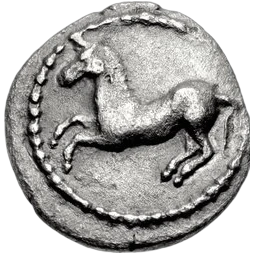
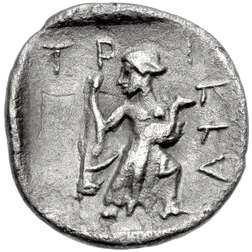
CNG, Triton XV (3 Jan 2012), lot 773 - CNG
- Obverse: Horse prancing left within dotted border; ΤΡΙ-ΚΚΑ (the final Α inverted)
- Reverse: Female figure in long chiton advancing right, head turned back, lifting her drapery with her right hand and holding a goose against her body with her left; graffito Π in left field; all within shallow incuse square
CNG catalogued this coin as Herkyna without qualification, citing Pausanias, and noted the reverse die link with Triton VII, lot 190.
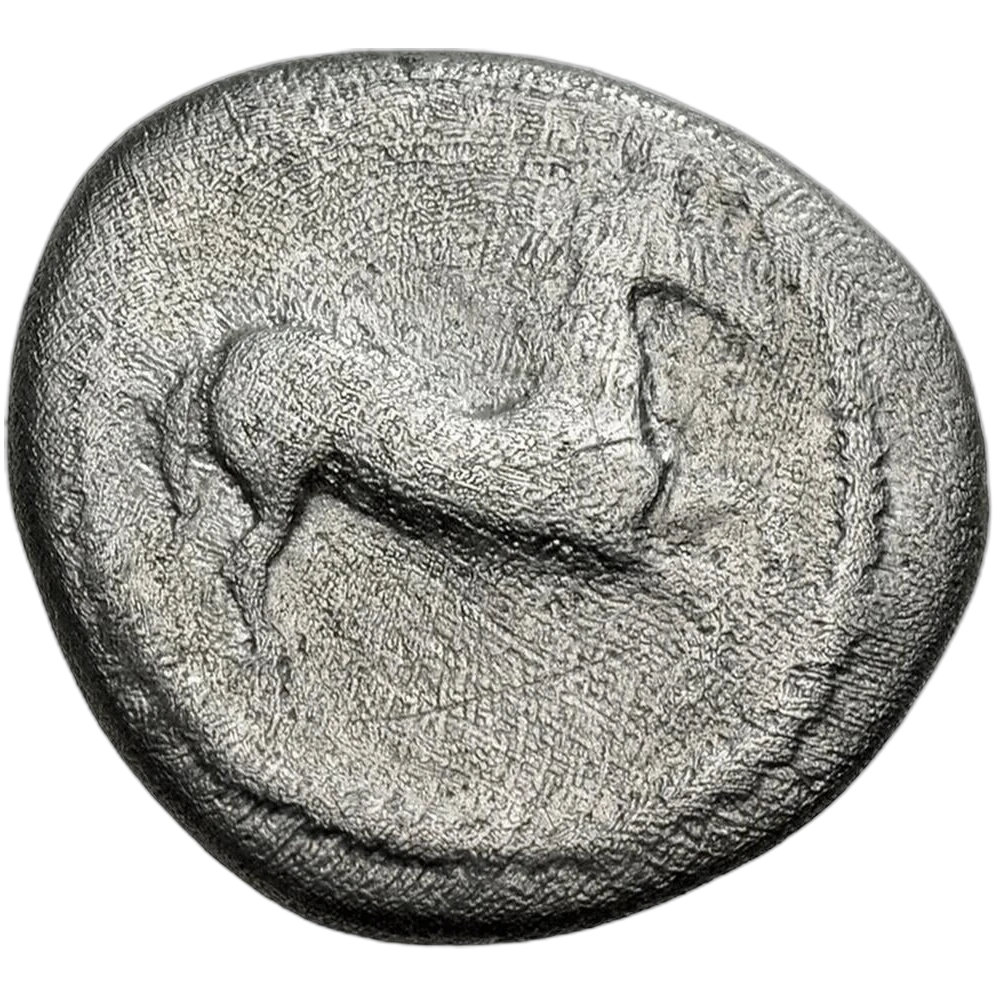
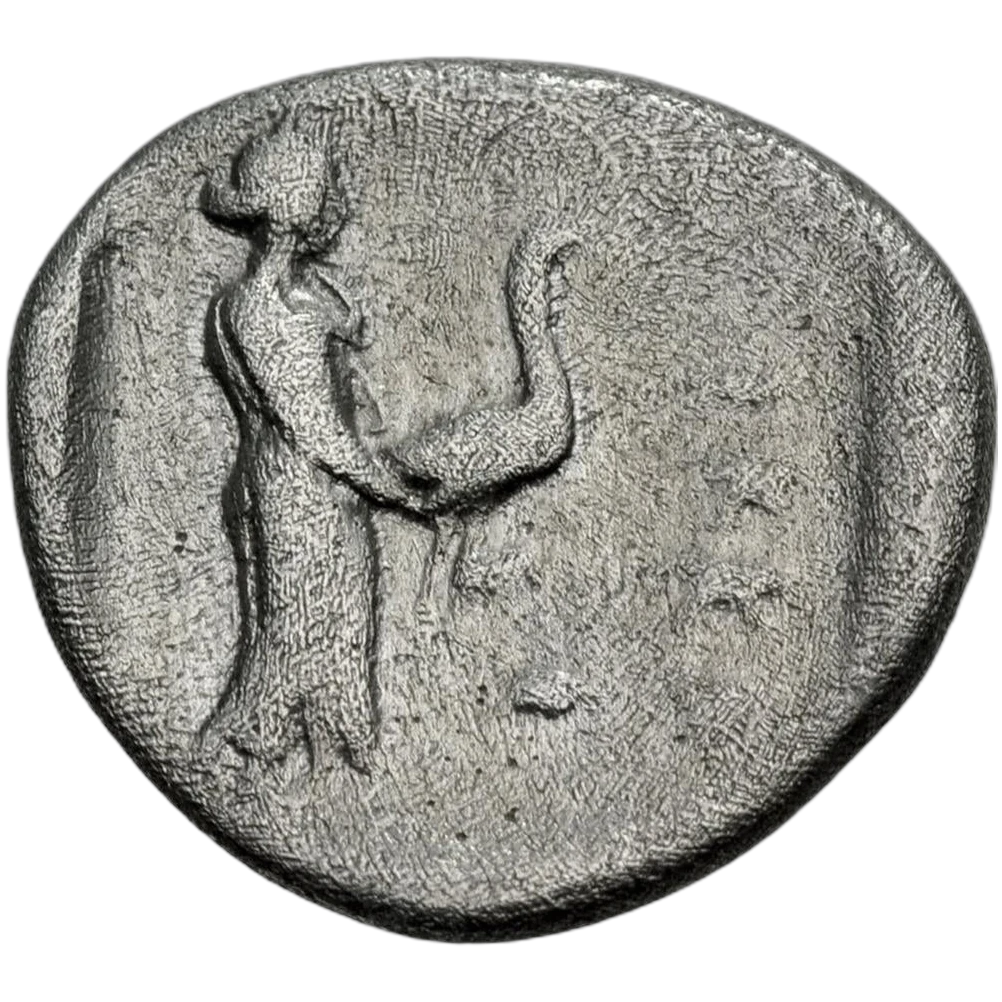
CNG, Electronic Auction 591 (16 Jul 2025), lot 78 - Numisbids
- Obverse: Horse leaping right
- Reverse: Female figure standing right, holding in both hands a goose right; [ΤΡ]-ΙΚΚΑ-[…] around; all within shallow incuse square
This is the best-preserved example of Type B. The bird is large, its neck in a pronounced S-curve, and it is held out from the body rather than clasped to the breast. By the date of this sale CNG had revised its description to "Hyrkyna or Epione."
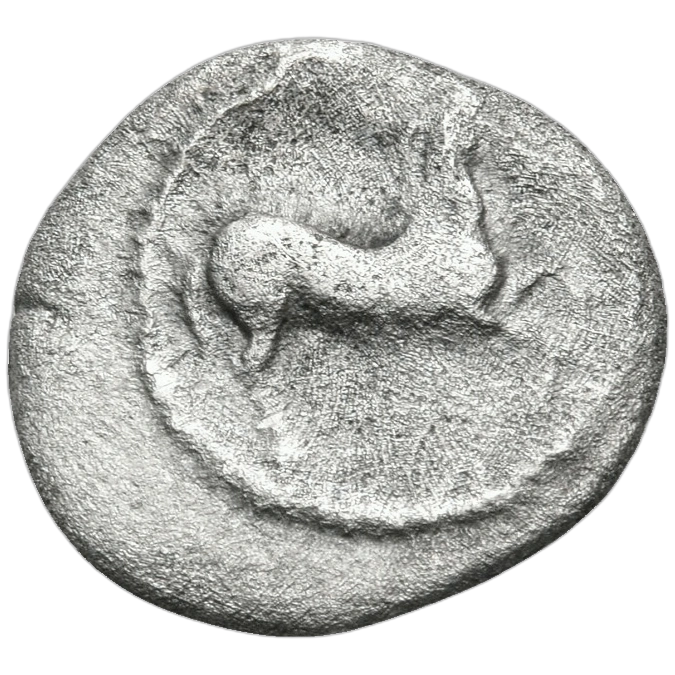
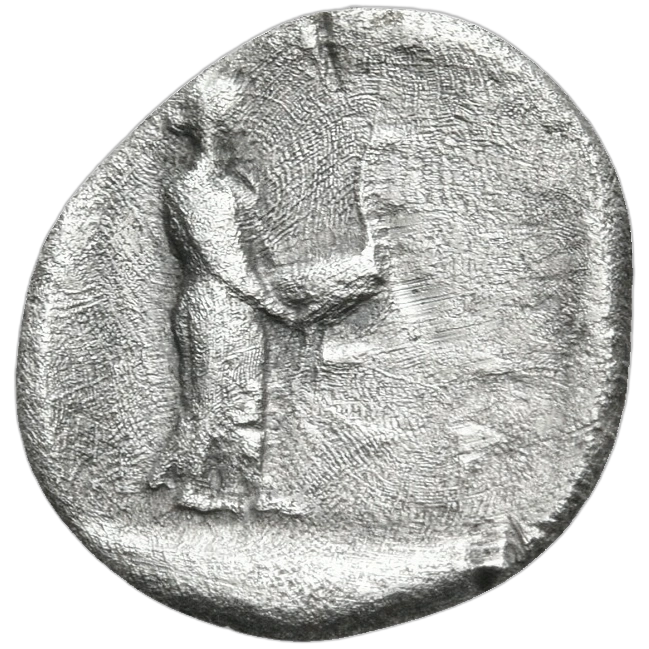
Nomos AG, obolos 43 (5 Jul 2026), lot 197; collection of the author - view coin page
- Obverse: Horse leaping right
- Reverse: Female figure standing right, holding in both hands a goose; [ΤΡ]-ΙΚΚΑ; all within shallow incuse square
The author's coin belongs to Type B but is a different specimen from the CNG piece. Nomos catalogued it as "Nymph (Hyrkyna or Epione)."
Three Candidates
Herkyna
Herkyna belongs to Lebadeia and the oracle of Trophonios. Her river rises at the springs beneath the oracle and flows through the modern town of Livadeia. Pausanias records both her myth and her cult image:
φασὶ δʼ ἐνταῦθα Ἕρκυναν ὁμοῦ Κόρῃ τῇ Δήμητρος παίζουσαν καὶ ἔχουσαν χῆνα ἀφεῖναι τοῦτον ἄκουσαν· ἐς δὲ ἄντρον κοῖλον ἐσπτάντος καὶ ὑπὸ λίθον ἀποκρύψαντος αὑτὸν ἐσελθοῦσα ἡ Κόρη λαμβάνει τὸν ὄρνιθα ὑπὸ τῷ λίθῳ κατακείμενον· ῥυῆναί τε δὴ τὸ ὕδωρ ὅθεν ἀνείλετο ἡ Κόρη τὸν λίθον καὶ ὀνομασθῆναι τὸν ποταμὸν ἐπὶ τούτῳ λέγουσιν Ἕρκυναν. καὶ ἔστι μὲν πρὸς τῇ ὄχθῃ τοῦ ποταμοῦ ναὸς Ἑρκύνης, ἐν δὲ αὐτῷ παρθένος χῆνα ἔχουσα ἐν ταῖς χερσίν.
Here they say that Herkyna, when playing with Kore, the daughter of Demeter, held a goose, which against her will she let loose. The bird flew into a hollow cave and hid under a stone; Kore entered and took the bird as it lay under the stone. The water flowed, they say, from the place where Kore took up the stone, and hence the river received the name of Herkyna. On the bank of the river there is a temple of Herkyna, in which is a maiden holding a goose in her arms.1
This is the passage cited by CNG for the Triton XV coin, and it constitutes the strongest argument for Herkyna: the goose appears both in her myth and in the arms of her cult statue. Little else is known of her. She was a figure of local cult at a Boeotian sanctuary.
Pausanias adds a further detail concerning the statues in the cave of the springs:
εἰσὶ δὲ ἐν τῷ σπηλαίῳ τοῦ ποταμοῦ τε αἱ πηγαὶ καὶ ἀγάλματα ὀρθά, περιειλιγμένοι δέ εἰσιν αὐτῶν τοῖς σκήπτροις δράκοντες. ταῦτα εἰκάσαι μὲν ἄν τις Ἀσκληπιοῦ τε εἶναι καὶ Ὑγείας, εἶεν δʼ ἂν Τροφώνιος καὶ Ἕρκυνα.
In the cave are the springs of the river and standing statues, and serpents are coiled about their sceptres. One might guess them to be Asklepios and Hygieia, but they might be Trophonios and Herkyna.1
Even at Lebadeia, therefore, the images associated with Herkyna could be read as members of the family of Asklepios. The ambiguity is ancient, but it does not bring Herkyna nearer to Thessaly.
The principal objection is one of distance. The springs of the Herkyna lie some 155 km in a straight line from Trikka, beyond Othrys, the Spercheios valley and the mountains of Phokis. No cult of Herkyna is attested in Thessaly, and no Thessalian river bears her name.
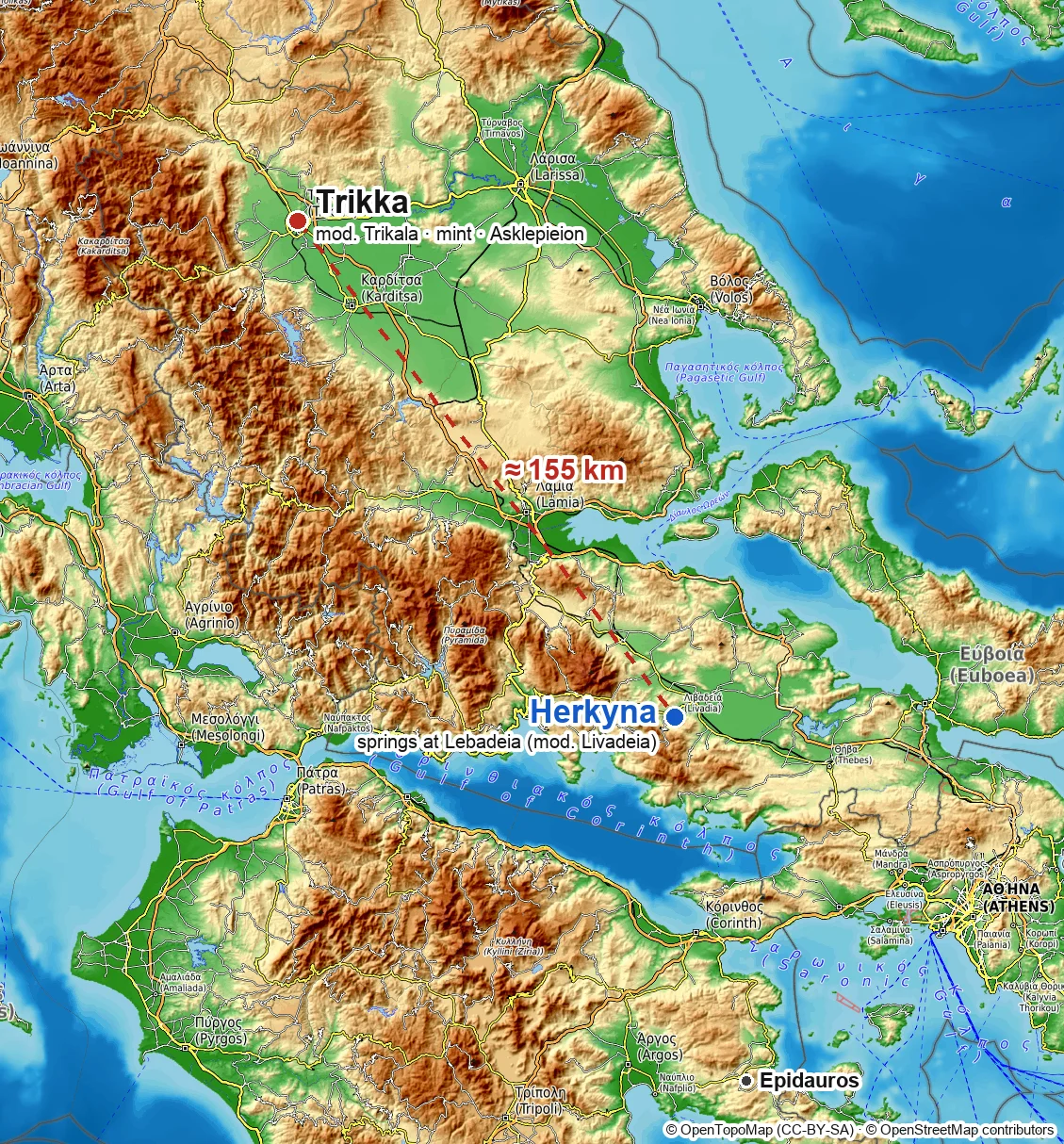
Trikka (modern Trikala) and the springs of the Herkyna at Lebadeia (modern Livadeia). Epidauros, the other great sanctuary of Asklepios, is shown for reference. Base map © OpenTopoMap (CC-BY-SA), data © OpenStreetMap contributors.
Epione
Epione was the wife of Asklepios and the mother of Hygieia, Panakeia and the physicians Machaon and Podaleirios. Unlike Herkyna, she is closely bound to Trikka through her family.
In the Catalogue of Ships, Homer names the sons of Asklepios as the leaders of the contingent from Trikka:2
οἳ δʼ εἶχον Τρίκκην καὶ Ἰθώμην κλωμακόεσσαν, … τῶν αὖθʼ ἡγείσθην Ἀσκληπιοῦ δύο παῖδε, ἰητῆρʼ ἀγαθὼ Ποδαλείριος ἠδὲ Μαχάων.
Those who held Trikka and rocky Ithome … were led by the two sons of Asklepios, the good healers Podaleirios and Machaon.
Strabo, commenting on the same line, places at Trikka the oldest and most celebrated sanctuary of the god:3
ἔστι δʼ ἡ μὲν Τρίκκη, ὅπου τὸ ἱερὸν τοῦ Ἀσκληπιοῦ τὸ ἀρχαιότατον καὶ ἐπιφανέστατον.
Trikka, where the most ancient and most famous temple of Asklepios is.
Elsewhere he reports the tradition that Asklepios was born beside the river Lethaios near Trikka (ὁ περὶ Τρίκκην, ἐφʼ ᾧ ὁ Ἀσκληπιὸς γεννηθῆναι λέγεται). Pindar makes the god's mother, Koronis, a Thessalian, εὐΐππου Φλεγύα θυγάτηρ, "daughter of Phlegyas of the fine horses," who lived παρὰ Βοιβιάδος κρημνοῖσιν, "by the banks of Lake Boibeis."4 Trikka was thus regarded in antiquity as the home of Asklepios and his house, and a member of that family is a natural subject for its coinage.
Epione is also associated with the goose. A votive relief from the Asklepieion on the south slope of the Athenian Acropolis (National Archaeological Museum 1377, now displayed in the Acropolis Museum; c. 350 BCE) shows Asklepios, Hygieia and a seated Epione receiving a procession of worshippers. The museum's description reads:
Epione is seated on a chair, holding most likely a phiale. The goose beneath her seat must be related to Asklepios' therapeutic capacity.5
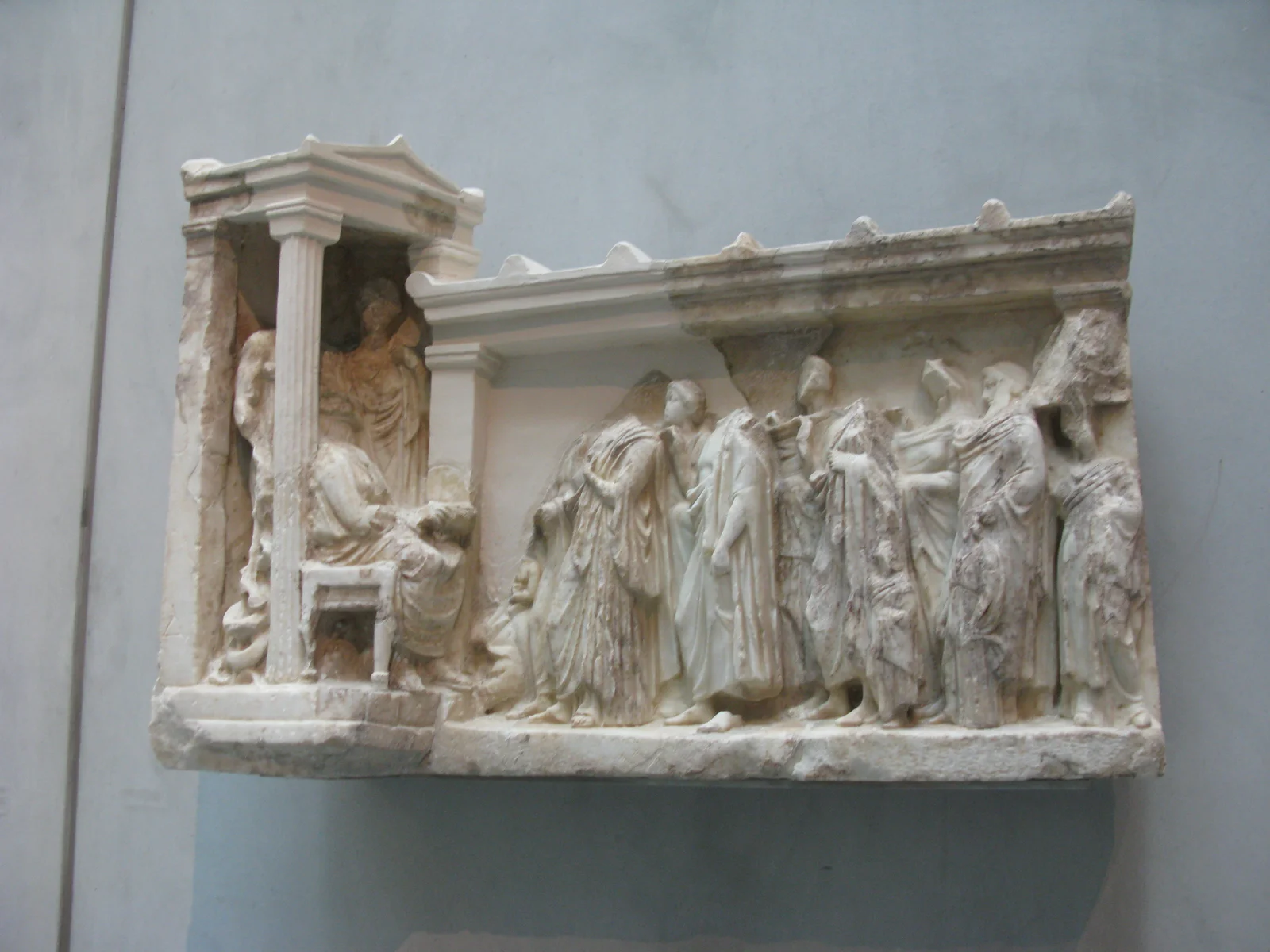
Votive relief from the Athenian Asklepieion, c. 350 BCE (NAM 1377). Epione is seated at left with the goose beneath her chair. Photo: Tilemahos Efthimiadis, CC BY-SA 2.0.
The goose therefore had a place in the imagery of the Asklepian family in the same period as the coins, and in the god's own sanctuary.
The relief appears, however, to be unique in this respect. None of the other reliefs commonly identified as including Epione shows a goose: the votive relief from Patras, the family relief from the excavation beneath the Acropolis Museum (M 1434), the relief with Asklepios seated on the omphalos (Acropolis Museum, c. 400 BCE), and the slab from Epidauros, NAM 1425. The identifications themselves are frequently tentative. NAM 1425 is described as "Asklepios with Epione or Hygieia," and has also been read as Zeus and Hera, while M 1434 is said to include "possibly Hygieia and Epione." Epione had no fixed attribute, and the goose of NAM 1377 remains a single instance.
A second image is sometimes adduced for Epione with a goose, but requires caution. The central acroterion of the west pediment of the temple of Asklepios at Epidauros (c. 380 BCE), a flying female figure holding a bird to her breast, is captioned by one photographic agency as "Epione, wife of Asklepios, holding a goose." The National Archaeological Museum identifies her as Nike holding a partridge.6 On that reading the statue associates a bird with the temple of the healing god, but it provides no evidence for Epione, and no weight is placed on it here.
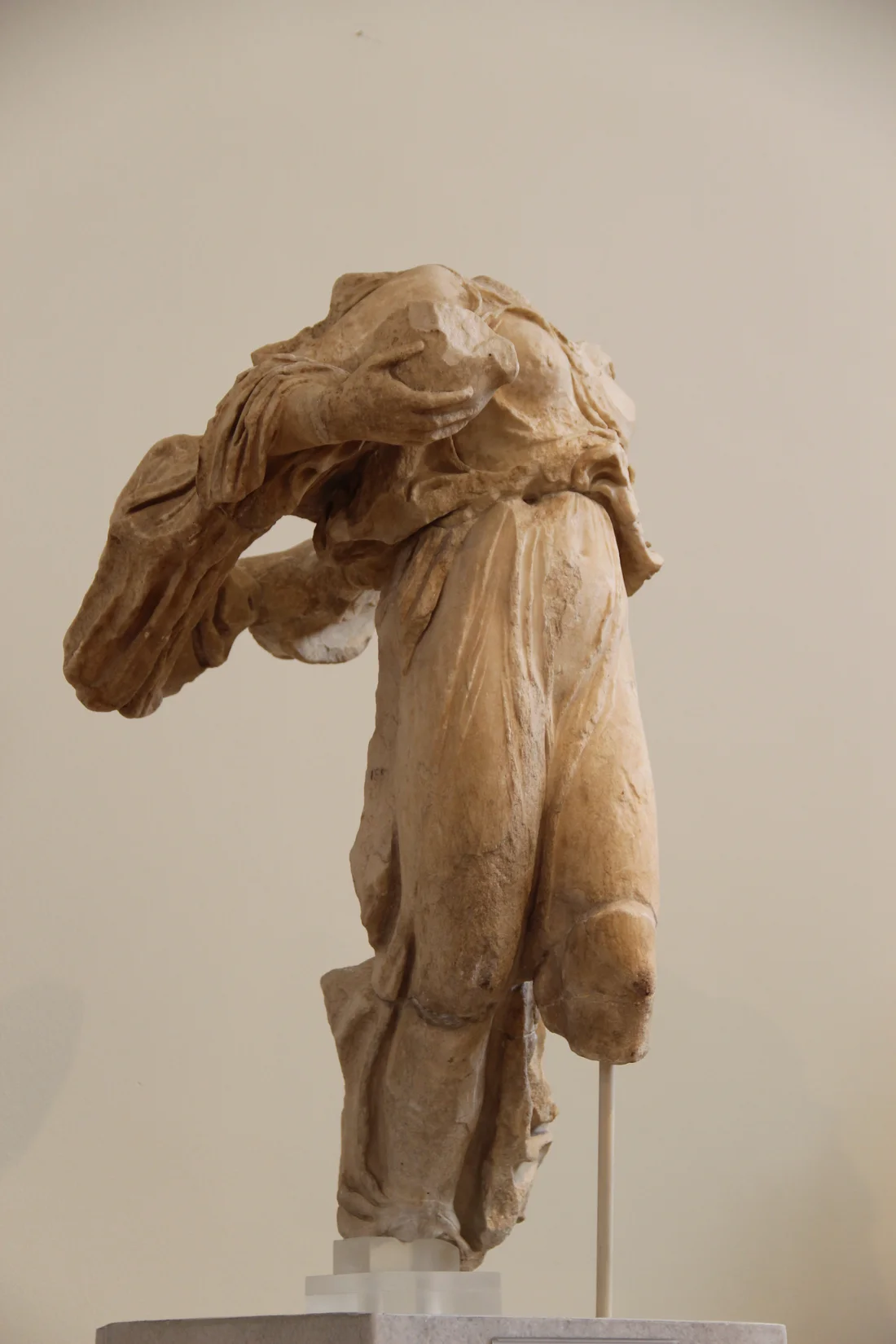
Acroterion from the temple of Asklepios at Epidauros, attributed to Timotheos, c. 380 BCE (NAM 155): Nike with a partridge, sometimes labelled Epione with a goose. Photo: Gary Todd, CC0.
Trikke
The third candidate is the eponymous nymph of the city. Stephanus of Byzantium records her:
Τρίκκη, πόλις Θεσσαλίας, ἀπὸ Τρίκκης τῆς Πηνειοῦ θυγατρός. τὸ ἐθνικὸν Τρικκαῖος.
Trikke, a city of Thessaly, named from Trikke, daughter of the Peneios. The ethnic is Trikkaios.7
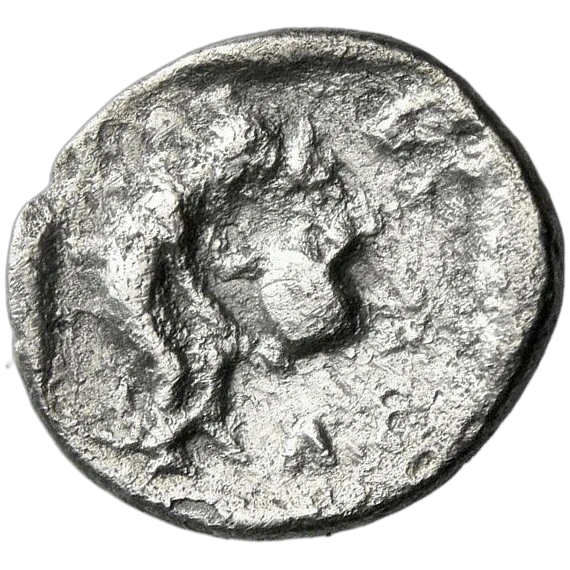
The Peneios is the river that flows past Trikka, and Trikke is accordingly a local water nymph in her own right. Unlike Herkyna or Epione, she appears regularly on the coinage of Trikka, frequently in small domestic scenes. Two coins in the author's collection, an obol and a trihemiobol, show her drawing water and holding a mirror:
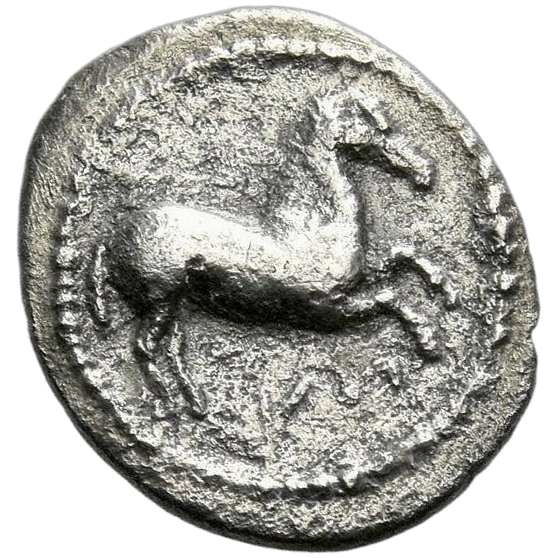
Collection of the author; ex BCD Collection (CNG Triton XV, lot 779) - view coin page
- Obverse: Free horse prancing right; below, ΥΕ (retrograde); border of dots
- Reverse: ΤΡΙ / ΚΚΑ. The nymph Trikke bending right, in long robes, balancing a hydria on her raised left knee under a lion's-head fountain spout with water running from its mouth


Collection of the author - view coin page
- Obverse: Thessalian horseman riding left, wearing petasos, chlamys and chiton, holding a long switch
- Reverse: ΤΡΙΚΚΑ. The nymph Trikke seated right on a stool with curved legs, holding a mirror in her left hand and a small box in her right
The fountain type has more than decorative significance. In drawing water at the city's spring, Trikke performs the characteristic office of a spring nymph, supplying water to her city. The type thus confirms that she was understood at Trikka as a nymph of the local waters, as befits a daughter of the Peneios.
A further obol, of the same date and module as the goose coins, shows her standing and bouncing a ball.8 The engravers of Trikka evidently favoured scenes of the nymph at the fountain, at her toilette and at play, and a figure holding a goose would sit comfortably within that series.
The later bronze coinage places Trikke and Asklepios on a single coin, her head on the obverse and the god on the reverse, seated and feeding a dove to his serpent:
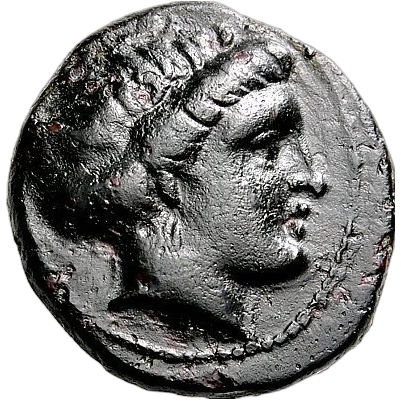
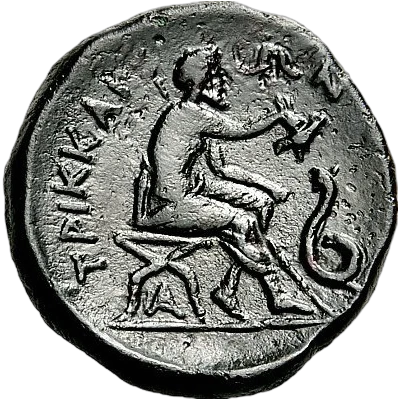
Nomos 4 (BCD Collection, 10 May 2011), lot 1358 - Nomos
- Obverse: Head of the nymph Trikke right, wearing pendant earring, hair in a roll
- Reverse: ΤΡΙΚΚΑΙ-ΩΝ. Asklepios, draped to the waist, seated right on a backless stool, holding a staff and a dove by its wings, feeding it to a snake coiled at right; below the stool, Α9
Here the bird is food for the serpent rather than an attribute of the god. The coin is nonetheless instructive, for it presents together the two principal figures of the city: its nymph and its god.
Conclusion
Since each candidate can be connected with a goose, iconography alone cannot decide the question, and the argument turns largely on locality. Herkyna has no attested connection with Trikka, whereas the city's principal cult was that of Asklepios. The pose of Type B points in the same direction: the woman stands motionless and holds the goose out in both hands, as a divinity presents an attribute, whereas in Herkyna's myth the goose escapes her during play. The livelier Type A, with its backward glance, accords better with that story, which may explain CNG's original identification. Even there, however, the goose is held securely rather than escaping.
Trikke remains the strongest alternative. The coinage of Trikka shows her at the fountain, with a mirror and with a ball, and a scene with a goose would not be out of place in that sequence. As a daughter of the Peneios, she has her own claim to a water bird. Against her, no text or image associates her with a goose, and the formal, presenting pose of Type B differs from the genre scenes of her other types.
The limits of the evidence must also be acknowledged. What is known of the mythology of Trikka derives from a few lines in Homer, Strabo and Stephanus. The goose figure may illustrate a local story, concerning Trikke or some other figure, that has not survived in the literary record. Herkyna herself is known chiefly because Pausanias visited Lebadeia, and his Description of Greece does not extend to Thessaly. An argument from silence cannot exclude a local myth.
CNG's description has moved from "Herkyna" (2012) to "Hyrkyna or Epione" (2025). Of these two, the local evidence favours Epione, although the support is slender: a single relief for the goose, and the city's cult for the place. Trikke is a serious alternative, and "female figure (Epione or Trikke?)" may be the most defensible description. On the same grounds, the Nomos description "Nymph (Hyrkyna or Epione)" suits only one of the two names it offers. Herkyna is a river nymph, while Epione is better described as a goddess, and "female figure" would accommodate both. "Nymph" is a common catalogue designation for unnamed female figures and is often accurate, but where the identification is open a neutral term is preferable. Finally, Pausanias spells the name Ἕρκυνα, "Herkyna"; the form "Hyrkyna" has no ancient authority.
Footnotes
Pausanias 2.29.1 (statues of Asklepios and Epione at Epidauros; see also 2.27.5, a statue of Epione inside the grove of the Asklepieion) and 9.39.2–3 (Herkyna). Greek text from the Perseus edition (Spiro, Teubner 1903); translation after W. H. S. Jones (Loeb). Available on Perseus.
↩Homer, Iliad 2.729–732. Line 730, omitted above, adds Oichalia, "city of Eurytos the Oichalian." Perseus.
The Thessalian location was contested in antiquity. The Messenians claimed the Asklepiadai for themselves, making Asklepios the son of Arsinoe, daughter of the Messenian Leukippos, and found a Trikka of their own (Pausanias 4.3.2):
καὶ γὰρ τοὺς Ἀσκληπιοῦ παῖδας στρατεῦσαί φασιν ἐπʼ Ἴλιον Μεσσηνίους ὄντας, Ἀρσινόης γὰρ Ἀσκληπιὸν τῆς Λευκίππου καὶ οὐ Κορωνίδος παῖδα εἶναι· καὶ Τρίκκαν τε καλοῦσιν ἔρημον ἐν τῇ Μεσσηνίᾳ χωρίον.
They say that the sons of Asklepios who went to Troy were Messenians, Asklepios being the son of Arsinoe, daughter of Leukippos, not of Koronis; and they call a deserted spot in Messenia Trikka.
Pausanias himself rejects the claim. At 2.26.7 he calls the Arsinoe genealogy the least credible of the stories about the god's birth. He quotes a Delphic oracle naming the mother as Φλεγυηὶς … Κορωνίς, "Koronis, daughter of Phlegyas," and says the Arsinoe version was inserted into the Hesiodic poems ἐς τὴν Μεσσηνίων χάριν, "to please the Messenians." The Messenian version also survived in local cult at Leuktra (3.26.4). The rivalry is itself instructive. To claim the sons of Asklepios, the Messenians were obliged to claim the name Trikka; they disputed not Homer's Trikka but its location, and their Trikka was a deserted site. Strabo regarded the Messenian cult as derived from the Thessalian: at Gerenia, where the Messenians showed Machaon's tomb, δείκνυται δʼ ἐν τῇ Γερηνίᾳ Τρικκαίου ἱερὸν Ἀσκληπιοῦ, ἀφίδρυμα τοῦ ἐν τῇ Θετταλικῇ Τρίκκῃ, "there is shown at Gerenia a sanctuary of Trikkaian Asklepios, an offshoot of the one in Thessalian Trikka" (Strabo 8.4.4).
↩Strabo, Geography 9.5.17, commenting on the same Homeric line; 14.1.39 (p. 647 Casaubon) for the birth on the Lethaios. At 8.6.15 he notes that the temple at Epidauros was full of tablets recording cures, καθάπερ ἐν Κῷ τε καὶ Τρίκκῃ, "just as at Kos and Trikka," placing Trikka among the principal healing sanctuaries. Pindar (Pythian 3.33–34) places Koronis at Lakereia and Pausanias (2.26) at Epidauros; the birthplace of the god was disputed, but the association of Trikka with the Asklepiadai was not. The Latin mythographer Hyginus gives both father and son the same origin: Asclepius Apollinis et Coronidis filius, a Tricca among the Argonauts (Fabulae 14.21), and Machaon Asclepii et Coronidis filius a Tricca among the Greeks at Troy (Fabulae 97.6). Perseus.
↩Pindar, Pythian 3.8 and 3.33–34; Koronis lived at Lakereia (ἐς Λακέρειαν, 3.33). Lake Boibeis (modern Karla) is in eastern Thessaly. In a rival tradition promoted by Epidauros, the god was born in the Argolid. Perseus.
↩Acropolis Museum, Relief in the form of a small temple and portico, inv. ΕΑΜ 1377 (National Archaeological Museum), Pentelic marble, c. 350 BCE, from the Sanctuary of Asklepios on the south slope.
↩National Archaeological Museum, Athens, inv. 155; N. Kaltsas, Sculpture in the National Archaeological Museum, Athens (2002): Nike holding a partridge, central acroterion of the west pediment. For the "Epione holding a goose" caption, see Bridgeman Images LRI4659721, which dates it to c. 400 BCE.
↩Trikka, AR obol, c. 440–400 BCE. Obverse: free horse trotting right. Reverse: ΤΡΙΚΚΑΙ-ΩΝ, Trikke standing facing, head left, in long drapery, bouncing a ball with her left hand. BCD Thessaly II (2012) 778.3; Traité 555. See WildWinds, Trikka. The ball-playing nymph is a familiar Thessalian obol type, best known at Larissa.
↩Trikka, Æ trichalkon, first half of the 4th century BCE. BCD Thessaly (Nomos 4, 10 May 2011), lot 1358; Rogers 552; SNG Copenhagen 267; SNG Munich 192; HGC 4, 336. In Nomos's description, Asklepios is "holding dove by its wings in his right hand, feeding it to a snake." BCD's own note adds that "it is possible that the scene may have some kind of ritualistic meaning rather than just showing a snake being fed."
↩