This English translation of Lauri Tudeer's Die Tetradrachmenprägung von Syrakus in der Periode der signierenden Künstler (1913) presents a groundbreaking analysis of the signed tetradrachms of Syracuse from the classical period. Tudeer's systematic study of die engravers' signatures, including the masters Euainetos, Kimon, Eukleidas, and Phrygillos, established the foundation for understanding artistic attribution in ancient Greek coinage. The complete illustrated catalog with coin images and die identifications is available as a companion resource. This constitutes the first online translation of Tudeer's work. Readers should also consult Wolfgang Fischer-Bossert's Coins, Artists, and Tyrants: Syracuse in the Time of the Peloponnesian War (ANS Numismatic Studies 33, 2017), which incorporates selected passages of Tudeer in a new English translation by Orla Mulholland, accompanied by a biography of Tudeer and over 100 pages of original scholarship on die links, epigraphy, imitations, hoard chronology, and the history of the field, making it the current standard reference on the subject.
Recent scholarship has further refined our understanding of the mint's organization and political context. Sebastiano Maltese (2022) argues that the Syracuse mint operated as a single unified workshop led by a group of master engravers, contra R. R. Holloway's earlier hypothesis of two parallel competing workshops, and connects the introduction of signed dies in the late 420s BCE to the democratic politics of the city's magistrates seeking public recognition. On this reading, the decline of signed coinage after c. 412 BCE reflects the reforms of Diocles and ultimately the rise of Dionysius I.
Selected references:
- R. R. Holloway, La struttura delle emissioni di Siracusa nel periodo dei signierende Künstler, Annali dell'Istituto Italiano di Numismatica 21-22 (1974/75)
- Wolfgang Fischer-Bossert, Coins, Artists, and Tyrants: Syracuse in the Time of the Peloponnesian War (ANS Numismatic Studies 33, 2017)
- Sebastiano Maltese, Maestri Firmanti (e Anonimi) a Siracusa. Cronologia e rete produttiva, in F. Nicoletti (a cura di), Siracusa Antica. Nuove prospettive di ricerca (2022)
Table of Contents
To my father and teacher, O. E. Tudeer, in love and gratitude
The coins of Syracuse have always attracted the interest of numismatists. Not only has the unusual size of the "medallions" brought this about, but also the beauty that distinguishes both these "medallions," i.e., the decadrachms, as well as the tetradrachms, particularly those of the flourishing period. It is scarcely worthwhile to provide here a reasonably complete list of those authors who have dealt with the coinage of Syracuse and especially with the signed coins of the flourishing period, for it would mainly be just a repetition of the index in Evans' "Syracusan Medallions and their engravers" (Num. Chron. 1891 pp. 205–376) pp. 206–208. The more important studies, insofar as they still have significance, will be mentioned in the course of the following investigation.
We have mentioned the epoch-making investigation by A. J. Evans and must therefore explain why it has once again been necessary to subject the tetradrachm coinage of Syracuse in its flourishing period to a new examination. It may seem that the question of how these coinages are to be arranged chronologically and evaluated artistically has been exhaustively treated in Evans' work; but as emerges from the literature that appeared later, some questions have remained open and unanswered. Thus Regling[1] draws attention to the fact that it has not yet been definitively established whether the signatures EYMHNOY and EYMENOY derive from one and the same die-cutter, as Evans believed, or whether we are not dealing with two different artists. The chronological question of when the new style began is answered differently by Holm[2] and Headlam[3] than by Evans, without their having, however, completely worked through the material to answer it. Some tetradrachm types that have become known later may also be of significance for the question of tetradrachm coinage. It therefore seems appropriate to subject the tetradrachm coinage in Syracuse during the period of artistic flowering to a thorough examination once more. This is attempted here with the inclusion of all accessible material, going back to the dies as far as possible and thus placing the investigation on firmer ground and a broader basis.
The investigation comprises 694 specimens (nos. 1–106) of Syracusan tetradrachms together with 4 specimens (nos. 107–109) of imitations and 11 specimens (nos. 110–113) of subaerate, apparently Syracusan tetradrachms, all of which I have examined either in the original, as casts, or in photographic reproduction. I was able to examine the originals in the collections at Berlin, Dresden, Gotha, London, and Paris. The casts that served as models for the plates of the more recent catalogs by Dr. Hirsch, the Egger Brothers, and some others have come to the Berlin Cabinet as gifts from the gentlemen concerned and could be used by me there. Casts and other communications from the collections at Aberdeen, Athens, Berlin, Boston, Brussels, Cambridge, Dresden, Glasgow, Gotha, The Hague, Copenhagen (Royal Cabinet and Thorvaldsen Museum), London, Munich, New York, Paris, Rome-Vatican, St. Petersburg, Syracuse, Vienna were sent to me in the customary gracious manner by Messrs. Gilroy, Svoronos, Dressel and Regling, Caskey, Alvin, Mc Clean, Schwinkowski, Macdonald, Pick, Dompierre de Chaufepié (†), Jørgensen, Grueber and Hill, Riggauer (†), Miss Richter, Babelon and de la Tour, Serafini, Markow and Retowski, Orsi, Kubitschek, those from the possession of Dr. Giesecke in Leipzig, Jameson in Paris, Oman in Oxford, Baron Pennisi di Floristella in Acireale, Sir H. Weber in London, State Councillor Yakountchikoff in St. Petersburg by the owners.
I am under great obligation of gratitude to the gentlemen named and especially to the directors of the Coin Cabinet in Berlin, Prof. Dr. Menadier and Prof. Dr. Dressel. My teacher, Dr. Regling, deserves my best thanks for the tireless kindness with which he has guided and accompanied my work both during my studies in Berlin and also later.
As Rs. I have designated, contrary to older custom and following the example of Hill and Regling, the concave side of the coin struck with the upper die; in some cases I have also used the designations chariot side and head side.
Since epigraphic fidelity in the reproduction of inscriptions cannot be achieved with printing types, uniform types (e.g., K, ) have been chosen instead of the different forms of letters; however, V and Y, large and small O and Ω, are distinguished and several forms are used for the so multiform N.
The dolphins that surround the head invariably turn their belly inward, where the contrary is not noted. — As the first horse I designate that which is nearest to the viewer. — The inscriptions on the coins are to be read from the inside, unless the contrary is noted. — The coins united under one (bold-printed) number are die-identical on both sides; the Vs. dies are numbered again with ordinary figures, the Rs. dies with italic numerals.
| A. = Section. | Z. = Drawing (after the citation of the illustration; all illustrations without Z. are mechanical). |
| Bdl. = Ground line. | v. l. = from left. |
| Pkr. = Pearl circle. | v. r. = from right. |
| Rs. = Reverse. | |
| Vs. = Obverse. |
The index of literature (cited in abbreviated form in the coin description) is found at the end of the coin description.
Head to the left. Hair arrangement of the same type as on 1 and 2, only the ridge at the nape smaller and the ampyx decorated with a zigzag line. The iris visible in the eye. The eyelashes on the upper eyelid indicated by a line in the inner corner of the eye. The ear uncovered with double earring. At the neck a cord decorated with 6 hanging pearls. — Two dolphins turned away from each other above the front of the head, one to the right in front of the chin, one to the right at the nape.
Head to the left. Hair arrangement of the same type as on 1 and 2. The eyelids narrow, the iris visible in the eye. The eyelashes on the upper eyelid indicated by a line in the inner corner of the eye. The ear uncovered with hook-shaped earring. At the neck a simple cord. — Two small dolphins facing each other in front of the face, two likewise at the nape beginning from the neck junction.
Head to the left. Almost like on 4, but in higher relief. — Two dolphins facing each other in front of the face, one to the right at the nape, one upward behind the head.
Head to the left. Almost like on 3, only the curls at the nape and the nose longer. At the neck a simple cord.
Head to the left, smaller than on the preceding. The hair bound with a crossing band, the lock tips free and richly flowing forth. The eyelids broad and distinct. The iris visible in the eye. Hook-shaped earring. At the neck a plain cord. — Two dolphins downward in front of the face, the third below the neck junction to the right, the fourth downward at the nape.
Head to the left of the same type as on 7, but small curls at the hairline, on the forehead and at the nape. The iris visible in the eye. The eyelashes on the upper eyelid indicated by a line in the inner corner of the eye. — Two dolphins facing each other in front of the face, the third below the neck junction to the right, the fourth downward at the nape.
Head to the left of the same type as on 7, almost like on 8, but somewhat smaller. The locks richer and longer except at the nape. The iris visible in the eye. The eyelashes on the upper eyelid indicated by a line in the inner corner of the eye. — In the position of the dolphins only very small variations from 8.
Head to the left, of the same type as on 7. The locks are somewhat shorter, several hanging at the nape. The band bound around the head cuts in more deeply. The eyelids less strongly protruding. The eyelashes on the upper eyelid indicated by a line in the inner corner of the eye. Double earring. At the neck a plain cord. — All four dolphins to the right, otherwise as on 8 and 9.
Head facing left, larger and broader than in the preceding type. Hair wavy, emanating symmetrically from the crown, rolled up at the nape, gathered above the temple into two parallel braid-like locks that extend from above the ear to the forehead. Two loose locks at the nape. The eyelids very distinct. The eyelashes visible on the lower eyelid. The iris visible in the eye. Hook-shaped earring. Simple cord around the short and strong neck. — Two dolphins facing each other before the face, the third facing right under the neck section, the fourth facing right at the nape.
Head facing left, somewhat smaller than on 12. Hairstyle of the same type, but more projecting and lower at the nape. The eye almost in frontal view. The eyelids broad and distinct, the upper one appearing as if applied afterward; the eyelashes visible on the lower, indicated on the upper by a stroke in the inner corner of the eye. The lips strongly formed. Hook-shaped earring. The neck longer and narrower, with simple cord. — The dolphins all facing left, arranged one after another in a circle.
Head facing left. The hair gathered in the same manner as on 12 and 13, but without the long locks at the temple, and much richer, with small curls at the hairline, at the temple and at the nape, as well as lock tips protruding from the head. Iris visible in the eye. The eyelashes visible on the lower eyelid, indicated on the upper by a stroke in the inner corner of the eye. The ear covered by hair with double earring. The lips strong. On the neck simple cord. — The dolphins all facing left, arranged one after another in a circle, extending from the forehead to the hair roll at the nape.
Head facing left. The hair rolled up at the nape in two parts, held together by a broader and a narrower band that cross each other. In the eye the iris visible. The eyelashes visible on the lower eyelid, indicated on the upper by a stroke in the inner corner of the eye. The lips strong. The ear half concealed, with hook-shaped earring. On the neck simple cord with simple pendant. — Two dolphins facing each other before the face, one under the neck section facing right, one downward at the back of the head.
Head facing left, the hair gathered in the same manner as on 12, 13, but without the long locks at the temple, thus as on 14, however simpler than on this one and without small curls at the hairline. The eye small with visible iris. The eyelashes on the upper eyelid indicated by a stroke in the inner corner of the eye. The ear uncovered, with hook-shaped earring. The lips narrow. On the neck pearl necklace. — Two dolphins facing each other before the head, two likewise at the nape.
Head facing left, larger than on 16. The hair gathered in a roll at the nape in the same manner as on 16, but concealing the ear. The eyelashes on the upper eyelid indicated by a stroke in the inner corner of the eye. Hook-shaped earring. Simple necklace. — Before the face two dolphins facing each other, two likewise at the nape.
Head facing left, smaller than on 17. Hairstyle as there. Small curls at the hairline. The iris visible in the eye. The eyelashes on the upper eyelid indicated by a stroke in the inner corner of the eye. Double earring. — Before the mouth two dolphins facing each other, one facing left before the forehead, one facing right at the nape.
Head facing left almost like 18, but the small curls at the hairline are missing. Hook-shaped earring. — Before the face two dolphins one behind the other downward, under the neck section one facing right, one likewise at the nape.
Head facing left. The hair gathered at the back in sphendone, whose ribbons are tied together in front. In front double ampyx. At the back of the head curls emerge from the sphendone; the curls at the temple are brushed upward over the sphendone band. The iris visible in the eye. The ear half concealed, with hook-shaped earring. Simple neck cord. — Two dolphins facing each other before the face. Two likewise at the nape.
Head facing left almost like on 17. The iris visible in the eye. The eyelashes on the upper eyelid indicated by a stroke in the inner corner of the eye. The ear half concealed, with hook-shaped earring. — Two dolphins facing each other before the face, one downward before the front of the head, one facing right at the nape.
Head facing left, of the same type as on 17–19. Small curls at the hairline. Iris visible in the eye. The eyelashes on the lower eyelid likewise, on the upper, thick, eyelid indicated by a stroke in the inner corner of the eye. The ear half concealed, without ornament. On the neck simple cord. — Two dolphins facing each other before the face, one facing right under the neck section, one facing right at the nape.
Head from l. Hairstyle of the same type as on 20 with ampyx and sphendone. The ampyx decorated with swan and on the lower border with zigzag line, on the sphendone two eight-rayed stars and on the lower border EVKΛEI. The iris visible in the eye. The eyelashes on the upper eyelid indicated by a stroke in the inner corner of the eye. The ear uncovered, with hook-shaped earring. Pearl necklace on the neck. — Two dolphins facing each other before the face, two likewise on the neck.
Head from l. Hairstyle with ampyx and sphendone of the same type as on 20 and 23. On the ampyx dolphin from l. over 3 waves, on the sphendone 3 eight-rayed stars. The iris visible in the eye. The ear uncovered, with hook-shaped earring. Pearl necklace on the neck. — Two dolphins facing each other before the face, two likewise on the neck. The dolphin before the mouth shows its belly half-turned toward the viewer, whereby both pectoral fins become visible.
Head from l. Hairstyle with roll of the same type as on 14 and others, with small curls at the hair border. The iris visible in the eye. The eyelashes on the upper eyelid indicated by a stroke in the inner corner of the eye. The ear almost uncovered, with double earring. Simple neck chain. — Two dolphins facing each other before the face, one from l. above the head, one from r. on the neck.
Head from l. The hair with sphendone knotted at the front, which is decorated with eight-rayed stars, and ampyx, which is decorated with an eight-rayed star and on the lower border with zigzag line. The curls at the temple combed upward over the ampyx. The iris visible in the eye. The eyelids as if applied afterwards and the eyelashes on the upper eyelid indicated by a stroke in the inner corner of the eye. The ear rather covered, with double earring. Pearl necklace on the neck. — Two dolphins facing each other before the face, two one behind the other on the neck and at the back of the head.
Head from l. The hair gathered in a cloth decorated with two six-rayed stars, which is knotted at the front of the head. At the forehead ampyx, which is decorated with star and on the lower border with zigzag lines. Curls emerge at the crown, at the temple the curls are combed upward over the ampyx. The iris visible in the eye. The eyelashes on the upper eyelid indicated by a stroke in the inner corner of the eye. The ear rather covered, with double earring. Pearl necklace on the neck. — Two dolphins facing each other before the face, two one behind the other downward on the neck and at the back of the head.
Head from l. The hair gathered at the nape into a roll and decorated with a wreath of grain ears, poppy, oak leaves and acorns. The iris visible in the eye. The eyelashes on the upper eyelid indicated by a stroke in the inner corner of the eye. The ear covered, with hook-shaped earring. Simple neck chain with pendant in the form of a lion's head. — Two dolphins one behind the other upward before the face, two likewise downward on the neck and at the back of the head.
Head from l. The hair simply rolled into a roll, with wreath of grain ears, poppy and oak leaves. The iris not visible in the eye. The ear uncovered, with hook-shaped earring. Simple neck chain with pearl-shaped pendant. The neck truncation rounded downward. — Two dolphins facing each other before the face, one from r. above the head, one downward on the neck.
Head l. with sphendone and ampyx. The sphendone decorated with four six-rayed stars. Individual locks emerge from the sphendone, the locks at the temples are combed upward over the ampyx. The iris visible in the eye. The ear partially covered, with ear ornament in the form of three pearls of different sizes hanging from one another. Simple cord at the neck. — Two dolphins one behind the other downward before the face, one l. above the head, one r. at the nape.
Head l. of the same type as on 16, only smaller. No locks emerge from the sphendone. The iris not indicated. Without necklace. — One dolphin downward before the face, three one behind the other downward behind the head from the crown to the neck section. Circular border.
Head l., of the same type as on 18. The sphendone decorated with stars. — Two dolphins facing each other before the face, two one behind the other downward behind the head.
Head l. The hair gathered in sphendone, which is tied in front, and ampyx, the lower edge of both decorated with zigzag line, the sphendone with dots arranged in groups of 4 and 5. Rich locks emerge from the sphendone; the locks at the temple are combed upward over the ampyx. The iris visible in the eye. The eyelashes at the upper eyelid indicated by a line in the inner corner of the eye. Ear half covered, with ear ornament consisting of a large ring with 5 pendants. At the neck simple cord with pearl-shaped pendant. — One dolphin downward before the face, one likewise at the nape, one emerging from under the neck section l., under the chin a fourth dolphin r., with belly facing outward, on whose back EYKΛEI.
Head in frontal view somewhat l., with helmet. The helmet has a high crest and upturned side flaps and is decorated with palmette ornaments, the upturned visor with palmette between tendrils. The hair flows in long locks from under the helmet, covering the ears. The iris and pupil visible. The earring double. The neck ornament has acorn-shaped pendants and in the center a pendant in the form of a lion's head. — On the left two dolphins one behind the other downward, on the right one downward, one upward emerging from the locks. Circular border.
Head facing, of the same type as on 36, somewhat more l. The ear ornament not visible. — On the left two dolphins one behind the other downward, the lower one turned outward; on the right two dolphins likewise, the lower one emerging from the locks.
Head r. The hair gathered on the crown into a tuft. The iris visible in the eye. The eyelashes at the upper eyelid indicated by a line in the outer corner of the eye. The ear uncovered, with ear ornament (ring with 3 pendants). At the neck simple cord. — Two dolphins one behind the other downward before the face, one downward at the nape, one r. emerging from under the neck section. Circular border.
Head r. of the same type as 38–39, but somewhat larger, nose and chin stronger. Different hair treatment. The iris not indicated.
Large head to the right. The hair in ampyx and sphendone, which is tied in front and decorated with four-rayed stars. Locks emerge from the sphendone. The locks at the temple are combed upward over the ampyx. The iris visible. The ear partially covered, with double earring. At the neck cord with six pearls. — Two small dolphins one behind the other downward before the face, one behind the head downward, one downward (belly to the right) emerging behind the nape. Circular border.
Head to the right, almost as on 41, but smaller. Nine pearls on the necklace. Somewhat different position of the dolphins.
Head to the right, strongly resembles 41, but the lower edge of the sphendone is decorated with zigzag line, the locks are considerably richer. — Two dolphins one behind the other downward before the face, one downward emerging from the sphendone, one downward at the nape, with belly turned outward. Circular border.
Head to the right. The hair at the nape in long locks, gathered at the temple and swept upward, with wreath of grain. Iris in the eye not visible. The ear partially covered, with double earring. At the neck cord with hanging pearls. — Two dolphins one behind the other downward before the face, two likewise behind the head.
Head to the left. The hair rolled up at the forehead and at the temples, part of the headband visible. The locks at the nape flow freely, rather short. The iris visible in the eye. The ear partially covered, with simple earring. At the neck plain band with pendant. — One dolphin to the right under the chin, two one behind the other to the left under the neck section and at the nape, all with belly facing outward. Circular border.
Large head to the left. The hair in ampyx and sphendone, which is tied in front and decorated with three eight-rayed stars. Short locks emerge from the sphendone. The locks at the temple swept upward over the ampyx. The iris not indicated. The ear uncovered, with double earring. At the neck plain cord. — Three dolphins one behind the other downward before the face, one to the right behind the nape.
Head to the left, rather large. The hair in ampyx and sphendone, the lower edge of which is decorated with zigzag line. The iris visible in the eye. The ear uncovered with double earring. At the neck band with four pearl-shaped pendants. — Two dolphins one behind the other downward before the face, one downward emerging from the sphendone, one, with belly facing outward, behind the nape downward.
Head to the left, smaller than on 46 and 47. The hair in sphendone and ampyx as on 46, except that the sphendone is decorated with dots arranged in groups of four and five. The locks combed over the ampyx richer. The iris visible. The ear uncovered, decorated with earring with three pendants attached to a crossbar. At the neck band with six pearls. — Two dolphins facing each other before the face, two one behind the other downward behind the head. Under the neck section small bearded satyr head to the right. Circular border.
Head to the left. The hair in sphendone and ampyx as on 48, but the sphendone is richly decorated with eight-rayed stars. The iris visible in the eye. The ear uncovered, with ear ornament in the form of a crossbar with three pendants. At the neck band with eight pearls. — Two dolphins facing each other before the face. One dolphin to the right emerging from under the neck section, one behind the nape downward, these two with belly facing outward. Circular border.
Head to the left, almost as on 49, but small variations in the arrangement of the locks, the formation of the eye and the position of the dolphins.
Head to the left, almost like 50, but somewhat smaller. The sphendone is decorated in the same manner, but the knot on the headband is missing. The iris in the eye not visible. On the neck, cord with six pearls. The position of the dolphins slightly different from 50.
Quadriga to the left in three-quarter view. The head of the third horse is turned backward, that of the fourth somewhat raised. The horses' legs arranged in lively manner. The chariot body in three-quarter view, the rear wheel visible between the horses' legs. The charioteer almost upright, head turned backward in three-quarter view with flowing hair, in l. hand three reins, in the outstretched r. two reins and the almost horizontally held goad. Beneath the forelegs of the horses an overturned pillar (?). — Nike from the right in vertical posture, wreath in hands, crowning the charioteer. — Simple exergue line. In the field, ear of grain to the left. Linear border.
Head from l. with broad band resembling a sphendone at the back, decorated with dots in star-shaped groups. The locks at the temple combed upward over the band. The iris in the eye not indicated. The ear partially covered, with double earring. On the neck simple cord with pearl-shaped pendant. — Two dolphins one behind the other downward before the face, one upward from the neck to the mouth, one downward at the nape. Linear border.
Head from l. Hair in ampyx and sphendone, knotted in front and decorated with dots in star-shaped groups. On the lower edge of the ampyx a zigzag line. A few locks spill forth from the sphendone; the locks at the temple are combed upward over the ampyx. The iris visible in the eye. The ear almost uncovered, with ear ornament in the form of a crossbar with three pendants. On the neck simple cord with pearl-shaped pendant. — Two dolphins one behind the other downward before the face, two likewise behind the head, the lower one at the nape emerging from beneath the sphendone. Linear border.
Head from l. Hair in ampyx and sphendone, knotted in front and richly decorated with stars. Some locks spill forth from the sphendone. The locks at the temple combed upward over the ampyx. The iris and pupil visible. The ear partially covered, with ear ornament of the same form as 56. On the neck simple cord. — Two dolphins facing each other before the face; one downward behind the head, one from r. emerging beneath the neck section, these two with belly facing outward.
Head from l. Hair in sphendone knotted in front and ampyx, whose lower edge is decorated with zigzag lines; the sphendone is decorated with dots in groups of four and five. A few locks spill forth from the sphendone. The locks at the temple are combed upward over the ampyx. The iris visible in the eye. The ear partially covered, with double earring. On the neck simple cord with pearl-shaped pendant. — Two dolphins facing each other before the face, one downward behind the nape, one downward before the front of the head. Linear border.
Head from l., almost like on 58, but somewhat smaller, and with minor variations. — The position of the dolphins slightly different. — The scroll with the name is absent.
Head from l. with broad band, which is knotted in front and decorated with various stars. The hair swells forth in rich curls upward, the curls at the temple are combed upward over the band. The iris visible in the eye. The ear partially covered, with double earring. On the neck simple cord with pearl-shaped pendant. — Three dolphins before the face, of which two one behind the other downward, the lowest, third, upward; one dolphin behind the nape downward. Linear circle.
Head from l., closely resembles 60, but the band at the nape is broader, the forehead knot is missing. — In the position of the dolphins small differences. — No inscription under the neck section.
Head from l. of the same type as on 60. The band considerably narrower and double at the nape. The iris visible in the eye. — In the position of the dolphins small differences. Linear circle.
Head from l. of the same type as on 60. The band considerably narrower, double at the nape. The iris not visible. — The dolphins as on 62.
Head from l. as on 63. The eye set deeper. The band around the hair and the position of the dolphins varying somewhat. Linear circle.
Head from l. of the same type as on 60. The band around the head double at the nape, the upper layer half covered by the lower. Deviations from 64 in the curls and in the position of the dolphins. The neck section more curved inward. Linear circle.
Head from l. of the same type as on 60. The band around the head double at the nape. The iris visible. The ear partially covered, with double earring. — The position of the dolphins varying somewhat from 65.
Head from l. of the same type as on 60. The band around the head double at the nape, but narrower than on 66. Deviations from 66 in the treatment of the curls and in the position of the dolphins. The neck section more curved inward. Linear circle.
Head from l., of the same type as on 60. Slight deviations from 67 in the hairband, in the curls and in the position of the dolphins. Linear circle.
Head from l. of the same type as on 60. The band at the nape more softly formed, double, otherwise only small deviations from 68 in the curls and in the position of the dolphins. Linear circle.
Head from l. of the same type as on 60. Slight deviations from 69 in the hairband, in the treatment of the curls and in the position of the dolphins. Linear circle.
Head from l. of the same type as on 60. The band at the nape narrow and single. The iris visible. Otherwise only minor deviations from 70 in the treatment of the curls and in the position of the dolphins. Linear circle.
Head from l. The hair in ampyx and netted sphendone, which is knotted in front. The curls at the temple combed upward over the ampyx. The iris and the pupil visible. The ear partially covered, with ear ornament in the form of a double pearl. Pearl necklace. — Two dolphins facing each other before the face, one downward behind the nape, one from l. under the neck section, with the belly outward. Dotted circle.
Head from r. The hair at the nape gathered into a roll, at the temple brushed upward (of the same kind as 15 and 25). The eye elongated. The ear partially covered, with double earring. On the neck simple cord. — Two dolphins facing each other before the face, one above the head from r., one downward behind the nape.
Head from r. of the same type as on 74. The iris and the pupil visible in the eye. The ear uncovered, without ornament. — Two dolphins one behind the other downward before the face, two likewise behind the head.
Head from l. with sphendone and ampyx, of the same type as on 23. The nose is more pointed, all forms thinner and somewhat blurred. The iris visible. The position of the dolphins somewhat different.
Head to left. The hair held together by crossing bands, in the same manner as on 15. The iris coarse, visible. The earring perhaps hook-shaped. On the neck a simple cord with pendant. — Two dolphins facing each other in front of the face, one below the neck line to right, one at the back of the head downward.
Head to left, almost as on 25, but the small curls at the hairline at the temple are missing, also other minor deviations and the entire execution coarser.
Head to left. The hair in a roll at the nape, with wreath of grain. Very close in arrangement as well as in the position of the dolphins to 29, only somewhat coarser.
Head to left with sphendone and ampyx. Very close in arrangement as well as in the position of the dolphins to obverse die 16.
In the literature there are references to several more coins from this period, which I could not include in the actual catalogue, however, because I knew them neither from casts nor from adequate illustrations. Yet they cannot be left completely unconsidered, and so they shall be listed here for the sake of completeness.
Especially in reviewing the older numismatic literature, we often encountered illustrations of otherwise unknown Syracusan coins. A more precise examination of these illustrations, for example in Paruta[14] and still in Castellus (Torremuzza)[15], shows however that even the drawings of coins that could be identified with certainty were executed with the greatest inaccuracy not only in the overall style, but also with respect to details, and this inaccuracy makes it probable that known coins lie behind illustrations that seem quite unfamiliar. I have therefore completely refrained from considering the coins illustrated in Torremuzza and his predecessors here, apart from individual cases where conjectures are still based on such illustrations in the most recent literature.
From the more recent literature, several descriptions of tetradrachms not supported by illustrations must be briefly treated here:
To the coins with ΦPY on the ampyx is connected No. 455 in Bunbury, whose head side is said to be similar to No. 158 in the B. M. C., but has the inscription on the left in large letters and behind the head a stork's head; the reverse is said to be like B. M. C. 158. According to this description, it appears that we have here an otherwise unknown obverse die, in combination with the chariot side of 56 (34). But this cannot be established on the basis of a mere description, because in these auction catalogues the descriptions and references to the literature are often not accurate.
Among the groups with the "large head" (63–72) there is, likewise in Bunbury, a coin, No. 463, which is said to be similar to No. 462, thus 69, but has the head to right and behind the head a K. Now there exists in this group a piece that bears a K (64, 42) behind the head, unfortunately omitted in the description on p. 46; perhaps then the piece in Bunbury also comes from this reverse die, and only the direction of the letter was not indicated; but this cannot be considered certain, and we must reckon with the possibility that there also exists a piece with a correctly positioned K.
Finally, E. J. Seltman has recently[16] mentioned a Syracusan tetradrachm, then in his possession, which bears the signature MAI below the head, and shows that this artist continued his activity in Syracuse after the destruction of Himera, where he had been active. He does not give a description of this coin, however, and unfortunately, as he kindly informs me, he has also not succeeded in obtaining an impression of it; it is therefore impossible to investigate the matter more closely. This discovery namely would be, if it were really confirmed, of great significance, since it is very questionable whether the well-known tetradrachm with MAI (B. M. C. No. 48) really belongs to Himera, or whether it is not rather a Punic imitation, perhaps struck after the destruction, as I hope to demonstrate elsewhere; if the latter were the case, and Seltman's reading were confirmed, we would have the first example of the same artist having been active in Greek and barbarian cities, which until now has not been proven.
Of the imitations of Syracusan tetradrachms from our period, I have included in the appendix (No. 107–109) only those that bear the ethnikon of Syracuse. On the other hand, I have omitted those tetradrachms that indeed have the types of Syracuse, but no ethnikon. Among these too there are many that are very well imitated — in several coin collections we encounter such anepigraphic coins in the middle of the Syracusan series, which have thus been interpreted by the curators as Syracusan —, but the inferior style immediately betrays the foreign origin in most cases; in some cases, however, it only becomes truly evident upon closer examination. A compilation of these coins too would be both useful and interesting and rewarding, but would have to be undertaken in connection with a treatment of similar imitations of the coins from the other cities of Sicily.
- EV on the obverse under the horses 10, 11; on the reverse, below the neck line 18, 19, 21, behind the nape 17, 22.
- EYAINETO on the obverse, on the ground line 12, on a tablet 14.
EYAI on the reverse, on a dolphin 24. - EYAPXIΔA on the reverse, in the exergue 31, under the horses 33.
- EVΘ on the obverse, in the exergue 15.
- EYKΛEIΔA on the reverse, on a diptych 16, on the helmet 36, 37.
EYKΛEI on the reverse, on the neck band of the sphendone 23, on a dolphin 35, on a half-opened scroll 58, 61. - EVMENOV on the reverse, below the neck line 25, 26, 27, [78]; [retrograde 74].
EYM on the reverse, below the neck line 28. - EVMHΛOV on the reverse, behind the nape 77].
- EVMHNOV on the obverse, in the exergue 9.
--- on the reverse, on the ampyx 4, below the neck line 12, 14, behind the nape 15.
EVMHNO on the reverse, on the ampyx 5. - IM on the reverse, behind the head 45.
- K on the reverse, behind the head 42 (missing in the description).
- KIMΩN on the obverse, on the ampyx 28, 29.
--- on the reverse, on the ground line 53. - APME on the reverse, below the neck line 49.
- ΩIΩN on the reverse, on the ampyx 2.
- ΦPY on the obverse, on the ampyx 16, 18, 19; [on the reverse, on the ampyx 80].
ΦPYΓIΛΛO on the reverse, below the neck line 29, [79].
APEΘOA on the obverse 28, 29.
YPAKOION 1–12, 14, 15, 17–22, 29, 18, 19, 46, 39, [75, 77, 79]; retrograde 13.
YPAKOIΩN 24–28, 36, 38–42, 44, 47–58 60–71, 37, [78]; retrograde 45, [74]; ending uncertain 43, 72, [76].
YPAKOIO 16, 23, 35, 37.
YPAKΩION 16.
[YPAKΩIΩN 80].
- Grain ear to left 30, 32–34, 20–23, 25–27, 30–32, 54, [43].
--- and EYAPXIΔA 31.
--- and YPAKOIΩN 53. - Dolphin to left 33–36.
- Two dolphins facing each other 2, 3, 10, 13, 14, [41].
- EVMHNOV 9.
- Fish to left, pursued by dolphin to left 6, 7.
- Fish to right, pursued by dolphin to right 11.
- Shell 5.
- Recumbent wheel 12, [39].
- Scylla to right, surrounded by fish and dolphin to right EVΘ 15, [42 (without signature)].
- Bull seized by a lion 24.
- YPAKOIΩN 37.
Ivy leaf under the horses 30.
Crane under the horse bellies 7.
Ball below the chin of the large head 73.
Charioteer winged 15, looking back 27, 54.
Female charioteer with burning torch in hand 30, 34, 20, 21, [43].
--- and looking back 31, 33.
Nike with palm branch in arm 15, 30–32.
--- with tablet 14.
Recumbent wheel under the horse feet 25.
Satyr head below the large head 48.
One rein torn loose and hanging 12, 14, 24, 25, 35.
The head facing forward 36, 37, 28, 29.
--- on the obverse 16–19, 28, 29.
--- with wreath of grain ears (Kora) 44.
--- of grain ears, poppy and oak leaf (Kora) 28, 29.
--- of reed leaves 73.
--- helmeted (Pallas Athena) 36, 37.
- Aufleger, O., Verzeichnis griechischer Münzen, welche in galvanoplastischen Nachbildungen zu beziehen sind. München 1883.
- Babelon, E., Traité des monnaies grecques et romaines. I, 1. Paris 1901.
- —see Bibliothèque Nationale.
- Beschreibung der antiken Münzen. III. 1. Italien. (Königliche Museen zu Berlin) [by Dressel, H.]. Berlin 1894.
- La Bibliothèque Nationale par Henry Marcel, Henri Bouchot, Ernest Babelon, Paul Marchal et Camille Couderc. (Les grandes Institutions de France). Paris 1907.
- B. M. C. See Catalogue.
- Burlington fine Arts Club Exhibition of ancient Greek art. [Part IV. Greek coins by G. F. Hill.] London 1904.
- Castellus, Gabriel L., [First Torremuzza], Siciliae populorum et urbium regum quoque et tyrannorum veteres nummi Saracenorum epocham antecedentes. Panormi 1781. — Auctarium I, ibid. 1789. — Auctarium II, ibid. 1791.
- Catalogue of the Greek coins in the British Museum. Sicily. Edited by Reginald Stuart Poole. Syracuse by Barclay V. Head. The other cities of Sicily by Percy Gardner. Siculo-Punic class and Lipara by the editor. London 1876. [Cited here as B. M. C.]
- Combe, Carolus, Nummorum veterum populorum et urbium, qui in museo Gulielmi Hunter asservantur, descriptio. London 1782.
- Corolla Numismatica. Numismatic essays in honour of Barclay V. Head. London 1906.
- Dannenberg, Hermann, Grundzüge der Münzkunde. 3. vermehrte und verbesserte Aufl., besorgt von F. Friedensburg. Leipzig 1912.
- Dressel, H., see Beschreibung.
- Du Chastel de la Howardries, Comte Albéric, Syracuse, ses monnaies d'argent et d'or au point de vue artistique. London 1898.
- Eckhel, Joseph, Doctrina numorum veterum. Pars I. Vol. I. Wien 1792.
- Evans, Arthur J., Some new artist's signatures on Sicilian coins. (Num. Chron. III Series, Vol. X. 1890 pp. 285–310).
- —Syracusan "Medallions" and their engravers, in the light of recent finds. (Num. Chron. III Series, Vol. XI. 1891 pp. 205–376). [Also published separately.]
- —Contributions to Sicilian numismatics. II. (Num. Chron. III Series, Vol. XVI. 1896 pp. 101–143).
- —Review of: Geschichte des sizilischen Münzwesens bis zur Zeit des Augustus. (Ad. Holm, Geschichte Siziliens im Altertum. Vol. III, p. 543–741. Pl. I–VIII.) (Num. Chron. III Series. Vol. XVIII. 1898 pp. 321–325).
- —The artistic engravers of Terina and the signature of Evaenetos on its later didrachm dies. (Num. Chron. IV Series. Vol. XII. 1912 pp. 21–62).
- Fairbanks, A., White Athenian lekythoi. New York 1907.
- [Fiorelli], Catalogo del Museo Nazionale di Napoli. Collezione Santangelo. Monete greche. Napoli 1866.
- —Catalogo del Museo Nazionale di Napoli. Medagliere. I. Monete greche. Napoli 1870.
- Forrer, L., Notes sur les signatures de graveurs sur les monnaies grecques. Bruxelles 1906. [From the Revue Belge de Numismatique. 1903–1906.]
- Foville, Jean de, Perséphone. (Le Musée II. Paris 1905. pp. 219/227).
- —Choix de monnaies et médailles du Cabinet de France. Monnaies de Sicile. (Rev. Num. IVe Série. Vol. XIII. 1908.)
- —Les monnaies grecques et romaines de la collection Valton. (Rev. Num. IVe Série. Vol. XIV. 1909.)
- Friedlaender, J., und v. Sallet, A., Das Königliche Münzkabinett. Berlin. 1. Aufl. 1873, 2. Aufl. 1877.
- Fritze, H. v., Das Corpus nummorum. (Klio VII, 1907. pp. 1–18).
- —Die autonomen Münzen von Ainos: eine chronologische Studie. (Nomisma IV. 1909. pp. 16–32).
- Froehner, W., Choix de monnaies anciennes. (Annuaire de la Société de Numismatique. III. 1868–1870.)
- Furtwängler, A., Meisterwerke der griechischen Plastik. Leipzig-Berlin 1893.
- —Die antiken Gemmen. Geschichte der Steinschneidekunst im klassischen Altertum. I–III. Leipzig-Berlin 1900.
- Gabrici, Ettore, Topografia e numismatica dell' antica Imera. (Riv. Ital. di Numismatica. VII. 1894.)
- Gardner, Percy, Sicilian studies. (Num. Chron. N. Series. Vol. XVI. 1876.)
- —The types of Greek coins. An archeological essay. Cambridge 1883.
- —see Catalogue.
- Garrucci, Raffaele, Le monete dell' Italia antica. Raccolta generale. I–II. Roma 1885.
- Guide to the C. P. Perkins coll. of coins, Boston, see Robinson.
- Guide to the coins of the ancients, see Head.
- Hadaczek, Karl, Der Ohrschmuck der Griechen und Etrusker. Abhandlungen des archäologisch-epigraphischen Seminars der Universität Wien. XIV. Heft. Wien 1903.
- Head, Barclay V., The Greek autonomous coins of the late Mr. Edw. Wigan, now in the British Museum. (Num. Chron. N. Series. Vol. XIII. 1873 pp. 89–124, 309–329.)
- —On the chronological sequence of the coins of Syracuse. (Num. Chron. N. Series. Vol. XIV. 1874 pp. 1–80.) [Also published separately.]
- —A Guide to the principal gold and silver coins of the ancients from circ. B. C. 700 to A. D. 1. (Synopsis of the contents of the British Museum. Department of coins and medals.) 2. Ed. London 1881.
- —Historia numorum. Oxford. 1. Ed. 1887. 2. Ed. 1911.
- —ἱστορία τῶν νομισμάτων. Translated by Svoronos, J. N. Athens 1898.
- —see Catalogue and Corolla.
- Headlam, Arthur C., Some notes on Sicilian coins. (Num. Chron. IV Series. Vol. VIII. 1908 pp. 1–16.)
- Hill, G. F., A handbook of Greek and Roman coins. London 1899.
- —Descriptive catalogue of ancient Greek coins, see J. Ward.
- —Coins of ancient Sicily. Westminster 1903.
- —See Burlington fine Arts Club.
- Holm, Ad., Geschichte Siziliens im Altertum. I–III. Leipzig 1874–1898.
- Imhoof-Blumer, F., Nymphen und Chariten auf griechischen Münzen. (Journal international d'Archéologie Numismatique. XI. 1908 pp. 1–213.)
- —und Keller, O., Tier- und Pflanzenbilder auf Münzen und Gemmen. Leipzig 1889.
- Jørgensen, C., Kvindehovedet paa de ældre mønter fra Syrakus. (Festskrift til J. L. Ussing. København 1900 pp. 117–143.)
- —On the earliest coins of Thurioi. (Corolla Numismatica.)
- Kinch, K.-F., Observations sur les noms attribués à des graveurs de monnaies grecques. (Rev. Num. IIIe Série. Vol. VII. 1889 pp. 473–501.)
- Leake, William Martin, Numismata Hellenica: A catalogue of Greek coins collected by ——. London 1856. — Supplement. London 1859.
- Lederer, Philipp, Die Tetradrachmenprägung von Segesta. Inaugural-Dissertation. München 1910.
- —Ein syrakusisches Tetradrachmon. (N. Z. N. F. III. Bd. 1910 pp. 1–6.)
- Lermann, W., Athenatypen auf griechischen Münzen. Beiträge zur Geschichte der Athena in der Kunst. München 1900.
- Luynes, H. duc de, Choix de médailles grecques. Paris 1840.
- Macdonald, George, Catalogue of Greek coins in the Hunterian collection, University of Glasgow. I. Glasgow 1899.
- —Coin types, their origin and development. Glasgow 1905.
- —The original significance of the inscription on ancient coins. (Procès-verbaux et mémoires du Congrès International de numismatique et d'art de la médaille contemporaine. Bruxelles 1910 pp. 281–288.)
- Müller, L., Déscription des monnaies antiques au Musée Thorvaldsen. Copenhague 1851. [Danish, 1850.]
- Münzen, Die antiken, Nordgriechenlands. I. Bd. B. Pick u. K. Regling: Dacien u. Moesien. 2. Teil, 1. Abt. Berlin 1910. — II. Bd. F. Münzer u. M. L. Strack: Thrakien. 1. Teil, 1. Heft. Berlin 1912.
- Noehden, George Henry, Specimens of ancient coins of Magna Graecia and Sicily. Selected from the cabinet of the Right Hon. the Lord Northwick. London 1828.
- Parnta, Sicilia numismatica. Palermo 1612.
- Poole, Reginald Stuart, On Greek coins as illustrating Greek art. (Num. Chron. N. Series. Vol. IV. 1864.)
- —See Catalogue.
- Ποστολάκας, Ἀχιλλεύς, Κατάλογος τῶν ἀρχαίων νομισμάτων χωρῶν, ἐθνῶν, πόλεων καὶ βασιλέων τοῦ Ἀθήνησιυ Ἐθνικοῦ Νομισματικοῦ Μουσείου. T. A'. Athens 1872.
- Raoul-Rochette, Lettre à M. le Duc de Luynes sur les graveurs des monnaies grecques. Paris 1831.
- Regling, Kurt, Terina. (Sechsundsechzigstes Programm zum Winckelmannsfeste der Archäologischen Gesellschaft zu Berlin.) Berlin 1906.
- —Die griechischen Münzen der Sammlung Warren. Berlin 1906.
- —Zum älteren römischen und italischen Münzwesen. Mit Beiträgen von C. F. Lehmann-Haupt. (Klio VI. 1906 pp. 489–528).
- —Zur griechischen Münzkunde. II. (Z. f. N. XXIII. 1902 pp. 190–202).
- —Review of Macdonald, Coin types. (Z. f. N. XXVI. pp. 212–220).
- —See Münzen Nordgriechenlands and A. v. Sallet.
- Renner, Victor v., Ein Fund Syrakusaner Tetradrachmen. (N. Z. XXIV. 1892 pp. 1–39).
- [Robinson, Edw.], Museum of Fine Arts. Boston. Guide to the Catharine Page Perkins collection of Greek and Roman coins. Boston 1902.
- Salinas, Antonio, Examen de quelques contrefaçons antiques des tétradrachmes de Syracuse, et du prétendu nom de graveur Eumelos. (Rev. Num N. Série. Vol. IX. 1864 pp. 351–362).
- —Le Monete delle antiche città di Sicilia. Palermo 1867.
- —Ripostiglio Siciliano di monete antiche di argento. (Atti della R. Accademia dei Lincei. Serie IV. Vol. 4. Notizie degli Scavi di Antichità. Roma 1888. pp. 295–312).
- Sallet, Alfred von, Die Künstlerinschriften auf griechischen Münzen. Berlin 1871.
- —Zu den Künstlerinschriften auf griechischen Münzen. (Z. f. N. II. 1875 pp. 1–9).
- —Tetradrachmon von Syrakus. (Archäologische Zeitung XXXIV. 1876 p. 202).
- —Die Erwerbungen des Kgl. Münzkabinetts vom Jahre 1885. (Z. f. N. XIV. 1887 pp. 1–30).
- —Die antiken Münzen. Neue Bearbeitung von Kurt Regling. (Handbücher der Kgl. Museen zu Berlin.) Berlin 1909.
- —See J. Friedlaender.
- Sambon, A., La cronologia delle monete di Neapolis. (Riv. Ital. di Numismatica. XV. 1902 pp. 119–137).
- —Les monnaies antiques de l'Italie. I. Paris 1903.
- —La gravure monétaire en Sicile. (Le Musée IV. Paris 1907 pp. 325–345). [Somewhat shorter than Préface in Catalogue Canessa (1907).]
- [Schachmann, K. A. v.], Catalogue raisonné d'une collection de médailles. Leipzig 1774.
- Seltman, E. J., Artémis sur une monnaie archaïque de Syracuse. (Rev. Num. IVe Série. Vol. V. 1901 pp. 421–428).
- —On some rare Sicilian tetradrachms. (Num. Chron. IV Series. Vol. X. 1910 pp. 223–237).
- Six, J. P., Monnaios grecques inédites et incertaines. XLII. (Num. Chron. III Series. Vol. XVII. 1897 pp. 220–225).
- Strack, Max L., see Münzen Nordgriechenlands.
- Streber, Franz, Die Syrakusanischen Stempelschneider Phrygillos, Sosion und Eumelos. Ein Beitrag zur Geschichte der griechischen Stempelschneidekunst. (Abhandlungen der Kgl. Bayr. Akademie der Wissenschaften. I. (Philos.-philol.) Cl. Bd. X. 1863 pp. 1–25).
- Σβορῶνος, I. Ν., Ἔκθεσις περὶ τοῦ Ἐθνικοῦ Νομισματικοῦ Μουσείου καὶ τῆς ἰδιαιτέρας νομισματικῆς συλλογῆς τοῦ Ἐθνικοῦ Πανεπιστημίου κατὰ τὸ ἀακαδημαϊκὸν ἔτος 1905–1906. (Journal international d'Archéologie Numismatique. IX. 1906 pp. 245–334).
- —see Head.
- Torremuzza, see Castellus.
- Ugdulena, Gregorio Ab., Sulle monete Punico-Sicule. (Atti dell' Accademia di Scienze e Lettere di Palermo. Vol. III.) Palermo 1857.
- Verzeichnis griechischer Münzen, see Aufleger.
- Ward, John, Greek coins and their parent cities. Accompanied by a catalogue of the author's collection. By G. F. Hill. London 1902.
- Weil, Rudolf, Die Künstlerinschriften der Sizilischen Münzen. (Vierundvierzigstes Programm zum Winckelmannsfeste der Archäologischen Gesellschaft zu Berlin.) Berlin 1884.
- Wroth, Warwick, Greek coins acquired by the British Museum in 1896. (Num. Chron. III Series. Vol. XVII. 1899 pp. 93–118.) — Id. 1900. (Num. Chron. III Series. Vol. XX. 1900 pp. 273–296.)
- Catalogue of the valuable collection of Greek coins, formed by the late Frank Sherman Benson. Sotheby. London 1909 (February).
- Catalogo del museo Bartolomeo Borghesi. 4. Monete greche. Sambon. Milano 1881.
- Collection J. Bougerol. Monnaies grecques. Monnaies françaises. Bourgey. Paris 1909 (June).
- Collection H. M. Monnaies grecques. Monnaies romaines. Monnaies françaises. Bourgey. Paris 1909 (December).
- Catalogue of the Bunbury collection of Greek coins I. Sotheby. London 1896 (June).
- Catalogue d'une collection de monnaies antiques. Grande-Grèce & Sicile. A. Sambon [author of the Préface] et C. & E. Canessa. Paris 1907 (December).
- Collection Caprotti (IIIe partie). Monnaies grecques et romaines. C. et C. Clerici. Milano 1910 (March).
- Catalogue of the collection of Greek coins in gold, silver and electrum, the property of Robert Carfrae (of Edinburgh). Sotheby. London 1894 (May).
- Catalogue of the collection of Greek coins, the property of Monsieur Auguste Delbeke of Antwerp. Sotheby. London 1907 (April).
- Collection de M. le Comte de D[uchastel]. Rollin et Feuardent. Paris 1889.
- Description des médailles grecques composant le cabinet de feu M. Prosper Dupré. Hoffmann. Paris 1867 (April).
- Auctions-Catalog einer alten Sammlung griechischer Münzen, hauptsächlich von Sizilien. Brüder Egger. Wien 1906 (December).
- Auktions-Katalog griechischer Münzen aus dem Besitze Sr. Durchlaucht des Fürsten Ch. Brüder Egger. Wien 1908 (January).
- Auktions-Katalog griechischer Münzen. Brüder Egger. Wien 1909 (November).
- Auktions-Katalog Nr. XXXIX. Griechische Münzen. Römische Münzen. Doubletten der Münzensammlungen des Allerhöchsten Kaiserhauses und aus anderem Besitz. Brüder Egger. Wien 1912 (January).
- Auktions-Katalog Nr. XLI. Sammlung Mme Ch., vormals Dr. Fenerly Bey etc.: griechische, römische und byzantinische Münzen. Brüder Egger. Wien 1912 (November).
- Catalogue of Greek coins. The property of a well known archeologist and traveller [A. J. Evans]. Sotheby. London 1898 (January).
- Cohen, Henri, Description des médailles grecques composant la collection de M. J. Gréau. Paris 1867 (November).
- Catalog einer gewählten Sammlung antiker Münzen, aus dem Besitz eines der hervorragendsten Sammler Italiens [Gnecchi]. L. u. L. Hamburger. Frankfurt a. M. 1894.
- Catalog einer Sammlung gewählt schöner griechischer und römischer Münzen eines ausländischen Cavaliers. L. u. L. Hamburger. Frankfurt a. M. 1901 (October).
- Lagerkatalog griechischer Münzen. No. XI. Joseph Hamburger. Frankfurt a. M. 1909.
- Médailles grecques et romaines. Aes Grave. Livres de numismatique, histoire, archéologie, appartenant au Dr. Paul Hartwig. P. e P. Santamaria. Rom 1910 (March).
- Griechische Münzen. Hispania, Gallia, Italia, Sicilia. Doubletten des Kgl. Münzkabinetts zu Berlin. A. Hess Nachf. Frankfurt a. M. 1902 (October).
- Griechische Münzen. Asien-Afrika. Doubletten des Kgl. Münzkabinetts zu Berlin. Nebst einer kleinen Serie großgriechischer u. a. Münzen aus anderem Besitz. A. Hess Nachf. Frankfurt a. M. 1907 (October).
- Hirsch, Dr. J., Auctions-Catalog VII. Hervorragende Sammlung griechischer und römischer Münzen aus dem Besitze des Herrn Comte G. in C., des Herrn B. in N. u. a. München 1902 (June).
- —Auctions-Catalog VIII. Höchst bedeutende Sammlung griechischer und römischer Münzen u. s. w. München 1903 (May).
- —Auctions-Catalog XI. Griechische und römische Münzen aus dem Besitze des Prof. Dr. M. in N. u. a. München 1904 (May).
- —Auctions-Catalog XII. Sammlung † Professor K[opf] in R[om] u. a. München 1904 (November).
- —Auctions-Catalog XIII. Hochbedeutende Sammlung griechischer Münzen aus dem Nachlasse eines bekannten Archäologen [Rhusopulos]. München 1905 (May).
- —Auctions-Catalog XIV. Bedeutende Sammlung griechischer Münzen und römischer Münzen nebst numismatischer Bibliothek aus dem Nachlasse des † Herrn Franz Merkens in Köln und eines ausländischen Ingenieurs. München 1905 (November).
- —Auctions-Catalog XV. Bedeutende Spezialsammlung griechischer Münzen von Hispania, Gallia, Italia, Sicilia, Carthago aus dem Besitze eines bekannten nordischen Sammlers [Philipsen] u. s. w. München 1906 (May).
- —Auctions-Catalog XVI. Griechische Münzen aus dem Besitze zweier Amateure und eines bedeutenden ausländischen Münzkabinetts. München 1906 (December).
- —Lagercatalog XVII. Verzeichnis von Münzen und Medaillen und numismatischen Werken mit beigesetzten Verkaufspreisen. I. Abt. München 1907 (February).
- —Auctions-Catalog XVIII. Bedeutende Sammlung römischer und byzantinischer Münzen des Herrn Dr. F. Imhoof-Blumer, sowie griechischer Münzen aus dem Besitze eines auswärtigen Diplomaten. München 1907.
- —Auctions-Catalog XIX. Hochbedeutende Sammlung griechischer Münzen mit einer einzigartigen Serie von Sizilien aus dem Besitze eines auswärtigen Gelehrten [Virzi]. München 1907.
- —Auctions-Catalog XX. Höchst bedeutende Sammlung griechischer und römischer Münzen des Herrn H. C. Hoskier in South Orange, New-Jersey, U. S. A. München 1907.
- —Auctions-Catalog XXI. Sammlung Konsul Eduard Friedrich Weber† Hamburg. I. Abt. Griechische Münzen. München 1908 (November).
- —Auctions-Catalog XXVI. Griechische und römische Münzen. 1. Doubletten des Kgl. Münzkabinetts zu Berlin. 2. Griechische Münzen aus dem Nachlasse eines bedeutenden auswärtigen Sammlers. 3. Römische und byzantinische Münzen aus dem Besitze eines bekannten französischen Amateurs. München 1910 (May).
- —Auctions-Catalog XXIX. Griechische Münzen. Sammlung Jean P. Lambros †. Athen. — Römische Münzen aus altem Besitz. — Numismatische Bibliothek. München 1910 (November).
- —Auctions-Catalog XXX. Griechische und römische Münzen aus dem Besitze des Rev. Percy Barron (Whyteleafe) und eines bekannten englischen Gelehrten. München 1911 (May).
- —Auctions-Catalog XXXI. Griechische, römische und byzantinische Münzen aus dem Besitze von Kommerzienrat H. G. Gutekunst in Stuttgart, Albert Niess in Braunschweig, T. W. Barron, Yew Tree Hall, Forest Gate (Essex) und aus hohem englischen Adelsbesitz. München 1912 (May).
- —Auctions-Catalog XXXII. Hochbedeutende Sammlung griechischer Münzen, vorzugsweise von Sicilia, aus altem Besitz [Virzi], sowie numismatische Bibliothek des Herrn Gustav Philipsen, Kopenhagen. München 1912 (November).
- Collection H. Hoffmann. Rollin et Feuardent. Paris 1898 (May).
- Collection de feu M. Jarry d'Orléans. Monnaies grecques et gauloises. Serrure. Paris 1906 (March).
- Catalogue of the important series of Roman bronze coins and a few Greek silver coins, collected by the late C. E. Mackerell. Sotheby. London 1906 (May).
- Collection Maddalena. Monnaies grecques et romaines. A. Sambon et C. et E. Canessa. Paris 1903 (May).
- Collections Martinetti & Nervegna. Médailles grecques et romaines. Aes Grave. A. Sambon et C. et E. Canessa. Rom 1907 (November).
- Römische und griechische Münzen. Sammlungen aus dem Nachlasse eines namhaften Münchener Künstlers und aus dem Besitze zweier ausländischer Amateure. Dr. E. Merzbacher Nachf. München 1909 (November).
- Sammlung griechischer und römischer Münzen. I. Griechische Münzen aus dem Besitz eines französischen Amateurs u. a. II. Römische Münzen aus dem Besitze des Generals S. v. H*** und des verstorbenen Herrn A. St. van Muyden in Genf. Dr. E. Merzbacher Nachf. München 1910 (November).
- The Montagu collection of coins. Catalogue of the Greek series. Sotheby. London 1896 (March).
- The Montagu collection of coins. Catalogue of the Greek series (second and final portion). Together with a small series of Roman silver & bronze coins and medallions. Sotheby. London 1897 (March).
- Collection Jules Norman. Monnaies grecques, romaines, gauloises, françaises. Bourgey. Paris 1910 (April).
- The O'Hagan coin collection. Catalogue of the important series of Greek coins, the property of H. Osborne O'Hagan. Sotheby. London 1908 (May).
- Auctions-Catalog der Sammlung griechischer, römischer und byzantinischer Münzen des Herrn Theodor Prowe in Moskau. Brüder Egger. Wien 1904 (November).
- Auktions-Katalog No. XL. Sammlung Theodor Prowe, Moskau. Griechische Münzen. Brüder Egger. Wien 1912 (May).
- Catalogo di monete greche. Collezione di un dotto numismatico straniero [Froehner]. R. Ratto. Genua 1909 (April).
- Catalogo di monete greche ed imperiali romane. Collezioni Celestino Cavedoni (di Modena) e Tonrot (di Parigi). R. Ratto. Milano 1911 (April).
- Monnaies grecques antiques. Rollin et Feuardent. Paris 1910 (May).
- Catalogue of the important collection of coins and medals of Wm. Rome. Sotheby. London 1904 (February).
- Collection Rous. Monnaies grecques, romaines, gauloises, françaises. Bourgey. Paris 1911 (May).
- Collection de Monnaies grecques et romaines. Sambon. Paris 1899 (December).
- Médailles grecques, jetons français. Sambon. Paris 1899 (March).
- Gemmes et médailles antiques. Sambon et Canessa. Paris 1902 (March).
- Médailles grecques et romaines. Doubles des collections Ms. Strozzi et Martinetti. En vente. J. Sambon. Paris 1910.
- Catalogue d'une riche collection de monnaies grecques et romaines consulaires et Impériales du Reyd J. H*** de Messine. Sambon. Rom 1883 (May).
- Catalogue de la collection de Mr. le Comte G. B. de C**. Monnaies grecques et romaines. En vente. J. Sambon. Florenz 1903.
- Catalogue of a choice collection of Greek coins, formed by a distinguished artist [Schiller]. Sotheby. London 1899 (July).
- Catalogue of a collection of Greek coins, formed by Harlan P. Smith. Sotheby. London 1905.
- Catalogue of the collection of Greek coins in gold, silver, electrum and bronze of a late collector. Sotheby. London 1900 (May).
- Catalogue of a valuable collection of Greek coins and the numismatic library of an American collector. Sotheby. London 1909 (April).
- Catalogue of Greek coins from a well known Cabinet. Sotheby. London 1909 (April).
- Catalogue of the collection of Greek coins, Roman Aurei etc., the property of a fellow of the Society of Antiquaries [Stanford]. Sotheby. London 1907 (December).
- Collection de médailles grecques, romaines etc., ayant appartenu à C. Stiavelli et à un autre collectionneur distingué. Santamaria. Rom 1908.
- Collection Strozzi. Médailles grecques et romaines. Aes grave. [Compiled by A. Sambon.] Sangiorgi. Rom 1907 (April).
- Catalogue of a collection of Greek coins, the property of a well known amateur [E. P. Warren]. Sotheby. London 1905 (May).
- Catalogue of the valuable collection of Greek coins formed by Prof. L. White-King. Sotheby. London 1909 (April).
- Collection du Comte Franz von Wotoch. Médailles grecques et romaines. Sambon et C. et E. Canessa. Paris 1901 (December).
The coinage of Syracuse shows from its earliest beginnings until the second half of the 5th century a calm development of style, without sudden changes and unprepared stylistic transitions. This can be demonstrated particularly clearly on the obverse types of the tetradrachms, i.e., the quadrigae. The oldest type is, as is well known, a racing chariot drawn by four horses proceeding calmly, and this type is tenaciously maintained, naturally with modifications. As elsewhere, on the Syracusan coins only two of the horses walking side by side are clearly depicted, the other two are indicated by doubling the contour lines. In the oldest coins, this doubling still gives the impression of awkwardness; the die-cutter would like to clearly depict all four horses[17], he also makes such attempts, but finds that he lacks space, and soon the custom of simple contour doubling becomes almost exclusively dominant. Only rarely does one find attempts to bring all 4 horses more clearly and in a different way into view. The simplest means is to make more than 8 legs visible, and efforts in this direction are found throughout the entire earlier tetradrachm coinage. Clear examples can be found in Du Chastel, Syracuse in numbers 1, 13, 14, 19, 20; to this comes a whole series of intermediate stages between the dominant custom of doubling the contour lines and the striving for greater naturalism. All these attempts are not particularly characteristic of Syracuse, but recur on the older coins of several Greek cities in Sicily, such as Katane, Gela, Leontinoi, but everywhere only sporadically; in Syracuse too they remain isolated, and instead of finding a development in the representation of the horses in this respect, it could rather seem that the exceptions, thus the attempts to make the 4 horses emerge more clearly, are found almost exclusively among the older archaic coins: the more vigorously the art develops, and the more the artists think about how the types could best and most clearly be represented, the more schematic the obverses become, the more one adheres in this respect to what has been traditionally handed down. The division of the quadriga into two parts, which is caused by this arrangement, leads the die-cutter in at least one case to give Nike two wreaths in her hands[18], as if she had to crown not the quadriga as a whole, but two horses, although the artist has observed the custom of contour doubling. — But also among the coins of the transitional period there are some in which more than 8 horse legs are clearly separated, such as Du Chastel V 55, 59, which rather give the impression of triga, as they are indeed often designated in older catalogs and other numismatic works as "triga."
The mentioned attempts to make more than 2 horses stand out are limited, however, to depicting more legs than are necessary for 2 horses; with regard to the rest of the horse's body, the artists are almost without exception satisfied with the doubling of the contour lines. Only in the representation of the horse heads can a striving for greater naturalism occasionally be perceived. In the heads too one can clearly see how the older period uses contour doubling more from awkwardness than in conscious adherence to an artistic law, for here too the second and fourth horses sometimes[19] emerge more clearly than on the later coins, especially on those of the transitional period. But only once, judging from the material at my disposal, is an attempt made to make all 4 horse heads visible through different positioning: On a tetradrachm from the later series of coins with the pistrix[20] the first horse has its neck stretched forward as usual, the third has its neck raised high and the necks of the second and fourth horses are concealed; but the heads are not drawn parallel, as usual, so that only the ears and forehead line of the second and fourth horses would be noticeable as otherwise, but rather the directions of the heads intersect, and even if the heads do not become completely visible, it is nevertheless much more clearly expressed that there are not 2 but 4 horse heads.
If further progress in the representation of the number of horses is not noticeable, the development has nevertheless gradually progressed step by step in other respects. Attempts are made to depict the horses in somewhat livelier action; but the few dies with galloping horses[21] remain isolated, and the majority of die-cutters are satisfied with the type of the calmly striding quadriga inherited from ancient times. The increased artistic skill, however, emerges in the ever more carefully worked details. Thus the horses become ever finer, the chariot is built more lightly, with large wheels instead of the small, cumbersome ones of the earliest period, and with a very light chariot box. The technical details on the pole, concerning the harnessing etc., are executed with great precision from the beginning[22], and this precision is maintained throughout this entire period. In addition, the charioteer is treated with ever-growing interest. On the chiton, the folds, overlaps etc. are worked out with greater care and greater skill, but the treatment of the garment nevertheless remains, in accordance with archaic taste, extremely regular even when the chiton is depicted fluttering in the wind. The bodily forms too, especially the legs of the charioteer, emerge clearly from the garment[23].
In the treatment of Nike, who was added to the original quadriga quite early, the development can naturally also be followed. Nike, at first hovering over the horses almost in a standing or running position[24], assumes a truly flying position and is raised ever more above the quadriga, while at first she filled the empty space between the charioteer and the upright horse necks. Nike, introduced since Hieron's chariot victory, was a welcome means for the artist to serve as a space filler instead of the inscription that had previously been in the same place (VRΑϘΟΙΟΝ), as a result of a horror vacui that is so characteristic especially on the older Greek coins. Not only is Nike's position gradually changed, and not without exceptions, but she is increasingly treated according to the significance she has on the coin image: she becomes smaller in proportion to the charioteer and the quadriga. At first she crowns the horses, and she retains this position throughout this entire period; but now and then an attempt is made to have Nike fly toward the quadriga to crown the charioteer: the original conception that the horses are the victors is thereby abandoned in favor of the abstract one, which recognizes the true victor in the charioteer. The first Nikes in the new direction[25] appear, to be sure, soon after the sea battle at Cumae (474 B.C.) on the coins with pistrix in the exergue, but only exceptionally, and the earlier direction nevertheless persists until the end of the period. In the treatment of Nike, as elsewhere on these coins, an ever-growing interest in precise reproduction of all details becomes noticeable, particularly in the varied costume. Nike's hovering position causes her garments partly to flutter, partly to hang from the body, both circumstances that are painstakingly observed especially on some groups of tetradrachms[26].
Even more clearly than on the obverse types, a distinct, extremely lively development of art in the treatment of the reverse type, the maiden's head, can be traced. It would be a rewarding task to follow this development in all details, to depict more precisely the various hairstyles and other head ornaments and at the same time to trace the development in the purely artistic treatment of the heads; here it suffices to draw attention to the main points in the development. The head was initially only of secondary importance, which is already expressed in the fact that the oldest coin has the quadratum incusum on the reverse[27], in the center of which a very small head was then inserted[28]. On the oldest tetradrachms with real reverses[29] the head is still quite small and the size of the surrounding dolphins and the inscription shows that the head is still subordinate to the whole. Around 474 B.C. (if the pistrix in the exergue really points to the sea victory at Cumae) the head is regularly formed larger and in the details, especially in the arrangement of the hair, which is usually uncovered and held together with a band, there is great freedom and variety. Later, after the victory of democracy, the pistrix in the exergue of the obverse gradually disappears again, and apart from the ever-increasing artistic refinement in the representation of the heads on the reverse, it can still be noted as an external characteristic that the heads become even larger; in the process, the dolphin circle often barely fits on the flan, although the dolphins have become ever smaller, so that they almost shed their former mythological significance and are now conceived only as a surrounding ornament. The hair ornament achieves greater significance. First the bands become wider[30], then various sphendonai are used, until finally all the hair is hidden in a sakkos[31], so that only curls at the forehead and temples are visible. This sakkos, which was also very commonly used in vase painting in a somewhat earlier period[32], is of varying form and decorated with rich ornamental stripes. At the end of the so-called transitional period, the head is again depicted with uncovered, abundant hair, held together by a band wound around four times[33].
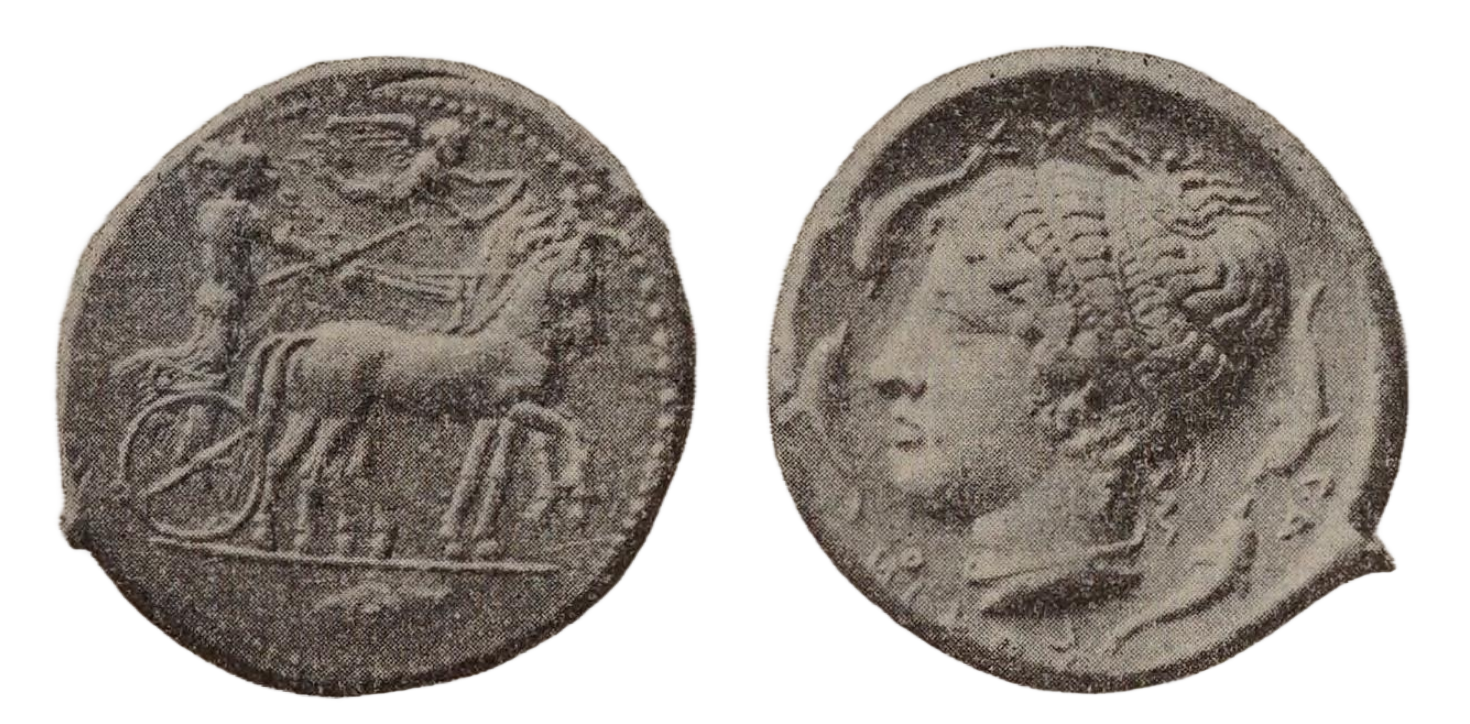
The coins on which the hair of the maiden's head is bound up in a topknot also belong to the end of this period[34].
The development that has been briefly sketched here is indeed tremendous and shows a magnificent growth of artistic ability. But the progress is organically linked to what was previously given; in the development, as stated, there are no gaps and no sudden, unprepared stylistic transitions. In this calmly flowing development, however, an only partially prepared break then occurs and a new style becomes noticeable in the coins. It remains to be investigated later whether we can determine with some certainty when this upheaval in die-cutting art occurred in Syracuse, for there is only agreement that this happened in the second half of the 5th century.
The new element in the style now coming into force appears both in the treatment of the obverse and the reverse. On the obverse we suddenly have quadrigae before us in which all four horses clearly stand out in lively movement. The horses are depicted galloping and a little in side view, each rear horse moved forward so much in front of the front one that head, chest and legs are visible. Naturally, this first attempt to depict the horses more perspectively cannot exactly be described as successful. The heads are often arranged in tiers, the rearmost head larger than the front ones, thus completely contrary to the laws of perspective, and since the die-cutter has depicted the bodies of the three rear horses as concealed by the first, thus thinking the viewpoint at the height of the horse's body, the rear horses, especially the last one, appear exceedingly long-necked. This is extremely striking on two different obverse dies, namely on 9 (with the inscription ΕVΜΗΝΟV) and 8. In order to be able to clearly depict all the legs of the four horses, the artist lines them up next to each other, sometimes somewhat fan-shaped, sometimes strictly parallel. He succeeds in approximately achieving the desired impression of lively movement only in the rarest cases. And while he each time depicts the rear horse moved somewhat further forward in front of the front one, thus showing the viewer the horses not directly from the side, but somewhat shifted forward, he depicts the racing chariot completely in side view, without paying attention to this incongruity.
The new style is accompanied by another innovation.
On several tetradrachms, in addition to the ethnikon, another inscription appears, a personal name, usually in the genitive. It is now almost unanimously admitted that this can only be the signature of the artist who either only designed or, probably, also executed the respective dies. As late as 1889, however, Kinch[35] attempted to prove that these names could only be those of persons who had dedicated offerings to the deity, and that the inscriptions were always placed in such a way that their placement alone indicated what the dedication consisted of. That it was possible to explain the inscriptions on the ampykes and sphendonai in this way is evident; but already with inscriptions under the neck the explanation presents difficulties. Research has also not agreed with Kinch's explanation, but has professed the older explanation as artists' names, which after the precedent of Steinbüchel (1818)[36], Payne-Knight (1821)[37] and Noehden (1826)[38] Raoul-Rochette[39] first substantiated in detail. For only in this way can the cases be explained in which obverse and reverse are provided with different names, as well as the circumstance that partly the same names are also used on coins outside Syracuse — in Kamarina and Katane, for example — and then in exactly the same manner. Decisively, style proves these coins to originate from the same hand.
On some somewhat older tetradrachms of Syracuse an A[40] can already be found, which is in various and rather hidden positions, and could perhaps also be explained as an artist's signature; but since the A appears quite isolated, this is not certain.
It seems different with the tetradrachm with the inscription VONEMVE (107), to which Headlam[41] has drawn attention more in passing and which Lederer[42] has declared to be the oldest signed coin of Syracuse, to be dated around 450–440 B.C. The obverse (38), which shows a calmly walking quadriga, agrees stylistically perfectly with the coins of the transitional period, the reverse (74) on the other hand presents a series of difficulties that make a different explanation than that given by Lederer more probable.
The head turned to the right has the hair in a chignon at the back, on the neck a simple cord and in the ear a double ring. Behind the head the last half of the retrograde inscription MNΩIOK is legible, under the neck likewise retrograde VONEMVE. From the same obverse die (38) as this tetradrachm comes, which Lederer did not notice, yet another one (108), which stylistically stands very close to this one, but which bears the inscription ΣVPAKOΣION on the reverse (75). This would seem to secure the position also of the previously discussed tetradrachm and at least its belonging to Syracuse, and if the illustration XV 33 bis in Du Chastel[43] were correct, which connects the reverse (75) of 108 with an otherwise known obverse die from the transitional period, then both coins (107 and 108) would also be linked with a third, certainly Syracusan piece. A more precise examination of this image shows, however, that the obverse and reverse, judging by the form and the notches on the edge, do not come from the same coin and that therefore here probably a confusion exists[44]. While these tetradrachms (107, 108) thus stand isolated in the series of Syracuse, they are, as Lederer has already emphasized, connected with those of Panormos by the fact that the same obverse die has also been used for a tetradrachm with the inscription NOKITIMPONA[45] on the reverse. In itself it would indeed not be inconceivable that the die-cutter or some mint master had migrated from one place to the other and thereby taken an obverse die with him; there are indeed other known cases where the same die has been used in different places[46], even if it seems unlikely that Syracuse with its large production would not have fully utilized its dies, where it has indeed often used dies that were already damaged in many ways, indeed almost destroyed.
But a more precise examination of the tetradrachm in question nevertheless teaches through stylistic features that the piece did not come from the Syracusan mint. To be sure, the obverse agrees in all essentials with those of the transitional period in Syracuse; it is different, however, with the reverse. First, its inscriptions are retrograde, which is unheard of in Syracuse in this period, and at the end of the city name stands a meaningless M. Furthermore, this way of forming the head does not occur at all in the earlier period; it is found only in the flourishing period, and when we examine the head sides from this period, it is striking how great the similarities are with the reverse 25(43), which bears the signature of Eumenes (EVMENOV). Point by point the details agree not only with regard to the arrangement of the hair, the form of the earring and the like, but also the small curls at the temple, which do not occur at all in the earlier period, recur, the position of the surrounding dolphins in relation to the head is the same, and likewise the manner of applying the inscriptions, only everything on the reverse (74) of 107 is executed in the opposite direction, the inscriptions thus retrograde; without difficulty we now recognize that here is a direct re-striking, whereby the die-cutter has engraved everything in the die as precisely as possible as it was on the coin model, without paying attention to the fact that he should form everything in negative. Such cases also occur elsewhere precisely in barbaric re-strikings[47].
How precisely and thereby purely mechanical work the die-cutter has done is also evident from the circumstance that in the ethnikon he writes N, in the signature N, just as the die-cutter of 25. Now the mystical M at the end of the ethnikon also finds its explanation, for on 25 an elongated die damage is perceptible, which begins at the ending N and goes downward, and this the re-striker has imitated through the M: this slip is the keystone to the proof that this is an imitation. When Lederer[48] then quite rightly emphasizes that the artistic work of the head is essentially simpler and less skillful than on all other dies with the same master's signature, this does not stem from the fact that this tetradrachm might be a couple of decades older than the others, but precisely from the fact that it is a re-striking.
Stylistically, the other tetradrachm (108) with the inscription ΣVPAKOΣION agrees completely with this one (107); the same harshness especially in the treatment of the eye and lips is also to be found here, also the same irregular form of the letters, which is partly also found on Eumenes' original, but is mainly attributable to the clumsiness of the die-cutter: 108 too is thus a re-striking. Where these re-strikings were executed cannot yet be determined. The connection of the obverse die also with a Panormos reverse die (cf. p. 102 n. 5) makes it appear possible that all these coins were produced in Panormos, but it is just as possible that both Syracusan and Panormos coins were re-struck in this way in a foreign place. In Paris (Collection de Luynes) there is a tetradrachm which on the head side, which shows the type with waved hair taken up in a chignon at the back, bears the incomplete inscription -OΣION, while the chariot side has the Punic inscription ziz. Ugdulena[49], who published this piece after de Luynes, would like to place it in Himera, but its place of origin can only be determined in connection with the admittedly still unsolved question of where the other ziz coins originated[50]. It may seem wonderful that the re-strikers have indeed retained the name of the model, but have added the name of the re-striking place (if ziz is a place name); but we see the same procedure in the tetradrachms struck by the Arabs after coins of Athens, which bear both the old ΑΘΕ and a new inscription, and in the same way Alexander coins have been imitated on Rhodes and elsewhere[51], to say nothing of many other such imitations in antiquity and the Middle Ages. We can therefore assume that this entire re-striking was carried out by the Punics, who by no means limited the models of their imitations to Syracuse, but also used the types of Himera and Katane[52] so skillfully that their relevant imitations have often been simply classified into the coin series of these cities. — This is probably the oldest re-striking of Syracusan tetradrachms; for apart from the fact that the chariot side of the re-struck coins is borrowed from the coins of the transitional period, the head side from the older series of the flourishing period, those treated here already occupy a special position among the re-struck coins of Syracuse in that here the slavish imitation has gone so far as to transfer the complete inscriptions to the new coins. We will have to deal later with an example of this barbaric re-striking. The significance that has been given to these tetradrachms for the coinage of Syracuse and especially for the appearance of the signed coins and their chronology they thus do not have, and Lederer's[53] older Eumenes must again be deleted from the lists of signing die-cutters.
As a transitional coin, which directly indicates the new style, on the other hand, a tetradrachm[54] is to be regarded, which to be sure still has the walking quadriga on the obverse, but on the reverse a head turned to the left, whose hair is held together by a narrow, multiply wound band; at the crown some curls have become free and likewise a pair of curls at the nape. Both the free treatment of the hair and the execution of the facial forms is decidedly more developed than on the heads with sakkos[55] or with four-fold wound band[56] and also still on those with widely spreading hair in a net[57], which are nevertheless proven by the use of the same obverse die to be the closest predecessors of this type. Noteworthy is the long lock or braid of hair that extends from the forehead along the temple to the ear, and the curls that hang free at the nape are a clear innovation. The modeling of the nose, the eye, the lips, the chin has become much softer, the forms are fuller and rounder. Also in the treatment of the dolphins something new has been added; to be sure, the custom of depicting all the dolphins in the same direction has already occasionally been broken earlier, here however the dolphins are not only turned toward each other in pairs, as already on some older tetradrachms[58], but they are also smaller and more naturalistically modeled. In any case, a new spirit shows itself in this reverse die, which by no means breaks with the traditions, but introduces a different developmental period.
The new style is introduced by two different die groups, namely on the one hand 1–9, on the other hand 10–17. Of these, those mentioned second seem to be in a certain dependence on the just-mentioned tetradrachm (p. 104 n. 6). Thus a certain similarity shows itself in the treatment of the hair, which, as on this older tetradrachm, is bound around several times with a simple band, whereby nevertheless at the crown the curls flutter out freely. Here the artist has gone significantly further in letting the curls free, and not only at the crown, but also further on, curl-tips have become free. On the other hand, the deviations are also not insignificant, whereby partly old motifs are referred back to, e.g., in the placement of the inscription before the face within the dolphin circle, as is generally the case on the older coins and still in the sakkos period.[59] The reduction in size of the head, on the other hand, is again an innovation, after in the last preceding decades the heads are formed large and quite filling the image surface. If therefore a significant dependence on the earlier period is present in these coins, I nevertheless place the group 1–9 before the group 10–17 and thus at the head of the new free artistic development. In the former, the size of the head is still maintained, and likewise the size of the flan, which on most specimens of this group reaches 26–32 mm, as the last coins of the transitional period measure, while only the oldest coins of the group 10–17 are struck on larger flans, the later ones however on significantly smaller flans — about 22–25 mm. The hairstyle of 1–9, on the other hand, is new, and something only remotely similar we find only at Du Chastel III 27, 32 and 33, whereby the similarity is limited to the way the hair is taken up at the back of the head, while the ampyx at the front of the head at 1–9 is completely new. Of the new elements in the hair ornament that occur for the first time on Du Chastel V 49, the long braids of hair that are drawn from forehead to ear along the hairline recur on them, as well as the little curls at the forehead and nape. In some, the position of the dolphins is still almost the same.
As we see, both groups offer details that clearly point to the older predecessors. If I nevertheless, as stated, place 1–9 at the head, it is because those signs of dependence that 10–17 show are more based on a direct, conscious reaching back to older elements, such as the position of the inscription in some dies, than on a truly organic further development of the given elements, as 1–9 express, while thereby bringing the vigorous and purposeful breakthrough of the new style more clearly to light despite all continuity.
Also the way in which the obverses are executed gives the group 1–9 precedence, for the quadrigae testify that here a truly creative artist has been active, while the quadrigae of the group 10–17 rather give the impression of imitation after 1–9.
At the head of the entire series I would like to place the tetradrachms with the signature ΩIΩN on the ampyx, as well as those that are directly connected with these (1–5). This group consists of two obverses (1 and 2) and three reverses (1, 2 and 3), of which only one reverse 2 is signed. The obverses offer for the first time the quadriga galloping — apart from the previously mentioned isolated attempts.[60] The horses' legs are arranged strictly parallel next to each other, only the left hind leg of the first horse is set somewhat backward. The horses' heads are also lined up next to each other and all at the same height. Nevertheless the chariot is depicted in side view, although in its representation too the three-quarter view presupposed by the position of the horses should have been expressed. The charioteer is fairly slender and not so disproportionately large in relation to the horses as on many of the immediately following obverse dies. He is formed somewhat precisely according to the law of frontality, with the head in side view, shoulders and chest however in front view. The difference of the two obverse dies 1 and 2 from each other is extremely slight, apart from the fact that 2 has two dolphins facing each other in the exergue, while the exergue in 1 is empty. In the treatment of the feathers on Nike's wings perhaps somewhat greater fineness in the detail work is to be found on 1, and noteworthy is that the charioteer on 2 holds a goad, on 1 not. The quadriga on 2 fills the available space more precisely: thereby the horses can be made somewhat larger in relation to the charioteer and Nike too has come to stand somewhat further from the charioteer and does not hold her branch right in his face; the charioteer is not bent forward as much as on 1. Despite the deviations, the style of both dies is the same in all essentials, as emerges especially from a comparison with other dies.
The three reverse dies (1, 2 and 3) that are connected with these obverse dies all show fairly the same type: the hair flows from the crown in wavy lines in all directions and is gathered in a chignon at the nape; from the forehead along the temples extend two (or at 3 one) strongly waved curls, which are perhaps to be understood as braids. At the forehead, at the ear and at the nape we find individual small curls in the manner as at Du Chastel V 49, as has already been emphasized. At the front of the head the hair is held together by an ampyx. In the eye the iris is visible and the bridge of the nose is somewhat deepened in the inner corner of the eye, whereby the eyeball becomes more arched. 1 and 2 also agree precisely in that the eyebrows are indicated by fine strokes, the lips are fairly short and thick and, what is especially noteworthy, have a raised seam at the edge, as also in bronze statues of this period[61]. As stated, 2 bears the signature of Sosion, but judging by the style 1 also comes from the same hand. Everything that can be proven as characteristic of Sosion from the signed die also fits for 1. In addition come some more external features, which in themselves would not be convincing, but can be well used as reinforcing indicia. Such are the position of the surrounding dolphins as well as the distribution of the inscription among the spaces between the dolphins, which is absolutely the same on both dies. The forms of the letters are also the same, which is particularly significant with regard to the Y, since otherwise in this period in Syracuse the form V with variations still predominates, while Sosion uses the sharply marked form Y. Finally, the necklace consists of a cord with a pendant in front and six hanging pearls, while the closest predecessors had only a simple cord, usually with a pendant in front. This precise agreement both in the large and in the small, both in externals and in points that belong directly to the artist's personal style, makes the previously expressed supposition[62] that this reverse die comes from Sosion's hand into certainty, insofar as it is at all possible to draw such conclusions from stylistic-critical grounds.
The question of whether the signed or the unsigned reverse die is the older can be answered with the help of the "state" ("État") of the dies[63]. The obverse die 1 was first used with the reverse die 1, then with die 2, as emerges from the state of the die; for all specimens of 2 (obv. 1, rev. 2) show a damage on the back of the first horse, while 1 b still comes from the undamaged obverse die, and on 1 g the damage still consists of a very thin line. With regard to obverse die 2, the situation is reversed; this die was used in fairly undamaged condition (apart from a small crack at the front feet of the first horse downward) together with reverse die 2, as 3 a shows; still during the striking of 3, however, a damage arose on the back of the first horse (3 b). Apart from these damages, however, we find on this obverse die 2 at the striking of 4 still a crack under the belly of the horses and a smaller crack at the horses' mane, whereby it becomes evident that 4 is later than 3. Now it can still be proven that the reverse die 1 was used first with obverse die 1 and secondly with 2, for a damage under the chin is still quite small on 1 b, g, i, on 1 a it is already larger and just as large it is on 4. With regard to 2, on the other hand, the sequence of strikings cannot be determined so certainly, yet it seems to me upon careful examination that this reverse die too was used first with obverse die 1, then with 2; for I believe I perceive on 3 a and b above the upper dolphin a couple of tiny cracks that are still missing on 2 a and b; also the filling of the space between the lips with a rough mass probably stems from a damage (rust?) to the die, since it is missing on 2 a. The unsigned reverse die (1) would thus be older than the signed one. A general consideration also seems to confirm this, for it is more probable that the artist at first does not yet put his signature on the die, but then, when the new type and the new style found favor, added his name. It remains to be investigated later whether it is possible to determine Sosion's origin.
In connection with obverse die 2, a third reverse die (3) is still used (5), and indeed as the last, as the damages to obverse die 2 show: they are the same as on 4, but the one on the mane has become much larger. This reverse die is often attributed to Sosion[64], partly probably because it has been brought into connection through coupling with the die that is signed by Sosion; in addition, however, the author of the catalog of the British Museum[65] has read traces of the signature ΩΩN on the ampyx. That an erroneous reading exists here is taught by the comparison of this coin with the others that come from the same die: the ampyx on the London tetradrachm (5 d) is somewhat worn, but e.g., the specimens in Brussels (5 a) and Glasgow (5 b) show quite clearly that the ampyx is only decorated with a simple zigzag line. The type is, as already mentioned earlier, to be sure the same, but the style is completely foreign to the Sosion coins. The chignon at the nape is smaller and the hair is not only divided into large curls that emanate from the crown, but the curls are split with vigorous strokes, not as on the previous ones divided by light strokes that indicate the individual strands, and only one braid extends along the temple. The nose is more vigorous, the eye fairly coarsely executed with very distinct iris; likewise the ear seems to be larger, and instead of the hook-shaped ear ornament we see here the spiral-wound earring, which looks like a double one. It is not conceivable to attribute this die to Sosion, for during such a short time span as that which must necessarily have elapsed between the striking of 1–4 and 5, such a stylistic change would be impossible. On the other hand, it is completely clear that the artist is dependent on Sosion's manner.
The same types both for the obverse and for the reverse dies as this group has also the group 6–9, which is composed of two different obverses (3 and 4) and three reverse dies (4, 5 and 6); of them two reverses (4 and 5) bear the signature of Eumenes (ΕVΜΗΝΟV), while the third reverse and both obverses are unsigned. One obverse die (3) looks similar to obverse 2 down to the smallest details, only the reins of the horses are depicted differently. The charioteer namely holds in the extended right hand three rein strands, whose ends, as it seems, are fastened to the front edge of the chariot box, in the left hand likewise three rein strands, while on obverse 2 he holds all the reins in the left hand and with the right only grasps into the reins, for steering or restraining. The other obverse die (4) offers, as stated, the same type as 1–2, and adheres more closely perhaps to 1, thus in the size of the quadriga and of the charioteer, in the position of the latter and also in that the exergue is empty. The style, however, is different, has become coarser. This is particularly noticeable in the treatment of the charioteer, who is formed more stocky, with shaggy hair, but also the forms of the horses are less slender and the feathers of Nike's wings are not so finely executed. The two obverse dies cannot be attributed to one and the same artist, but rather it gives the impression that 3 probably comes from the same hand as 1 and 2, but not 4. Since all these dies are unsigned, it is not possible to assert with certainty that this artist was Sosion, even if it is fairly probable that the artist who carried through the new head type and the definitive breakthrough of the new style also introduced the new obverse type[66]. Obverse die 4, on the other hand, could perhaps be a work of Eumenes, who would have imitated Sosion's type, as he, as we shall soon see, imitates his reverse type. The circumstance that 4 and 3 come from different hands and at least one of these dies is thus executed by a different artist than the reverse die with which it appears connected should not surprise us, for such certainly attested cases will occupy us often still.
The reverse dies of the group 6–9 also show the same type as 1–5, even if the style is not that of Sosion. The oldest of these dies is 4 (signature EVMHNOV on the ampyx), for it appears on some specimens, like 7 c, connected with obverse die 4, when this was still fairly undamaged; on most specimens of 7, however, a damage on the horses' backs already clearly emerges, and this damage is also perceptible on the specimens of 8 and 9. The hairstyle of the head on this die is quite of the same kind as on 1, only the chignon at the nape is somewhat larger. The face is more elongated, especially the nose is longer, and the lips are somewhat thinner. The eyeball does not protrude as vigorously, since the bridge of the nose does not have the same depression at the corner of the eye as at 1. The ear sits somewhat higher than on the Sosion tetradrachms, but gives the impression as if it sat much higher, because the face is so much longer and the position of the ear in relation to the mouth is thereby significantly shifted. This awakens the perception as if 4 were more archaic than 1 and 2, and this perception is also reinforced by the forms of the letters, which have not turned out so finely regular as on 1 and 2 and still have the older form V instead of Y, as well as by the fact that the position of the dolphins corresponds more precisely to that on the last tetradrachm of the transitional period[67] than on 1 and 2. If I nevertheless in contrast to the older view[68] have considered the Sosion group as the older, it is based precisely on the fact that I see in Sosion the innovator, in Eumenes here only the imitator, who has preserved more of the older elements. The forms of the letters attest to this, for still long after Sosion the old forms are mainly used; likewise Eumenes is not the inventor of the new quadriga type, for that obverse die that bears his complete signature (9) is much larger, much more clumsily executed than obverse die 4, which is connected with his reverse dies (4 and 5 on 7 and 8); such an enervation of style can hardly have taken place in an independent artist; on the other hand, it is possible that a weaker artist, when he closely follows a better model, as here Sosion's chariot side, can execute works that are significantly better than those that he creates independently.
The other reverse die of Eumenes in this group (5) (signed on the ampyx EVMHNO) is distinguished from the one just treated by the incomparably higher relief, which gives the head a swollen, somewhat blurred expression. Especially nose and mouth have become thicker and fleshier as well as the cheek, but in the detail treatment the similarity with 4 is still striking, as the nape hair especially shows, whose outermost thinner wavy line easily gives the impression as if there a strand stood out further from the rest of the hair, and thereby somewhat weakens the clear lifting of the relief from the image surface. On the other hand, this die adheres still more closely to 1 and 2, thus somewhat in the position of the dolphins and also in the forms of the letters, which are more vigorous and more regular than on 4; likewise the distribution of the inscription among the dolphins is clearly influenced by 1 and 2. These circumstances as well as the clumsy execution could make it credible that 5 were older than 4, if it did not rather emerge clearly from the state of the obverse die, as already stated, that 4 is older. How this coarsening is to be explained cannot be said.
The third reverse die (6), which is connected with obverse die 4 (9), is completely separated in style from the Eumenes dies and this difference emerges even more clearly since the head type, with the hair held together in front by the ampyx and taken up in a chignon at the nape, is quite the same. On the other hand, we must bring this die into very close connection with 3. We find the same manner in the treatment of the hair with vigorous emphasis of the strands in the curls, the same straight nose, if also even longer and more pointed. The ear too is formed in the same way, although the modeling is much more inartistic and formed almost only by the outer line and a couple of points in the interior, and the earring has the same form, differing from the others. In addition comes the fact that the same way in which the dolphins are grouped and the inscription distributed among them on both separates them from the remaining reverse dies otherwise belonging to the same group. In the treatment of the lips and the eye deviations are to be sure present, but it seems nevertheless as if these were partly based on careless striking of 9. Since both dies (3 and 6) are unsigned, we can only designate it as highly probable that both come from the hand of the same artist. This one is, as stated, neither Sosion nor Eumenes, but he adheres to Sosion, even if he is significantly weaker.
The activity of Sosion, who introduced the type of this group in Syracuse, is only demonstrable in this group; then he disappears again. Compared with his rival and successor Eumenes, as well as with the other contemporary die engravers in Syracuse, he has precedence both through finer conception and through incomparably greater technical skill.
As already mentioned, chronologically closest to group 1–9 stands group 10–17, which is composed of three obv. dies (5, 6 and 7) and five rev. dies (7, 8, 9, 10 and 11). The chronological order of these dies can only be established with certainty in part. Thus it is certain that 10 (5 + 7) is older than 11 (5 + 8) and 12 (5 + 9), because obv. die 5 has a crack across the hooves of the front legs of the horses as well as one across the reins during the striking of 11 and 12, both of which are still absent on 10. Likewise obv. die 7 was combined later with rev. die 11 (and 12) than with 9 and 10, since the flaw beside the right shoulder of the charioteer only appears on 17 (7 + 11) and 18 (7 + 12). It also seems to me that rev. die 10 shows a flaw between the neck and dolphin tail as well as one on the K of the legend during the striking of 16 (7 + 10), which are still absent during the striking of 14 (6 + 10). On the other hand, I cannot decide whether on rev. die 9 during the striking of 15 (7 + 9) there is really a flaw on the lip and on the upper eyelid that is absent during the striking of 12 (5 + 9) and 13 (6 + 9), or whether these cracks on the single known tetradrachm 15 a are only on the coin. Nevertheless, the order of the tetradrachms of this group can be determined to some extent, even if the sequence of all dies relative to one another is not established.
The obverses stand in part quite close to those already treated. The galloping horses are represented strictly parallel, both with regard to the heads and the legs, but otherwise they differ considerably from one another on the different dies. On the first die, 5, the parallelization is broken by the fact that there is a somewhat larger space between the outermost legs in the row and the middle ones; moreover, the fourth horse has broken out of the row and stretches its neck forward, so that the whole head becomes visible. But since this head has become too large in relation to the other heads closer to the viewer, this deviation from the otherwise symmetrical treatment does not have a particularly pleasing effect. The other die (6) offers a characteristic example of how the front legs of the horses have been arranged in a fan shape. The third die (7) also shows this, which is extremely weak in the treatment of the horse heads: the head of the first horse is quite small and set on a very short neck, which is probably due to the effort to leave sufficient room for all horse heads. On all these dies the horse heads are arranged in a stepped manner, such that the heads of the rear horses rise somewhat above the head of the front one, without any attention being paid to indicating this position perspectively in other respects, whereas in the first group (1–9) all horse heads were at the same height. Among these dies, the first (5) makes the impression of real, lively movement with the outstretched head of the last horse and the charioteer who bends forward grasping the reins. On the third die (7) a quietly standing crane is depicted under the bellies of the horses, which completely destroys the illusion of strong movement of the horses; it is only an accessory symbol of the same kind as the symbols in the exergue, which in this group consist of a shell (5) or a fish pursued by a dolphin (6 and 7). Up to now it has not yet been possible to find any really satisfactory explanations for these figures in the exergue, any more than for many other similar figures on the tetradrachms of Syracuse in this period. It would of course not be impossible that they could have references to historical and political events concerning Syracuse, just as the lion in the exergue of the Demareteion refers to the victory at Himera, the pistrix probably to the victory at Cumae, the olive branch perhaps to the alliance with Gela in the year 424.[69] But it is equally possible that they could have only an administrative or financial-technical significance. Here it suffices to note that they in any case have no substantive relationship to the type itself.
The 5 rev. dies look extremely similar to one another in part; the differences between 10 and 11, for example, exist almost only in the curls of the lock tips. Only 7 seems to separate itself somewhat more from the others; thus the locks do not flutter freely from all sides, but are confined mainly to the back of the head, and only a couple of lock tips have become free at the front of the head; also the form of the lock curls seems to be somewhat different. Unfortunately, the single specimen is so worn that it cannot be concluded from it with certainty, and equally not whether any deviations in the facial features from the others can be established. In any case there seems to be no reason to deny this die to the artist who executed the other rev. dies in this group; and it can hardly be doubted that the others all come from one hand. On rev. 9 there are strokes between the neck cut and the dolphin that give the impression of an inscription. However, it is impossible to interpret these marks; to all appearances they are not traces of writing but only irregularities in the die. The artist thus remains unknown; it is not Eumenos, as has been claimed.[70] As already emphasized,[71] the artist in some points, such as in the position of the legend on 7, 10 and 11, reaches back to older motifs, and also the hair treatment seems in part to be direct further development of that on the last tetradrachm type of the transitional period;[72] but as mentioned, this group does not directly follow this one, but rather the stylistic development already indicates that the Sosion group is to be inserted in between.
Also with regard to this group it cannot be said whether all three obv. dies have the same originator and whether they all stem from the same artist as the rev. dies. At least obv. die 7 gives the impression of being executed by a different die engraver than the other two (5 and 6).
The striking of this group seems to have proceeded at least partially at two different minting benches, for only thus can the rather complicated die couplings be explained.
This group is followed by group 18–24, which is already freed from the school of the transitional period. The transition between both groups is mediated by rev. die 12, which appears combined both with obv. die 7 (18) and with 8 (19), and indeed a small flaw above the first O in the ethnikon proves that 12 was used later with 8 than with 7.
This reverse, which bears a signature ΕVΜΗΝΟV in very small letters under the neck, half hidden by the raised edge of the neck cut, shows a new type that indeed leans on the type of Sosion but is still independently developed. The hair is gathered in a roll at the nape and drawn from the forehead along the temple in two long locks or braids to the ear, as already on 1–5. The ampyx, however, is missing. The treatment of the hair is completely the same as on 4 and 5, also the outermost, thin wavy line at the nape is executed, which gives the impression as if a strand stood out farther there from the rest of the hair, and likewise the little locks at the nape and at the ear are quite the same, only the long locks at the temple are more jagged. Lips and ear ornament are of the same form. On the other hand, the head is smaller and the face shorter and also otherwise better executed, partly because the ear has received a more correct place and does not sit so high. The artist has attempted in this die to create a lifelike image with the greatest possible precision and thereby already offers too much of a good thing in the eye, for he depicts not only the lashes of the upper eyelid in the inner corner of the eye, which is represented as a thick applied line, but also along the lower eyelid the lashes are indicated by small cross-strokes. The iris in the eye is especially emphasized, the eyebrows on the other hand are only weakly marked. In the precise representation of the eye, the artist has indeed only used beginnings that had already appeared earlier in the coinage of Syracuse with better skill, for both indication of the iris and of the lashes in the upper and lower eyelid occur already earlier.[73] The forms of the letters are completely the same as on 4.
The second obv. die (8), which was used for the striking of 19 with this rev. die, shows in the treatment of the quadriga still the same weak points that were to be noted in the previous one, both the strict parallelization of the horse heads and legs and the incorrect size relationships of the horse heads to one another, which become visible in a stepped manner one above the other, and the peculiar shortness of the neck of the first horse. Also the treatment of Nike offers the same errors as before: she is represented too large and flies too low, so that it almost appears as if she wants to give the charioteer the victory wreath that she carries, instead of really crowning him with it. The charioteer is also too large in relation to the horses. While on the obverses of the new style treated so far Nike has always had a branch or a garland in her hands, here she again carries the wreath with hanging ribbons, which she has carried more often than the branch on the coins of the earlier period. The whole style of this die gives the impression that it does not come from the same hand as dies 6 and 7, even though the corresponding points are indeed very numerous.
In the chronological sequence of the tetradrachms there now comes a rev. type (13) that on the one hand has clearly been influenced by the previous type — as well as by the type of Sosion, as the treatment of the hair especially shows. On the other hand, however, the eye is not represented in side view but in front view in a manner that was no longer used at the end of the previous period. Also the dolphins are larger than usual in this period. Besides all these moments, the circumstance also has the effect that the ethnikon is written retrograde and distributed around the head in the same way as on the older coins,[74] that one would like to move the age of this die significantly before the beginning of the new style and see in it the prototype of the Sosion and older Eumenos type. But since the two obv. dies (8 unsigned, 9 by Eumenos) with which this die appears combined otherwise only appear together with rev. dies signed by Eumenos and Eukleidas, such a conception cannot be maintained. But also the style of this die, despite all archaic features, is basically the same as on the other coins of this period, so that we perhaps have to do here with a die that did not come from the hand of the new artists but derives from a die engraver in the mint who has already experienced part of the older development and now, although he has taken the new dies as a model, cannot completely free himself from the older direction. Thus the presence of such diverse elements in this type is most simply explained. For such a conscious reaching back to the older style on the part of the new artists, who otherwise so vigorously emphasize the peculiarity of the new direction even when they use and further develop older elements, cannot yet be imagined.
As mentioned, this die (13) appears first with the unsigned obv. die (8; 20), then with another obv. die, namely one that bears the signature ΕVΜΗΝΟV in the exergue (9; 21). The striking of coins from these two dies (21) occurred later than that of obv. die 8 with rev. die 13 (20), for 20 g, j and l still do not show the flaw of the rev. die on the back of the dolphin before the forehead, which is more or less clearly visible on the other specimens of 20 and on all specimens of 21, insofar as this part of the die is not "off the flan."
In style this die 9 strongly recalls die 8, but also with die 6 clear points of contact connect it. Yet 9 makes a significantly less pleasing impression than the obv. dies treated previously. The proportions of the individual horses to one another, which also earlier were often not correctly grasped and represented, diverge here even more. The horses are represented at a gallop, but it seems to the viewer as if they, with their front bodies raised somewhat above the horizontal position, rear up somewhat without actually moving forward. The necks are raised almost vertically and the whole has an unnatural effect, since the heads become visible more than half one above the other and somewhat before one another, yet the bodies are hidden by that of the first horse and all horses stand on the same ground line. If the conjecture that C. Jørgensen has expressed[75] were correct, that traces of the meta are visible under the front legs, the position of the horses could perhaps be explained as influenced by the fact that they are just about to turn around the meta. But even on the best preserved specimens the "traces" are so weak and indeterminate that it is not possible for me to see anything in them other than a die crack, which is indeed to be found on all known specimens. By the position of the horses the upper part of the field is also strongly impaired and the space for Nike is significantly reduced. She is indeed formed somewhat smaller than before, but nevertheless almost completely fills the space that lies between the dotted border and the line formed by the horse heads, the right arm of the charioteer (which is stretched far forward to the horse necks), and the head of the charioteer (which touches the dotted border at the same height as the head of the outermost horse), so that Nike indeed touches the horse heads with her feet, the arm and face of the charioteer with her hands and the branch that she again carries instead of the wreath. The whole testifies to a certain inability of the artist to put into action the new idea of composing lively movement into the narrow space of the coin surface.
Besides with rev. die 13, this obv. die 9 also appears combined with three other rev. dies, namely 14, 15 and 16. The order in which these were used emerges with considerable certainty from the condition of obv. die (9), for the small flaws under the hooves of the front feet and before the hooves of the hind feet appear more strongly on 23 (9 + 15) than on 21 (9 + 13) and 22 (9 + 14), and on 24 (9 + 16) a new crack is added that extends obliquely backward from the hooves of the front feet. The two first-mentioned dies are by Eumenos, whose signature on 15 extends upward behind the head, on 14 is half under the neck cut and half behind the nape. Both also agree in characteristic points with the obv. die 12 signed by Eumenos, even though the heads are shaped differently. Especially in the treatment of the eye, the lips and also the hair, striking similarities are present. The lips are short and strong, somewhat protruding. The eye with the precisely drawn lashes is also the same on all these dies. But although the hair on 12 and 14 is held together in the same way, it nevertheless makes at first glance a quite different impression on 12 than on 14. It is much richer, much more voluminous, so that the face appears smaller, and in addition a multitude of very small locks emerge along the hairline at the temples as well as at the front of the head, which indeed enliven the whole but also cause the head not to offer the dignified impression that 12 gives. The little lock before the ear and that which, creeping out from the nape hair, hangs down over the neck, are on the other hand quite in the manner of 12. The nose, however, differs significantly from that on 12; it is shorter, with shorter wings, and forms a straighter line with the forehead, more in the manner of the so-called Greek profile. This die 14 seems to have been destroyed soon, for only two specimens from it are known, and both show die flaws on the dolphin under the neck. Instead of this die, 15 was taken into use, this too as mentioned from the hand of Eumenos. It recalls 12 more: eye, lips and hair treatment are similar, even though the hair is otherwise worn in a quite different and for Syracuse new manner. It is indeed likewise gathered in a roll at the nape, but the whole hair is held together by bands wound several times around the head, of which two crossing loops are visible; at the nape it is still evident that the band draws the hair together at two further points. But the way in which the individual strands are brought to view seems to be the same as in 12. The nose has at the bridge the same bend that is foreign to the Greek profile, but is otherwise somewhat shorter, whereby the head becomes somewhat shorter in the direction from the tip of the nose to the nape. The chin takes a middle position between 12 and 14; it namely has the same indentation under the lip as 14, but otherwise resembles in its roundness die 12.
With rev. die 16, which, as mentioned, appears combined last with obv. die 9 (24), a new die engraver enters into activity, as the signature EVKA
EIΔA on a diptych under the chin shows. In type this die is of the same kind as 13 and 14, but in the treatment a different artist makes himself clearly known. This already comes to light in the hair, for instead of the long locks that are drawn from the forehead to the ear, here the locks at the forehead and at the temples are combed upward and rolled into a roll in the same way as the nape hair; in this point 14 indeed takes a kind of middle position, but the whole manner of hair treatment on this rev. 16 is conspicuous and stands apart from the usual. The locks on the Eukleidas die are thinner and softer and the hair is full and rich. Also the very short little locks at the hairline before the ear and at the nape differ from the manner of Eumenos, for they are shorter and less wavy. Likewise lock tips have become free on the outer line of the head and become somewhat visible. Still more clearly the differently constituted style works on the other parts of the head. The profile line of forehead and nose is straight, only the tip of the nose projects a little. The lips are longer and thinner. But especially the eye is represented in a different way: the eyelids, on which the lashes are not worked out, give the impression as if they were somewhat swollen and not quite organically connected with the rest, but as if added later; the upper eyelid projects significantly further than the lower, whereby the front boundary line of the eye triangle assumes a much more oblique position than on 12, 14 and 15. A pearl necklace has taken the place of the simple cord. The dolphins are more finely executed. The ethnikon is written in larger, strong and beautiful letters, which are more modern, as the form Y proves, which was previously only to be found on the Sosion dies. Extremely noteworthy is the form of the ethnikon, YΡΑΚΟΙΟ instead of the otherwise usual VΡΑΚΟΙΟΝ or YΡΑΚΟΙΩΝ. Evans has interpreted this[76] as a sign of the uncertainty that necessarily had to enter in the use of O and Ω at the time when the new Ionic alphabet was penetrating, and which Eukleidas tried to escape by choosing a form in which no doubt could arise as to which letter was to be chosen. This explanation is indeed not inconceivable, for we see, for example in Katane,[77] the same change of forms taking place. Incidentally, the occurrence of this masculine adjective form on the coins of Syracuse shows that such an adjectival inscription need not stand in relation to the depicted deity, and thus the conception that Macdonald[78] has most recently presented is the correct one, that the adjectival form of the ethnikon on coins presupposes a noun like νόμισμα, χαρακτήρ etc. It does not now seem credible that at the same place several such designations as νόμισμα, χαρακτήρ etc. would have been used side by side without further ado in the official terminology fundamental to the form of the ethnikon on the coins, but rather some special reason must be assumed if such fluctuations occur. Whether the mentioned Evansian explanation with regard to Eukleidas is correct can hardly be decided now, but in any case the circumstance also speaks for it that only he in Syracuse has used a masculine form, and this not on a single but on several rev. dies (16, 23, 35, 37). Also in the way he accommodates his signature, this artist shows something new. The signature is namely placed on an opened diptych that is located under the chin of the goddess, with extremely small letters; thus in this too he deviates from the custom of Eumenos, who usually sets it quite freely in the field and only on those dies that are influenced by Sosion (4, 5) displays the signature less openly. The custom of placing parts of the coin inscription on diptychs, tablets, half-unrolled scrolls etc., which we will encounter several more times in Syracuse, seems to have arisen around this time. In part the artists' names were indicated in this way, for which we have examples besides in Syracuse also in Katane and on a coin that is usually attributed to Himera; but also the ethnikon was placed in the same way, e.g. on some coins of Metapontum and later in Rome. The custom seems to have passed from the great art into the minor art, as one has recently attempted to demonstrate.[79]
This rev. die (16) has been used together with several obv. dies, namely besides with 9 also with 10 and 11, and indeed with 9 earlier than with 10 and 11, as the flaw on the last of the ethnikon testifies, which is still absent on the specimens of 24 (9 + 16), but is perceptible on all specimens of 25 (10 + 16) and 30 (11 + 16), insofar as the end of the ethnikon has come onto the flan. It is more uncertain whether 16 was used earlier with 10 than with 11, but I believe I perceive on the photographic image of 30 c available to me on the rev. a small crack under the tail of the dolphin that is located before the chin, which is otherwise absent, and this would prove that the striking of 30 (11 + 16) took place after that of 25 (10 + 16). These two obv. dies (10, 11) bear the signature EV and are usually attributed to Eumenos, whether rightly seems to me questionable. Compared to die 9, which is signed with the complete name ΕVΜΗΝΟV, namely, great deviations are noticeable. The strict, rigid parallelization that is so characteristic in the representation of the horses on 9 is here mitigated, the legs are represented somewhat more bent, especially the hind legs, which on 10 make a somewhat too weak impression. The heads are all at the same height, and not only the head of the last horse is treated more freely, but also the others are, especially on 11, somewhat freed from parallelism. While this is a clear development, especially 10 otherwise makes an unexpectedly clumsy impression: the fairly large charioteer with his disproportionately thick head stands in no relation to the small horses; the way he grasps the reins with his right hand shows that the artist indeed had as a model a quadriga in the style of 9; but he did not think that the reins on the right side can well come to the height of the ears of the first horse if the last horse holds its head high as on 9, but that this is impossible if it holds its head at the same height as the others and moreover holds the muzzle straight down, not stretched forward, as is the case on 10. Also Nike with a taenia in her hands is clumsily executed. Obv. die 11 is already somewhat more successful. Although here too the horses are unusually small, they are otherwise significantly better executed, and especially noteworthy is that we have here for the first time a real attempt to leave the parallelization of the horse legs and thereby to achieve somewhat more variety and life. For while the hind legs of the other horses namely touch the ground strongly bent, one horse (which is not evident) makes a more vigorous jumping movement and braces the legs on the ground. Also otherwise die 11 is more pleasing than 10; the charioteer is indeed too long, but no longer so coarse, and also Nike, who holds a wreath, is more slender and finely represented. If the signature EV were not there, and it were not unbelievable that two different artists who worked at the same time would both have signed their works only with EV, one would attribute the two dies to different artists; for it is strange that an artist has executed two dies (which, as will be explained in more detail, are completely contemporaneous) so similar in the main type and yet so different in the whole style. That 10 has two dolphins facing each other in the exergue, 11 on the other hand a dolphin to the right pursuing a tuna, is in this case without significance, for the same figures in the exergue also recur on other dies and are evidently occasioned by other circumstances, not by the feeling of the artist, as has already been noted earlier.[80] From the Eumenos die 9 these dies are separated not only by great external deviations but also by the whole style as it comes to light in the line drawing, and it therefore seems to me hardly possible to attribute these dies also to Eumenos.
Obv. die 10 has been used with five different rev. dies (besides 16 also 17, 18, 19 and 20), of which two (16 and 17) have also been combined with 11, while four (17, 18, 19 and 20) have also been used with a third obv. die (12) and one (20) also with a fourth (13). This circumstance alone points to a lively minting activity, and therefore it is difficult to establish the chronological order of these dies. After precise investigation I believe I can order them as follows: with 10 first 16, then 17 was used, after these 18 was taken into use; for while the obv. die during the striking of 25 (10 + 16) and 26 (10 + 17) has only a small crack above the horse head but is otherwise undamaged, during the striking of 27 (10 + 18) a new flaw arises before the front legs of the horses (27 c undamaged, the others damaged), as well as smaller cracks from the back of the first dolphin to the ground line and to the right of the ground line upward. We find the same flaws on the obv. die during the striking of 28 (10 + 19), but in addition a crack across the signature and the hind legs is added. With die 10 damaged in this way, rev. die 17 was taken into use once more (26 c) and then also rev. die 20 (29). That the striking of 29 (10 + 20) occurred later than that of 28 (10 + 19) is clear, because the obv. die indeed has no new clear cracks, but was otherwise in fairly bad condition during the striking and, as it seems, was somewhat corroded by oxide.[81] — The chronological order of the rev. dies 16, 21, 22, 17 combined with obv. die 11, on the other hand, cannot be determined by such clear die flaws, only it seems that the crack behind the charioteer arose during the striking of 30 (11 + 16), since one specimen probably does not have this crack (30 b), while otherwise this crack is present everywhere. Thus 30 would probably be older than 31–33 (11 + 21, 22, 17); on the obv. of 33 h a point above the wing of Nike can possibly also be understood as a flaw, whereby it would be established that 33 (11 + 17) was the last striking with this obv. die.
The manifold relationships between the coins from obv. dies 10 and 11 make it highly probable that both dies were in use at the same time, that thus at that time work was being done at at least two minting benches in the mint of Syracuse; otherwise it would hardly be explicable how these couplings arose, for it does not seem to have been the custom to keep once-used dies unused for a long time. The question will still occupy us, for several of these dies have also been used with a third obv. die.
The three rev. dies 17, 18, 19 form a unified group that also closes together without the signature EV that is to be found on all three. The type is the one common to Eumenos (12 and 14) and Eukleidas (16), with the maiden's head to the left, whose hair is gathered in a roll at the nape and, as on 14 and 16, is also brushed upward at forehead and temples and rolled in a roll-like manner, without visible bands that held it together. The crown of the head, however, is very flat and formed in lower relief than the gathered hair. Also otherwise the head is formed in flatter relief than on the other tetradrachms already treated, perhaps with the exception of 9 (4 + 6). Especially characteristic for this group is the treatment of the lips, which are short and unnaturally drawn together. The nose is fairly pointed and its lower line curves strongly inward. Only on 18 is the eye more precisely articulated, with especially emphasized iris, the eyes on the other dies are empty. Among the common peculiarities also belongs the treatment of the ear, for here too they differ from the previous Eumenos and Eukleidas types and approach rather die 6; for although the ear on those dies is half hidden, one nevertheless sees that the inner lines in the ear are also here only indicated by one or a couple of points.
In order to treat this group completely, we must also draw head dies 21 and 22 into the investigation, for these too are signed with EV and also belong to this group stylistically. Especially 22 agrees completely with rev. dies 17–19, and indeed it is most similar to die 18; for example, only on these two are the small locks at the hairline along the temple indicated; noteworthy, however, is that on 22 the lashes are executed in the lower eyelid and the lips are formed somewhat fleshier. Things are somewhat different with die 21, where the line formed by forehead and nose goes more vertically and the direction of the line that can be drawn from the lips to the chin deviates less from that of the forehead and nose line, whereby the upper part of the head becomes disproportionately broad compared with the lower part. Yet there are so many stylistically similar points that this die too can be attributed without hesitation to the same artist as dies 17–19 and 22. The question of who this EV is we must leave open until we have examined one of the dies to be treated next.
Combined with obv. die 10 there also appears a rev. die (20) that already at first glance betrays a different hand. The head is fairly small and the hair is put into an opisthosphendone, whose bands are knotted in front. Moreover the hair is held together by an ampyx, which, like the sphendone, is decorated with stars. At the back of the head, however, rich locks swell out, while the locks that emerge at the temple under the ampyx are drawn upward over the bands of the sphendone. From the crown of the head the hair goes in all directions in soft, wavy locks, which are only indicated, not worked out more precisely, in quite a different manner than on the heads of the previous group. The forms of the face are rounder and softer, as especially the tip of the nose and lips show. Noteworthy is the indentation in the lower part of the upper lip, as well as the formation of the eye, which is smaller and whose lids and other surroundings are softer. Characteristic of the new style are also the forms of the letters in the ethnikon, which are large, strong and very symmetrical in contrast to the previous ones (the Sosion coins, as well as 3, 5 and 16 excepted), where the letters give the impression as if they were scratched into the die without greater precision. And yet precisely on this die there is an imprecision in the execution of the inscription, since the first has remained standing reversed as , while indeed earlier once a correction in the die is perceptible (on 19), but otherwise on the dies treated so far despite the often greater carelessness in the execution of the letters no errors occur in the inscription (the alternation of N and Λ cannot be considered an error, since evidently both forms were equally valid around this time).
This die 20, which is still undamaged during the striking of 29 (10 + 20), appears later with a small flaw on the neck combined with obv. dies 12 (38) and 13 (40), but with the former not as its first rev. die.
With obv. die 12 a completely new style is introduced in the treatment of the quadrigae. Already in the external type a great change is noticeable, for horses and racing chariot are both really represented in three-quarter view, while previously only by displacement of the horses was the appearance created as if the team were not seen completely in side view. The horses are formed in extremely lively movement, whereby the tendency toward representation of parallel lines becomes visible only in the necks and heads of the three front horses, which all appear arranged side by side, whereas the last horse with head raised high upward has moved forward before the others. The rigid parallelization of the legs has yielded to a picturesquely lively representation that does not shy away from letting the legs cross, without always considering whether everything agrees with reality, if only the impression of lively movement is gained. The tendency toward the picturesque that is characteristic of this obv. type also manifests itself in the fact that a rein of the fourth horse has broken off or slipped from the hand of the charioteer, now hangs to the ground and has wound itself around a front leg of the horse. The chariot is formed with significantly larger wheels than before and makes a lighter, more mobile impression. The quadriga seems to be driven by a woman, for the long hair of the charioteer is gathered in a topknot on top of the head and at least on some specimens the female breasts seem to be clear. By the strong movement her garment flutters far backward. As the quadriga together with charioteer is represented in three-quarter view, so also by the position of the wings of Nike it is indicated that she too is to be understood in three-quarter view, and indeed also she in three-quarter view from the front. In the exergue a loose, lying wheel is represented and on the ground line are signs that on especially well preserved specimens can be read as EYAINETO. Thus, as was to be expected, the new style is introduced by an artist previously unknown on Syracusan coins, who immediately shows that he stands significantly higher than the older artists, both as regards purely technical skill and in truly artistic talent.
This die 12 is first combined with rev. dies of the older style that have already been used with obv. die 10, namely 17, 18 and 19 and also, as already noted, with 20, but between dies 19 and 20 the new head die 23 has come into use, as emerges with unusual great clarity from the gradually arising and growing flaw of the obv. die. During the striking of 34 (12 + 17) and 35 (12 + 18) the die is undamaged, at 36 (12 + 19) a small crack from the elbow of Nike to the goad is perceptible. With the individual specimens of number 37 (12 + 23), which have come down to us in especially large number and were therefore probably also struck in larger number than usual, we can then follow the growth of the die flaws in all details: the crack develops upward across the face of Nike and also extends further downward, beside it a new crack arises along the charioteer, which then extends over the hindquarters of the horses, and these two cracks unite above and widen into a large pit in the die. In this condition obv. die 12 (after use with 23) was occasionally once combined with rev. die 20 (38) and finally, when the crack in the die already extended across the ground line to the dotted circle below, 19 was once more taken into use in combination with it (36 j).[82]
Two of the rev. dies that appear combined with obv. die 12 do not belong to the group of EV dies, namely 20 and 23, of which 20 has already been presented more precisely. The other again, 23, belongs according to the whole type to the same group as 20, and only in the detail treatment are deviations to be noted. Thus on 23, for example, the ampyx is decorated with a swan and has a zigzag line on the lower edge. The eyebrow and the upper eyelid are less fleshy, but the eyelids give the impression as if they were added later. On the lower edge of the sphendone at the nape we read the artist's signature EYKΛEI; Eukleidas thus is the creator of this die. Characteristic for him is the form of the ethnikon, YPAKOIO, and also in the treatment of the eye and the lips, to emphasize the most obvious, we find undoubted points of contact with 16, which indeed comes from him.
While obv. die 12, which had already become actually unusable through the large flaw, was still used with rev. dies 20 (38) and again 19 (36 j), a new obv. die (13) was taken into use, and indeed first together with rev. die 23 (39), which now shows on all specimens the flaw on the dolphin before the chin that on 37 (12 + 23) was still in the process of arising and is to be found only on some specimens of 37 (such as e.g. 37 c e g l u cc, which also mostly already had the large flaw of the obv. die).[83] Stylistically now this new obv. die (13) shows no traces of the fact that the already previously used, stylistically so far developed obv. die by Euainetos (12) had exerted influence; the type of 13 is rather quite the same as in 10 and 11, indeed the representation of the horses still weaker, for the hind legs are bent still more, whereby the horses sink closer to the ground, in a manner that is highly improbable for galloping horses. Nike offers, as on 11, the charioteer, who this time is represented with a pointed beard, a wreath. Not only in all more significant externals does the image of 13 agree with that on 10 and 11, but the whole manner in which everything is executed is so completely the same that one can without doubt attribute this unsigned die 13 to the artist of 10 and 11, thus to EV.
After rev. die 23 (39) had probably been rejected because of the die cracks mentioned above, for obv. die 13 rev. die 20 was once more taken into use (40), to then be replaced by a new rev. die (24; 41). This order of the dies is completely certain, since the obv. die during the striking of 39 (13 + 23) has only a very slight crack under the bellies of the horses, which is already somewhat clearer at 40 (13 + 20), but at 41 (13 + 24) is very strong and is accompanied by a crack across the reins and one behind the tail of the right dolphin in the exergue.[84] The new rev. die (24), which was thus used during the last service of obv. die 13, is executed completely in the manner of dies 20 and 23 and shows on the belly of the dolphin before the chin in microscopic letters the signature EYAI, which is now understood by everyone as Euainetos. The correspondence with die 23 signed by Eukleidas is remarkably great and only through precise investigation can reliable characteristics for one and the other artist be obtained. v. Sallet[85] would like to regard the sharp indentation that is visible on the lower part of the upper lip of the head as especially characteristic of Euainetos. But the same indentation is perceptible on the upper lip of the head by Eukleidas (23). On the other hand, the treatment of the nose and the eyes offers some distinguishing points. Thus the frontal angle above the eye on the head that Euainetos executed (24) projects somewhat, while the transition from forehead to temple on that of Eukleidas (23) is imperceptible. The nose of the maiden's head by Euainetos seems to be somewhat more pointed and the nostrils are not as completely executed as Eukleidas has done it. Perhaps something characteristic for the difference of the two artists is also to be found in the treatment of the neck, which in the Euainetos die (24) has double skin folds and seems to be somewhat softer and fleshier. Probably without significance is that Eukleidas has placed a swan on the ampyx, Euainetos on the other hand a dolphin, and also the other decoration of the headdress is somewhat different. On the other hand, in the form of the letters in the ethnikon a characteristic for the style of the two artists is to be found, for Eukleidas has fairly small and lightly scratched letters, which are nevertheless precisely and symmetrically formed, not as carelessly as e.g. those of Eumenos; Euainetos on the other hand has thick, strong letters of somewhat more varying size.
After we have determined the distinguishing features of dies 23 (Eukleidas) and 24 (Euainetos), die 20 must also be subjected to a precise comparison with these dies, since indeed all three have completely the same type. In doing so we see that the form of the nose and of the forehead above the eye agrees completely with that on rev. die 24 by Euainetos. Likewise the treatment of the small locks at the nape is the same, and the sphendone at the back of the head is of the same size as on 24 and thus somewhat smaller and less projecting than on 23. It is also not without significance that the letters in the ethnikon of 20 are similar to those on 24 in form and manner of execution, whereby the circumstance can be of weight that 20 begins with a reversed () and ends on ON, while 24 begins correctly and ends on ΩN. Since it is completely evidently proven by die cracks both on rev. die 20 itself and on obv. die 13 that 20 was in use earlier than rev. die 24, we cannot regard 20 as an unsigned imitation of the rev. die 24 signed by Euainetos, but must see in it the older die, which to all appearances is also older than the Eukleidas die 23. The points in which 20 agrees with 24 are indeed so characteristic that this die must come from Euainetos. This also agrees with the fact that with this die both a new type and a new style have been introduced into the coin series of Syracuse, which one will a priori rather attribute to a new artist than to one who has already been active earlier in Syracuse. Also the circumstance that 24 is unconditionally superior to die 20 in technical skill, since in the former everything is executed much more sharply and precisely, agrees well with the fact that 20 is an earlier work of Euainetos, who had not yet at that time attained the complete mastery of the technical means of expression that then comes to light so beautifully on 24.
In connection with rev. die 24 after obv. die 13 again a new obv. die (14) appears (42). It cannot be proven with complete certainty that this die 14 was used later than 13 with rev. die 24, since no changes are perceptible in the condition of the rev. die, but equally the opposite cannot be proven. As on 12, also on this die the quadriga is represented running to the right, not as otherwise always to the left, and also this time in three-quarter view, even though the chariot stands somewhat less obliquely to the viewer. The horses are represented in lively gallop, the first three with their heads parallel side by side, the fourth more freely and somewhat moved forward, which is substantively justified since its rein has also slipped from the hand of the charioteer on this die and hangs to the ground. The charioteer, who has a somewhat archaically formed head with pointed beard, is smaller, and the size relationship between him and the horses is more correct. He holds the reins taut and the horses do not rear up as much as on 12. Nike, who is unusually small, carries in her hands besides the wreath also a tablet with the inscription EYAIN
ETO. This inscription thus testifies that this die comes from the same artist as 12, and thereby only confirms the assumption to which a precise stylistic-critical investigation must lead: the horses offer the most striking proofs of this, for example besides in the external forms also in the strongly emphasized musculature on the neck and on the legs. More a curiosity is that on both dies the four horses have only seven hind legs. In the exergue we find again the two dolphins facing each other.
According to Evans[86] and thereafter Hill[87] and Forrer[88] obv. die 14 would be the older and 12 the younger, and in this conception Forrer refers to Weil,[89] who indeed does not say this outright but nevertheless seems to indicate this through the order in which he treats the two obv. dies, as well as through the judgment that he pronounces on the two. With the help of die couplings etc., however, we have proven that 12 is older than 14 and also the stylistic criteria do not speak against it. The image of a quadriga in the race is more unified on 14, on which the position of the charioteer and the way he holds the reins taut and directs his whole attention to the horses brings the seriousness of the moment before our eyes; on 12 on the other hand the female charioteer holds the reins with an almost slack hand, and while the horses rear up and the rein of the outermost has slipped loose, she looks calmly at the viewer without particularly concerning herself about the critical situation of the quadriga. The individual parts are successful, but such a rounded representation has not yet arisen at 12 as is the case on 14.
With 14 not only rev. die 24 by Euainetos has been in use, but also three other rev. dies, namely 25, 26 and 27, and indeed in this order, as emerges from the condition of obv. die (9). For during the striking of 43 (14 + 25) a small crack arises between the goad and the knees of Nike, which is absent on 42 (14 + 24) and still on some specimens of 43 (f i s) and is quite small on 43 t and w. This crack extends during the striking of 44 (14+26) already from the knees of Nike to the goad, and as is noticeable on 44 h, a new crack arises across the thighs of the horse hind legs. On all specimens of 45 (14 + 27) these two cracks are perceptible and the older has become still somewhat stronger.[90]
Rev. die 25 has again taken up the type that is represented by 12, 17–19 and 21–22, thus the head whose hair is pinned up in a roll at the nape and is drawn upward at the forehead and the temple. 26 and 27 on the other hand have utilized elements from dies 20, 24 by Euainetos and 23 by Eukleidas, but with certain changes. Both show the hair as those do in sphendone and ampyx, which on both are decorated with stars and have a zigzag ornament on the lower edge of the ampyx. But both ampyx and sphendone are significantly broader, and the sphendone does not embrace the nape hair completely and almost like a sack, but is drawn more tightly around the head and leaves visible not only the small locks that have stolen out but also a strip of the hair at the nape. In this way a significantly smaller part of the crown hair is left uncovered, and the locks, whose longer and shorter tips swell out from the band, almost fill the whole free space at the top of the crown. The locks at the temple are drawn upward, but only over the ampyx, while the band of the sphendone at 27 is uncovered in its whole breadth and at 26 is only partially covered by the locks. The eyes are relatively long with especially marked iris, the eyelids are thick and as if added, not organically connected with the surrounding area. The lips are short and strong, only at 27 with the indentation on the lower part of the upper lip that we have noted on dies 20, 23, 24. All these dies (25–27), which have the ethnikon YPAKOIΩN, are signed with EVMENOV. Usually these dies are assigned to the same artist who executed the dies signed with EVMHNOV and to whom then also the dies with EV as well as the die to be treated later (28) with EVM are given. This conception is already expressed by v. Sallet[91] and Head[92] and is shared by Weil,[93] who calls the artist Eumenos. Evans,[94] who shares Weil's conception that the EVMHNOV tetradrachms represent the older manner of the same artist who later signed EVMENOV and whom he calls Eumenēs,[95] then attempted to justify this conception more precisely; the inconsistency that, while the signature reads EVMHNOV, the ethnikon is written in the form VPAKOION, whereas later EVMENOV and YPAKOIΩN were written side by side, and that thus the new letters H and Ω were not taken into use at the same time by the artist, but H earlier and still in incorrect application, he explains by the fact that in the adoption of some new letters to those used since ancient times a certain uncertainty can initially prevail. This conception has been generally accepted and only Regling[96] has asserted that EVMHNOV and EVMENOV designated different artists, an Eumēnos and an Eumenēs, without supporting this remark with other reasons than that no examples of erroneous use of H for E in the penetration of the Ionic alphabet have been proven for Sicily. And indeed the examples that Evans brings forward[97] such as YΡΑΚΩΙΟΝ instead of YΡΑΚΟΙΩΝ on our obv. die 16 or ΗΡΜΕ and ΔΙΩΝYΩ on red-figured vases cannot be used as fully valid for our case, for the examples on the vases have nothing to do with Sicily and the example from Syracuse comes from a die by Phrygillos, to whom another error in the inscriptions has also been proven; he namely originally cut YΡΚΟ into the die on 18, and even though he subsequently corrected this error, we nevertheless see that the incorrectly applied Ω can also simply be a writing error. On the other hand, the spellings VΡΑΚΟΙΟΝ and ΕVΜΗΝΟV on the one hand, on the other hand YΡΑΚΟΙΩΝ and ΕVΜΕΝΟV are really consistently carried through. Lederer[98] has recently joined Regling's conception. He justifies it somewhat more precisely with reference to the stylistic differentiation of the heads, without concealing how difficult it is to distribute similar dies to different artists on the basis of only stylistic differences. What the stylistic differences would be in this case, however, Lederer has not indicated; still less has he rejected the possibility that the stylistic differentiation could derive from the fact that the tetradrachms with ΕVΜΕΝΟV are younger and that in between Euainetos appeared with his new style, which Eukleidas immediately joined, and which could then indeed also have had influence on Eumenos (or Eumenes). An objection like this latter could of course not be refuted bindingly. The deviations in style, on the other hand, that are present between the two groups, are certain. Especially in the treatment of the eye and the lips I see on 25–27 a different hand than on 12, 14 and 15; likewise the forms of the dolphins on the ΕVΜΕΝΟV dies are very different from those of the ΕVΜΗΝΟV dies, and yet the dolphins are very characteristic for the different artists. The forms of the letters on 25–27 are remarkably uncertain and ugly (one need only look at the signatures or the beginning of the ethnikon on 26!) and indeed agree in this deficiency with those on the Eumenos tetradrachms, but the forms in themselves are nevertheless fundamentally different. — If therefore ΕVΜΗΝΟV and ΕVΜΕΝΟV do not designate the same artist, the question still remains how ΕV relates to these artists. As has already been explained, the ΕV rev. dies are mainly combined with obv. dies that likewise bear the signature ΕV, and thus must surely be attributed to the same artist. These obv. dies, however, separate themselves in turn fairly sharply from the obv. die that certainly comes from Eumenos (?), and can hardly come from the same artist Eumenos. But still greater is the difference between the rev. dies of ΕV and of Eumenos, which comes to light especially sharply in the treatment of the nose and lips as well as of the eye; and this difference also with regard to the rev. dies makes it still more improbable that ΕVΜΗΝΟV and ΕV could designate the same artist. Somewhat more difficult is the question with regard to ΕV and ΕVΜΕΝΟV, for both rev. die 21 and 22 show certain elements that recur on 25, thus on 21 the form of the nose, on 22 the small locks at the hairline along the temple. The formation of the eye on all ΕV dies, of the nose and the lips on most, on the other hand, is quite different from that on the ΕVΜΕΝΟV dies, likewise the form of the letters. Only 21 and 25 seem to me to stand fairly close to one another, but also with regard to these the indicated differences are perceptible. I therefore believe that we have in ΕV an artist whose complete name is unknown to us and will remain so, but who is artistically different from both Eumenos and Eumenes, although he stands fairly close to them.
In addition to the tetradrachm coinage with obverse die 14 and the reverse dies 24–27, another series of tetradrachms appears, partly struck simultaneously, namely 46–48 (obv. 15, rev. 28. 29, 26). On obverse die 15 we have, as always, a quadriga, this time also turned to the right as on the Euainetos obverses and rendered even more in three-quarter view. The horses, which rear up and are vigorously held back by the charioteer, as is evident from the position of the heads of the three rear horses, are arranged side by side in such a way that the neck and chest of all four horses become visible. The chariot is also rendered in consistently executed three-quarter view, whereby the front edge of the chariot box is more richly articulated than on the obverse dies of Euainetos (12. 14), on which the edge was also visible. The charioteer, who is naked and winged and thus intended to represent a genius, is naturally also formed in three-quarter view, and bends back somewhat in order to maintain his balance better and to have the horses more firmly in his hand; this posture has already been observed, for example, on obverse dies 7, 12 and 14, but it is nowhere executed as clearly as here. He holds in both hands the reins, whose ends hang down loosely, and looks sideways upward toward the Nike, who holds in her right hand the wreath with which she is just about to crown him, while in her left hand, leaning against her arm, she holds an elongated object. This object cannot be recognized on most specimens, it only looks as if the left arm were incorrectly drawn and disproportionately thick; but the very fact that she does not hold the wreath with both hands, as she always does otherwise (except on 14, on which she holds the wreath with one hand, but in the other the tablet with the artist's signature), but has the other hand free, suggests the thought that she is supposed to be holding something in her hand: on particularly good specimens it is really clear that the Nike has an object in her arm, whose upper tip apparently merges with the feathers of the wing. It cannot be a caduceus, as Weil[99] — the only one who mentions anything about it — thinks. Rather it must be a palm branch or even an aplustre, for it looks very similar to the object that the Nike bears on the chariot side of the tetradrachms of Euarchidas (30–33) and which is usually seen as an aplustre. In the exergue we have a vividly executed Scylla from the right, on whose body two dog forelegs protrude. On her left shoulder she holds the trident and with her extended right hand she seems to grasp at a small fish swimming before her; behind her, above the long-winding tail of the sea monster, is a small dolphin. Before the Scylla is located the signature of the artist who, if he did not invent this new type, at least introduced it in Syracuse; unfortunately the name is given only in abbreviated form, ΕYΘ; since only this die can be attributed to him with certainty and no other trace of him can be found in Syracuse, only hypothetical expansions, such as Euthymos, can be proposed. Weil[100] draws attention to the fact that the image in the exergue occurs in simpler form on contemporary coins of Akragas, while the quadriga is strikingly reminiscent of one of the latest tetradrachms of Selinus and concludes from this that Euth- came from western Sicily, probably from Akragas or Selinus. Evans[101] on the other hand regards the appearance of the new type both in Syracuse and in Selinus as an influence from Cyrene and finds great similarity in the arrangement of the horses with that on the Cyrenaean staters of this time. However that may be — the question of where the various types originate will have to be treated separately — in any case the artist is an innovator[102] among the die engravers of Syracuse and his appearance seems to have occurred around the time of some naval event worthy of remembrance. At least both the figures in the exergue and the attribute in Nike's hand point to such an explanation. We will approach the question more closely in the chronological fixing of the tetradrachms of this time, where we will also address Hill's conjecture,[103] who sees in this die an allusion to the naval victory of the Syracusans over the Athenians in the year 425 B.C. in the strait of Messana.
The reverses that appear connected with this obverse die 15 come from three different dies (28, 29, 26), of which the last, 26, had already been used with obverse die 14 (44). The obverse die (15) shows in the striking of 46 (15 + 28) a small crack beginning to form under Nike's left hand, which is still absent on some specimens (thus 46 r), as well as on some specimens small cracks above Nike's wing and from Scylla's neck to her tail (thus 46 q). These cracks are already somewhat larger in the striking of 47 (15 + 29), but in addition a long crack has appeared that extends over the third horse and traces of which are noticeable up to the edge of the flan; under the front feet of the horses a rough spot is furthermore perceptible, evidently as a result of rusting of the die, which becomes increasingly clear (cf. 47 j, m, with 47 d, e, g). This rough spot can be found on all specimens of 48 (15 + 26), and it seems to have expanded further.[104] On the basis of the condition of the obverse die it thus becomes clear that the reverse dies were used in the order 28, 29, 26. The oldest of these, 28, shows the usual head, with the hair gathered fairly in the manner of 25 in a roll, but around the head is wound a wreath of barley ears, poppy, acorn and oak leaves, which only indistinctly allows the hair on the crown to shimmer through. Besides this unusual ornament, the goddess wears on the otherwise quite plain necklace a pendant in the form of a finely executed little lion's head, an ornament that is encountered on several tetradrachms from the transitional period.[105] The nose is straight, the lips short and full, in the eye the iris is indicated as are the eyebrows. The ear, which is half covered by the hair, is extremely simple, executed only as if by a line and a dot, and the hook-shaped earring winds in the same way as the little curls on both sides of it. This die, which like the obverse die 15 connected with it represents an innovation, bears the signature ΕVΜ, which is usually interpreted as Eumenos[106] or Eumenes,[107] thus as the artist to whom the dies with ΕVΜΗΝΟV, ΕV and ΕVΜΕΝΟV are attributed. After we have distributed these dies among three different artists, even a superficial examination shows that neither Eumenos nor ΕV has anything to do with die 28. Regarding the relationship of ΕVΜ to ΕVΜΕΝΟV, the decision is more difficult. Apart from the wreath, which is not found on the dies otherwise signed by Eumenes, but which could nevertheless have been introduced on a particular, unknown to us, occasion, we find that the profile line is significantly straighter, and that the necklace is adorned with a particularly finely executed pendant. The epigraphic evidence does not clarify the matter further, for even if the forms of the letters are not completely identical with those on older dies, the deviations are too small to be used as evidence against the identification of ΕVΜ with Eumenes. Against the identity of the artists might speak, but by no means convincingly, that the obverse die of the new artist ΕVΘ has also been connected with another reverse die of a hitherto unknown artist, Phrygillos. The form of the signature, ΕVΜ instead of the longer ΕVΜΕΝΟV can again have no decisive significance against the identity, since the names of Euainetos, Eukleidas, Kimon also occur both abbreviated and complete.[108] It seems to me in any case that the possibility exists that ΕVΜ could really designate Eumenes, although I do not dare to assert this with any certainty.
As mentioned, the ΕVΘ-die (15) is secondly connected with a reverse die (29) (47) that is signed by the artist Phrygillos (ΦΡYΓΙΛΛ
Ο under the neck section).[109] The type of the head is the same as on the preceding die, but the whole style has become different. Already in the arrangement of the hair and the wreath differences make themselves felt. The wreath is much simpler, one can distinguish all its components clearly and precisely, and it also does not cover the hair on the crown in the way as with ΕYΜ. The roll at the nape as well as the hair rolled up from the temples is not gathered up so high, whereby the hair on the crown is also left freer. In contrast to 28, the nose on 29 does not form a straight line with the forehead, but bends at the bridge of the nose, as on the older dies, while the nose itself is nevertheless straight. The tip of the nose is blunt. The lips are short and fairly full, but characteristic of this die is the greater width of the upper lip. Particularly characteristic of the new artist in relation to those previously treated is the treatment of the profile line and the lips, as well as the position of the eye, which lies deeper, so that the bridge of the nose is broader than on those previously treated, whereby it should be noted that the lashes on the upper eyelid are not indicated, as is usually the case, in the inner corner of the eye. The entire die clearly shows how strongly the artist still felt the influence of his predecessors in Syracuse, but also that from the beginning he asserts his own style in many points. To illustrate the uncertainty that still prevailed in Syracuse regarding orthography, attention may already be drawn to the fact that while Eum(,) writes VΡΑΚΟΙΩΝ, Phrygillos again uses the old spelling YΡΑΚΟΙΟΝ.
Besides the already known reverse die 26, which was first used with obverse die 14 (44), and afterwards, as the tiny die cracks before the nose and at the nape testify, was still used with 15 (48), whereby the at least relative contemporaneity of the two series 42–45 and 46–48 is proven, a fourth reverse die is brought into connection with this obverse die 15 in the literature. This is based, however, only on an illustration in Castellus (Torremuzza[110]) and is not confirmed, as far as I know, by any existing coin. Weil[111] believes he can attribute this die to Eumenos (thus probably according to my understanding Eumenes), while the arrangement in Forrer[112] rather gives occasion for the view that he sees in this die a work of Phrygillos. As is well known, however, the illustrations in Castellus are generally so unreliable that it is impossible to build even reasonably certain conclusions on them, even less so when the illustration, as in this case, was also taken from the work of Paruta,[113] which truly has no better reputation than that of Castellus. Even less can one establish die identities or differences on the basis of such illustrations, but must be glad if one can only ascertain with some probability which coin types the editor wants to represent. It thus seems probable that we have here a perhaps somewhat more than usually distorted illustration of a tetradrachm of 48.
As becomes clear from the preceding grouping of the coins, the obverse die of ΕVΘ (15) is not older than the obverse dies of Euainetos (12 and 14), as Hill[114] still says, albeit hesitantly, but certainly younger than 12 and probably also somewhat younger than 14, even though the striking of the two groups 42–45 and 46–48, at least in part, took place simultaneously at two different coining tables.
From the die engraver Phrygillos, who executed the reverse die (29), there are three other signed head dies (16, 18, 19), which form a unified group (to which an unsigned one, 17, also belongs) and are also connected with each other through direct die linkages. All these dies represent the usual reverse type, i.e. the head of the nymph or goddess, but as clearly emerges from some specimens, such as 56 b and 54 a, here the head has been used as an obverse type, completely contrary to the usual practice of this time in Syracuse and also otherwise in Sicily. More precise reasons why the striking here deviated from the usual cannot be put forward; for the reason that perhaps the lower obverse die, fixed in the anvil, would be more resistant and therefore more suitable for the higher relief that the head requires in comparison with the chariot, makes no convincing impression in the case now occupying us. On the contrary, the quadrigas are in many respects precisely here of extremely fine workmanship in relatively high relief, which would have required the more protected position of the lower, thus the obverse die, just as much as the heads.
The obverse dies offer, as mentioned, the usual reverse type, the head from the left. The hair is gathered in the nape in a sphendone, which on dies 16 and 19 is star-decorated, on 18 unadorned; in front the hair is held together by an ampyx, on which the signature ΦΡY is more or less clearly readable. From the sphendone on 16 some curls emerge, and the curls at the temple are drawn upward, with the exception of some small curls, one of which before the ear is longer, and which, instead of winding as usual, are formed like screws. The ear ornament has the form of three pearls hanging from each other, of which the uppermost is the largest, the lowermost the smallest — thus here too a deviation from the previously known form is perceptible. The nose is straight, but nevertheless does not form a straight line with the forehead, but deviates somewhat at the bridge of the nose. The eye lies fairly deep, the iris is not indicated, and the lower eyelid ends disproportionately early. On 16 and 19 the eyebrow is strongly marked, but the lashes are not indicated at all. In the whole head a style characteristic of the artist is perceptible in the strong, full forms, which easily make a somewhat coarse impression, especially in less well-struck specimens.
We already said that these dies are attributed to Phrygillos, although the signature only reads ΦΡY. That this identification of the artists is justified is made evident by a comparative examination of dies 29 and 16, 18, 19. Apart from such externalities as the distribution of the ethnic partly between the dolphins, partly within the dolphin circle, wherein 29 has great and characteristic similarities with 16 and 19, the treatment of the nose and lips offers particularly great similarities, and also in the chin and in the eye there are similarities that, difficult to define as they are, nevertheless clearly reveal the same hand.
As characteristic of Phrygillos we must also regard a certain carelessness that is particularly perceptible in the execution of the ethnic. The circumstance that he, who usually writes YΡΑΚΟΙΟΝ, has written YΡΑΚΩΙΟΝ on 16, could indeed also be based on uncertainty in the use of the new letters, but to interpret it rather as carelessness is nevertheless obvious when we see how on 18 he first wrote YΡΚΟ, only to change this to YΡΑΚ, without however being able to completely erase the error.
To this group still belongs die 17, which unfortunately is known only in one specimen. The type deviates in the representation of the sphendone from those just treated, for here the upper edge of the sphendone forms an unbroken line from the nape to the forehead and the sphendone bands end in a knot; it is uncertain whether a special ampyx is present, or whether the headband of the sphendone has also been treated as an ampyx despite the knot. In style certain similarities with the Phrygillos coins are present, but on the other hand great deviations are also to be noted that cast doubt on whether this die is to be attributed to Phrygillos, e.g. in the treatment of the lips. As ear ornament the double ring known from ancient times is used, not the triple pearl ornament. Judging from the illustration[115] (I have not succeeded in obtaining the original or a cast), the possibility cannot be simply dismissed that this piece is overstruck. Thus the knot of the sphendone gives the impression as if it did not belong to this die at all, and the dolphin, whose dorsal fin becomes visible under the neck section, also does not fit into the picture as it otherwise lies before us. At the back of the head it only looks like a double strike, but the other oddities can hardly be explained by a double strike. How they are to be explained, however, is not clear to me.
The reverses that are connected with the obverse dies just discussed have for their part the usual obverse type, the quadriga, and are five in number (30–34). Of these, four (30–33) form a unified, stylistically coherent group, as is already to be expected because as a result of the deviation from the usual arrangement of obverse and reverse, these chariot reverses cannot appear in connection with heads that are themselves worked as reverses. The quadrigas are from the left in three-quarter view and in lively movement, without however achieving the impression of rapid forward rushing. The horses look in all directions, the second horse on all dies raises its head straight upward, the first and third look backward on 30, 31, 32 and on 33 they hold their heads in front view, while the first horse on 34 looks straight ahead and only the third has turned its head. On several dies (except 34) the hind legs are formed as if the horses were vigorously held in check and therefore had sunk into their hind legs, without however this position being fully carried through. It is noteworthy that, although the hind legs and often something of the hindquarters of one of the horses, which becomes visible under the belly of the first horse, are executed with great precision, nevertheless only on 34 are the hind legs of all four horses represented. The forelegs are arranged in a lively and true-to-nature manner. On the chariot, which is represented in three-quarter view, stands on these dies a female charioteer instead of the usual male. She is everywhere too large, but on 31 and 32 has achieved a quite disproportionate size. On dies 31, 32 and 33 she looks at the viewer, and on 32 and 33 her face is surrounded by long, flowing curls. Of particular interest is the artistic treatment of the long garment with overlay and mantle, which are represented as fluttering in the wind. The charioteer holds, as usual, the reins in her left hand, but instead of the driving stick in her right hand she holds a burning torch. The Nike flying toward her holds not only the wreath in her right hand, but on all dies except 34 she also has in her extended left hand an object that has usually been explained as an aphlaston. This explanation does not seem to me completely secure, and I will return to it later. In the exergue on all is represented an ear of grain.
This whole group of reverse dies is attributed to the artist Euarchidas, since the correct reading of the signature on dies 31 and 33 has been found. Previously, as still in Weil[116], it was read as EYΚΛΕΙΔΑ, then Salinas[117] showed that this reading was based on incomplete and unclear coins, and the correct reading is EYΑΡΧΙΔΑ. Forrer[118] offers in his work "Signatures des graveurs" under Eukleidas still the old, false reading, under Euarchidas the correct one and a complete exposition about the earlier false readings. — Now the question is to be answered, did Euarchidas also make those chariot dies of this group that are unsigned, or are they to be attributed to another? As mentioned, two (31 and 33) are signed by Euarchidas, but three (30, 32, 34) are unsigned. Regarding die 32 it can hardly be doubted that it comes from the hand of Euarchidas. Not only is the general position of the quadriga similar to that of dies 31 and 33, but the charioteer is completely of the same type, with richly fluttering garment, the head turned toward the viewer. Die 30 also does not deny its origin from Euarchidas; the position of the horses, which is so characteristic of his dies, is also found here. The hind legs are bent, so that a part of the hindquarters of three horses becomes visible — the hind legs of the fourth horse are not indicated at all; noteworthy, however, is that on this die the belly line of the second and third horses also becomes visible, while of the fourth horse again only head, chest and forelegs are indicated, and on this die it makes even more than on the others the impression as if the third and fourth horses were grown together, with one body and two front parts. The charioteer indeed looks at the Nike, not at the viewer, as on 31–33, but her garment shows in general the same style as the previously treated dies, and particularly noteworthy is that it, fluttering strongly in the wind, forms a bulge behind the head, as on the other dies attributed to Euarchidas. Matters are somewhat different with die 34. Already the treatment of the horses makes a different impression. The lively movement on the previous dies gives way here to a significantly calmer one, and the hind legs are arranged somewhat stiffly alongside each other, even if their position otherwise indicates rapid movement. But not only is the position changed, the cutting of the die has also become different, less fine and sharp. The deviations are relatively large; thus the charioteer has her hair clearly gathered in a roll, while the Euarchidas dies represent it fluttering in the wind, and her garment flutters in a somewhat different way and appears incomprehensibly long and wide at the bottom. The Nike for her part is small and thick and holds only the wreath with both hands. It is probably also significant that the two signed dies and those clearly to be attributed to Euarchidas 30 and 32 show no trace of the chariot box — the viewer may imagine as he will in what way the large charioteer can stand in the chariot that is drawn by the small horses. On 34 on the other hand one sees the chariot box. If therefore much is to be noted in common between dies 30–33 on the one hand and 34 on the other, it nevertheless seems, if not exactly impossible, at least not necessary to attribute this die to the same artist (Euarchidas) who executed those. Rather, 34 can be brought into connection with obverse dies 21, 22 etc., but only stylistically, not mechanically through die linkages. But before we proceed to these dies, the chronological order of the Phrygillos obverses and the reverses connected with them must still be discussed. It cannot be established with complete certainty in all points, but the relationship of most dies to each other is nevertheless clear. Obverse die 18 was first connected with reverse die 30 (51); already then small injuries are noticeable on it before the eye and under the chin. Besides these cracks, in the striking of 52 (18 + 31) a small crack has formed at the tail of the dolphin before the face. In the striking of 53 (18 + 32) the crack under the chin has become longer and sharper and a new crack runs from the pectoral fin of the dolphin behind the nape to the tail of the lower dolphin. On 54 (18 + 33) finally the obverse die has acquired two cracks at the tail of the dolphin behind the nape.[119] Reverse die 33, which in the striking of 54a is still uninjured, shows in the striking of 54b and likewise of 55 (19 + 33) an injury under one of the forelegs of the fourth horse, thus 55 must be later than 54. Likewise 55 is again older than 56 (19 + 33), since obverse die 19 in the striking of 56 shows between the chin and the last O in the ethnic an injury that on 55 is significantly smaller. On the other hand, 49 (16 + 30) and 50 (17 + 30) are indeed connected with the rest of the group through linkages, but certain marks for their chronological relationship to 51, with which they both come from the same reverse die (30), are lacking.
The object that Nike holds in her hand on several dies of this group and which has been interpreted as an aphlaston, is explained as a symbol of some naval victory,[120] and this victory is thought to be the great victory of the Syracusans over the Athenians in the year 413 B.C. Undoubtedly much speaks for this interpretation, but it is not certain; we postpone this point as well as the question of the entire chronology of these tetradrachms to the final section.
The type of the chariot side that first appears on the reverse dies of Euarchidas is used on some other dies as well, but with the difference that the aphlaston (?) is absent on these dies as on 34. Already this circumstance makes it probable that these dies are somewhat younger than those of Euarchidas; for the innovation in the type, the introduction of the female figure with burning torch as charioteer of the quadriga, seems to contain a reference to some historical event just as much as the introduction of the aphlaston (?) in Nike's hand, and if this is so, all this will probably refer to related events. That the aphlaston is then omitted while the charioteer with the torch is still retained, is probably most simply understood as a return to normal conditions, whereby the charioteer was still retained for a while for artistic reasons.
This type is found on two dies that are not worked as reverse dies like the Euarchidas dies, but are again as before obverse dies, namely 20 and 21, which however are only stylistically close to each other, without being connected with each other through direct linkage. Both dies are in many respects similar to die 34, particularly in the position of the horses; it is however on 20 treated somewhat more skillfully, especially as regards the hind legs, so that the horses seem to rush forward more. This impression of 20 is further strengthened by the position of the charioteer, who bends forward somewhat and stretches the torch far before her, in the manner as on 34. Also the size of the charioteer is on these dies better adapted to the horses, whereby the disproportion that on the chariot dies of the previous group has such a disturbing effect has been remedied. On 20 the garment of the charioteer is also similar to that on 34, while 21 approaches in this respect more die 30, also in that the garment of the charioteer forms a large bulge behind the head. Nike, although also fairly small on 20, is nevertheless not formed as small as on 34. On 21 her position is however not completely correctly adjusted, for she is represented as if she were holding the wreath right into the burning flame of the torch. Overall these dies make the impression as if they had not been copied directly from the certainly Euarchidean dies, but rather that 34, which perhaps does not come from Euarchidas, had served them as a model. The circumstance that these dies also have an ear of grain in the exergue like those of the previous group can prove nothing direct for the artistic relationship, for this ear of grain recurs on almost all following dies up to 87.
It cannot be determined with certainty which of these obverse dies (20, 21) is the older. Both stand equally close to the models, both are connected with reverse dies that represent more or less considerable innovations in the coinage in Syracuse. It seems to me however probable that 20 is somewhat older, mainly because on the only reverse die (35) that is connected with it, there is a closer connection to the older dies (57). This reverse die 35 is in many respects remarkable. The head is turned to the left with the hair in sphendone and ampyx. The sphendone, which is knotted in front and broad at the nape and looks more like a folded cloth, is decorated on the lower edge with a zigzag ornament (likewise the lower edge of the ampyx) and set with star-like arranged dots at the nape. From the sphendone curls emerge and the curls at the temple are brushed upward. The ornaments of the head include, as usual, necklace and earring, which this time is unusually magnificent and consists of a large ring to which 5 pearls hanging on cords or chains are attached. On the dolphin that lies before the chin of the maiden's head, on the best specimens stands the inscription ΕYΚΛΕΙ (first recognized in the Hirsch cat. 8, 991). Previously various assumptions have been expressed: thus for example in B. M. C. 161 this coin is reckoned to the group of Phrygillos, probably because of the relationship of the chariot sides; for these, which were previously attributed to Eukleidas through erroneous reading of the inscription on some dies, offer, as already emphasized earlier,[121] grounds for an approximation of this coin to the Phrygillos coins, while their heads are not only different in type but also offer completely different style. As soon as through the discovery of the signature the authorship of Eukleidas became known, to which the form of the ethnic YΡΑΚΟΙΟ should already have drawn attention, it has been easy to find stylistic peculiarities that are characteristic of the Eukleidas dies. I would particularly draw attention to the quite obvious similarity in the treatment of the profile, both of the nose and of the lips, that prevails between dies 16 and 35 and has such a striking effect because the age difference is already fairly great and the Eukleidas dies lying in between do not offer such striking similarities, even if for example in the points in which reverse dies 23 and 24 differ from each other, the Eukleidas die 23 is similar to this die (35). On the other hand it must be admitted that in 35 something of the manner of Euainetos is also noticeable, though in my opinion mainly in the way the signature has been placed on the front dolphin, for that is not otherwise the habit of Eukleidas. Such an influence, however, especially in externalities, is not only to be expected but actually to be presupposed.
As mentioned, the tetradrachm group that was struck with obverse die 21 is perhaps somewhat younger than 57 (20 + 35), even if the possibility of partly simultaneous striking must be admitted, without however being able to be proven. Obverse die 21 is connected with five different reverse dies (36–40), of which the first 2 (36 and 37) offer something completely new in the coinage of Syracuse, while the others have taken up again an older type from the transitional period. The injuries on obverse die 21 allow the chronological order of the reverses to be established insofar as we can see with certainty that 36 (58) is the oldest; on one specimen (58 h) we find namely the ground line still without side cracks; otherwise it is more injured and these injuries become somewhat larger and more numerous in the striking of 60–62 (21 + 38–40). The order of dies 38, 39, 40 on the other hand cannot be determined with the help of the condition of 21.
The absolutely new thing in the coin series of Syracuse that is introduced with 36 and 37 consists in the fact that the female head is not formed as usual in profile, but from the front with a small turn to the left. The head is covered by a richly decorated helmet, under which rich curls flow on both sides of the face. The helmet is provided with a high crest, the side flaps, which are formed like wings, are raised, and on the front of the helmet as well as on the headband are rich palmette ornaments, between which stands the inscription EYK|ΛΕΙΔA or ΕY|Κ|ΛΕΙΔ. On 36 one sees at the ear the double earring so common in Syracuse, while the ear on 37 is completely covered by the curls. Both have at the neck a necklace of long drop-shaped pearls and in the middle between these a larger pendant in the form of a lion's head. As usual the head is surrounded by dolphins, one of which is represented as if emerging from the rich mass of curls. For Eukleidas, who thus introduced this type in Syracuse, it is also characteristic that on 37 the ethnic has the form YΡΑΚΟΙΟ; on 36 he has used the later general form YΡΑΚΟΙΩΝ.
Already through the turn of the head it becomes difficult to compare the style of these dies with those previously treated from the hand of Eukleidas. With 35 they are perhaps connected by the grouping of the dolphins, especially the way in which one is half hidden visible behind or under the head. As something generally characteristic of Eukleidas this cannot be regarded, but rather as an innovation that was precisely introduced by Eukleidas in his later period.
What is new about this type is now not only the representation of the head in frontal view, but also the helmet; we are thus dealing not with the usual goddess or nymph, but with Athena. Why the artist has abandoned the goddess familiar from ancient times cannot be said, and perhaps we will never be able to state the real reason with certainty. Nevertheless the dolphins are retained and we now stand before the remarkable combination between Athena and dolphins.
The circumstance that 37 offers YΡΑΚΟΙΟ, while 36 has YΡΑΚΟΙΩΝ, would authorize us, it seems, to regard 37 as the older die, and the stylistic examination seems to confirm this view. 37 is turned somewhat more to the left, and the left cheek rises higher, as this die is also otherwise more concavely formed to raise the facial relief than usual, whereby the coin becomes disproportionately thick on one side. Since however the injuries of the obverse die (21) prove with certainty that 36 was used before 37, those circumstances must be explained otherwise: either we must set up the hypothesis that 37 was first executed as an attempt, but was set aside as unsuccessful, only to be taken into use for a shorter time after all when 36 had become unusable. Or it would also be possible that Eukleidas took his model from outside, and in 36 adhered more closely to it, but in 37 worked somewhat more independently. The facial features on 36 make a somewhat coarser impression, but at the same time have a more lively expression. Both dies were unfortunately more or less injured in the striking of most coins, whereby the impression is somewhat disturbed: it turned out namely that for the high relief of a frontal head the upper die was not suitable — a sad experience that Kimon then took as a lesson for the Arethusa. On 37 a large injury runs right under the mouth across the face and disfigures it, but the small injuries on 36, which like cracks run from the nose over the lips and likewise from the helmet crest to the front helmet edge, have an even more significantly disturbing effect as soon as one examines the coins more closely. A large, gradually growing injury is perceptible at the left edge of 36.
The other group of reverses (38–40) that are connected with obverse die 21 (60–62) offers a head from the right with the hair gathered in a topknot on the crown. The type is clearly a resumption of a type of the transitional period[122] (which is connected with an obverse with galloping quadriga), but naturally executed according to the stylistic taste and with the artistic ability of this newer time. As this head differs from those previously treated by its type, so a different taste also makes itself felt in the execution. Something new is also the ear ornament, which is formed by a ring thicker toward the bottom with three hanging drop-shaped pearls in the manner as on 35, though significantly simpler. Since these pearls on 38 and 40 only hang vertically when the head is held somewhat inclined forward, and the long neck thereby has such a bend as if the body to be connected to it were in horizontal position, Evans[123] has expressed the conjecture that this head would be that of a flying Nike and represents an enlargement of the head of one of the flying Nikes above the quadrigas. Although the small Nike heads are in general not so clearly executed or at least struck that it would be possible in every case to establish how their hair is gathered and adorned, there are nevertheless enough cases where we can clearly distinguish how she wears her hair, and there we find really that on some dies she has the hair gathered in a topknot on the crown, even though she more often has a roll at the nape and sometimes the opisthosphendone is clear. Nike's hairstyle seems in many cases to be determined according to that of the maiden's head on the reverse[124], without however this circumstance otherwise having given rise to the assumption that the maiden's head of the reverse should represent a Nike head. Already this seems to me to stand against Evans' conjecture, and in addition on 39 neither the position of the pendants on the earring nor the bend of the neck is the same, but the usual upright position of the head is to be presupposed, while the type is otherwise absolutely the same; thus a special explanation for the type with hair topknot appears excluded; rather we have here simply a resumption of the old type from the earlier period. Such resumptions of older types occur often. On Greek coins of later time one often finds not only resumed types but also attempts to imitate the older style. In our time, however, such attempts do not occur where the constant artistic development also makes itself felt in the die-cutting art; but we also know here in Syracuse cases of type repetition: the type of the decadrachms of Euainetos and of the tetradrachm 106 executed after these was taken into use again for tetradrachms in the time of Agathokles. The case is somewhat different for example in Athens, which tenaciously held fast to its old type and old style.
In the execution of dies 38, 39, 40 the observer immediately notices the different style. Dies 38 and 39 show in every respect the same hand, while in 40 something foreign has entered, which becomes all the more perceptible because the type is exactly the same. The whole makes in 40 a somewhat coarser but more vigorous impression; both in the treatment of the hair and that of the other details one misses the extraordinary fineness that appears so clearly in the two other dies (38, 39). But also the forms are different, the nose is longer and more vigorous, the chin less drawn in, also the lips and the eye differently formed, so that undoubtedly a different hand is present. As we will see later[125], other dies (43, 44) can be assigned to this artist, which however stand stylistically higher and are to be dated somewhat later.
The connection of these unsigned reverses 38–40 with the same obverse die (21) with which dies 36 and 37 of Eukleidas are linked, raises the question whether those dies can also be attributed to Eukleidas. The answer must however be negative, for the style of dies 38 and 39 as well as that of 40 is foreign to that on the Eukleidas dies. Regarding 40 this is particularly clear, but also the fine cutting of dies 38 and 39 differs from the style of Eukleidas, for example very clearly in the execution of the eye and the eyebrows, likewise in the treatment of the nose and the lips, to emphasize only some striking points. Also the form of the letters, which on 38 and 39 are unusually large and beautiful, is not similar to the letters of Eukleidas.
After this group formed by 21 (58–62) I treat next some stylistically interesting, mostly unsigned groups that in the series of Syracusan tetradrachms have not received the attention that in my opinion is their due. This circumstance may find its explanation in the fact that interest in the coins of the flourishing period has concentrated mainly on the signed tetradrachms and the decadrachms, while the unsigned ones have remained more on the side[126]. Of a single and unified group one can hardly speak, but the three groups into which these coins are distributed are all three (63–65, 68–72 and 73–77) connected with each other through die linkages and the two earlier ones also stylistically. In addition a couple of individual dies (66, 67) attach themselves to these groups.
Of these groups 63–65 will probably be the oldest. It consists of only one obverse die (22), which appears connected with three reverse dies (41–43). On the obverse die the quadriga is formed as usual at this time in three-quarter view, the horses gallop calmly, whereby the two rear horses are advanced somewhat further and more lively moved; the third has its head turned backward in three-quarter view. The hind legs are arranged rather stiffly parallel to each other. The charioteer holds the reins of three horses, but the reins of the first horse are attached to the edge of the chariot box formed in profile view, a custom that we have not seen before in this form on the coin dies; the others the charioteer holds. The workmanship is good, as can be seen for example from the heads of the first two horses.
Connected with this appears firstly a reverse die (41) that represents a large head from the right, whose hair is held together by sphendone and ampyx, of which the former is decorated with stars at the nape. The curls at the temples are combed upward, not very rich but finely executed. On the head the facial line most captures attention. The profile is almost purely "Greek", the lips are finely cut and have like a seam at the edge, as is also perceptible on bronze heads[127]. The position of the dolphins also deserves to be particularly emphasized, because of the precise adaptation to the spatial relationships, which was particularly important here since the size of the head does not leave much space. The dolphins are relatively small, the two before the face are brought very close to it, of the two dolphins behind the head the lower emerges half from the nape corner, while the curve of the upper one follows the contour line of the sphendone. The neck section shows a doubly curved arch. At the eye particularly striking is the finely mediated transition from the cheek to the lower eyelid, while the eye itself is not formed without fault, as the form of the outer corner of the eye shows.
In close connection with this die (41) stands 42, not only because it was used with the same obverse die, but also stylistically. The head, from the right, is smaller and does not fill the space so exactly, but otherwise it agrees in the whole arrangement with 41; the headdress is the same, the arrangement of the hair likewise and the arrangement of the dolphins corresponds to that on 41, even if the dolphins are somewhat larger. As regards the finer correspondences, we see such in the forms of the curls for example immediately above the sphendone at the back of the head, likewise in the form of the nose and the lips. But particular attention deserves the formation of the eye. Namely only the lower half of the iris is visible, the upper is covered by the eyelid; the lower eyelid rises only insignificantly from the eye, but under the eyelid a larger thickening is perceptible, instead of the slight transition to the cheek that is so finely executed on 41, and the outer corner of the eye also stands out more sharply by this. These differences initially suggest the assumption of another artist for this die 42, and for this assumption speaks also the circumstance that in the nape corner a small K becomes visible, while 41 is completely unsigned. The stylistic correspondence with 41 seems to me however otherwise so great that I nevertheless believe I can perceive the same hand in the two dies, and thus also attribute 41 to the artist K, provided that K is really an artist's signature. This we must probably believe, for other inscriptions cannot be demonstrated on the coins of Syracuse in this time. Can we now say who this K was? According to the statement of Forrer[128] Sambon attributes these coins to Kimon. We have however such characteristic examples of the style of Kimon and the heads in profile that he drew form such a strictly closed group that we cannot attribute these coins to him, whose style is quite different, only because on one of these a K is attached and Kimon also sometimes signs his decadrachms with a K[129].
With obverse die 22 we find still a third reverse die connected, 43. This again shows a somewhat larger head from the right with sphendone and ampyx like those previously discussed, and also in the other arrangement it adheres to these, only that of the dolphins behind the nape the upper emerges half from the sphendone, the lower with the back turned inward fills the empty space in the nape corner. But the whole execution has become different. The curls that are brushed upward from the temple form a much richer mass, and likewise from the sphendone emerge thicker curls winding in richer curves, as well as the little curls at the hair edge are more numerous and more lively executed. The nose is longer and less straight, less "Greek", and the lips, especially the upper lip, seem to be somewhat more vigorous. Particularly interesting is the execution of the eye. The depression at the inner corner of the eye is larger and extends more downward, the iris is sharply marked and forms almost a surface seen from the side. Above the eye arches the strong upper eyelid and the outer corner of the eye stands out sharply from its surroundings. It is hardly possible to attribute this die to the same artist who executed 41 and 42, so clearly do stylistic peculiarities emerge here that are foreign to the other dies.
In what order these three reverse dies were used with obverse die 22 cannot be established with certainty, since the obverse die bears no particular injuries or wear marks. It is probable however that 41 is the oldest, for on it an injury on the cheek is noticeable on some specimens, which may well have contributed to this die being replaced by 42 or 43. On the other hand perhaps 43 is the last, because a different artist has been active on it. These conjectures however lack all certainty and could only be confirmed or overturned by die cracks and the like on 22.
To this group we must first attach a coin, namely 66 (23 + 44), which comes from an isolated die pair, but already judging from the obverse stands very close to group 63–65.
The quadriga on obverse die 23 is namely completely arranged and executed in the same way as on 22, as particularly the position of the horse heads and the position of the legs show. The position of the charioteer is indeed somewhat changed, the position of Nike likewise, and under the front feet of the horses the loosened rein of the fourth horse again hangs down to the ground. But also the technical execution is pretty much the same, only it seems that the same care has not been devoted to the hind legs as on 22, if this impression is not simply caused by the fact that the specimens known to me of 66 all have a somewhat worn obverse.
The reverse 44 for its part shows a completely new type. The head from the right wears the hair hanging down freely in long rich curls at the nape, from the forehead and the temple it is brushed upward and laid around a band, of which perhaps a piece is visible at the nape and which in any case also holds together the hair that falls from the crown to the nape, so that the curls can flow freely only at the nape. Connected with the band is an ear of grain that adorns the head. In the ear we see the old double earring. But even if this type is completely new for Syracuse, a couple of dies can be found that show a certain stylistic relationship, namely firstly 43, which, as has already been set forth, agrees with 41, 42 in type, but is stylistically different. The curls that are brushed upward from the temple wind both on 43 and on 44 with the same strong backward bends, the small curls at the temple extend in the same way on both along the hair edge, and the form of the double earring is in a striking way the same. The similarities in nose, lips, chin are also great, and even if in 43 the iris is more clearly marked in the eye, the execution of the eye is otherwise the same, as particularly the attachment of the upper eyelid immediately under the eyebrow and the forms of the eye corners show. That also the neck section, insofar as it is visible on 44, is of the same form, can on the other hand hardly be used as evidence for the relationship of these dies, for 52 also seems to have pretty much the same form. The first impression of these two dies 43 and 44 indeed reveals no closer relationship, for 43 is significantly more lively and vivid than 44, which is entirely rest and dignity, but as mentioned, the stylistic similarities in the details are so great that we can most simply explain them by the assumption of a common author for both dies. In this case 44 would probably be the later piece, in which the artist no longer felt so bound to his predecessors, but more independently executed his own idea.
For this view speaks also the second die (40) that is to be connected with 44 on the basis of stylistic similarities. As has already been set forth, despite the same type, which is foreign in the series of Syracusan tetradrachms of this time, on the one hand 38 and 39, on the other hand 40 cannot be attributed to the same artist because of the great deviations in style. Common with 44 and 43 on the other hand is on 40 besides the calm dignity that prevails in these and has found particularly good expression on 44, also the size of the heads, which differs from 38 and 39, and a multitude of details that are executed in the same way. In the first place the formation of the mouth and the chin on all three dies is very similar, with regard to 40 and 44 one could say that it is identical. Also the nose is formed in the same way, and in 40 and 44 the eyes are also completely alike, while admittedly 43 has to show a richer articulation in this point, even if the contour lines of the eye are the same. — Common indeed to the three dies 38–40 is that through the position of the head on 38, 39 and 40 the profile line is changed, as if to form an exact curved line from the front of the head to the neck corner; in 40 however the chin does not recede with it as in 38 and 39, only the direction of the forehead and to some extent of the nose adapts itself to the coin circle, and herein this die differs from 43 and 44. Since the hair on 40, 43, 44 is arranged in such different ways, it is difficult to discover similarities in the hair treatment; only the small curls at forehead and temple are attached on all similarly to the hair edge, not treated more freely as otherwise. The similarities that in dies 44 and 40 are then still expressed in the form of the letters seem to me so great that we may attribute the three dies 40, 43, 44 to the same artist. Thereby 40 makes the impression as if it were the oldest, the artist leans closely on 38 and 39, even more closely than he leans on 41 in 43, and his individuality does not yet emerge as clearly as in 43 and especially in die 44, which shows both his individuality and his ability fully developed. This development indeed agrees exactly with the chronological arrangement of these coins that I have presented as the probable one for other reasons.
Only with hesitation have I inserted 67 (24 + 45) here behind 66. Both regarding chronology and also stylistically this tetradrachm offers great difficulties, and the only known specimen drew the attention of researchers to itself early on. Both the obverse and the reverse stand completely isolated in the series of tetradrachms of Syracuse. On the obverse the quadriga, which is formed in three-quarter view, forms a densely crowded group that is represented as extremely agitated with horses that restlessly rear up and are not ready to continue rushing and the charioteer, who bends far forward to bring the unruly animals back under control with the driving stick, whereby one rein of the fourth horse has slipped from his hand. Such a lively arrangement of the quadriga does not occur on the coins of Syracuse treated so far, but it does in Katane, among others on the tetradrachm die that Euainetos executed and signed for this city[130]. On this die the movement of the horses is better motivated, for the meta is indicated around which the quadriga is just turning, whereby naturally the apparent disorder and unrest of the horses is completely comprehensible; for this turn around the meta is indeed the most exciting moment of the race, as its description is also so popular with the poets. Nike on this die is again unusually small, as on 34, even if not so disproportionately thick. The subsidiary type in the exergue is a bull sunk to his knees, which a lion grabs and bites in the neck. — Equally foreign the reverse strikes us. The head from the left is large and fills almost the entire space. The dolphins, which, only three, are grouped around the neck, are quite small; also the inscription is unusually small and curiously retrograde. The hair is held together with a band, of which a piece is visible above the forehead, but otherwise it is covered by the curls that at forehead and temple are brushed upward in a broad, dense mass; at the nape the abundance of curls flutters out backward. The facial forms are soft and rounded. At the eye the upper eyelid extends significantly further forward than the lower, without thereby creating such an oblique front line of the eye as for example on 50, since the outer edge of the iris is not drawn so far outward, but more in the manner as on 44 is formed. Also otherwise individual points of contact with 66 (23 + 44) occur, thus in the treatment of the neck, in the curls at the nape and in the lips. These correspondences unfortunately do not suffice to see in the artist who executed 66 also the creator of 67, for the deviations are too great, especially when we also include in the comparison the two other reverse dies (40 and 43) of the unknown artist of 44. The profile line is different, for the chin recedes somewhat, somewhat as on 38, 39, and the nose lies in a straight line with the forehead. The softness of the forms, which is particularly clearly perceptible also in the treatment of the nose, is also foreign to both 44 and 40 and 43. If we thus could still find certain direct points of reference and comparison for the obverse, albeit not in Syracuse but in neighboring Katane, this is not possible regarding the reverse, which bears the signature IM (or MI). Poole[131], who first drew attention to this tetradrachm, wanted to see in it an example of the looser Ionian art practice, in contrast to the tauter, more vigorous, Attic and Doric. For the assertion that the artist came from the Greek East or at least had his training from there, the group in the exergue of the obverse is also brought into the field, which indeed agrees with the well-known coin type of Tarsus and Acanthus (cf. further below). Head[132] on the other hand also leaves open the possibility that the stylistic difference could be based on this piece being perhaps ten or twenty years younger than the other signed coins of Syracuse. A comparison with the coins of the Ionian cities of Asia Minor from the end of the fifth and the beginning of the fourth century does not really speak for Poole's view, without however being able simply to reject his hypothesis on the basis of such a comparison. This question will still occupy us. In any case it is not possible to find direct relationships between the other tetradrachms of this time in Syracuse and this piece. On the other hand there is a hemidrachm of Syracuse that has on the head side the signature IM, on the chariot side the signature KIM in the exergue[133]. Since Kimon on some decadrachms signs KIM, on others again KIMΩN[134], it is extremely probable that this chariot side also comes from him. The signature on the head side again can hardly designate anyone other than the maker of 45 (67); thus a point of reference for the placement of this tetradrachm in the series of Syracusan tetradrachms would be gained. If I have inserted it precisely here, behind 66, it was done because of the similarities that exist in the style of this tetradrachm with 66, and which in my opinion nevertheless presuppose a certain contemporaneity.
With group 63–65 (22 + 41–43) (regarding 66 and 67 cf. pp. 165–170), reverse die 42 (68 A) connects a larger group that consists of 68–72 and that is connected with others through rather complicated die linkages. But even without the linkage 68 A which became known to me only during printing, I had already brought these groups close together because of their stylistic similarity. From the condition of 42 it cannot be concluded whether this die was first connected with obverse die 22 (64) and only then with 25 (68 A), whether thus group 63–65 is older than 68–72. With this obverse die 25 five further reverse dies (46–50) are then connected. Obverse 25 offers like 22 the quadriga in three-quarter view, the horses gallop calmly, whereby the two rear horses are nevertheless advanced somewhat further and more lively moved; the third horse looks backward in three-quarter view. The hind legs are arranged rather stiffly parallel to each other, yet this schematism appears less clearly here since on the ground under and partly between the hind feet of the horses lies a loose wheel. As on 22, here too the reins of the first horse are attached to the front edge of the chariot box, the others the charioteer holds in both hands, except the outer rein of the fourth horse, which has slipped loose and hangs freely to the ground. The rear wheel is visible between the horse legs; thus the artist does not want to allude with the lying wheel to a misfortune of the represented quadriga, but only to enliven his picture through a characteristic example from the race track. Otherwise the similarity with 22 is strikingly great — I only draw attention also to the formation of the heads of the horses —, so great that the same hand may be thought of, for the deviations are not so significant that they could be decisive against the great stylistic similarities.
With this obverse die 25 we find a series of reverse dies (46–50) connected, whose chronological order cannot be established quite certainly. A small injury of 25 on the ground line, where the lying wheel is located, only proves that 71 (25 + 49), and 72 (25 + 50) were struck later than 68–70, and indeed 71 before 72, for the injury of 25 extends on 72 to below the ground line, while on 71 it is only just perceptible at the point of contact of the wheel with the ground line. On the other hand it still seems unclear to me whether the circumstance that the face of the charioteer, as also often the wreath of Nike, on good specimens of nos. 68–70 is effaced, but on the obverse of 68 b (25 + 46) otherwise disfigured by double strike is clearly struck, really points to an injury in the die that would have arisen after the striking of 68 and thus would prove that 68 is older than 68 A (25 + 42), 69 (25 + 47) and 70 (25 + 48).
Of the reverse dies 47 shows very great similarity with 41, the whole arrangement is completely the same, even if everything stands in opposite direction, since 41 is represented from the right, 47 on the other hand from the left. The hair is held together in the same way with sphendone and ampyx, and the curls wind and emerge in complete agreement with 41; only the sphendone is not star-decorated, but bears on the lower nape band a zigzag ornament. Also the position of the dolphins behind the head has become somewhat different, the upper emerges half from the sphendone, while the lower, with the back turned inward, in its characteristic curve helps to fill the empty triangle behind the nape. The correspondences of the heads extend to the forms of the individual curls and of the eye. On the other hand the formation of the upper lip is different and likewise the nose, which runs just as straight from the forehead as on 41, but gives the impression that the bridge of the nose is unusually thick and vigorous. Despite these deviations the stylistic relationship of the two dies seems to me so great that I consider their origin from one and the same hand possible.
Even more striking is the similarity of these two dies (41 and 47) when one compares them with one of the other dies that are connected with 25, namely with 46. The position and size of the head is the same as on 47, and the general arrangement of the hair corresponds to it also, only the sphendone is decorated with stars as on 41 and the zigzag ornament is missing. As great as the similarity is in general, the impression is quite different, which results from the execution of the detail. Also the dolphins are arranged in a different way, namely three one after another downward rather unsightly before the face and only one behind the nape; the necklace here is simple (without pearls). The whole face is different, executed in a somewhat larger manner, as the profile line shows, with prominent lips; the eye, which is not more precisely executed, confirms this impression. It seems that we are dealing here with a somewhat older die engraver, for he also still writes YΡΑΚΟΙOΝ, while otherwise the spelling with Ω has already prevailed.
Beside these two heads we find a smaller one on 48. Here too the hair is gathered in the same way as on the two previous ones, the form of the sphendone decorated with star-like dot arrangements at the nape is however somewhat changed; it is less bag-like, and on the lower edge of its headband is a zigzag ornament. The little curls at the temples are very rich, and the curls at the nape are reminiscent of corkscrews. In the ear we see a quite unique ear ornament, a little knob to which hangs a ring, and to this is again attached a bar with three pendants. The individual elements of this ear ornament are well known, also in Syracuse, where they were partly already to be found earlier, partly appear around this time — I only remind of 35 —; but we do not otherwise find the earring so richly articulated here. Under the head we see also a small satyr head from the right, which, notwithstanding its smallness, is very finely executed. In the large head some elements are perceptible that are reminiscent of Euainetos' die 24, not only a certain something in the general arrangement, but also for example the forms of the curls. The fineness of Euainetos the die engraver does not achieve however, as the thick lips and the eye show, which looks as if formed from a dot between two rather abruptly set-on edges. A particular difficulty with this die is posed by the explanation of the satyr head. So far we found on the coins of Syracuse in this time only in the exergue of the obverse various, though seldom changing, subsidiary types, whose meaning however has not yet been able to be established. Of subsidiary types in the field I know only the ivy leaf on obverse 30 and the crane on obverse 7. In addition Bunbury catalogue 455 (not illustrated) mentions a stork head that is located on the reverse behind the head, but which is not to be found on the tetradrachms known to me[135]. So far it has not succeeded in finding a generally recognized explanation for these subsidiary types; for the attempts to set their appearance and their change in connection with historical events have only succeeded in some cases, while many subsidiary types are of such a nature that their explanation in this way hardly seems possible. We stand here initially before a non liquet.
Finally, as mentioned, in connection with the obverse die 25, the reverse dies 49 and 50 appear, which are very close to each other, but in clear contrast to those previously discussed. On 49 the head is seen from the left, as with those just discussed, and the hair is also enclosed by ampyx and sphendone. This looks as if it were only a net, for the forms of the individual hair curls are (of which traces were already noticeable on 46 and 48) clearly visible in the sphendone at the neck; more precise examination shows, however, that it is a normal sphendone, which is made of unusually thin and fine material and densely covered with stars. The uncovered part of the hair is considerably larger than on the preceding dies. The profile line is strong, for the nose projects somewhat more and the lips are also considerably more strongly modeled. The whole facial surface is more animated, the cheek slopes already at the line that can be drawn from the outer end of the lower eyelid to the nostril, so that the nose forms a unified surface separated from the cheek. The line that arises from the inner end of the upper eyelid to that of the lower through the foreshortening in the profile position of the eye is sharply marked and runs in a fairly vertical direction, while on 47, for example, this line neither emerges so clearly nor has this direction. Somewhat more similarity in these points is to be found with 48, but even this is not significant enough to draw any conclusions about the relationship, for the style on 49 is also entirely different from 48. On 49 we find a clear striving for decorative elaboration of the individual forms as far as possible, without destroying the truth to nature in the image of the nymph's head, as the small curls at the temple show particularly clearly. Instead of the double earring we see in the ear the ornament with pendants, which we first found on 35, then on 38–40 and 48; here on 49, however, it is simplified insofar as the crossbar to which the three pendants are attached is fastened directly to the ear by a hook not shown. Also characteristic for the artist is the way he has grouped the dolphins around the head, with one emerging halfway under the neck section, and the apparently thick and indistinct form of the dolphin before the chin, which is at least partly due to the fact that it lies more on its back and turns its belly toward the viewer, as well as the fine execution of the pectoral fins of the other dolphins, which contrasts strangely with this. He has signed this die APME[136], thus he was called Parmenion, Parmenides or something similar.
Not only in the whole type does 50 show the greatest agreement with 49, but also with respect to a whole series of details. Particularly characteristic is the form of the small curls at the forehead and at the neck, as well as the clumsy form of the dolphin before the chin, which here has probably arisen only through imitation, since the position of the dolphin is not clearly indicated as on 49, but rather it appears as if it were depicted in side view. The pectoral fins of the other dolphins are as finely executed as on 49. Also in the execution of the lips and the nose 50 is very similar to die 49. The eye, however, is formed somewhat differently, for the line from the inner end of the upper eyelid to the lower stands at an angle not only to the direction of the nose, but also to the vertical line of the face, while on 49 it runs fairly vertically; otherwise, however, this part of the face is modeled in the same way. 49 bears a pearl necklace, while 50 has only a simple cord on the neck. It seems, however, that no doubt is possible that this die also comes from APME like 49. Evans[137] also believes he can read on a specimen that was formerly in his collection, now in the beautiful collection of Jameson in Paris, the letters AP on the neck. According to the cast of this specimen, which has been made available to me through the kindness of Jameson, as well as according to the specimens of 73 (26 + 50) in the Münzkabinett in Berlin, whose reverse comes from this very die, it has not been possible for me to establish this reading; the possibility, however, that at least a stands on the neck must be conceded. The place for the signature that Evans believes he has found would be new for Syracuse, but by no means impossible, since Euainetos in Kamarina on didrachms[138] has placed his signature in this way.
Connected with this reverse die (50), another obverse die (26) occurs (73), which, judging by the increasing oxidation of the reverse die, which is particularly clearly perceptible under the neck section, was used later than 25. In the treatment of the horses there is a certain similarity with 25, but greater variety is introduced in their position by the fact that the second horse braces its hind feet on the ground to spring, while the others gallop in the usual manner. The division of the quadriga into two thus also finds expression in the hind feet. The chariot box is in three-quarter view, the driver, who assumes the same position as on 25, also holds the reins of the first horse. Overall the die makes the impression as if it came from the same hand as 25, but against this speaks the strange bow-shaped object that lies at the feet of the first two horses, and can hardly be explained otherwise than as a misunderstood rudiment of the lying wheel that occupies this place on 25; also the strange splitting of the ground line and the relationship of the quadriga to the ground line does not seem to be able to come from the same artist who executed 25, for on 26 the rear horses distance themselves from the ground line in a completely incomprehensible way, while their distance from the ground line on 25 is justified by the position of the front horses.
The artist who made the other reverse die (51) that is connected with 26 besides 50, has closely followed the image of 50 as far as was possible for him. The headdress and the arrangement of the hair are the same, the earring likewise, and also the characteristic position of the dolphins recurs here. The execution, however, has become different. The strands of hair that go from the crown in all directions are all uniform, without the usual division into curls being indicated, the curls that wind upward from the temple are longer and more individually executed, and the sphendone at the neck shows the same ornamentation, but not the fine indication of the curls hidden in it. The same stylistic deviations are also perceptible on nose, lips and eye, the face has become longer, since the space between eye and nostril is longer, and the characteristic formation of the transition from the cheek to the nose is also missing here. Insignificant, of course, is the circumstance that the pearl necklace reappears here. — From the condition of 26 it cannot be concluded whether 73 (26 + 50) or 74 (26 + 51) was struck first; I have therefore placed 73 first, since in such cases it is probably more likely that first one die is replaced, thus here the obverse die, than that both would have been newly acquired.
This die, like the later to be discussed 57, Evans[139] also attributes to the artist APME; for even if they are unsigned, they agree so precisely in style and type with 49 and 50 that they must come from the same hand. In my opinion, however, these dies can hardly have been executed by APME, for as has just been explained, only the type is the same, but the style is different.
Forrer[140] for his part, who completely shares Evans's view regarding dies 51 and 57, says that 47 and 48 also come from the hand of "Parmenion," even if they have not been listed among his works in the Catalogue of the British Museum. In the treatment of the coins of Kimon, however, he has pointed to the possibility that these very head dies 47 and 48 as well as 41, 42 and 52 might perhaps have to be attributed to Kimon and only the chariot dies to them come from "Parmenion." That the head dies 47, 48 do not come from APME seems certain to me on the basis of the completely different style. How it stands with the chariot dies is again a hardly solvable question, since these chariot dies are all unsigned; but it is not very probable that APME executed them, because on the one hand they are stylistically fairly close to 21, and on the other hand this style appears on the obverse dies considerably earlier than APME executed the reverse dies 49 and 50; rather this style is indeed contemporary with the reverse dies 41 and 46, and could therefore more readily be attributed to the artist who executed these dies. As difficult as it is to assign obverse and reverse dies to one and the same artist on purely stylistic grounds, it seems to me nevertheless in this case that the cut of the obverse dies 22 and 25 stands incomparably closer to the reverse dies 41 and 47 than to the reverse dies of APME 49 and 50, and that therefore Forrer's conjecture regarding the attribution of those chariots to APME is also not stylistically justified.
Alongside this series (68–74) runs another, which appears connected with it through double die couplings, and which consists of one obverse die (27) with three reverse dies (46, 52 and 49) (75–77). The obverse die has the quadriga from the left galloping calmly in the usual manner, but somewhat more compressed than on those previously discussed; the third horse looks backward in three-quarter view. The horse bodies and necks are unusually thick, the heads of the two front ones fairly small. The hind legs are closely lined up, with those of the two rear horses unnaturally softly formed. The reins of the first horse are again fastened to the edge of the chariot box seen in side view, one rein of the fourth horse has come loose and hangs on the ground; the driver holds the others and the driving rod in his left hand, while he raises his right with widely spread fingers, as if to greet the Nike. This movement, which perhaps is meant to characterize the relationship of the victor to Nike, makes the impression as if the arm movement of the torch-bearing female driver on 30, 21 and other dies had served as a model, and it is noteworthy that the driver on 27 has turned his head toward the viewer, as on the chariot sides 31–33. Also noteworthy on the chariot is the form of the front wheel, whose spokes are not straight but curved and form with the rim a figure like an 8, as was already the case on 20, 21 and to some extent on 31 and 33. The whole image is very unsatisfactory, partly because of the shortness and thickness of the first horse and the disproportionate size of the driver, partly because of the clumsy execution.
The reverse dies that appear connected with this obverse die 27 were 46, 52 and 49, and indeed in this order; for at the striking of 75 (27 + 46) the obverse die was still completely undamaged, except at the edge of the wheel circle, while already at the striking of 76 (27 + 52) tiny die cracks are perceptible across the driving rod and above the horse's back and the wheel circle is more destroyed, and at the striking of 77 (27 + 49) the damage to the driving rod has become larger and a large crack arises across the head of the second horse[141]. The first of these reverse dies, 46, appears, as already said, also connected with the obverse die 25 (68), and this coupling is the earlier one, as the dot between the lips proves, which on the reverse of 68a is still faint, on 68 b and 75 is larger and stronger. The reverse die 52, which was taken into use after 46 in connection with 27 (76), corresponds in type to the reverse dies 41 and 47, but the head is considerably smaller. Both the headdress with the star-decorated sphendone, whose lower band at the neck bears a zigzag ornament as on 47, as well as the ear ornament and also the form of the eye and the lips as well as, it seems, the nose is particularly very similar to the reverse die 41, only the position of the dolphins deviates from this. Also in the arrangement of the curls there are deviations, but in any case this die must be brought very close to 41, even if it will hardly be possible to attribute it to the same artist.
As has already been explained, the last reverse die (49) that was connected with this obverse die 27 (77) appears, like 46, also connected with the obverse die 25 (71). It is not possible, however, on the basis of the condition of 49 to decide with certainty whether the striking of 71 (25 + 49) or 77 (27 + 49) is the older. Be that as it may, it is clear that the series 75–77 was not struck after 68–74, but that during the time when the series 68–74 was being struck at one coining table, work was also being done at another coining table at least temporarily. This best explains the coupling of the reverse die 46 with the obverse die 27, while the obverse die 25, with which 46 had first been connected, was still being used further with several reverse dies, and likewise later the connection of the reverse die 49 with both 25 and 27.
Usually the obverse die 27 is also given to APME, and this attribution seems at first natural, for of the couplings with the obverse die 27, 27 + 49 (77) is by far the most frequent (we know 16 specimens of it) and already because of the signature APME the best known, while 75 is known only in three specimens, 76 in only one. From the condition of this obverse die 27, however, it is clear that precisely the signed piece 77 was struck last. This already weakens the usual assumption, and in addition there is a certain something in the style of the obverse die that does not agree with the style of APME, but rather harmonizes in its somewhat coarse and clumsy execution with the style of the reverse die 46. It seems to me therefore probable that this die 27 must also be denied to APME.
The classification of these groups (63–77) immediately after the group in which the Athena head of Eukleidas appears (58–62) does not agree with the usual view, which places some of these tetradrachms at the end of the entire tetradrachm coinage. Thus Holm[142] would like to regard as the youngest tetradrachms, which already fall into the reign of Dionysios, precisely 62, 77, 67, 70 and 66 (i.e., Head, Syracuse VI 1–5), while Evans[143] counts 77 among the latest and Hill[144] indeed 77 among the latest, but 63 to a somewhat older time, even before 58–62. Of these, Holm has retained the correct arrangement of the coins that Head had already brought in his fundamental orderings of the Syracusan coins, whereby the group 58–62 and the groups 63–65 etc. are placed close to each other. That these two groups may not be separated by others is clear from the style of the dies, while the groups that I regard as the later ones are considerably more foreign. In externals the obverse dies differ from each other, the torch-bearing female driver is again replaced by an ordinary driver, but the strange position of the driver on 27 (75–77), where he raises his hand toward the Nike, and his head position still seem to preserve a reminiscence of the position on 30 and others, which also speaks for the placement of these groups precisely after the Pallas and "Nike" head group. The head dies differ even more externally from each other. Nevertheless I believe myself justified on the basis of style in bringing these groups close together. One can clearly distinguish the personal style of the artists on these dies, even if there are cases where the artist has followed his predecessors so closely that this own style is hardly recognizable anymore, and although even when he maintains it unshakably, there are often traces of a certain similarity present, which speak perhaps even more for relative contemporaneity than for influence. This I see in this case in the precise and fine, but at the same time strong execution, which is so characteristic of both the Phrygillos dies and the dies of groups 63–65 and 68–72.
Also the ear of grain in the exergue, which is common to these groups, is in my opinion proof of this connection. There have indeed been cases among the dies treated earlier where the same secondary symbol in the exergue has been used at different times with interruptions by other symbols. Thus we find, for example, the two dolphins facing each other on Sosion coins (on 2 and 3), then again in the ΕV group (on 10), on 13 and still used by Euainetos (on 14), likewise the fish fleeing before the dolphin on 6, 7 and on 11, which quite certainly were not struck immediately one after another. These symbols, however, occur only sporadically — only in the Sosion group do the two dolphins appear on two (albeit closely related) obverse dies —, while here the same symbol occurs on several entire series of dies, in which the dies in each separate group quite certainly belong close together. If we wanted to tear these groups apart by inserting other groups between the Phrygillos group and the other groups or between 58–62 and 63–77, then again a group would have to be inserted in between that forms a complete unity both stylistically and through the symbol, the dolphin, in the exergue. The occurrence of the ear of grain in the exergue would not be binding proof of the connection of these dies if it were stylistically difficult to understand; here, however, where the style has led to the same result, the ear of grain contributes to strengthening the cohesion.
We now come to the best-known tetradrachms of Syracuse, namely the famous Arethusa heads of Kimon (78–81 with dies 28, 29 and 53, 54), which in many respects occupy an exceptional position. Eukleidas deserved the credit for having first brought a head in frontal view (36, 37): here too we have two different dies with the head from the front, but otherwise there are not exactly many similarities between the two types. There a Pallas head with strong facial features, covered by a richly decorated helmet, here again a face with finely cut features, the head uncovered, the hair floating freely in long curls held together at the front of the head by an ampyx. These dies, which bear the signature ΚΙΜΩΝ on the ampyx, show in everything the activity of an artist who, as far as we can now see, had not previously worked for Syracuse on tetradrachm dies. Already in this do these coins deviate from the customary manner in Syracuse, that they, like the previously discussed group of Phrygillos and Euarchidas (49–56), place the head on the obverse, the quadriga on the reverse. To Kimon therefore belongs the progress of having recognized, beyond Eukleidas, that for a frontal head the obverse is the right place. The two obverse dies (28, 29) with the frontal head differ in small details from each other, in the fall of the curls, in the length of the visible part of the ampyx, in the position of the surrounding dolphins. Also the treatment of the eyes is somewhat different, for on 28 they are more protruding and thereby as well as through sharp delimitation of the individual parts they make a somewhat hard impression, while the eyes on 29 lie somewhat deeper; since they are thereby shaded, they seem to be more softly executed, and the individual parts are also not so sharply cut. The mouth is somewhat larger on 28 and the corners of the mouth are executed with greater clarity and sharp transition, on 29 they are softer. Their great significance for the determination of the nymph or goddess depicted on the usual tetradrachms, these dies have in the circumstance that above the head and still outside the circle of pearls the name ΑΡΕΘΟΑ can be read. Thereby it is established that the nymph Arethusa is depicted on Syracusan coins, although this does not yet establish without further ado whether the heads are all to be understood as those of Arethusa or whether perhaps here or there another deity may be depicted. More on this question later, here the reference suffices.
The quadrigas of the reverse (53, 54) show, like the heads, a new hand and a new spirit. On 54 we see the horses galloping calmly, only the fourth braces its hind feet into the ground and rears up. The driver, who firmly holds the reins, looks backward in three-quarter view and in the wind his hair flutters far out to the left of his face. Nike strides in an unusual manner, as on the archaic coins[145], over the horse heads toward the driver, instead of hovering outstretched as usual. Before the horses' feet lies on the ground an overturned pillar[146], which perhaps is meant to designate the finish line on the racetrack that this quadriga has reached first. Then the backward glance of the driver finds its simple explanation in the pleasure of seeing how far back the other participants in the race still are. The work on this die is very fine and precise, as can be seen especially on the driver and on the Nike. The other reverse die (53) shows the quadriga in extremely lively movement, the horses rear up violently, so that the bellies of the rear ones become visible under those of the front horses, and the driver, deeply bent and in greatest tension, pulls the reins taut on the left and lets them loose on the right, extending his right hand with the driving rod far out. A difficult left turn on the racetrack is depicted. On this die Nike flies toward the driver again in the usual hovering position. Only this die 53 is signed, and indeed it bears the name ΚΙΜΩΝ on the broad ground line. On 54, on the other hand, no signature is to be found, for the small strokes visible on the overturned pillar cannot be recognized as letters (but see p. 184 note 2). If we nevertheless attribute it to Kimon, it happens first because no more precise stylistic analogies, but only vague similarities are to be found among the other quadrigas. Then the style seems to agree well with that of the obverse, while the stylistic similarities between the signed (53) and the unsigned reverse 54 are not exactly decisive. Also with the chariot sides of the decadrachms of Kimon the signed die 53 shows considerably greater similarities than 54, but here one can hardly take into account the stylistic development in Kimon's manner between the execution of the Arethusa heads and the decadrachms; for it does not seem possible to me to concede that the striking of these two groups, which are stylistically so different in many ways, took place almost at the same time, with an interval of at most a couple of years, as Evans[147] seeks to establish. This belongs, however, to the question of the absolute chronology of the Syracusan coins of the flourishing period and thus to the conclusion.
In what order, then, were 78–81 struck? We can see that 80 (29 + 53) was struck before 81 (29 + 54), for the obverse die 29 has at the striking of 81 at the transition from chin to neck a small crack, which is still missing on 80, and already at the striking of 80 a damage arises to the dorsal fin of the dolphin to the left of the head, which then recurs on 81. Likewise it is clear that 81 (29 + 54) was struck before 79 (28 + 54), for while on all specimens of 79 that allow it to be recognized, there is a crack behind the driver on the reverse 54, this crack is missing on 81 b, c, h, j and is only to be found on 81 f, g. The sequence 80–81–79 would thus be established, but the position of 78 (28 + 53) in the series presents difficulties. The obverse die 28 shows both at the striking of 78 and of 79 on some specimens (e.g. 78 b, g, h, 79 e) a damage that extends from the dolphin to the left of the head to the edge of the die (or of the flan), while other specimens (e.g. 78 e, 79 a, d) are undamaged; it cannot therefore be said with which reverse die this obverse die 28 was first connected; it (28) has been used alternately now with one, now with the other, then again with one, so work was being done at two coining tables simultaneously. The same result is offered to us by the reverse die 53, for this appears undamaged both with the obverse die 28 (e.g. 78 e) and with die 29 (e.g. 80 b), but on other specimens of both 78 and 80 we find a small crack from the back of the first horse upward and one at the rear wheel; yet it seems to me possible that the damages in the reverse die 53 arose at the striking of 80, for 80 e has only the damage at the wheel, but not yet that on the horse's back; I cannot assert this with certainty, however, for 78 a also seems to be damaged in this way, but unfortunately this specimen is somewhat disfigured by double striking and also otherwise not in good condition, so that my conclusions are uncertain. The question, therefore, which dies are the older, cannot be answered on the basis of the condition of the dies. The general stylistic examination makes it probable, given the artistic progress that 28 represents compared to 29, that 28 is the older. On the obverse 29 one can moreover read to the left of the head close to the circle of pearls about ΙΩ and on some specimens (like 81 f) something like a very indistinct N, but the I is formed from the lower edge of the snout of that dolphin whose head is visible only between the curls, and the and Ω are also connected with the curl tips. It thus appears as if Kimon on this die first wanted to place the ethnic according to the custom hitherto followed in Syracuse of bringing the ethnic on the head side (i.e. usually the reverse), but then abandoned this intention and put the ethnic on the reverse die (the chariot side), but could not completely erase the traces of his first attempt on the head side. When the head with its widely fluttering curls so completely fills the whole field as is the case on these dies, it is much more natural to put the ethnic on the chariot side, where it has more room and also becomes clearer. These traces of an ethnic on the obverse likewise speak for 29 being the older obverse die, 28, where no such traces are to be found, the younger. Of the reverse dies 53 seems older than 54. As a Syracusan model for the lively movement of the quadriga on 53, the obverse die 24 (67) can perhaps be named, if it is really older; in any case, however, we find in neighboring Katane on tetradrachms[148] quadrigas depicted in similar movement, as has already been emphasized with regard to 67, even if the agreements are not so great that we would necessarily have to presuppose direct influences in one direction or the other. The reverse 54 then already approaches more closely the previously discussed Syracusan quadrigas, even if it still looks foreign, especially with regard to the position of Nike, which has its analogue again in Katane[149].
The classification of this group (78–81) after the groups 63–77, with which it is connected by no couplings, is done on the one hand on the basis of the ear of grain in the exergue, which is common to these, and which, as I have already emphasized, probably designates a closed coinage period, even if we cannot say what the ear of grain and the other symbols really mean to designate; on the other hand, however, because in some groups to be discussed later certain influences of these coins can be observed.
The tetradrachms to be discussed next after the "Arethusa" coins follow in part closely certain predecessors, but a change in style is noticeable, which can first be observed in the quadrigas. The earlier arrangement of bringing the quadrigas on the obverse, the heads on the reverse, has now been taken up again. First comes the group 82–85, which consists of two obverses (30 and 31) and three reverses (55–57). The quadriga on 30 and 31 is depicted in calm gallop, the first and third horses look back with their heads in three-quarter view. The legs are meant to indicate lively movement, but in the execution there prevails a strange stiffness; especially the forelegs are stiff and unnatural, and also the way the feet and hooves are depicted deviates clearly from the earlier manner. Characteristic for the artist seem to be the short, rounded ears of the horses. Also the bearded driver is treated in a peculiar way, there is something archaic in the whole stiff posture as he stands there in his garment broadly belted at the body, which flutters in the wind. Nike is fairly large, but otherwise treated in the usual manner. In the exergue is again the ear of grain. The two obverse dies are extremely similar to each other and the differences consist, apart from the ivy leaf that is placed only on 30 under the horses, mainly in the fact that the driver on 30 holds the driving rod obliquely in his right hand, on 31 however almost horizontally and in his left hand; the ground line, which on 30 is double, shrinks together on 31, whereby the doubling becomes less clear. The whole shows that the artist is considerably weaker than his immediate predecessors, but does not content himself with mechanically imitating them, but wants to offer something of his own.
The reverse dies that were connected with these two obverse dies are 55, 56 and 57, and the striking occurred in the following order: 82 (30 + 55), 83 (30 + 56), 84 (31 + 56), 85 (31 + 57). At the striking of 83, namely, 30 shows on the back of the horses and from the ground line downward greater damages than at the striking of 82; the reverse 56 has on 84 traces of a die crack before the nose, which is still missing on 83, and traces of greater damages under the neck than on 83. The obverse (31) is fairly indistinct on all specimens of 85, but it still seems that the obverse die had greater and more damages at the striking of 85 than of 84.
On the reverse die 55 we have the usual head from the left, whose hair is held together by a broad, star-decorated band; this band is probably meant to represent a sphendone, whose frontal band is unusually broad, while it is relatively narrow at the neck. The curls at the temple are, as always with the types with sphendone, pulled upward, otherwise the sphendone holds the hair well together, only at the back of the head are a few very small curls visible. The style of this head is new in the series of Syracusan tetradrachms, but by no means outstanding.
The reverse die 56 takes up the type of Eukleidas from 23 and of Euainetos from 20 and 24, with the hair held together by ampyx and sphendone. As the position of the dolphins shows, however, it follows most closely 41, even if the ear ornament is the newer one (crossbar with three pendants as on 38–40). The style, however, has become different, the lines, for example those of the nose and the lips, are thinner, the vivacious image has faded. The whole treatment, especially of the eye, but also of the profile, offers such characteristic and unmistakable similarities with 55 that we are justified in regarding this die as having come from the hand of the same artist.
The third of these reverse dies (57) is attributed by Evans[150] to APME because of the extraordinarily great similarity that exists between this and the reverse die (51) likewise given by Evans to Parme. In the discussion of 51 I have brought forward the reasons why it does not seem possible to me to agree with Evans in the attribution to APME, the attribution of 57 to APME thus falls away; the attribution to the same artist as 51 remains, for the two reverse dies actually agree fairly well in style, only that the execution on 57 is unconditionally finer and more perfect than on 51.
This whole group clearly stands under the influence of the great groups 63–77, for not only the reverses 56 and 57 have their closest models there, but also the obverses stand close to these like a weak copy to a good original.
Stylistically connected with this group, without being able to be proven through direct die couplings as immediately following it, appears the group 86–87, which comes from one obverse die (32) and two reverse dies (58 and 59). 32 is to a high degree similar to the obverse dies 30 and 31. In the representation of the quadriga the same stiffness is present and also the strange way of depicting the lower legs and the hooves recurs here, likewise the rounded form of the horse ears. Only the third horse looks back and the necks of the two rear horses look almost as if grown together, while their bodies are not indicated at all, although the hind legs of the horses are complete in number. The bearded driver also stands here strangely stiff, looking up at Nike, somewhat bent and the arms stiffly extended; and although the chariot wheels and also the chariot box are correctly depicted in three-quarter view, the driver stands exactly in side view. The whole style is the same as on 30 and 31 and all three dies will thus probably be attributable to the same artist. The type, however, leans even somewhat closer to 22, thus in the arrangement of the horse heads, also in the position of the driver.
The first reverse die (58) that appears connected with this obverse die offers again a work of Eukleidas (signed ΕYΚΛΕΙ on a small scroll under the neck), the second (59) is unsigned and somewhat younger, as the more sharply emerging small cracks in the obverse die, e.g. behind the neck of the first horse and across the driving rod, testify to it. The first die shows a head that in type is similar to the head of Eukleidas on 23, but also to the type of 41. The hair is, as also on 56, taken up in the same way as on the older dies 23, 20, 24 with sphendone and ampyx and also the ornamentation of these as well as the way the hair is otherwise arranged is the same. The style, however, is so changed in this head that without the clear signature on the scroll under the head one would hardly come to the idea of attributing this die to Eukleidas. The head is somewhat larger, the features are stronger without the somewhat affected fineness of 23, and the eye is more widely opened with better executed lids, but without indication of the eyelashes. It stands closest perhaps to the Athena head (36) both in the stronger features and with regard to the form of the double earring, which indeed also occurs otherwise often on the tetradrachms of Syracuse from this time instead of the hook-shaped one. And also in the ethnic this die agrees only with 36 among the Eukleidas dies discussed so far.
The reverse die 59, which was then connected with the obverse die 32, is in all essentials copied after the reverse die 58, but precisely thereby one sees clearly the difference of hands. 59 is more delicate, one might say executed with more uncertain strokes. Especially the treatment of the mouth shows unequivocally the hand of another artist; the upper lip looks as if attached later, and in the corner of the mouth a depression is indicated that is not only bounded on the lower lip as on 58, but extends to close to the nostril. On the other hand, no agreements can be found between this die and those signed by Eukleidas that would be characteristic of Eukleidas. But the agreements with 55 and 56 are very clear, thus in the treatment of the curls, e.g. in the way the last temple curl draws itself backward over the sphendone. Also in the representation of the profile, the lips and the eye similarities are perceptible, thus precisely in the points in which 59 differs from the Eukleidas die 58. It therefore seems to me that sufficient reason is present to attribute this die to the creator of dies 55 and 56, an artist who is not Eukleidas, as is so often asserted in the catalogues.
These two groups 82–85 and 86–87 seem to me fairly contemporary, and it is difficult to decide whether one or the other is older or whether they were perhaps struck alongside each other. With regard to both, the threads that connect them with the earlier ones are clear. On the one hand the Eukleidas already known through several dies appears again (58), on the other hand the unknown die cutter who, following APME, executed the reverse die 51, has also made the reverse die 57. Both groups show clear influences from the groups 63–77, which are fairly equally strong in both, so that this too can hardly decide for the priority of one or the other group.
The relationship of these two groups (82–85, 86–87) to the following large group (88–104, in the exergue of the obverse dolphin) only testifies that they stand very close to each other in time, but can no more than their relationship to the predecessors lead to a certain result about their mutual age. On the one hand, namely, the group 88–104 is introduced by 88, whose reverse die (60) comes from Eukleidas and shows his style at the same stage of development as on die 58. On the other hand, however, the group 82–85 (30–31 + 55–57) is connected through a direct die coupling with this group, for the reverse die 57 appears once in connection with the obverse die 34 (95), which is otherwise only connected with reverse dies of the group 88–104. As will be explained in more detail later, however, this coupling does not belong at the beginning of the group 88–104, but approximately in its middle. Therefore it could seem as if the whole group 82–85 were contemporary with the older coins of that group 88–104 and thus somewhat younger than 86–87; but it cannot be said with certainty, for the possibility exists that the reverse die 57 after the striking of 85 was preserved for some time and then for some reason taken into use again with 34 (95), even if in this case nothing clarifying this question can be concluded from the condition of the die. For the contemporaneity of groups 86–87 with 82–85 and against the contemporaneity of 82–85 with the older ones of 88–104, however, speaks the circumstance that both the obverse die 32 and 30 and 31 have the ear of grain in the exergue, while the obverse dies of group 88–104 (33–35) have a dolphin, for these symbols in the exergue seem to me to comprise temporally limited groups.
The large connected group 88–104, in which we see three obverse dies (33–35) and twelve reverse dies (60–71) used (besides the reverse die 57, which connects it with those previously discussed), offers an extremely unified picture, for the connection between the dies is not only proven through die couplings, but also without these one would have strung these dies together because of the unified type. On the obverse (33–35) we have the arrangement of horses already appearing on die 30, in the modification of 32, whereby the two front horses look forward, the last likewise, but the third looks back; the two rear horses are advanced further and the division of the team into two is sharply marked, perhaps most on 35. Noteworthy is the resumption of the custom of contour doubling with regard to the horse legs, for on 34 and 35 the two rear horses have received only two distinct hind legs, whose feet touch the ground line, while on 33 all four hind legs of the two rear horses are depicted, but the two front ones must make do with only two hind legs; the missing legs are indicated everywhere by thin lines (doubled contours). The artist of course does not want to simply omit some hind legs, but also does not want to depict all individually, probably because he, who does not command the means of expression as well as several of his predecessors, does not succeed in doing this in pleasing form. For otherwise there are considerable weaknesses in the artistic execution to be observed on these obverse dies, over which the great precision cannot deceive, with which the artist has executed a series of details. Least pleasing is die 33, which shows the driver in a strangely crooked posture, the garment fluttering in an unusual way; he holds the reins quite loosely in his hand and is completely distracted from everything else by the sight of the approaching Nike. 35 is better succeeded in that Nike is moved somewhat higher; the driver looks, it seems, in three-quarter view at the viewer, and the reins are distributed on his two hands; the second horse looks upward and one rein of the fourth horse has slipped loose and hangs on the ground. The clearest impression of real movement is made by 34, for here the driver, as his position indicates, is completely absorbed in his activity, while admittedly the horses are depicted in the same manner as on 33 and 35 and only again the position of the head of the second horse is different. It is quite possible that 33 does not come from the same artist as 34 and 35, for some peculiarities on 33, such as the round form of the horse ears and the posture of the heads of the two first horses as well as the garment of the driver fluttering in parallel heavy folds are not to be found on 34 and 35. Also Nike is more slenderly formed on 34 and 35 and better placed. In part 33 has these peculiarities in common with 32, thus for example the form of the horse ears and the horse heads, and otherwise the style is fairly similar; but the similarities are not yet so great that one could conclude with some certainty on common authorship of 32 and 33. Also the two other obverse dies (34, 35) offer great similarities with 32, even if not as great as 33 offered. On many specimens of 35 it seems as if Nike had a very long neck, and on this neck not really a head, but only the skull with the hair sat; this, however, is only due to incomplete striking and cannot even, as more precise comparison shows, be used for the chronology of the reverse dies connected with 35.
As said, with these three obverse dies twelve (or thirteen, including the earlier die 57) reverse dies have been used. All these new dies show the same type, namely a head from the left, whose hair is wound with a broad band, but otherwise floats freely upward. The exact chronological sequence of all individual reverse dies cannot be established without further ado, but the basic outline of the order, namely the succession of the obverse dies, is nevertheless fixed. Through the condition of those reverse dies that are connected with two obverse dies, it is namely clear that 33 was first taken into use, then 34 and finally 35; for at the striking of 93 (34 + 64) damages are noticeable on the reverse die both under the chin and at the neck, which on some specimens of 92 (33 + 64) (thus 92 f and g) are partly completely missing, partly considerably smaller, and likewise on the reverse of 102 (35 + 69) small cracks are to be seen under the neck section, which are still missing on 69 at the striking of 100 (34 + 69), and on the reverse die 70 at the striking of 103 (35 + 70) there is a damage before the forehead, which also shifts the forehead line somewhat, which is not yet to be found on 101 (34 + 70).[151]
The obverse die 33 appears in connection with five reverse dies, namely 60–64. The oldest of these is 60, as the condition of the obverse die shows; for while it later shows a multitude of small cracks, there are some specimens of 88 (33 + 60) that still come from the undamaged obverse die, e.g. 88 c; 88 f shows only a couple of insignificant damages under the hind legs of the horses, while e.g. 88 i and l have on the obverse a whole series of small strokes, whose number is fairly constant and only gradually grows. (About 88 b see p. 196.) After the reverse die 60, 61 was taken into use (89), for on one specimen (89 i) a damage is missing that starts from the neck of the first horse, and which is to be found on most specimens of 89, as well as on 90–92 (33 + 62–64). Noteworthy also is that the reverse die 60 was taken into use again at least once after the striking of 89 (33 + 61), for on 88 b (33 + 60) the damage behind the horse neck is present. The order of use of the other reverse dies (62–64) with the obverse die 33 cannot be established on the basis of the condition of the die.
The oldest of these reverse dies (60) bears the signature of Eukleidas (ΕYΚΛΕΙ) on an opened scroll under the head. The hair is pulled upward, the curl tips flutter freely in the wind, but it still appears as if the curls were held together somehow at the top of the crown, although no band is visible there. Also this arrangement of the hair in comparison to that on the other dies of this group, in which the whole hair floats completely freely upward, shows in my opinion that we have here the prototype, which somewhat follows the older tetradrachms (cf. 7–11), and from which the hair arrangement then developed further. The broad band, which lies double at the back of the head, is decorated with stars, and above it are, as usual, the curls at the temple brushed upward. In the ear is the traditional double ring. The stylistic connection of this die with the reverse die 58 signed in the same way is unmistakable and particularly clear in the execution of the eye, the nose, the lips and the chin. It is clear that no long time can have elapsed between the execution of both dies.
Entirely in the manner of this die is 61 worked, not only in the whole type, but also with regard to details, such as the position of the dolphins around the head. In the treatment, however, it is noticeable that the curls at the top of the head already float completely freely upward. The possibility must be conceded that this die can still come from the hand of Eukleidas, although a more precise examination nevertheless shows that in the whole execution a somewhat different spirit is to be found. The forms seem to have become sharper, especially around eye and mouth the expression is different.
If with this die (61) some uncertainty could still prevail whether Eukleidas executed it, this possibility is excluded with those now to be discussed. As said, the type remains the same, only with minor variations in the position of the surrounding dolphins, in the form of the head band and of course also in the lines of the individual waving curls; but thereby the overall impression is not impaired. In connection with the obverse die 33 there occur, as already said, the reverse dies 62, 63, 64, even if it is not certain whether the chronological sequence is this, for the damages of the obverse die 33 in the form of numerous strokes it already shows on 89 (33 + 61), indeed partly on 88 (33 + 60). These strangely numerous parallel strokes, moreover, make the impression as if they were not all die damages, but partly based on some error that was committed in the treatment of the flan during striking. All these three heads (on 62–64) have the band at the neck laid double, but without any ornamentation, the nose is thin and fairly pointed, the lips are likewise thin and sharply cut, the eye is relatively small and not much of the eyeball is visible between the lids (especially on 62). The surrounding dolphins are arranged in a somewhat different way: the two dolphins before the forehead and the face seem not to swim away from the head as on 60 and 61, but toward the head. In the treatment of the hair a certain schematization is perceptible, e.g. in the curls before the ear, and especially 63 shows strangely stiff wave lines in the large curls. The whole manner of these dies is somewhat mechanical; the die cutter has had his model (60) and worked fairly mechanically according to it, thereby this dryness has arisen in the image.
The reverse die 64 appears furthermore connected with the obverse die 34 (93), and indeed it forms the transition to the series that appears in connection with 34, as the obverse die 34 still undamaged at 93 (34 + 64) proves. While then 34 was still fairly new and still unused, the old dies 57 (95) and 62 (94) were used with it; but then the obverse die 34 was still used with the new reverse dies 65–70 (96–101), and probably in this order, as the gradually arising damages on the horse's back and under the feet and also the corrosion of the obverse die 34 seem to show. All these reverses show in broad outline the same style as those just discussed, and in the detail treatment only the usual small deviations are to be found, whereby e.g. with regard to the band 66 follows more closely 64, while 65, 67, 68, 70 form in this respect their own group. 65 and 67 are also otherwise somewhat more finely and softly executed than 64 and 66; the nose is not so thin, the lines are fuller and the upper line of the upper lip not so sharply emphasized; the eye, however, is still just as imprecisely and schematically executed. We will hardly have a different die cutter before us in 65–68, 70 than hitherto. This is rather to be presupposed with 69, for here to the greater softness of the forms is added the richer elaboration of the head band, which at the neck somewhat puffs up and makes the impression as if it were not drawn as tightly as on the other dies. In agreement with this we also see the hair formed more fully, partly more approximated to 60 and 61, partly, as the curl at the neck shows, in a somewhat more independent manner.
Now it seems that precisely 69 was used only for a very short time for striking 100 together with the obverse die 34, to then be connected with 35 (102), while still for the simultaneous striking of tetradrachms with the old obverse die 34 (101) a new reverse die, namely 70, was produced. The noteworthy thing about this, however, is that the new obverse die 35 is also not entirely of the same style as 33 and 34, even if with completely the same type, as we saw on p. 194, the differences are not great. Nevertheless on 35 too a striving for more life is to be seen; thus the die cutter has, as has already been emphasized, taken up again the old motif of the loosened rein.
After 34 and 60 had become unusable, 70 was first used with 35 for striking 103 and then replaced by 71, as the damage above the right hand of the driver on 35 shows, which on 104 (35 + 71) is larger and clearer than on 102 and 103. The die 71 also forms the head band narrow and simple at the neck, but otherwise remains completely with the old and also seems purely stylistically to belong to the same group as 66, 70 and others.
This whole group discussed here shows with complete clarity how alongside the great artists who were active in the mint of Syracuse, a series of less significant die cutters worked, who then repeated the types created by the recognized masters, only with less success. Here the strong, full form-giving of Eukleidas is flattened into a dry schematism, and the impression of life that 60 gives, the later ones cannot even approximately achieve. In this respect this group forms a very characteristic counterpart to 25–33, where we also found a series of weaker reverse dies (17–19, 21, 22) that took up the type of Eumenos and Eukleidas (12, 16), but executed it with a certain dryness. It must be conceded, however, that if the achievement of the greater artists were not there for comparison, we would probably find these reverse dies rather tolerable. — A Punic imitation of the group 88–104 shows a meander as ground line for the quadriga and two ears of grain behind the head, whose ampyx bears a K[152]; it will occupy us later.
Chronologically close to this group of tetradrachms that have on the obverse in the exergue the one large dolphin, 105 (36 + 72) will be to be placed, already because of the great similarity of the obverses, which is not limited only to the dolphin in the exergue and to the general external arrangement, but is perceptible in the whole style. The die was already disfigured at the striking of the specimens known to us by a multitude of small cracks, and these damages are perhaps to blame for the unpleasant impression of this coin. Yet this bad impression is not based only on this, but also on stylistic defects: the two rear horses, which are advanced further, look as if they consisted only of the front parts, and the two associated hind legs do not seem organically connected with them. Also the hind legs of the second horse are not well drawn, but moved much too close to the forelegs. Better succeeded are the Nike and the driver, as far as one can judge from the coins that are also unclear in technical execution. In comparison with the obverse dies discussed earlier, first those of the group 88–104 (33–35), this die is artistically extremely weak and must, even if similarities in style with the obverse dies 34 and 35 are present, be attributed to a poor imitator.
The reverse die 72, on the other hand, stands completely isolated among the tetradrachms of Syracuse with regard to type and its style also seems foreign. The head, whose hair at the neck is held together by a net and at the front of the head has an ampyx and whose ear ornament is a double pearl, shows such great agreement with the head dies that Kimon executed for the decadrachm coinage in Syracuse, that it has been designated by researchers without hesitation as a work of Kimon[153]. That this die was executed after a decadrachm of Kimon is completely certain, so precisely are all characteristics in type imitated. The form of the net at the neck is the same, so also the short, broad ampyx, the ornament in the ear and on the neck, the position of the dolphins and the inscription; but also the forms of the individual small curls recur here, as well as the high relief. And indeed this die agrees best with that decadrachm type of Kimon that Evans has designated as the second type[154]. Yet it seems to me that in the reduction of the head the details have not been executed correspondingly more finely, but have often turned out strangely coarse; thus for example nose and lips and the eye together with the surrounding area are formed more harshly than on the decadrachms. We know what fine and precise work Kimon has done for the dies of the tetradrachms in Syracuse. Likewise both the large decadrachms and the small gold staters of Kimon show a fineness of execution adapted to the size of the image. Now if it were also conceivable that Kimon for a tetradrachm die would have slavishly imitated the type he had created for the decadrachms, the difference in execution makes the viewer pause, but no less also the connection of this reverse die with such a weak obverse die, which for its part is also an imitation, but has nothing at all to do with the Kimonian chariot dies. Evans[155] indeed considers the chariot side type (36) coupled with 72 to be somewhat older than that connected with the coins with the frontal head (78–81); but I showed that this is not so, but that this chariot side type 36 is later and even an artistically weak imitation after 33–35. Regling[156] reads on the ampyx of 72 K, and this could speak for the authorship of Kimon, for some of his decadrachms bear precisely this signature, while on others the signature is more complete. But the sign does not seem to me necessarily certainly a K, but rather a star, and moreover it must be remembered that 42 has a K at the neck (the K is erroneously missing above in the description), without our being able to attribute this die to Kimon; and if this is really only an imitation after the decadrachms, why could the signature not also be imitated exactly or in the somewhat altered form of a star? The question of how this tetradrachm is actually to be classified in the series of tetradrachms of Syracuse is made more difficult by the fact that both obverse and reverse stand isolated and are not brought into direct connection with others through any couplings. The solution will probably be that we have here a relatively late striking, whereby the artist has taken the model of his reverse from the famous decadrachms, which then still circulated. With the obverse he follows the last larger tetradrachm coinage, but already the strange weakness of the obverse die suggests that at that time the striking of tetradrachms occurred only exceptionally, and not only had the artistic creative power of the die cutters disappeared, but also the tradition was broken off, which in the earlier vigorous activity of the mint contributed strongly to the elevation of the works of the more insignificant artists, even when they followed their immediate predecessors closely.
The same explanation also applies to the last of our tetradrachms, 106 (37 + 73). On the obverse (37) we have a calmly galloping quadriga, which is depicted somewhat schematically in its calm movement with all heads in almost the same position; the second and fourth horses brace their hind feet into the ground, the other two really gallop; the charioteer in the chariot box seen in three-quarter view bends far forward and extends the driving rod almost horizontally over the horse heads. On the reverse is a head from the left, the hair at the neck taken up and decorated with rich, winding curls, in which reed leaves are interwoven. The agreement with the decadrachm type of Euainetos[157] is completely clear, and this tetradrachm stands closest to the type with dot in the neck angle[158], as here too a dot appears in the same place. In the whole structure the tetradrachms struck under Agathocles[159] are similar to this tetradrachm, at least so it seems to me, and yet it is clear that these are later, but ours is struck not too long after the imitated decadrachm. Is this tetradrachm now executed by Euainetos himself? I do not think so. As precisely as the die cutter seeks to imitate the decadrachm types, he nevertheless forgets that they are also really to be adapted to the size of the tetradrachm flan, and the execution of the face therefore becomes somewhat coarse, as for example the nose clearly shows. With the tetradrachms of Syracuse signed by Euainetos and his coins of Kamarina and Katane there is stylistically no real similarity present, and also the decadrachms signed by Euainetos himself show a different style, more similar to his other coins. We will thus also have here only one of the last tetradrachm strikings of Dionysios before us, from the time when he had discontinued the regular striking of tetradrachms and only now and then struck such. With precise comparison of the reverse of 105 (72) and 106 (73) there is thereby a certain stylistic similarity to be found, which shows itself in the execution of the nose, partly also of the eye and in the forms of the smaller curls and curlettes, insofar as they are not taken directly from the models. That they both would be due to the same die cutter cannot be asserted, but in any case the two stand very close to each other temporally and stylistically.
These two coins form the conclusion of the long series of tetradrachms from the flourishing period of Syracuse, and only after a longer pause, under Agathocles, was the striking of tetradrachms resumed for a short time. With these, which follow in type precisely the decadrachm type of Euainetos and thus nevertheless form a kind of continuation of the type on 106, we no longer concern ourselves, since they already belong to another art period.
Already in the introduction to this chapter[160] two tetradrachms (107 and 108) were discussed, which are usually regarded as coins of Syracuse, but which proved to be imitations of Syracusan tetradrachms. Among the tetradrachms attributed to Syracuse there is at least one more that must be assigned to the same class of coins, namely 109 (39 + 76). Here too we have before us a tetradrachm with the ethnikon of Syracuse, of which, however, on the only known specimen only the beginning VΡΑΚΟ.. is preserved, and this piece also follows the type of the genuine tetradrachms of Syracuse very closely. The tetradrachm 37, whose obverse (12) is by Euainetos, whose reverse (23) is by Eukleidas, was the model, but the imitation has by no means succeeded as well as in the case of 107 and 108. On the obverse (39) the charioteer has become much too long, the horses are more slender, their necks and chests stand out from one another in a remarkably sharp manner, and the whole execution has become inferior; this is clearly recognizable, although on the only preserved specimen part of the outline has been displaced by slight double striking. Much worse, however, is the reverse (76), which instead of the fine, precisely executed detail of the charming head on the original shows a creation whose details appear blurred. Not only this lack of clarity in the detail, which is particularly evident in the treatment of the hair, but also the entire style of the head is completely foreign to the Syracusan coins. One need only look at the facial lines to recognize that here something foreign and un-Greek is present, which is evident in the form of the nose, the upper lip and the chin, but also in the treatment of the eye. The circumstance that the piece bears the ethnikon of Syracuse cannot obscure the fact that this coin was not produced in Syracuse. Even if it were possible to assume that one of the other Greek cities of Sicily had once had coins struck with exactly the types of Syracuse for commercial reasons, it would hardly have placed the name of Syracuse on them.[161] We must therefore attribute this piece, like 107–108, to the barbarians, presumably more to the Punics than to the natives.
It would be desirable that the coin series of Syracuse from earlier times as well as those of the other Greek cities of Sicily should once be examined to determine whether more such barbaric imitations with the respective city name might be found; I believe I have found a couple of examples, as I already said earlier on p. 103–104. As the examples discussed here show, which are imitated after Syracusan coins from the first half of the flourishing period, these coins were already produced before the great invasion of the Carthaginians; they are then later replaced by coins struck in large quantities, which although they have taken their types from the coins of the Greek cities, mainly from Syracuse, now have their own inscriptions in Punic script and language. Between these two groups one would perhaps then insert the one that consists of barbaric imitations of Sicilian coins without inscription. An intermediate position would naturally also be occupied by the coins that have retained the original Greek inscription and at the same time bear the new Punic inscription.
Besides these imitated coins, the subaerate tetradrachms of Syracuse from this period deserve special mention, if only because they have so often been included without further ado among the ordinary coins and are indeed in part so well executed that their style can hardly arouse suspicion. Up to now such coins have been found from four different die pairs, namely 110 (40 + 77), 111 (41 + 78), 112 (42 + 79), 113 (43 + 80), of which no fewer than 8 specimens are known of the first (110), while the others are represented by only one each. In addition, in the Borghesi collection[162] according to the catalog there were two different subaerate tetradrachms of Syracuse with artists' names, which unfortunately cannot be considered here since they are not illustrated and their whereabouts are unknown. Likewise v. Sallet[163] mentions a subaerate tetradrachm (imitated after a Euainetos tetradrachm (42)), which however is unknown to me. This relatively rich coinage of subaerate coins raises the question of whether we are perhaps dealing with state products, for as is assumed, in antiquity some states issued subaerate coins by state authority, such as Segesta precisely in our period.[164] Particularly 110, which has come down to us in many specimens, while of the products of so many dies of genuine tetradrachms only one or a couple of specimens are known, and whose coinage was thus probably a strong one, one would like to regard as having been struck by state authority for this reason. But for one thing, all dies of subaerate tetradrachms of Syracuse have been used only for such, not also for genuine ones.[165] In this case it would have been natural for the state, in order to avoid all suspicion, to have had the plated coins produced from the same dies that were used for the good coins, as the Segestans did[166]. Furthermore, precisely for 110 the quality of the dies is different from that of the genuine coins. When one looks at one of these coins, one immediately has the impression that the dies from which they originated were remarkably bumpy, and also the other execution of these dies is of such a nature that it seems remarkable how these coins could for so long be inserted without further ado into the series of Syracusan coinages without arousing suspicion. The obverse follows 1 and 4, the reverse follows 15, but both are executed in much flatter relief and on both the work is extremely clumsy and crude, as is particularly evident on the reverse in the treatment of lips, eye and hair, on the obverse for example in the treatment of the horses' legs. It is the merit of Salinas[167] to have shown that this coin is an ancient forgery, taking as proof not only the execution of the dies, which is simply inconceivable in Syracuse at this time, but also the strange form of the artist's signature (ΕVΜΗΛΟV) and the weight of the specimens known to him. He has thus deleted the name Eumelos from the list of die cutters and shown that this name arose only through clumsy imitation of the signature of Eumenos.[168]
Also 111 comes from dies (41 + 78) which, even if they follow their models in Syracuse much more closely, are nevertheless not executed as one may expect in Syracuse at this time. The obverse, which follows 13, is still fairly well done in comparison with the model, which precisely does not belong to the best products of die cutting art in Syracuse; the reverse (78) however, which is executed after the Eumenes die 25, has about the same weaknesses as the reverse (77) of 110, if not to the same degree. Already at first sight this piece seems suspicious, and exact examination confirms this stylistically as well; moreover, on the only known piece the copper core is also clearly visible in a hole.
Also the head types of Phrygillos, both 29 as well as 16, have been imitated for subaerate tetradrachms (112, 113), both fairly successfully, although the head (80) imitated after 16 stands much higher than the one (79) whose model was 29. The similarity in type of 112 (42 + 79) with 47 (15 + 29) is great, especially on the obverse (chariot side), and at least on the reverse the artist's signature can also be read — the obverse is so worn that it is not possible from the cast to determine whether the signature (ΕYΘ) is also to be found there. Because of the wear of the obverse, it also cannot be said whether the small deviations from 15 consist entirely only of coarsenings. Fortunately the reverse is clearer, and there the style completely different from 29 clearly emerges. The reverse looks blurred and all lines seem to be coarser. Admittedly 29 also has something crude in the facial features in comparison with the contemporary dies 26 and 28, but for example the nose on 29 is not as thick as on 79, and likewise the lips on 79 are thicker and the eye lies deeper, shadowed by the fleshy upper eyelid. These deviations on the imitated tetradrachm, which are immediately noticeable at first glance, are very simply explained, since this piece too is subaerate.
The situation is somewhat more difficult with 113 (43 + 80), which follows very closely 49 (16 + 30) and the other Phrygillos-Euarchidas series. At first sight it arouses no mistrust at all, so precisely is the style maintained, and also the faulty inscription YΡΑΚΩΙΩΝ would fit excellently with the manner of Phrygillos, who on one occasion corrected the incorrectly written ethnikon in the die, on another occasion writes YΡΑΚΩΙΟΝ without noticing the error. The reverse 80 (head side) stands closest to the obverse 16 signed by Phrygillos, only the execution of the lips and to some extent also that of the nose makes a somewhat coarser impression. The obverse 43 (chariot side) on the other hand, although it offers the type of Euarchidas, presents it in the modified form that is to be found on the obverse (21) of group 58–62, whereby the deviations from this die are extremely insignificant. The circumstance that the obverse and reverse dies belong stylistically to different groups would not yet be a reason to doubt the genuineness of this tetradrachm, for group 58–62 stands close to the Phrygillos-Euarchidas group, and this piece could precisely represent the transitional link. A precise examination proves, however, that it is really plated, the weight (15.74 g) also confirms this. With this piece, which stylistically stands so close to its models, the suspicion is particularly strong that it belongs to an official coinage of subaerate tetradrachms as a result of money shortage. But here too the isolated position of this tetradrachm, which is not connected by any die links with the stylistically closely related coins, speaks against this assumption.
To clarify where these subaerate tetradrachms actually originated would only be possible if we could find stylistic analogies; up to now at least this has not succeeded. A certain similarity is to be found between some of the imitated coins and some subaerate ones; thus particularly 107 shows stylistic similarities with 111, but these two are executed after tetradrachms of Eumenes (43), and since the imitations have turned out fairly well, the similarity will be due to the common model. Likewise 112 has a certain similarity in style with 109, which lies partly in the remarkably blurred treatment of the hair, partly however can also be perceived in the execution of the eye and the facial features, although it is difficult to fix these similarities in words. However, since we do not yet know where these imitations were executed, even the most precise stylistic agreement of the subaerate ones with these would lead to no certain result concerning their place of minting. The clumsiness on 110 makes about the same impression as on some of the Punic Ziz coins, but 110 too has its very own style, which we do not otherwise find. Concerning 113, the good style in my opinion allows for the possibility that Phrygillos himself might have executed these dies (or at least the obverse die), but even then the place of minting would be undetermined, only it would then hardly be to be sought outside the Hellenic area, while this restriction does not seem necessary for example for 110. In view of the great deviations in style and in technical skill that are to be observed on the subaerate tetradrachms, it is most probable that they have no common origin, but arose independently of one another. They also cannot form a uniform group chronologically, since it appears that they were executed fairly soon after their models, and these are separated from one another temporally as well as stylistically.
For the weight of the coins from the period treated here, the following table (see page 211) can be established.
| 1. | 2. | 3. | 4. | |||||
|---|---|---|---|---|---|---|---|---|
| Weight | before 485 | Tyranny | later | Flourishing | ||||
| and older | transitional | period | ||||||
| Democracy | period | |||||||
| Number | % | Number | % | Number | % | Number | % | |
| —16.00 | 1 | 3 | 4 | ½ | 1 | ½ | 5 | 1 |
| 16.01—16.40 | 9 | 1 | 5 | 2 | 7 | 1½ | ||
| 16.41—16.70 | 4 | 11 | 25 | 3 | 12 | 4½ | 20 | 4 |
| 16.71—16.80 | 25 | 3 | 3 | 1 | 18 | 4 | ||
| 16.81—16.90 | 2 | 6 | 30 | 4 | 23 | 8½ | 34 | 8 |
| 16.91—17.00 | 3 | 8½ | 61 | 7½ | 38 | 14 | 37 | 8 |
| 17.01—17.10 | 8 | 23 | 109 | 14 | 48 | 17½ | 61 | 13 |
| 17.11—17.20 | 6 | 17 | 140 | 18 | 59 | 21½ | 84 | 18 |
| 17.21—17.30 | 6 | 17 | 173 | 22 | 43 | 16 | 127 | 27½ |
| 17.31—17.40 | 3 | 8½ | 142 | 18 | 16 | 6 | 60 | 13 |
| 17.41—17.50 | 2 | 6 | 60 | 7½ | 17 | 6 | 6 | 1 |
| 17.51 and higher | 11 | 1½ | 7 | 2½ | 4 | 1 | ||
| 35 | (100) | 789 | (100) | 272 | (100) | 463 | (100) | |
For comparison I have added information about the weight of the older tetradrachms, divided into three groups, namely 1. from the period before Gelon (before 485 B.C.)[169]; 2. from the period of the Tyranny and the older Democracy[170]; 3. the last coinages of the transitional period (thus the coins with large head, which have the hair in the sphendone with crossband, in the sakkos, with a band wound four times or in a net)[171]. I have treated this last-mentioned group separately from the others because it stands out stylistically and certainly dates from the later period of the Democracy. A separation of the coins of the Tyranny on the one hand, the coins of the older Democracy on the other hand would have been desirable, for I am convinced that many more coins from the transitional period are to be attributed to the older Democracy, but in order to make this separation it would have been necessary to work through the entire material, for which there is no opportunity at present. For the flourishing period I have only utilized weight information about such coins that I have included in my catalog (p. 4—74), and whose weight I have either checked myself, received from the museum administrations and owners, or found in the catalogs for illustrated coins; on the other hand, I have not utilized the weight information for such coins that have only been mentioned in catalogs etc. but not illustrated. For the other periods I have weighed the coins in the Royal Coin Cabinet in Berlin and extracted the weight information from the catalogs of the British Museum, the Museum Hunterianum, the Ward and Warren collections and from the auction catalogs Benson, Bunbury, Canessa, Carfrae, Delbeke, Egger (1906, 1908, 1909, No. 39, 41), Hirsch (13, 14, 15, 16, 17, 21, 26, 29, 31, 32), Maddalena, Merzbacher (1909, 1910), Montagu (1896, 1897), O'Hagan, Prowe (1904, 1912), Ratto (1910, 1911), Sandeman, Sotheby ("late collector", "well known archaeologist", "well known amateur", "American collector", "well known cabinet"), Stanford, White-King as well as the information that v. Renner published in N. Z. 24 (p. 1—39), but without checking more precisely whether perhaps the same specimen might have been included repeatedly in this way, unless this information was to be found in the catalog in question itself.
If we compare the data of the weight table with one another and with the nominal standard weight of the tetradrachm in Sicily, 17.4 g[172], the large fluctuations already within the individual groups catch the eye. Especially in the oldest period there seems to have been a fairly great uncertainty concerning the weight, since the strongest group has the weight 17.01—17.10 g, while 17.11—17.20 g and 17.21—17.30 g are somewhat weaker. The material is however too limited to allow a more definite statement about this. Periods 2 and 4 agree fairly precisely; in both the tetradrachms of 17.21—17.30 g form the focal point; only the percentage in period 4 is somewhat larger, while period 2 has a somewhat larger percentage in the next higher weight group 17.31—17.40 g, and thus approaches the standard weight most closely of all these groups, whereas in the flourishing period a somewhat lighter coinage is to be observed. Period 3, which comprises the coins of the later transitional period, shows on the other hand a clear decline in comparison to the preceding period, and the figures are overall also lower than in the 4th period, for its focal point is formed by the weight category 17.11—17.20 g, and also the percentages of the weight groups 17.01—17.10 g and especially 16.91—17.00 g are larger, while the higher weight groups show lower percentages. These clear fluctuations in weight that are to be found between the individual groups do not, however, seem to be so significant that one could conclude from them any reductions and re-increases of the weight.
Among the individual groups of tetradrachms from the flourishing period, on the other hand, no definite fluctuations concerning the weight can be observed, but rather the same distribution of lighter and heavier pieces is evident in all groups. It may seem remarkable that the weights of the tetradrachms fluctuate so strongly, but we must bear in mind how difficult with the relatively simple technique of that time the coinage of the coins to exactly the same weight was. There is no reason to see in those pieces whose weight is strikingly low a direct attempt at fraud on the part of the state, for even if among 463 tetradrachms 5 reach at most 16 g and a further 7 weigh no more than 16.40 g, thus are strikingly light, on the other hand there are 4 tetradrachms whose weight exceeds 17.50 g, thus not only considerably exceed the average weight, which is about 17.20—17.30 g, but also the nominal standard weight of the tetradrachm in Sicily, 17.4 g. In comparing the actual coin weight with the nominal one we must remember not only the difficulties of uniform striking, but also that in some specimens the wear is noticeable, whereby the average weight also becomes somewhat lower. Moreover it is clear that the remedy must have been relatively large, and under such circumstances there is always a noticeable tendency among money users to keep the heavier coins, possibly even to melt them down (to cull them out), and to let only the lighter ones circulate. In this way the heavier ones disappear sooner, while the lighter ones are preserved, and hence among the coins preserved to us pieces of too high a weight occur more rarely than those of too low. This rule, which in the Middle Ages was indeed very general and became extremely noticeable for the monetary system, is also to be assumed for antiquity, and by this too the average weight of the coin stock was reduced.
* * *
Just as the weight of the tetradrachms can show large fluctuations, which however only in the transitional period show a clearly perceptible change in average weight, so also the size of the flan is not absolutely determined, but rather it varies within certain limits. We have, however, already drawn attention to the fact that in these variations a certain order can nevertheless be established[173]. The older tetradrachms of Syracuse have a diameter of about 22—24 mm; in the transitional period it grows and reaches about 25—28 mm in the last coins of this period. The oldest group of the flourishing period, the Sosion group (1–9), is struck on flans of the same size. Some of the oldest coins in group 10–17 are still struck on just such flans, but most have a diameter of only about 22—25 mm and are thus as large as the tetradrachms of the Tyranny. In the immediately following coinages the diameter of the flans grows again slowly and amounts to about 23—26 mm, whereby it is evident that group 63–72 is struck on somewhat larger flans than groups 34–45, 46–48. The coins of group 78–81 with the Arethusa head facing front are again almost as large as those of the Sosion group, but then for the coins of group 88–104 smaller flans are brought into use, similar thus to group 10–17, as indeed in the arrangement of the hair a certain kinship of these groups was to be found. This dimension is however not carried through so consistently that not occasionally individual specimens deviate considerably from the average size of their group, thus for example 56 b has 33 mm in diameter, while the general diameter of the Phrygillos-Euarchidas group (49–56) amounts to about 24–28 mm. For the cohesion of the individual groups, the diameters of the coins can in some cases serve, if not as proof, then as confirmation of other conclusions, as we have shown in the treatment of the oldest groups of the flourishing period.
The number of specimens that are known to us from the individual dies is shown in the following tables:
Obverse Dies: Number of Specimens
| No. | Amt. | No. | Amt. | No. | Amt. | No. | Amt. | |||
|---|---|---|---|---|---|---|---|---|---|---|
| 1 | 13 | 12 | 46 | 23 | 4 | 34 | 44 | |||
| 2 | 13 | 13 | 14 | 24 | 1 | 35 | 30 | |||
| 3 | 1 | 14 | 53 | 25 | 13 | 36 | 5 | |||
| 4 | 9 | 15 | 48 | 26 | 18 | 37 | 2 | |||
| 5 | 6 | 16 | 7 | 27 | 20 | 38 | 3 | |||
| 6 | 6 | 17 | 1 | 28 | 15 | 39 | 1 | |||
| 7 | 13 | 18 | 14 | 29 | 15 | 40 | 8 | |||
| 8 | 23 | 19 | 4 | 30 | 28 | 41 | 1 | |||
| 9 | 32 | 20 | 9 | 31 | 10 | 42 | 1 | |||
| 10 | 32 | 21 | 39 | 32 | 26 | 43 | 1 | |||
| 11 | 24 | 22 | 17 | 33 | 39 |
Reverse Dies: Number of Specimens
| No. | Amt. | No. | Amt. | No. | Amt. | No. | Amt. | No. | Amt. |
|---|---|---|---|---|---|---|---|---|---|
| 1 | 16 | 17 | 15 | 33 | 5 | 49 | 18 | 65 | 13 |
| 2 | 4 | 18 | 14 | 34 | 2 | 50 | 6 | 66 | 7 |
| 3 | 5 | 19 | 17 | 35 | 9 | 51 | 15 | 67 | 10 |
| 4 | 7 | 20 | 12 | 36 | 9 | 52 | 1 | 68 | 2 |
| 5 | 1 | 21 | 5 | 37 | 2 | 53 | 13 | 69 | 6 |
| 6 | 2 | 22 | 2 | 38 | 7 | 54 | 17 | 70 | 14 |
| 7 | 1 | 23 | 38 | 39 | 13 | 55 | 22 | 71 | 18 |
| 8 | 3 | 24 | 20 | 40 | 8 | 56 | 12 | 72 | 5 |
| 9 | 8 | 25 | 24 | 41 | 12 | 57 | 5 | 73 | 2 |
| 10 | 3 | 26 | 12 | 42 | 2 | 58 | 10 | 74 | 2 |
| 11 | 5 | 27 | 7 | 43 | 4 | 59 | 16 | 75 | 1 |
| 12 | 16 | 28 | 27 | 44 | 4 | 60 | 14 | 76 | 1 |
| 13 | 14 | 29 | 17 | 45 | 1 | 61 | 9 | 77 | 8 |
| 14 | 2 | 30 | 12 | 46 | 5 | 62 | 3 | 78 | 1 |
| 15 | 18 | 31 | 2 | 47 | 3 | 63 | 6 | 79 | 1 |
| 16 | 17 | 32 | 5 | 48 | 2 | 64 | 10 | 80 | 1 |
The number of preserved coins from one die thus varies between 1 and 53 with respect to the obverse dies and 1 and 38 with respect to the reverse dies. On average we have 19 specimens from each obverse die and 10 specimens from each reverse die. The lower obverse die, fixed in the anvil, thus held out here almost twice as long as the loose reverse die, which is directly struck by the hammer during minting[174]. In contrast to the older view that die identity can be established for pre-Christian coins only in isolated cases[175], we see that there are very many coins from one and the same die[176]; therefore, according to all appearances, the coinage from the individual dies in antiquity in general will also have been much larger than was previously assumed[177]. Noteworthy is the long use of a die observable in many cases, even after it has suffered gross injuries, thus here 12, 33 and 23[178]; in this we observe that the number of coins from some heavily damaged dies in particular is strikingly large. It seems that either the need for new money was so great that it was not possible for the die cutters to produce new dies rapidly enough, or the situation of the city may have been so distressed that the mint was not left with enough labor to produce new dies after the old ones had actually already become unusable[179].
Already in the treatment of the individual dies, the various die-cutters who were active during the flourishing period for the Syracusan tetradrachms have been characterized more or less precisely; a more comprehensive presentation of the artists follows here. As is natural, the die-cutters are of extremely different artistic rank. Among them we know the most famous and outstanding among the Greek die-cutters, but alongside these appear others who, while skilled workers, are by no means independent artists. One would naturally be inclined to group the die-cutters according to whether they signed their works or not, and to expect the artists in the former group, the craftsmen in the latter. Such a grouping would probably be correct in the main, but nevertheless some artists would thereby be done an injustice; for even among the die-cutters who have not given their names, there are several who must be counted among the truly significant artists[180].
First we wish to consider the signing artists. As already emphasized earlier, in my view Sosion stands first in chronological order, who brought the new type with the four-horse chariot in lively movement to the obverse die. It is quite possible that Eumenos, as is usually claimed[181], is the elder, but not in the sense that he first placed his signature on the coins and introduced the new four-horse chariot type, but in the sense that he may already have been active in Syracuse before the innovation. A comparison between Du Chastel V 49 (here text illustration p. 99) and 6 (3+4) makes it appear very probable that the reverse dies of both originate from Eumenos. The similarities in style are very great; I point only to the profile line of the face as well as to the forms of the neck, the position of the dolphins and the forms of the letters in the ethnic. In the treatment of the hair we find just as great agreement with the Sosion die 2 as with the Eumenos die 4, as indeed these two dies stand stylistically close to each other, although they are executed by different artists. But precisely in the points in which the reverse die on Du Chastel V 49 and our die 4 otherwise agree, the difference between the works of Sosion and Eumenos can be perceived.
With Sosion, to whom we attribute an unsigned reverse die (1) and a signed one (2), and to whom the unsigned obverse dies (1—2) connected with these must probably also be given, the new style is thus introduced on the obverse dies, and at the same time we find on his reverse dies another form of the letters, Y instead of V, and moreover in the signature on the ampyx Ω, while yet the ethnic reads YΡΑΚΟIΟΝ as on the older tetradrachms. This is not the place to investigate more closely the appearance of the new Ionic orthography in Sicily; but the forms of the letters and the appearance of Ω in the signature on 2 nevertheless give the impression that the artist was either a foreigner or that he received part of his training abroad, probably in the East, where the new forms were earlier at home. In the ethnic he used the traditional form, for in the official form the force of inertia always prevails more strongly than in inscriptions of a more private character, as here in the half-hidden signature.
The name of the artist, Sosion, offers no certain points of reference for the question of whether he is Syracusan or foreign. As common as names compounded with ΩΙ have been throughout the Hellenic world, so rare is the form ΩΙΩΝ. From Hermione in Argolis we know three examples from the 3rd century, from Dyrrhachium perhaps also one[182]. It thus occurs in Doric territory; the name would therefore not speak against Sosion's origin from Syracuse. But even if we consider Sosion as Syracusan, it still seems to me, as said, that he did not introduce his innovations without some influences from outside. Both the new letter forms and the new obverse type speak for this view. The influences need not have been particularly strong, for the personal element in Sosion's works, the fine cutting etc.[183], must not be overlooked, and the development in the transitional period tends in this direction anyway, for example toward greater naturalism and freedom in the representation of the chariot sides as well; but with the appearance of the new obverse type we must remember that in the motherland (especially in Athens) in the great art the greater freedom in the representation of the four-horse chariot had already broken through, and the new type may have become known from there.
The works of Eumenos cannot compete with those of Sosion. If my assumption that he executed the head side of the coin Du Chastel V 49 is correct, we can see in him a typical example of the position of an artist who already received his training in the older period and then adopted the new style introduced by another hand. His reverses with the head succeed well, for these form a direct continuation of the artistic direction of the transitional period, but the obverses, whose type was introduced by Sosion and which Eumenos only imitates, clearly show that he does not master the new style; the execution becomes much stiffer than on Sosion's dies. The later reverses of Eumenos also show the same precise but stiff work and also a certain independence in the ornamentation of the head.
Evans[184] also attributes group 10–17 to Eumenos, although the dies are unsigned. However, the formation of the head on the reverse dies speaks against this, as do the four-horse chariots, which, although executed just as stiffly and clumsily as those of Eumenos, show a foreign style, so that we cannot use them for the characterization of Eumenos.
We have denied the signature EV, which is usually also understood as that of Eumenos, to him. We cannot place the artist who signs EV in the same rank as the two generally known artists. His four-horse chariots are similar to those of Eumenos in many respects, but the attempts to avoid the false proportions and stiff forms of Eumenos's horses (cf. die 9) lead only to clumsy, awkward forms that by no means indicate progress. The maiden heads of EV on the reverses are remarkably dry in comparison to those of Sosion and Eumenos, their forms are sharp and less beautiful. This very circumstance also characterizes in many other cases those die-cutters who have closely adhered to a specific model and strive to imitate it exactly (thus 59 after 58 and 61—71 after 60).
Eukleidas, whose first work (reverse 16) is somewhat older than the dies of EV, is often counted among the younger die-cutters[185] of the flourishing period, mainly probably because of the Athena head from the front (36 and 37). However, the chronological arrangement of the dies I have presented shows that he was active earlier than Euainetos (precisely on this point the order is completely secured by die linkages and fractures), but also worked for Syracuse longer than most other die-cutters. The obverse dies of Eukleidas therefore offer a particularly interesting example of the development that the type of the maiden head has undergone even with a single artist. The older dies of Eukleidas closely follow the immediately preceding type (thus 16 to Eumenos and 23 to the unsigned Euainetos die 20), but his personal style is nevertheless unmistakable. In these dies he works very finely and precisely, but somewhat dryly. The somewhat mechanical imitation of nature, however, which appears in the older dies, for example in those of Eumenos, in the treatment of certain details, for example in the effort to indicate the eyelashes precisely, has already become significantly milder. It is noteworthy that 23 closely follows the unsigned Euainetos die 20 in type, but strongly recalls the younger Euainetos die 24 in the fineness of execution. In the treatment of the type, greater freedom and independence can already be perceived on the next younger work of Eukleidas (35), although reminiscences are noticeable there too; stylistically, however, this die stands close to the two older reverse dies of Eukleidas in the fine die-cutting etc. The later dies, on which (with the exception of 37) the ethnic has also received the generally usual form YΡΑΚΟΙΩΝ instead of the YΡΑΚΟΙΟ previously more characteristic of Eukleidas, testify to greater independence with clear development also in personal style. The facial forms become fuller and more vigorous, the execution is more precise, but the previously sometimes almost painful fineness (for example in the hair treatment on 16) has disappeared. We find that Eukleidas is particularly receptive to new directions at the beginning, but that he by no means remains at this stage, but with the strengthening of artistic and not merely technical ability also becomes capable of further development and innovations. Through this the Athena head (36—37) gains the greatest significance for the characterization of Eukleidas, for here he stands isolated in Syracuse as regards the type, and as inventor of the attempt to represent the head from the front. We have already pointed out (p. 183) that it is at least probable that these dies are older than those of Kimon (28—29). This is supported first by the circumstance that the dies of Eukleidas (57–59) must be placed immediately behind the Phrygillos-Euarchidas group (47—56) due to the style of the obverse dies, while the Arethusa heads of Kimon are somewhat later than his first decadrachms; and since, as we shall see, these are at most contemporary with the tetradrachm group Phrygillos-Euarchidas, but probably somewhat later, the Athena heads of Eukleidas will also be somewhat older than the Arethusa heads of Kimon. To this is added the style of the Athena heads, which represent a somewhat earlier stage than Kimon's heads from the front, and the observation (pp. 159, 183) that Kimon, learning from Eukleidas's mistake, chose the lower die for his head from the front. The view[186] that we could already perceive the influence of Phrygillos in die 16, the first of Eukleidas, has become untenable through the present arrangement of the dies. But the style of Phrygillos has also not been influential for the later heads of Eukleidas.
The most famous among the die-cutters of Syracuse, Euainetos, has already been the subject of such manifold and detailed investigations that we can treat him more briefly here. Through die linkages it is evidently proven that obverse die 12, with the four-horse chariot in lively movement, is older than 14, on which the horses gallop more calmly. The development thus does not lead so clearly to representing the horses in lively action, as Weil[187] thinks. Also from the style of the dies it seems to emerge that obverse die 14 is younger; the size of the charioteer is better proportioned, the arrangement of Nike's wings, one of which forms the background for her head[188], is more skillful and more thought out. — Important for the activity of Euainetos is then the reverse die 20 which can be attributed to him with some certainty. This unsigned die is older than the signed 24 and shows Euainetos's style not yet at the same high level, but the letter forms characteristic of him and also his other characteristics in the whole treatment can be perceived there. However, I have not succeeded in finding works by him that fill the gap between his tetradrachm dies and his decadrachm and gold dies. The works he executed outside Syracuse in Katane and Kamarina[189] agree stylistically exactly with his Syracusan tetradrachm dies, only the dies for Kamarina can perhaps be considered somewhat more developed, although the completely different types (obverse head of Hipparis from the front, reverse the nymph Kamarina sitting on a swimming swan) make an exact comparison difficult. The change in style shown by the decadrachms can be partly explained by the changed size relationships of the coins and by the influence of Kimon's decadrachms; but primarily, since the small gold coins of Euainetos also show the same changes, the difference will rest on the temporal difference. This is also supported by the circumstance that this later style of Euainetos can be perceived in somewhat further development on didrachms of Terina, as Evans[190], who discovered Euainetos's signature here, explains, after Regling[191] had already earlier noticed the influence of Euainetos's decadrachms here. That we have here the last known works of Euainetos is clear not only through the style, but also through the chronological position of these didrachms in the coin series of Terina[192].
With the four reverse dies (25—27 together with 28) of Eumenes we find ourselves again at that artistic level above which the works of Euainetos have risen. Eumenes stands close to the older artists, both Eumenos and EV, and also to the older works of Eukleidas, especially in his first die (25); the characteristic formation of the eyelashes on the upper eyelid also recurs on his dies, but in his later dies, which show the type more freely developed, there is nevertheless a greater certainty in execution to be perceived, which is still missed on the older dies. The drachms that bear his signature show his style at exactly the same developmental stage as his tetradrachm dies.
The style of Phrygillos does not fit well with the other artistic activity of the die-cutters in Syracuse. When he, as on 29, directly follows the predecessor, he approaches to some extent the style generally valid for Syracuse, but as soon as he works more freely, as in the series 49—56, where we have three head dies (16, 18, 19) from him, he conforms to the general type only insofar as he represents a maiden head surrounded by dolphins, but shows a completely different taste. We see there vigorous, somewhat robust features that stand in sharp contrast to the otherwise so characteristic striving for fineness and expressiveness. These circumstances suggest assuming that Phrygillos was either a foreign artist who moved to Syracuse, or that he at least received considerable influences from outside that determined the direction of his style. Furtwängler[193] suspects that Phrygillos, "as the name suggests," is an Asia Minor who was trained in Athens. That the name would in any way speak for Phrygillos's origin from Asia Minor is in my opinion not credible. The form Phrygillos is, to my knowledge, attested neither in Asia Minor nor elsewhere on inscriptions or in literature, nor as a slave name, as Furtwängler perhaps thought, connecting the name with Phrygia, for as is known, free men only rarely bear names derived from people names. The style of Phrygillos's coins also shows no connection with the coins of the Asia Minor Greek cities. If we thus cannot connect Phrygillos with the East, we rather find somewhat closer to Syracuse some coin groups that stand close to his: the same style can be perceived on didrachms and tetradrachms of Thurii and on didrachms of Terina. Especially in Thurii a group shows a certain kinship in the treatment of the facial lines, especially the nose, mouth and chin, and we find the same stylistic peculiarities, though somewhat weaker, in Terina[194]. With some coins of Thurii these similarities are so great that the assumption lies temptingly close to attribute these to the same hand. The coins in question now have above the forehead of Athena in the field a small Φ, whose meaning is still disputed; for while several scholars, most recently Regling[195], to whom Evans has joined[196], see it as an artist's signature, Gaebler and v. Fritze[197] for example deny this and see in it only an official's name. The reasons that speak for understanding the Φ as an artist's signature are in my opinion sufficient.
Now Regling has taken up the hypothesis that A. Sambon[198] expressed without justifying it, that the bird under the bull in Thurii (and under the girl's seat in Terina) is a finch (φρυγίλος) and the speaking sign of the artist Phrygillos, and attempted to justify it somewhat more precisely, without however considering the question as in any way decided — an attempt that v. Fritze and Gaebler have decidedly rejected[199], but which Evans regards as justified[200]. On the other hand, Regling does not dare to understand the ΦΡY on the reverse of Thurii with the charging bull[201], which Gardner interpreted as Phrygillos, without further ado as an artist's signature and signature of precisely this same Phrygillos, because this piece makes a younger impression. Jørgensen[202] on the other hand, in his detailed study of the older didrachms of Thurii, understands the ΦΡY as a signature, but of another artist than the one who signs with Φ. However that may be, in my opinion there are also certain stylistic differences among the coins signed with Φ, which leave open the possibility of finding two different artists here as well.
As said, the stylistic similarities of the series from Syracuse with ΦΡY are precisely with the coins of Thurii that have Φ on the obverse, partly ΦΡY on the reverse, so great that it must be seriously considered whether these coins from Syracuse should not be attributed to the same artist. It would even be possible that for Thurii the obverse with Φ and the reverse with ΦΡY stem from the same artist, although the difference of the representations does not permit an exact comparison; thereby the resolution of the Φ of the obverse into Φρυ- would at least be secured.
If we thus do not dare to decide whether this Φ in Thurii-Terina was really called Phrygillos and whether he and the Phrygillos of Syracuse are the same person, it can nevertheless be confidently said that this group in Syracuse was influenced by Thurii. In Syracuse it stands, as already emphasized, completely isolated, while the prototypes in Thurii fit beautifully into the coin series of that city without standing out stylistically. Chronologically it also fits well, for the signature Φ first appears on the younger series of didrachms with olive branch on Athena's helmet, which Jørgensen places around 425, to then appear on both tetradrachms and didrachms with the Scylla on the helmet. For the possibility that Phrygillos was not a native Syracusan but an immigrant, there also speaks the fact that he, in sharp contrast to the old custom in Syracuse, does not place the head on the reverse, but uses the obverse for this, completely in the same way as the die-cutters in Thurii and the other South Italian cities at this time. From this custom there is otherwise only one deviation in Syracuse, namely in the striking of the Arethusa tetradrachms of Kimon. There, however, we were able to explain this deviation (see pp. 159, 183) by the fact that the die-cutter, in order to strike the high relief of a head from the front in a satisfactory manner, had to engrave the head on the fixed lower die, since a high relief could be produced more easily with the lower die than with the upper one, and furthermore the reverse dies both produced double strikes more easily and also suffered more themselves; the severe damage to Eukleidas's Athena head from the front was a warning example here. But here with Phrygillos, where it concerns the usual head turned to the side, we must fall back on foreign influence to explain this anomaly. Incidentally, here with Kimon a similar foreign influence could also play a role, as had led Phrygillos to depart from the usual custom (cf. p. 237).
Furtwängler wanted to identify this Phrygillos with a gem-cutter who also signed ΦΡYΓΙΛΛΟ and who depicted an Eros crouching on the ground[203]. In itself it would already be probable that gem-cutters were active as die-cutters, or vice versa; and Furtwängler[204], supported by Evans[205], has also brought forward a second example in a gem that repeats the composition on the golden hundred-litra pieces[206] most precisely and which they have therefore attributed to Euainetos. In this they see a δημοσία σφραγίς made by him. Apart, however, from the fact that the δημοσία σφραγίς of Syracuse according to Perdrizet's presentation[207] rather had the maiden head surrounded by four dolphins, Roßbach[208] has shown that in this case they were deceived by a forgery. Euainetos as a gem-cutter is thus not known — how is it with Phrygillos? A comparison of his coin dies with the gem does not lead to more certain results than that in the gem a somewhat more archaic treatment is present, as Roßbach rightly says. But whether the inscription is meant to designate the artist or the owner is already uncertain, so much more the question of the identity of the gem-cutter with the die-cutter.
If the small copper coins with the signature ΦΡY, as is probable, originate from Phrygillos, they must, judging by the illustrations (Cat. Maddalena No. 657—658), represent a somewhat later stage of his development.
The connection of the dies of Euarchidas exclusively with the head dies of Phrygillos[209] could initially speak for a non-Syracusan origin of that die-cutter. Although his style is independent, his chariot-side dies fit well stylistically into the series of the other chariot sides of Syracuse. Also no foreign influences are perceptible here.
The only die of the artist EYΘ, who signed a chariot die (15), has attracted the attention of many scholars. Weil[210] seeks the origin of the type that this artist used for his chariot side in western Sicily, partly because of the Scylla in the exergue, which recurs in simpler form on a tetradrachm in Akragas and is also found in larger form on a somewhat earlier tetradrachm there, partly because of the arrangement of the horses, for which he finds analogies both in Akragas and in Selinus, of which those in Selinus are particularly clear and striking, and would like to explain the appearance of the type in Syracuse by the appearance of the Carthaginians, from whom to escape the artist would have fled from Akragas or Selinus to Syracuse. Evans[211] on the other hand points out that the type stands just as isolated in the coinage of Selinus as in Syracuse, and cannot approve the assumed origin of the artist from Selinus already because the connection of the Euth die with various somewhat older reverse dies makes it difficult to assume the production of this die after 420, while the Selinuntine tetradrachm is the last in the entire tetradrachm coinage of Selinus and can therefore have been struck at most a few years before the destruction of that city. Now Evans's dating of the Euth die seems to me indeed somewhat too high, but that the Syracusan tetradrachms with EYΘ are older than that of Selinus is also clear to me. Nevertheless I cannot agree with his main argumentation about the origin of this type. He believes he has found the prototype in Cyrene[212] in a group of gold staters that were struck somewhat after 431 and are thus contemporary with the EYΘ coins. The strictly parallel arrangement of the horses, the effort to represent both horses and chariot even more from the front, and the wings of the charioteer, all features that are particularly characteristic of this type, are all also to be found on the Cyrenaic staters, and not as something accidental, but there as something constant. In this, however, Evans overlooks that all the stater types that he reproduces for comparison represent the horses walking calmly, while those that have running four-horse chariots and are stylistically older have no points of comparison with the EYΘ die. The winged charioteer, furthermore, who is a Nike in Cyrene, is also not constant there, but appears only in two small groups[213], of which one with the four-horse chariot from the front does not come into consideration here at all, while the other probably comprises only a single die and can therefore not be a longer-lasting phenomenon in the coinage in Cyrene. Evans indeed claims that in Cyrene the wings of the female charioteer arose from the widely fluttering mantle of the charioteer on a somewhat older stater, but does not seem to have thought that we may well attribute such a semi-mechanical development, which must partly rest on misunderstandings, to foreign, barbarian imitators, but not to artistically independent Greeks. The third point again, the effort to represent the four-horse chariot more from the front, requires no foreign influence; we can see in the entire earlier development of the four-horse chariot schema in Syracuse that it strives toward the same goal; the obverse dies of Euainetos offer the horses, for example, already much more from the front than those of Eumenos; and that a die-cutter goes somewhat further in this is indeed in the whole direction, even if the others did not follow him in this, but struck other paths. Evans also cannot demonstrate any closer relationships between Cyrene and the Sicilian cities, but must content himself with assumptions, and the influence that he tries to demonstrate from Syracuse on the coinage of Cyrene[214] cannot justify the assumption of an influence in the opposite direction on the coin types. — Against the derivation from Cyrene also speak the chronological facts. We cannot indeed consider Six's argumentation[215] as binding that the staters in question were only struck in the first half of the 3rd century and the type of the seated Zeus is a borrowing from the tetradrachms of Seleucus I and Antiochus I of Syria, for this is stylistically not possible. However, these staters also cannot have originated around 425—420, as Evans thinks, but at the earliest around 400, probably somewhat later still, as the execution of the four-horse chariot and even more that of the standing or seated Zeus on the reverse clearly shows, while the oldest with the running four-horse chariots, which are somewhat more archaic, were probably struck before 400, as Head[216] also suspects. — We have thus found no model for the type of Euth outside Syracuse, but can here too only note a one-time, singular deviation from the general schema, which however can be explained from the general preconditions. Only the secondary mark in the exergue offers difficulties, which however are not directly affected by those of solving the question of origin; more on this later.
On the helmet of an Athena on the coins of Thurii we find the inscription EVΘ, and this helmet is decorated with a Scylla.[217] Since we already found one of the artists active in Syracuse working previously in Thurii or at least had to presuppose Thurian influence on him[218], the association of the EVΘ coin from Thurii with the EVΘ obverse in Syracuse would be obvious; we would then have an explanation of where the Scylla in the exergue of the Syracusan tetradrachm comes from, for on the tetradrachms and later didrachms of Thurii it is used almost exclusively as helmet decoration of Athena, and the artist could therefore have used this figure in memory of his homeland. This assumption, however, fails on chronological difficulties, for the tetradrachm of Thurii in question cannot be earlier than 380—370 BC, judging by the entire stylistic development that can be perceived in Thurii, and at that time the EVΘ who was active in Syracuse can no longer be active in Thurii; moreover it is hardly probable that this inscription in Thurii is an artist's signature at all.
Evans has also seen in Kimon an artist originally foreign to Syracuse, who came either from the Chalcidian cities of Sicily or from Lower Italy. In support of this view he first points out that in Himera already around 450 an older Kimon was active as a die-cutter[219], perhaps the grandfather of this Kimon. In Messana, the metropolis of Himera, furthermore two dies are signed by Kimon, and moreover there is a didrachm from Metapontum that bears the same signature, whereby his activity in Lower Italy is documentarily proven. Of even greater significance, however, says Evans[220], is that in Neapolis a type of didrachm shows a female head from the front that shows a striking similarity to Kimon's Arethusa heads (28—29), and also on certain heads turned to the right from Neapolis similarities with the Syracusan decadrachm types of Kimon can be perceived. The form of the ear ornament that he uses also speaks for the non-Syracusan origin of Kimon, once (Decadr. I) a lotus-shaped pendant, and then often a single double pearl, both forms that otherwise occur only in Lower Italy, and even there only occasionally.
Against these assertions by Evans, however, I must raise a series of objections. First against his dating of the coin of Himera: we can hardly place this style of the nymph before 430, even if we do not want to go as far as Gabrici[221], who places this coin among those of the "beautiful" style ("419—409") of Himera. Thus we cannot accept the kinship relationship between the alleged Kimon of Himera and the Kimon of Syracuse suspected by Evans; on the other hand, stylistic reasons make it impossible to attribute the coin of Himera to the Kimon of Syracuse.
As concerns the appearance of Kimon in Lower Italy, his signature rests only on the reading of a coin of Metapontum in Garrucci[222] according to a specimen in his collection. Given Garrucci's unreliability, also noted by Evans[223],[224] however, I could not rid myself from the start of the suspicion that this signature was not secure. Meanwhile a large part of the Garrucci collection has been auctioned at Dr. Hirsch in Munich (Catalogue 30) and the relevant specimen from it, on which Garrucci (in the text) had read ΚΙΜΩΝ, while already his draftsman reproduced the letter remains behind the head not thus, but as ΚΙΝΟΝ, was found there under No. 197, plate VI: the reading ΙΝΟΝ is completely certain[225], and thus the alleged evidence of Kimon's activity in Metapontum collapses.
But the didrachms of Neapolis with nymph head from the front can also hardly be considered as personal creations of Kimon, and least of all as the prototypes of the Syracusan Arethusa coins. Sambon has treated the coins of Neapolis in several studies and shown[226] that these Neapolitan coins were not struck in the 5th century, but only around 390, and are thus not older than the Arethusa heads from the front, for as Evans has clearly shown, the influence of these heads is already noticeable in Sicily in the last decade of the 5th century. The chronology for the coins of Neapolis that Sambon has established and Head[227] has accepted seems to take account of the development in stylistic terms as well as the historically known facts so precisely that it may be regarded as secured.
The same applies to the coins of Neapolis with nymph heads in profile, as well as those of Hyria and Nola, cities whose coins are very similar to the Neapolitan ones. It is not completely clear whether Evans[228] advocates the view that Kimon executed some of these, when he speaks of the great stylistic similarities and the recurrence of certain technical details both on these coins and on his decadrachms of the second and third styles (and on the Syracusan tetradrachm 105, which Evans attributes to Kimon). Here it perhaps means less that Sambon also places these South Italian coins only after 400 BC, since it has not been claimed of them that they were in any way exemplary for the coins of Syracuse. It seems to me, however, that the stylistic and technical similarities are also not so great that a close relationship could be acknowledged. The treatment of the facial lines is completely different on the coins of Neapolis, Nola and Hyria than on those of Syracuse, and the design of the hair also rests on completely different elements on these South Italian coins than on the Syracusan ones.
The only remaining one of the reasons that Evans brings into the field for the non-Sicilian, but Chalcidian, perhaps South Italian origin of Kimon, is the form of the earring on his Syracusan coins. It is true that the forms of the ear ornament that Kimon represented on his coins of Syracuse, the lotus flower and the single pearl, do not otherwise occur there. However, it seems to me that Evans in this case has drawn his conclusions somewhat too hastily, and that a more precise investigation might perhaps lead to another result. In drawing on the numismatic material from the South Italian cities, unfortunately it becomes very noticeable how uncertain its chronology is in many cases, and therefore it happens that my renewed investigation also by no means can claim to be in any way exhaustive. The ear ornament of the Greeks has now been treated by Hadaczek[229] with the aid of numismatic material as well. As useful as this industrious compilation is, the author has not always been able to clarify the course of development of the types, and the treatment of the question of how the various forms migrated especially leaves more precise information to be desired. This incompleteness is particularly felt when we want to use this work in solving the question now occupying us, for although both the double, spiral-like rings and the bars with pendants are treated there, the forms that are characteristic of Kimon, thus firstly the lotus flower, secondly the double or single pearl, are not.
According to Evans[230] then, Kimon got the ear ornament in the form of a flower from Neapolis, where it appears on the coins for a time. But on the one hand the similarity of Kimon's earring with that of Neapolis and Nola is by no means so great, for Kimon forms a flower cup from which a pistil and two stamens hang[231], while in Neapolis the middle part is surrounded by two curved leaves whose ends bend outward[232]. On the other hand, the difference between these types and the ear ornament consisting of a bar with pendants is not so great and so decided that one could not readily consider all three forms as developed from the same basic form; this does not dispute Kimon's design deviating from the other Syracusan artists, but rather proves his originality, since this form is neither Sicilian nor directly South Italian. With this it should also not be said that Kimon must have invented this form completely independently, for as Evans has shown, such flowers as pendants have been used frequently and in many regions. Here too it must be remembered that the Neapolitan coins that have this form of ear ornament are, as already said, only placed by Sambon between 400 and 390, and thus the hypothesis of Evans, that Kimon was influenced by their ear ornament, is also not tenable.
In general the forms of ear ornament in Syracuse have not been as uniform as one could easily believe according to Evans's presentation. The older tetradrachms, apart from the oldest, show many different kinds of earrings with pendants, whereby the form that is characteristic of Phrygillos also finds its prototype.[233] Only in the later transitional period does that form appear that is also predominant in the older flourishing period, namely the open, spirally wound ring, which on the coins is partly hook-shaped, partly gives the impression of a double ring. Other deviating forms, however, as we have seen, already appear before the appearance of Kimon. Thus for example with Eukleidas, who is native to Syracuse, on 35 the large ring with many pendants, which stands close to the bar with pendants. The crossbar with pendants can be documented on Attic vase paintings much earlier, at the beginning of the 5th century[234]; thereby the assumption, as if the Kimonian form were an original invention of his time, from which then on other Syracusan coins the form of the bar with pendants developed, is proven not to be valid, as possible as it also is that the development of this form of ear ornament was originally that which Evans assumes.[235]
The connection of Kimon with the Magna Graecian cities is thus quite uncertain, even if not impossible. The circumstance that he exchanged the types of the obverse and reverse dies for his tetradrachms also need not speak for the assumption that he was a foreigner in the mint workshop of Syracuse, for firstly Phrygillos had already once undertaken this exchange, then it is explained by purely technical considerations (see above pp. 183 and 227), and the forward turning of the Arethusa head also proves nothing on this point, after Eukleidas had already formed his Pallas head from the front.
A question of interest is still that of whether the striking of Kimon's decadrachms for Syracuse is older than his tetradrachms, thus how these strikings relate to each other chronologically and therefore also stylistically. We have designated the reverse die 53 with the four-horse chariot in lively movement as the oldest of the reverse dies of the tetradrachms. A comparison with the four-horse chariots on the decadrachms shows that these stand significantly closer to the four-horse chariot on 53 than to the reverse die 54. The external arrangement is in many respects the same, thus the position of the chariot, the charioteer and Nike, and to some extent also the position of the horses, even if on the decadrachms they are not moved so strongly. But the style is also more similar to die 53, while on 54, apart from the sharp external deviations, the style has already changed somewhat; the die-cutting has become finer, the forms are less vigorous and rounded. But now we see that on the decadrachms, according to the old custom in Syracuse, the four-horse chariot is on the obverse, the head on the reverse (in which I find, by the way, another reason for the assumption that Kimon did not come from Magna Graecia like Phrygillos). Thus we must place the decadrachms before die 53.
On two of the last tetradrachms of Messana the signature ΚΙΜΩΝ is read and Evans[236] attributes these coins to the same Kimon who also worked for Syracuse. The one tetradrachm, on which on the side with the hare the remains of the signature ΩΝ are discerned, still has the old usual ethnic ΜΕΣΣΑΝΙΟΝ and on the obverse a lively galloping two-horse chariot with the chariot in three-quarter view, and on the reverse under the hare a relatively large female head with stephane from the right.[237] Evans would like to consider this as older than the Syracusan coins of Kimon. But if Messana already adopted this type with the lively moving two-horse chariot before 412 BC (for around 412 Evans places the appearance of Kimon in Syracuse), how does it happen that later the stiffer type was adopted again? Messana was not destroyed until 396, thus struck more or less abundantly until this year, and nevertheless there is only this one type with lively two-horse chariot, otherwise they are all represented in calm step. Since I know the coin in question only through the illustration in the Num. Chron. and according to this little can be judged about the personal style of these dies, I must leave open whether this coin, provided that the signature is read correctly[238], is to be attributed to the same Kimon who was active in Syracuse. Some similarity is perhaps to be found between the Messanian two-horse chariot and the four-horse chariots on Kimon's Syracusan coins, but in my opinion not enough to permit an identification of the die-cutters. — On the other tetradrachm[239] one reads Kimon's signature on the ground line; on the obverse the mules (or horses?) step calmly, the front one has its head in three-quarter view turned toward the viewers, Nike holds in one hand a wreath, in the other a caduceus; the chariot is represented in side view, the female charioteer looks in a remarkably stiff manner toward Nike. The way in which the mules are represented is more developed than on other dies from Messana with the stepping animals, the formation of forms is more naturalistic, and the circumstance that the two dolphins present on many tetradrachms in the exergue have been replaced by a fish (as on the previously mentioned die by an ear of grain) strengthens the view that these tetradrachms are later than those with two dolphins, which otherwise for a long time filled the exergue of the obverse, while the secondary marks on the reverse varied. The style of this tetradrachm does not seem to speak for the identity of its maker with the Syracusan Kimon. The Messanian two-horse chariot is remarkably stiff and can by no means be compared with Kimon's four-horse chariots, even if we wanted to assume that the Messanian tetradrachm was a significantly older work than the Syracusan ones, which is extremely unlikely: rather it seems that this tetradrachm belongs precisely to the latest from Messana, and is thus probably somewhat younger than Kimon's tetradrachms in Syracuse. The circumstance that the signature is located on the ground line, as on the reverse die 53 of Kimon in Syracuse, is not sufficient to change the result of these considerations, for this way of signing was used not only by Kimon, but also, and already earlier, by Euainetos. We thus cannot join the attempts to find works of our Kimon also in Messana. — About the letter Κ, which is found on a Punic imitation after Syracusan model and which has been erroneously interpreted as Kimon, see below.
The style of the artist APME signing Parme… seems indeed at first glance to be foreign to Syracuse. The artist likes to form the locks etc. according to purely decorative considerations, somewhat in the manner of the coins of the "rich" style of Terina and Neapolis[240]; with this style he also otherwise shows a certain kinship. The rich style, however, appears in these Magna Graecian cities significantly after the time in which APME works, namely only in the first decades of the 4th century BC. It is thus excluded that APME was influenced by these places. His close connection with the artistic activity in Syracuse is furthermore also incompatible with foreign origin, also apart from the purely mechanical linkages through which his dies are brought close to those of other artists. Rather certain points of contact with the decadrachms of Kimon's first style are to be perceived, thus in the position of the dolphins, in the form of the lips, the small locks at the hair edge and also to some extent in the headdress, although with APME the stephane does not consist of a net, as with Kimon. On the other hand the unsigned "Nike" heads 38 and 39 also show in style a certain, but difficult to define similarity, which is mainly noticeable in the fine die-cutting. It thus does not seem necessary to me to seek the origin of APME outside Syracuse.
Already in the placement of the tetradrachm with the signature ΙΜ (67) we have discussed Poole's assumption that this artist came from Ionia[241]. His style shows, as we saw, such great similarities with that on 63—66, that he was probably active in Syracuse at the same time as the makers of these dies and relatively closely related to them, and not significantly later, as Head[242] thought. These similarities as well as the clear dependence on Euainetos's four-horse chariot on a die from Katane seem to me to speak for the belonging of ΙΜ if not directly to Syracuse then at least to Sicily. The Ionian coins of this time also do not offer the style that 67 has. The bull with the lion in the exergue remains unexplained, but that it should mean that the artist came from the East is not provable, and with the coins of Tarsus and Acanthus bearing this image[243] neither the tetradrachm 67 nor the hemidrachm, whose head side comes from ΙΜ, show the slightest stylistic kinship.
Let us now turn to those die-cutters who have not signed their works. Among these there are three who are of greater significance, namely 1. the artist of the "Nike" heads 38, 39, 2. the artist who made the dies 41, 47 and probably also the obverse dies 22 and 25, and 3. the artist of the reverse dies 40, 43 and 44. The personal style of each individual of these three is sharply pronounced and clearly recognizable. Especially beautiful are the works of the second, the reverse dies 41, 47, with the large, calm head, while the obverse dies are also good and beautiful work, but remind more of their predecessors. The size of the head on the reverse offers opportunity for a more solemn representation of the goddess, and the artist has fully used this opportunity. The first of the named artists achieves extraordinarily fine work on his reverse dies 38 and 39 and also shows a certain independence in the choice of type, by taking up again a head type from the transitional period and developing it further according to the taste and artistic development of his time; his dies are however perhaps a little too delicate. The three reverse dies of the third unknown artist work most personally, as different as they also are among themselves with regard to the type. These dies (40, 43 and 44) show heads of unusual dignity and simplicity and a rare greatness in the expression of the goddess.
We must also count the maker(s?) of the dies for group 10—17 among the more independent die-cutters, although he is not particularly significant as an artist. He has appropriated the new style, but in execution still stands somewhat behind Eumenos, and is clearly dependent in many respects on the older art, also in such externalities as the arrangement of the inscription, in which Sosion and Eumenos already work more freely. However, he has developed the reverse type quite independently, while with regard to the obverse type he stands at the same or somewhat lower level as Eumenos.
Most die-cutters, however, who have not given their signatures, can only be regarded as imitators. Such are for example the makers of 3 and 6, 13, 51 and 57, 59, and the large series 61—71 and in many cases of the corresponding obverse dies, as well as of 105 and 106, which latter however have their models among the decadrachms. Most show among themselves a clear kinship in the flattening of the image; the forms become more pointed and sharper. If among the signing artists one or another is a foreigner and the artistic activity outside Syracuse has exerted a certain influence on others, these non-signing die-cutters constitute the core body of the mint, whose art is practiced in a workmanlike manner, often technically skillful, but for the most part dry and without a breath of higher art[244].
After we have characterized the individual die-cutters of the flourishing period of Syracuse, we must still seek to uncover in broad strokes the general relationships in which the die-cutting art of Syracuse stands to the minting activity in the rest of Sicily as well as in the Hellenic world in general. In doing so we must first seek out the common points that are perhaps to be found in the coins of the various cities of Sicily.
The oldest representations of the four-horse chariot are on the coins of the Sicilian cities that used it as a type[245], on the whole fairly similar to each other; of the horses two are clearly indicated, two only suggested by doubling of contours. Now and then, however, attempts appear not only in Syracuse, but also in other cities, to represent the four-horse chariots more lively and clearly, for the inadequacy of the doubling of contours is often recognized. Of these attempts a tetradrachm from Katane[246] offers a particularly clear example. We see the horses from the right walking calmly, one foreleg and one hindleg raised; the horses are crowned by Nike. But instead of two horses, here three are brought into view, all strictly parallel next to each other, and the contours of the middle horse are doubled, thus the die-cutter wants to represent a four-horse chariot after all. Naturally he has not drawn the consequences, but has drawn reins only for three horses; but in this respect he does not stand alone, but, as we have occasionally emphasized, the artists in Syracuse at the time of highest flourishing, while they have executed most things with great precision, have nevertheless believed they could neglect one thing or another for special reasons or also without any reason. And as the artist of this die has represented reins only for three horses, so he gives only to the first horse two hind legs, as far as one can judge from the coin coming from a somewhat damaged obverse die.
While this attempt to make the four-horse chariot appear more completely is so far demonstrable only on this coin from Katane, the attempt to give the four-horse chariot somewhat more life is to be found in several places. Already among the oldest tetradrachms of Gela[247] and Leontini[248] there are individual ones on which a curious attempt is made to represent the horses running or galloping. The intention is clear, but the horses are represented extremely awkwardly with their long, stiff and yet bent for running legs. Later several attempts were made to give the walking horses a somewhat freer leg position (for example one foreleg is raised high), but again and again one returned to the calmly walking type with legs hardly raised from the ground. But both in Syracuse and in Katane an attempt was once made with more skill to represent the horses in livelier movement, rearing, perhaps at a gallop; in Syracuse[249] the old schema for representing the number four of the horses is still maintained. Judging by the head type, this attempt in Syracuse is somewhat older than in Katane[250]; for one of the two Katanian head dies belongs to a group that is to be placed around 422 BC, if Evans's view[251] is correct, that a die of the type with short curly hair is to be connected with a similar die in Leontini and both are to be attributed to the same artist: but this type of Leontini is the last from this city, which was destroyed by the Syracusans in 422 BC and later exercised no significant minting activity. This time determination is certainly not absolutely certain, but in any case we must place the head type of Katane in question around 425–420; and since stylistically this head type[252], which is connected with one obverse die with the galloping four-horse chariot, must nevertheless belong to the youngest from the transitional period, this obverse type will also still have been in use in Katane around 425–420. In Syracuse on the other hand it must be moved up significantly higher, even if we do not approve Evans's placement of the beginning of the period with artist signatures (around 440), but place this point considerably later; for the development that the head types have undergone since the type that is connected with the galloping quadriga[253] until that with which the new style makes its entrance cannot be compressed into a few years. — The two Katanian obverse dies agree stylistically completely, but the head die that is connected with the other[254] suggests a somewhat higher age than around 425 for the appearance of this type. However, it also belongs to an art period that is already more highly developed than that to which the Syracusan reverse die belongs. The Katanian dies also have close relationships to the previously discussed die with three clearly emerging horses in the four-horse chariot; for on this die in a curious way only three hind legs are indicated, all with the usual doubling of contours, which is double for one hind leg, thus according to the same procedure as on the die with three horses, while heads and forelegs of the horses are executed in the usual way, though somewhat unclearly. But this Katanian die is of relatively late date, perhaps still used after 422 (destruction of Leontini), as its great agreement with the reverse type of that Katanian tetradrachm[255] shows, which according to Evans was struck immediately after the Katanian piece connected with the last tetradrachms of Leontini. Thus we may see in the older die with galloping four-horse chariot a preliminary stage for this attempt to bring more than two horses into view. For clarifying the relationship to the Syracusan type this circumstance can of course help nothing, and the position of Nike, who on the Syracusan crowns the charioteer, on the Katanian the horses, cannot be used to establish the age of the dies; for this position is very variable on both the Syracusan and Katanian coins of the transitional period until the appearance of the new style. But, as said, with the help of the reverse dies we can nevertheless establish that the attempt to represent galloping horses in this way is older in Syracuse than in Katane, and on the basis of the great similarities it will also be permitted to assert that the die-cutters in Katane received their model for this from Syracuse.
The connections in the coinage of individual cities among themselves, which are thus already probable in the transitional period, gain greater significance the higher the art develops, the more personal the activity of the die-cutters becomes. Let us begin with those cities that are closest to Syracuse.
In a survey of the coins of Kamarina we find that the minting activity there has been weak, both in the archaic period and still in the transitional period. From the latter there are the didrachms with helmet and palm. Only relatively late in this period do tetradrachms appear, and these have on the obverse the four-horse chariot in lively movement, on the reverse a Heracles head covered with the lion skin. The appearance of the four-horse chariot would in itself not yet be evidence for borrowings from Syracuse, for the four-horse chariot is a coin type in many other Sicilian cities; but now on several tetradrachms, especially the older ones, a great similarity is found in the style with the Syracusans. The similarity in respect to the four-horse chariots is unmistakable, for example between a Kamarinian tetradrachm[256] and our Syracusan obverses 1 and 2. The whole way in which the horses are represented, both in the position of the heads and the legs, the way in which the charioteers bend forward, how the garment of the charioteer is visible between the spokes of the wheel and how Nike flies to the charioteer with the laurel wreath in her hands, agrees so exactly that one would most like, despite the lack of signatures, to recognize the same hand in the two dies. It means little that the four-horse chariot in Kamarina is driven by Athena in a helmet with high crest, in Syracuse by an ordinary charioteer. It is certain that the makers of the two dies are not independent of each other, but that they belong to the same school, for example so that one is the immediate pupil of the other.
The same style that some tetradrachms of Syracuse have is also shown by the obverse dies of some Kamarinian tetradrachms. With one at Warren's[257] the Syracusan obverse dies 6 and 9 offer great similarities, although the arrangement of the horse heads on 9 is different and 6 has arranged the forelegs of the horses differently. In any case one will also have to assume influences of one on the other here. Thus furthermore a tetradrachm in Berlin (formerly Fox) stands close to the Syracusan tetradrachm 18 (7 + 12), without however the agreements being as great as on the first-treated dies. That in these cases the influencer was Syracuse becomes clear without further ado when we consider the position of the relevant chariot sides in the series of Syracusan coins, where they fit in organically, repeat themselves with smaller variants and develop slowly further, while the introduction of the four-horse chariot on the coins of Kamarina only happened around this time and the other obverse dies[258] of this period and also somewhat later show a significantly greater execution without any development, until again a new impulse comes from outside. This new influence is represented for example by a tetradrachm with the pillar in the exergue[259], and it is easy to see that we have here an example of the influence that Euainetos's first obverse type (12) exercised in the neighboring cities: even if the overall picture has become shorter and higher, the movements of the horses are not so lively, the common points nevertheless emerge sharply, thus the position of the first three horse heads, the position of the hind legs and the way in which the rear wheel is visible between the legs, the form of the parapet of the chariot box, the knob of the wheel axle, the way in which the charioteer holds reins and goad, and in addition the circumstance that the tail of the first horse does not flutter backward as usual in the rapid journey, but hangs downward; all this recalls most vividly the obverse die 12 in Syracuse. In the exergue we find instead of the lying wheel an overturned pillar, probably the meta, and in this reference to the race track a connection with the Syracusan die could also be found. But now the inscription EXI is found in the exergue by the pillar; since this is without doubt an artist's signature, we have the work of an otherwise unknown die-cutter who has followed the Syracusan obverse die 12 in everything for the obverse die. However, the fineness of Euainetos is lacking in the execution and as characteristic of the maker of this die could be cited the obliquely placed wheel. — For the great influence of Euainetos in Kamarina, which is also explained by the fact that he was himself active there[260], there also testifies the circumstance that two further obverse dies in Kamarina can be derived from the same obverse die 12 of Euainetos. One[261] makes in all essentials the same impression as the previously treated one, the deviations are only small. The other die[262] is significantly weaker in execution, a series of details are neglected and omitted; thus the rear chariot wheel is missing. The horses, especially the fourth, rear up higher, but in a way that makes more the impression that the die-cutter chose this position for lack of space, than that the movement of the horses is really organic. But the garment of the female charioteer again follows very closely the model on die 12. The Kamarinian die is connected with two reverse dies, both of which offer a young Heracles head. One of these bears the signature of Exakestidas on a diptych before the chin[263]. Nevertheless the associated obverse die cannot be attributed to this artist Exakestidas, for that obverse die which bears his signature has a completely different style[264]: it shows a lively, finely executed four-horse chariot whose individual parts are well balanced. This chariot die would also hardly be conceivable without its predecessors in Syracuse, whereby especially Kimon's reverse dies 53 and 54 may not have been without influence, while the garment of the female charioteer nevertheless recalls again the charioteers of Euainetos and the manner of signature on the ground line occurs both with Euainetos and with Kimon. However, the artist has understood how to develop all this in an independent way, whereby he has only not succeeded in forming the forelegs of the horses naturally and lively. From his hand probably also comes the unsigned die[265] that shows the ethnic and two amphorae in the exergue.
The four-horse chariots on the obverse dies of Kamarina thus appeared completely under the influence of Syracuse, and as soon as a striving for greater independence is to be perceived, a certain flagging in the artistic value of the obverse dies is also to be noted.
Katane immediately after the restoration (461 BC) placed the four-horse chariot on the obverse, on the reverse a youth's head, and the stylistic agreement between these Katanian types and those in Syracuse is often very great[266], without however our being able to attribute this to the influence of one city on the other; we must rather explain this similarity only with the sameness of artistic development, for the other contemporary coins in Sicily with similar types show the same manner. In the course of development, as has already been presented more precisely in the discussion of the general formation of the four-horse chariot type (pp. 243–246), partly independent approaches are perceptible in Katane, partly influences from Syracuse can be assumed. How the transition to the free style proceeded cannot be said with certainty, but it seems as if the last type of the transitional period was that with the galloping and rearing horses, which appears on the reverse connected with stylistically fairly well-developed heads[267], and this type must still have been in use in the twenties of the 5th century, to then be replaced without transition by a type with four-horse chariot in liveliest action. This transition, which stands in sharp contrast to the development in Syracuse, where although the introduction of the new style in the obverse types happens quite without transition, the change however has not been nearly so violent, must rest on the fact that Katane longer than Syracuse represented the stiff four-horse chariots of the transitional period on its coins and then without further ado, to make up for what was missed, adopted the modern four-horse chariots in lively action that had already come into use in other places. It is noteworthy that Katane with the adoption of the new style at the same time introduces the new orthography and now consistently writes ΚΑΤΑΝAΙΩΝ. On one of the last tetradrachms[268] of the transitional period ΚΑΤΑΝAΙΟ is written, which indeed agrees with the spelling of Eukleidas in Syracuse, and there is explained as an attempt to avoid the uncertainty in the designation of the ending with ΟΝ or ΩΝ[269].
The adoption of the new style was not a purely mechanically imitative one, as we established it in Kamarina, but the die-cutters of Katane immediately developed the types independently and thereby created mainly two types, one (1, 2, 3)[270] that crowds the horses together and shows the first ones rearing, somewhat coarsely but vigorously executed, with an H in the exergue, and the other (1, 2)[271] with horses rushing forward, which is more finely executed in die-cutting. How the individual dies are to be ordered chronologically cannot be said with certainty, but those that are connected with unsigned reverse dies seem to be the older ones. Euainetos also, who in Syracuse represented his four-horse chariots indeed rapidly rushing forward, but nevertheless in fairly calm posture, here takes up the type of the lively rearing four-horse chariot[272], which shows a certain similarity to Kimon's four-horse chariot, but follows more closely the actual Katanian types, however in incomparably finer execution. Of the Katanian die-cutters Procles has followed the type further developed by Euainetos, as especially the reverse shows[273], without however having imitated completely slavishly. The others, Choirion[274] and Herakleidas[275], seem to have worked more independently, and it is possible that to the latter the vigorous reverse dies with H in the exergue are also to be attributed[276]. A certain dependence on Euainetos's Syracusan obverse dies might perhaps be seen in the loosely hanging rein, but otherwise Herakleidas is independent. Whether to him also the finer but unsigned obverse dies are to be attributed, I do not dare to decide; a certain stylistic similarity with the obverse die of the signed tetradrachm speaks for it, but the difference in the execution of the four-horse chariot makes this attribution nevertheless less probable.
In Katane we have thus been able to note a general influence from Syracuse, which is to be recognized in the adoption of the lively moving four-horse chariot in developed form instead of the calmly walking, more archaic one long retained, and also in certain points dependencies on Syracusan coins, while nevertheless the Katanians have preserved their independence in the main and have also caused Euainetos, when he was active in Katane, to adopt their type for his tetradrachm die, while he retained on the drachm[277] his type of four-horse chariot known from Syracuse.
As mentioned[278], we already see among the oldest quadrigas on coins of Gela isolated attempts to make the movement of the horses somewhat more lively; these attempts, however, which do not accord with the abilities of the die-cutters, had to remain isolated, and the calm, stiff quadriga is maintained for the tetradrachms even at a time when the art of the die-cutters had already reached a significantly higher level, as the double appearance of the beautiful youthful head of the river god Gelas[279] on the reverse proves: it is indeed still treated in the manner of the later transitional period, but nevertheless makes a later impression than the obverse die, which in 1 shows an extremely finely executed quadriga driven by a winged female figure. As the appearance of the Ω in the ethnic on this die already proves, it belongs to the latest in Gela before the appearance of the modern style on their coins. The adoption of this modern style seems to have occurred here as well without significant intermediate stages; for the two obverse dies that show it and depict the quadrigas in lively motion already offer the image of high action. The older of them will probably be the one[280] on which the quadriga is depicted from the right in three-quarter view, the heads of the three front horses parallel, that of the fourth extended forward, driven by a winged figure, above an eagle, in the exergue a shell. Although the driver is winged, one nevertheless notices that the arrangement on die 14 of Euainetos in Syracuse was the model according to which this die was executed—but without great skill. The other obverse die[281] depicts the quadriga hastening to the left, the third horse looking toward the second, the fourth bracing its hind legs vigorously on the ground for the jump, while the others are in ordinary gallop position; the tails of the third and fourth horses become visible under the belly of the first, and the tail of the first hangs before the chariot to the ground. The entire arrangement shows a striking correspondence with the Syracusan reverse type 54, which is attributed to Kimon. In addition to these points of contact comes the form of the chariot box and the costume of the driver, who on both dies wears a belt wound many times around the body, as well as the appearance of the grain ear in the exergue. With these correspondences, it is less significant that on the Syracusan die a Nike hovers toward the driver in an almost standing posture and the driver looks obliquely backward, while on the Gelan die an eagle flies above the quadriga and the driver looks at his horses. No doubt can exist that this die, despite its fine execution, is in the main an imitation of the Syracusan one. Certain coarsenings show this, and particularly characteristic of an imitator is the neglect of the rear chariot wheel, which is missing on the Gelan die, although the front breastwork of the chariot box is depicted in three-quarter view as on the Syracusan die. We can therefore establish that Gela too was strongly influenced by Syracuse in adopting the new style in the representation of the quadriga. For the reverses, this influence cannot be established because of the great variety of types; we can only establish that progress is perceptible on them as well, especially on the reverse die of the last tetradrachm coinage of Gela, where we have an entire, calmly standing bull with a bearded human head before a grain stalk.[282]
In Akragas stylistic correspondences of the coins with those of other cities, primarily Syracuse, are very difficult to establish, already because the simple types of the calmly sitting eagle and the crab are maintained for a long time. Only the appearance of the quadriga type offers the possibility of a more precise comparison. The coin with the quadriga on the obverse and with the two eagles devouring a hare on the reverse was introduced approximately in the years of the siege of Syracuse by the Athenians, hardly only after the victory of the Syracusans, as Hill[283] seems to assume; for since Akragas was destroyed by the Carthaginians around 406 BC and its coinage ceased for a longer time thereby, and on the other hand we must assume a period of several years for the coinages with quadrigas, too short a time would remain for the development in style if the piece were placed after 413. The type of quadriga on the tetradrachms of Akragas, which according to both style and the form of the letters is the oldest[284], already gives the horses in lively motion, each visible individually; the manner in which the horses are depicted, especially the remarkably soft, powerless form of the hind legs, brings to mind the Punic imitations of Syracusan tetradrachms and also in part the larger, more independent quadrigas of Kamarina. Characteristic of the artist of this die is that, in order to make all four horses really visible, he has them raise their tails, so that above the back of the first horse three more horse tails become visible. Artistically significantly higher stand the two following dies, one of which bears the signature MYP.[285] The division of the quadriga into two parts, which characterizes the later obverse dies in Syracuse, is also carried out here, whereby the first two horses gallop calmly side by side, while the third and fourth horses are advanced further and the third looks backward. In the entire arrangement there is so much that directly recalls the Syracusan obverse dies 22 and 25 that one will at least assume influence of one on the other, and in this case the Syracusan die would be the prototype; this emerges from the greater precision with which the details have been executed. The reins that the driver holds actually go to the heads of the third and fourth horses, except for the one that has come loose or been torn off and hangs loosely on the ground from the head of the fourth horse. The chariot axle is visible, likewise the rear wheel and on 25 still one lying on the ground. All this is neglected on the Akragantine die. The similarities are indeed very great, but we will not find the same hand in the die from Syracuse as in those from Akragas; for the die-cutter who signed this careless, superficially treated imitation in Akragas with MYP cannot have previously worked more finely and precisely in Syracuse without signing his work. Forrer[286] sees in the die with MYP much analogy with the EYΘ die (15) in Syracuse, as well as great similarity in the arrangement of the horses with the latest tetradrachms of Selinus, and refers to Weil for this.[287] This, however, is an oversight, for Weil only points out that on this tetradrachm of Akragas in the exergue there is a small Skylla as on the Syracusan one of EYO (15), but finds analogies in the execution of the team on 15 rather with the Akragantine tetradrachm B.M.C. 57[288], which analogies seem weak to me, incidentally. The assertion of Forrer, which thus rests in large part on a misunderstanding, cannot be maintained before the coins. The two last obverse dies of Akragas (see note 4 and p. 257 note 1) again show greater artistic independence. The horses, driven by a winged figure, storm to the left in lively motion. The chariot is depicted in three-quarter view and the rear wheel also becomes visible. Although a certain similarity with the Kimonian type on reverse 53 is unmistakable, especially with the die with the city name on a tablet[289], e.g. the manner of rearing of the horses, so that the bellies of the rear horses become visible under that of the first, and the position of the driver, who bent forward stretches the goad far before him immediately above the heads of the horses; the other die[290] is freer than the previous one from the influence of the Kimonian model, even if something in the representation of the driver recalls that it too is not completely freely invented. Such influences, however, cannot deprive the artists who made these dies (it is not unlikely that both are to be attributed to one and the same artist) of the merit of independence, especially in comparison with MYP. In any case, Syracuse is also the giver in relation to Akragas, even if the die-cutters of Akragas developed what was received independently.
On the coins of Himera the quadriga appears early, and is therefore of interest to us here. Most tetradrachms of Himera until its destruction in the year 409 BC show the quadriga in the usual calm posture of the archaic and transitional period and therefore offer nothing of significance for the question of whether and to what extent the newer style of Syracuse is noticeable. Only the piece on which Evans[291] has read the signature of a Kimon, whom he interprets as grandfather of the famous die-cutter in Syracuse and places around 450 BC, must we consider somewhat more closely. The obverse offers the quadriga indeed in calm posture, striding vigorously, and with the usual contour doubling to indicate the four horses. But the first two horses are advanced significantly further than the two rear ones, whereby the rear part of the latter comes into view, and the driver bends unusually far forward. All this gives the quadriga the appearance of livelier motion than is otherwise perceptible on coins of such old time. Therefore Gabrici[292] has placed this tetradrachm in the time of the beautiful style and will not go back beyond 415 BC. But even if, for example, the position of the Nike, who flies to crown the driver and seems to come from the height, speaks for the fact that this tetradrachm is significantly younger than 450 BC, the entire formation of the quadriga is such that it can hardly be conceivable around 415, and to this is added the reverse with the nymph, which from this die to the last certainly Himeran ones shows a longer stylistic development than is conceivable in only about 6 years. We must therefore choose a dating between that of Evans (450 BC) and that of Gabrici (415 BC), whereby the assumption falls away that the alleged Kimon was a grandfather of the famous Kimon. Nevertheless, we have in this piece an independent attempt at the further development of the stiff quadriga. The other tetradrachm[293] in the series of coins of Himera that has attracted greater attention presents difficulties of quite a different kind. The types are indeed those usual in Himera, on the obverse a quadriga, this time in high action, the Nike who crowns the driver, and on the reverse the sacrificing nymph and the small bathing satyr. Already v. Sallet[294] and Weil[295] suspected that on the tablet, which the Nike carries in the manner of the obverse dies of Euainetos in Syracuse (14) and Katane, an artist's name could be read. Evans[296] then succeeded in the reading: on the specimen in Paris he read the inscription MAI, and since then it has been established that an artist also signed his work on the coins of Himera. Both Weil and Evans found close relationships to the Syracusan obverse dies of Euainetos (12 and 14). v. Sallet is content to say that the moving quadriga resembles that on the coins of EYΘ etc. of Syracuse. Apart from the presence of the tablet, which indeed recalls Euainetos, I cannot, however, discover the peculiarities in the execution of the team that are found in Euainetos. Also for the somewhat similar position of the driver, the Euarchidas dies offer much greater similarities. The horses then are depicted in a very different position than Euainetos did it, and Evans' explanation[297] that this is a coinage several years younger, during which time a certain development took place, precisely weakens the significance of the assumed influence from Euainetos, and in fact one finds more precise models in the position of the horses among the later tetradrachms of Syracuse, such as for example on obverses 22 and 27.
One question, however, that has hitherto been disregarded, is whether this tetradrachm may be attributed to the coins of Himera at all. The types are indeed the Himeran ones, but the ethnic is missing and is not replaced by the letters HI, which Evans found on the Paris specimen under the nymph. The occurrence of H is otherwise unheard of on Sicilian coins, and even if on Himeran coins the aspirate has been expressed in various ways, this form nevertheless makes a suspicious impression. To this is added the pistrix in the exergue of the obverse, which indeed appears on older Syracusan coins, perhaps as a reference to the victory at Kyme (474 BC), and is also found on coins of Katane around 480–470, but otherwise is characteristic of Punic coins, and its appearance on a coin of Himera so shortly before the destruction by the Carthaginians in the year 409 would be inexplicable. Upon closer examination of this tetradrachm it now seems to me that the style in many respects corresponds with that of the certainly Punic restrikes of Greek coins; I therefore suspect that this tetradrachm comes from a Punic mint, which possibly was active in Himera after the conquest. The artist Mai.. thus drops out of the ranks of Greek artists[298], indeed the question even arises whether the inscription really refers to the die-cutter, or whether we are not rather dealing with an attempt to imitate Euainetos' tablet exactly, whereby the name was misread or misspelled. As is known, there are other, certainly Punic restrikes that bear artist signatures; for example, the tetradrachm in Egger Cat. (1908) VI 117 has on the reverse on the ampyx the letter K and has therefore been attributed to Kimon, despite the fact that the extremely crude style should have made such an attribution impossible without further ado. Against my conception[299] of the Himeran tetradrachm as a Punic imitation, the better executed reverse die cannot be adduced, already because this reverse is also, as it were, hybrid; the form of the altar namely seems to come from the only Segestean tetradrachm with the sacrificing nymph[300], while otherwise the Himeran type has been maintained.
The coinage of Thermai, as the newly founded city was named after the destruction of Himera by the Carthaginians, must also be touched upon here; for their coins appear at least in part as Greek coins with Greek ethnic and Greek artist signature. In the types they follow the Syracusan coins, primarily the decadrachms of Kimon[301], but then also—in the reverse type (head)—the tetradrachms of Parme[302]. They incidentally occupy a remarkable intermediate position between the purely Greek and the Siculo-Punic coins. Stylistically they namely stand extraordinarily close to the Siculo-Punic coins; if they did not have the Greek ethnic and on some the signature ΚΛΗ, one would unhesitatingly attribute them to the non-Greek coins[303].
Like so many of the cities of Sicily, Selinus maintains the archaic form of the walking quadriga rather long, which here was probably introduced after the restoration of the city in the year 461.[304] Here, however, one finds the important modification that on the chariot two persons stand, the female one drives, the male figure shoots an arrow. The introduction of this type had special reasons, which are made clear by the types and subsidiary marks, but need not concern us here.[305] Of significance is only to establish that the representation of the quadriga has undergone the same development as for example in Syracuse, thus initially while retaining the arrangement of contour doubling shows an ever-increasing fineness and naturalness in execution. Especially the youngest dies of this type[306] show a more advanced development within the old framework than the Syracusan tetradrachms have achieved on this path, whereby the Artemis, who had long been almost hidden by Apollo, so that only the hands that held the reins were visible, finally disappeared. A correspondingly analogous stage of development also shows the representation of the sacrificing Selinus on the reverse. Immediately following these dies is the last tetradrachm of Selinus, minted about 410–409 BC[307], the only one that has the type of the lively moving quadriga. This is depicted in more than three-quarter view, the horses rearing, but executed fairly parallel, in the exergue ethnic and grain ear, above the horses a large wreath, which already appears on a couple of older dies. Already Weil[308] has drawn attention to the great similarity of the EYΘ die of Syracuse (15) with this obverse die (cf. above p. 143). It is especially striking in the arrangement of the horses, but also manifests itself in the fact that on both a winged figure drives the horses. Weil would, however, conclude from this and from the circumstance that he finds connecting points with coins of Akragas (above pp. 229, 256) that this type actually comes from western Sicily, whence the artist EYΘ brought it to Syracuse. That the Selinuntine tetradrachm cannot be older than that of EYΘ in Syracuse, Evans[309] has shown, not only through chronological circumstances, whereby he places the Syracusan tetradrachm too high, but also through stylistic considerations. We will therefore rather have to establish here the influence from Syracuse, especially since the Cyrenaean influence that Evans claims to have uncovered here fails (above pp. 229–231). — One thinks initially of a certain relationship to Syracuse in the appearance of the grain ear, which—while on the most highly developed tetradrachms of the older style in Selinus[310] a grain stands in the exergue—on the last tetradrachm fills the exergue under the ethnic. The close relationships of Selinus to Syracuse in contrast to those of Segesta to Athens could indeed very well have found expression in the coinage, and the time of the coins would also speak for it. Since, however, the grain ear is a fairly general subsidiary mark on Sicilian coins, and we cannot presuppose relationships of the respective cities to each other every time it appears, this conjecture remains uncertain. Also the circumstance that Selinus received clear influences from Syracuse in the style of its coins need not speak for the grain ear as an external sign of the political relationships of Selinus to Syracuse, for, as we have seen, for example Kamarina received very strong influences in the style of its coins from Syracuse and yet the external relationship of these cities to each other has been anything but good.
In the sparse tetradrachm series of Segesta the quadriga appears at the beginning of the series and again on the last tetradrachms. The two older ones, which Lederer[311] places around the middle of the 5th century, show the usual, calmly walking quadriga with contour doubling, which is so general on Sicilian coins of this time. The features particularly characteristic of the older obverse die (with the quadriga) are emphasized by Lederer, but make it probable that we must place this die and thus also the beginning of the tetradrachm coinage of Segesta at least a decade later than he does: the forms of the horses as well as the garment of the female driver and not least the Nike flying toward the driver cannot have originated already around the middle of the 5th century. In the case of the second obverse die, as Lederer emphasizes, one should probably think of influence from Himera, so great is the kinship shown by, for example, the forms of the horses.
The last type of the tetradrachms of Segesta again shows a quadriga, this time however, as the time, 415–409 BC, demands it, in lively motion. The influence from the Syracusan quadriga types is unmistakable here. Lederer indeed finds a noteworthy independence in the skillful grouping of the horse heads[312] (the yoke horses turn their heads toward each other, while the side horses look outward), but the same grouping is also found on the Syracusan obverse die 30, and therefore this feature too can have been taken over from Syracuse, even if die 30 is unsigned and otherwise not such a one whose influence we would seek here. Lederer's praise of this die of Segesta is in any case somewhat too strong, for it cannot be counted among the most successful works of contemporary die-cutting art. The hind legs of the horses are clumsily executed, the artist has not found the balance between the front parts and the rear parts with the many legs, and for all the careful detail execution he has nevertheless forgotten the rear wheel. In comparison with the contemporary tetradrachm of the related Eryx this die is undoubtedly outstanding, but in comparison with its models from Syracuse not.
Of the strong influence that the die-cutting art of Syracuse exerted in Segesta, two more reverse dies with maiden head (Lederer K1 and K2) testify, which led Evans[313] and even more Holm[314] to extend the activity of Euainetos to Segesta. The investigation that Lederer has devoted to these dies, however, proves that this is not correct. But these dies did arise under the influence of various reverse dies of Syracuse, whereby, as Lederer emphasizes, our No. 41 (Du Chastel VII 79) has been of particularly great significance. Even more than with the quadrigas of Segesta, the foreign, non-Greek element comes to light on these reverse dies. We cannot actually call them barbaric, but neither purely Greek. There are namely clear traces in the formation of forms to be seen that Segesta was not actually a Greek city, as this was to be recognized to an even higher degree on the coins of Thermai.
Even more clearly the non-Greek elements appear on the coins of Eryx. In the more Greek coinage period of this city, in which we find half- or fully Greek inscriptions, only a single example of the quadriga is offered[315], and the entire stiff, semi-barbarous manner in which the horses, depicted galloping in three-quarter view, are arranged strictly parallel side by side, the legs of all in absolutely the same position, all thin and powerless, proves without further ado that we are not dealing here with an independent creation, but with a wretched imitation of the richer art of the purely Greek cities. This is surprising insofar as the reverse type (Aphrodite and Eros) nevertheless proves that the Erycinians in the time of artistic flowering in Sicily did not lack inventiveness, even if the technical ability is not comparable with it. Incidentally, a certain stylistic similarity with the so-called Himeran tetradrachm, which we discussed on pp. 257–260, is to be established, one more proof of the non-Greek origin of the last-mentioned coin.
We have already drawn attention in the treatment of Kimon's dies to those dies of Messana that show traces of the newer stylistic development. Messana never used the quadriga type for its coins, but held fast to the mule biga. The stylistic development too shows unusually long no traces of an influence from outside. The old method of contour doubling with a calmly walking biga is still used on coins that Evans[316] and Headlam[317] would like to place around the year 425 BC, because at that time Syracuse and Messana concluded an alliance; as a sign of this alliance the dolphins turned toward each other in the exergue on the coins would namely have been introduced. Hill[318] has already emphasized that this can hardly be reconciled with the style of the coins of the two cities, for even if we wanted to assume that Messana had remained relatively untouched by the artistic development in Syracuse, the difference in style is nevertheless greater than can be presupposed between the coins of two cities that lie fairly close to each other and have just concluded an alliance. In any case the development in Messana proceeds slowly, as the tenacious holding fast to the old ethnic ΜΕΑΝΙΟΝ (ΜΕΕΝΙΟΝ) also proves, which still appears on many tetradrachms that can be counted among the youngest. Only a single die shows the biga in livelier motion. In this one, which was already treated above on p. 238, the foreign influence is clearly perceptible, but whether Syracuse was the giver in this case cannot be decided.
In the treatment of the points of contact between the coins of Syracuse and those of the other cities of Sicily, Leontinoi must not be passed over. Among the oldest coins of Leontinoi and Syracuse there are remarkably strong similarities; the style of the Syracusan Damareteion recurs on tetradrachms of Leontinoi in only a somewhat coarsened form[319], and on an even somewhat older tetradrachm of Leontinoi we find a head with tied-up plait[320] that completely recalls certain Syracusan tetradrachms[321], whereby the arrangement of the four barley grains around the Leontine head recalls the arrangement of the dolphins on the Syracusan coins. The similarities are so great that direct influence must be considered. Hill, who most recently drew attention to these similarities[322] notes that Leontinoi was defeated and incorporated by Hieron; it is only natural that these circumstances caused the abandonment of the old reverse type, the lion head—the lion recurs only as a subsidiary mark on these coins. Here then the influence of Syracuse is especially clearly noticeable. After Leontinoi became free again, we can no longer perceive such great similarities with the Syracusan ones on the tetradrachms, partly admittedly because of the difference in types, since Leontinoi in the later period adopts the lion head again as reverse type, but brings the Apollo head instead of the quadriga onto the obverse. In the treatment of this Apollo head the general artistic development can be followed; but already at the beginning of the flowering period the tetradrachms cease, and the apparently last tetradrachms[323] stand on fairly the same level as the last tetradrachm of Syracuse from the transitional period and the first tetradrachms of the flowering period, those of Sosion and Eumenos, without however direct influences being established. Since Leontinoi was destroyed by the Syracusans in the year 422 (albeit only for a short time)[324] and to all appearances its coinage ceased thereby, the style of its coins offers a special interest for the question of when the so-called flowering period of die-cutting art in Sicily began[325].
As a result of this comparative presentation we thus find that Syracuse received no clearly tangible influences from the other cities of Sicily. The older artistic development in some cities, such as Katane and Leontinoi, indeed proceeds parallel with that of Syracuse, whereby however already points of contact emerge that partly testify to Syracusan influence, while other cities like Messana go their own ways in die-cutting art, without much contact with the others. The flowering period, however, makes itself felt most powerfully in Syracuse, and at least from the beginning of this period on we find how the artistic influence of Syracuse makes itself felt in wider circles. Most strongly it emerges in Kamarina, Akragas and Selinus, to say nothing of the non-Greek cities, whose coins show little independence in execution in general, but only here and there in the choice of types. In the coinage art of Sicily, Syracuse is in any case more giver than receiver.
But how does it stand in this respect with Magna Graecia and the motherland? As is known, Furtwängler[326] for example strongly emphasizes the influence that the great art of the motherland in the second half of the 5th century exerted on minor art and among other things also on die-cutting art. He especially draws attention to the fact that this influence has not limited itself only to the art centers in the motherland, but also makes itself clearly felt in minor art in Magna Graecia and in Sicily. It is not the place here to examine in general how far this assertion is correct or whether perhaps restrictions are nevertheless necessary in it; we have to occupy ourselves here only with the question whether really the new coin style in Syracuse is dependent on the great art of the motherland, as Furtwängler has assumed.
If we review the series of tetradrachms of Syracuse beginning from the oldest, we find, as has already been emphasized several times, a steady, calm development, an even average growth of artistic ability, which of course does not exclude the appearance of unusually outstanding artists, such as that of the Damareteion, or on the other hand of bunglers who do not reach the average line of their time. However lively the connections with the outside world, especially also with the motherland, must have been, we can nevertheless not prove direct influences on the die-cutting art of Syracuse. In externals we establish for example that the appearance of the various fashions in headwear, which makes the older tetradrachms among other things so interesting, is by no means perceptible in Syracuse at the same time or only somewhat later than in the motherland, as one would be inclined to assume in view of the active connections. The sakkos namely, whose form is easy to recognize on vase paintings and otherwise in the products of minor art and which therefore offers a characteristic example, is found in Athens already on red-figured vases of the severe style, perhaps already on black-figured vases, thus in the first decades of the 5th century. In Syracuse, however, it is only found a whole generation later, in the transitional period, thus according to my conception about 450–430, perhaps even somewhat later. It is now indeed not absolutely necessary that the influence must have extended to such externals, it could nevertheless also manifest itself only in the entire style even without them. But, as said, tangible influences are also not demonstrable in the style. With this I naturally do not want to claim that the development of die-cutting art, as well as of art in general, in Syracuse developed completely independently, entirely separated from the rest of Greek art. It is only to be noted that the development on the whole in Syracuse has indeed occurred in the same direction as in the motherland, without our being able to demonstrate direct connection to the art of the motherland anywhere.
The transition to the flowering period on the Syracusan coins has often been presented as very abrupt, as a break with the older tradition. We have already emphasized that this is not the case, however much it has this appearance. On the one hand we have found in the older artistic activity certain beginnings in the direction of greater freedom and naturalism in the representation of the quadriga. On the other hand we must once again draw attention to the development particularly emerging in the treatment of the head that characterizes the last tetradrachms of the transitional period. We expressed on p. 218 the conjecture that the oldest work of Eumenos might perhaps be found in the head on that tetradrachm that immediately precedes the "new style". But otherwise too we saw in many points how strong the tradition is in Syracuse, how long reminiscences from older times still recur. We have, however (p. 218), partly based on epigraphic grounds, expressed the conjecture that the emergence of the new style with the new, livelier representation of the quadriga would not be explainable without influences from outside. The close relationships, however, to the artistic activity of the motherland that Furtwängler wants to find seem to us precisely not to be discoverable in the works of those artists who in our opinion are native to Syracuse. Somewhat more of this is offered, however, by the dies of the artists who, as seems probable to us, were active in Magna Graecia or perhaps even come from there, such as Phrygíllos, even if in his case the stylistic points of contact with the coins of Thurioi among others are indeed clear, but connections with the great art of the motherland are not demonstrable[327]. For Kimon, however, Evans' conjecture that he came not from Sicily but from Greece could not be proven in any way, and his art too does not speak unconditionally for it. We must therefore regard the Syracusan die-cutting art also in the flowering period as mainly independent, which has indeed received certain impulses from outside, but on the whole works further on the inherited foundation[328].
The influences that this art for its part has exerted outside of Greek Sicily, especially the influence of the coins of Euainetos and Kimon on the East, have already been presented several times with great precision, therefore it does not seem necessary to dwell longer on it here[329]; the dependence of the Punic coins on the Syracusan ones as well as the entire coinage of the Carthaginians would admittedly still require more precise investigation. Here we only want to draw attention to the fact that not only Euainetos, whose activity extended to Lower Italy, and Kimon exerted influence on coins outside Sicily: other artists too have rather left clear traces, even if their works have not become so widely known. It is interesting for example to perceive how the type of our reverse die 44 (66) recurs in Metapontum in a form[330] that makes the imitation unmistakable.
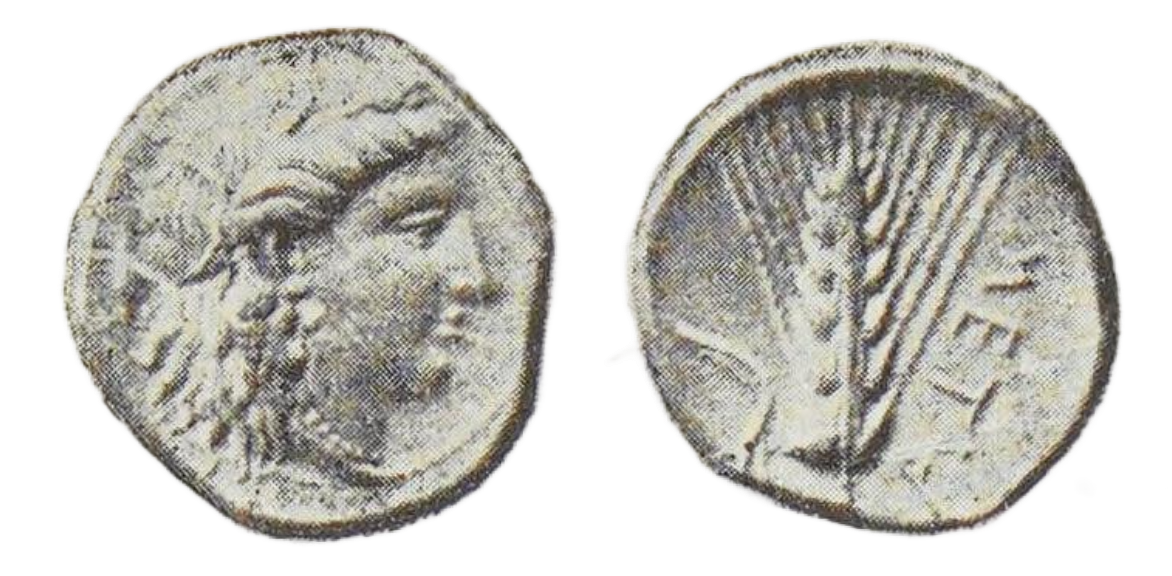
Concerning the identification of the female head[331] that is depicted on most Syracusan coins until the beginning of the 4th century, no agreement has yet been reached. Only in some cases is the identification certain, namely in 36 and 37 ( 58, 59), which have an Athena, in 44 ( 66), where the grain ears clearly designate Kora, and in 28 and 29 ( 78–81), which bear the clear inscription ΑΡΕΘΟΑ. On 28 and 29 ( 46, 47) we must see a Kora or rather a Demeter, if the distinguishing features (long hair for Kora, tied-up hair for Demeter) are correctly established. For the remaining heads the following identifications have been proposed: Demeter, Kora, Nike, Artemis, as well as the nymphs Arethusa and Kyane, which should either encompass all remaining heads or be limited only to individual groups. — Since on all the others except the mentioned numbers 28, 29, 44 the grain wreath or otherwise attributes pointing to Demeter and Kora are missing, these are excluded. We have already rejected the interpretation of the head on 38–40 as Nike[332]. As for Artemis, Head[333] recently allows the possibility that the head in many cases could be an Artemis head, perhaps an Artemis who was identified with Arethusa, as P. Gardner had conjectured[334]. I must therefore, while immediately prefacing that I unconditionally agree with Imhoof-Blumer's interpretation of the head (see p. 271 note 1) as a nymph head, go more closely into the proofs that Jørgensen[335] and Seltman[336] have brought forward for the interpretation of the head as Artemis.
For the identification of the head on the older coins, Jørgensen first makes the point that the similarity in the treatment of the Damareteion type in Syracuse and of the contemporary type of the Apollo head in Leontinoi[337] without further ado also suggests the juxtaposition of the depicted divine heads as Apollo and Artemis. A decisive proof for the identification "Artemis" this is of course not, since the stylistic similarity of both heads indeed does not require a mythological parallelism. For the interpretation as Artemis, Seltman then, starting from the same juxtaposition, here Apollo, there Artemis, has brought into the field the circular line around the head on the Damareteion and some other older Syracusan coins, and on the other hand around the lion head on some coins of Leontinoi: since Apollo was venerated in Leontinoi as sun god, he sees in this line an indication of the sun disk and therefore wants to see in the corresponding line on the coins of Syracuse the moon disk; for this reason he recognizes in the head an Artemis. With this representation of a moon goddess he compares the image on an electrum stater of Kyzikos[338], where a head is depicted on the background of a real disk. A comparison of this disk with the line circle on the coins of Leontinoi and Syracuse is, however, not apt, since the disk and the sharp line circle are quite different and also give the image a quite different appearance; moreover the disk on the Kyzikene stater represents a diskos[339], the image is thus a representation of the same kind as the well-known relief fragment in Athens with the head that stands out from the diskos disk[340]. Seltman's assertion thus lacks probability, and Evans' explanation that this line isolates the head from the surrounding dolphins for purely artistic motives[341] is completely sufficient.
That thirdly the laurel wreath of the Damareteion designates the head specifically as that of Artemis is already therefore not correct, because the wreath is rather an olive wreath, thus the ordinary victor's wreath[342], which on the Damareteion is just as much in place if the head is an Arethusa as if it is an Artemis.
Jørgensen[343] then turns (fourthly) against the interpretation as Arethusa with the following objection: it would be inexplicable why on 28 and 29 ( 78–81) the name (ΑΡΕΘΟΑ) was suddenly placed next to the image, if the depicted deity were the same one that had always been depicted on the coins; but the addition of the name would be comprehensible if the image of this deity had not previously appeared on the coins, a deity who indeed could not be distinguished from the previously depicted ones by clear attributes.
The occurrence of inscriptions with the names of the depicted deities, heroes, etc. on the coins has not yet been precisely investigated. We find on the Sicilian and Lower Italian coins of the 5th and 4th centuries a multitude of coin images provided with name inscriptions, even if we disregard the names that simultaneously designate the city, such as Kamarina, Taras, Terina. Thus we have on coins of Terina the inscription ΝΙΚΑ, on didrachms of Metapontum ΗΟΜΟΝΟΙΑ, ΗYΓΙΕΙΑ, ΔΑΜΑΤΗΡ, ΛΕYΚΙΟ, ΝΙΚΑ, on tetradrachms of Katane ΑΟΛΛΩΝ, to name only a few examples, as well as on the smaller denominations of Kamarina ΙΑΡΙ, of Katane ΑΜΕΝΑΝΟ, of Messana ΦΕΡΑΙΜΩΝ, of Naxos ΑΙΝΟ, of Syracuse ΛΕYΚΑΙ. Partly these names are indeed used almost consistently, so the names on the smaller denominations, partly they designate really different deities, like some of the names on the coins of Metapontum, so that in this case it is uncertain how the unnamed heads are to be identified. However, the tetradrachms of Katane without inscription show just as well an Apollo head[344] as that toward the end of the series appearing once with the inscription ΑΟΛΛΩΝ, and in Terina[345] the Nike is the standing type of the reverse, but only the first time is she designated as ΝΙΚΑ. Since there are thus other examples of the same deity appearing in general unnamed but nevertheless sometimes named, there is no reason to deny this for Syracuse.
After other deities too (Athena, Kora) have appeared on the tetradrachms of Syracuse with retention of the dolphins around them that actually belong only to the water nymph, the character of the Arethusa heads as water nymph then emerges somewhat more sharply: the decadrachms of Euainetos give her a reed wreath[346], and on the last tetradrachm group ( 88–104) the flowing hair seems intended to evoke the impression of a water nymph. If we further note that on the electrum coins from the second half of the 4th century the Artemis appears with characteristic subsidiary marks (quiver and bow) and without dolphins, no reason seems to remain to regard the heads on the tetradrachms as those of an Artemis. We therefore hold them to be a nymph and identify them — since no point of reference has been found for the reference to the nymph Kyane, to which Imhoof still alludes[347] — as they are identified on 78–81: Arethusa.
In the precise fixing of the time around which the tetradrachms of Syracuse discussed here were minted, various divergent opinions prevail, even if a certain agreement has been reached that these coins come from the last half of the 5th century. But when their coinage began, opinions still diverge on this, and likewise on how long their coinage lasted. The investigation by Head[348] on the chronology of the coins of Syracuse, which was epoch-making in its time, has indeed otherwise achieved general validity, but precisely regarding the dating of the coins from the flowering period, which Head here places around 406–345 BC, other opinions have become dominant. A radical change in the dating was proposed by Evans[349] in his fine and precise investigation "Syracusan Medallions and their engravers" and supported with abundant material both from the history of Sicily, especially of course of Syracuse, and from the coinage in stylistic respects. The datings that appeared later also build in the main on Evans, even if they approach here and there more or less Head's old classification; such datings have been offered by Holm[350], Hill[351] and Headlam[352] and Head[353] too has abandoned his old classification, without however completely adopting the newer views.
Head's original conception is that the flowering period of the coinage of Syracuse falls mainly in the reign of Dionysios I. Fairly until the siege of Syracuse by the Athenians the advanced transitional style would have lasted and only after the great victory would the first artists of the new style who signed their coin dies have appeared in Syracuse, such as Eumenos, Soson (correctly Sosion), Phrygillos, Euainetos, Euth, in order to develop the new style to its full flowering during the reign of the tyrant Dionysios.
That this dating of Head's, insofar as it concerns the coins of the flowering period, is not correct, Weil[354] has already shown, by pointing to the Syracusan influences that are perceptible in the coins of such Sicilian cities that were destroyed in the great Carthaginian storm after 410 BC. Starting from this point, Evans then developed the question further. He finds[355] that Euainetos' tetradrachm head 24 can hardly be younger than 425 BC, because Segesta imitated it about 416–413, and places[356] the origin of the die of ΕYΘ (15) in the year 420 BC. Starting from these dates, he finds that the beginning of the period with artist signatures is not to be placed later than 440 BC. He has the tetradrachm coinage end soon after the beginning of the reign of Dionysios.
Against this dating some weighty objections have been made, and Holm[357] has assumed about 430 instead of 440 as the beginning of the flowering period, to which Hill[358] and Regling[359] have agreed. In earlier research the older tetradrachm coinage in Syracuse and its development has not been sufficiently taken into account in the treatment of the question around what time the so-called flowering period, the time of the signing artists, begins. Only Headlam[360] has drawn attention to the fact that this circumstance too must be observed. We have in the coinage of the Damareteion a fixed point (480 BC), and even if the development of art in this century proceeded with lightning speed, the time span 480–440 BC, as Evans wants it, will nevertheless be too short for such a great development as that from the Damareteion type to the first tetradrachm of Sosion, quite apart from the fact that then the coinage too with its many variants and numerous die linkages in this time would have been disproportionately richer than in the following years[361]. But if we extend the transitional period by about 10–15 years, it corresponds to the development and the richness of the coinages significantly better.
To about the year 425 BC or rather a couple of years earlier, as the starting year of the signing artists, we are brought, as it seems to me, by several other circumstances as well. We have seen how strong the influence of the Syracusan coining art on the other Greek cities of Sicily has been and how the new art is also perceptible in cities where a direct influence from Syracuse was not demonstrable. Among the more significant Greek cities that minted coins in the flowering period, however, as we have seen, Leontinoi occupies a divergent position. Its coins have gone through the entire earlier development, but only the onset of the flowering period is still perceptible on them; then they cease. Since there is no reason to assume that the artistic development in Leontinoi would have been considerably slower, it is clear that the coinage in Leontinoi ceased still at the beginning of the flowering period. Holm[362] would like to place the cessation of the Leontine coinage already soon after the severe distress of the city by the Syracusans in the year 427 BC. Hill[363] however has the coinage last until 422, the year of the destruction, and Headlam[364] and Head[365] agree with him; on this circumstance Headlam builds his placement of the beginning of the flowering period only shortly before 420, since he (wrongly) also finds no traces of the flowering period on the last Leontine tetradrachms. The cessation of the coinage of Leontinoi now cannot be placed earlier than in the year 422 in connection with the destruction of the city, but since the last coins stand on the same level as the oldest Eumenos tetradrachms in Syracuse, the so-called flowering period in Syracuse must have begun at the latest 425 BC, but probably still a couple of years earlier.
Evans[366], to whom Hill[367] has agreed, introduced a new element into the debate in one of his later essays, by placing the die of ΕYΘ (15) with the Skylla in the exergue right after 425 BC, since he sees in the Skylla an allusion to the naval victory that the Syracusans and their allies won over the Athenians in that year. As we have seen, these tetradrachms (46–48) and the tetradrachms of Euarchidas and Phrygillos (49–56) must be brought chronologically close to each other. This latter group now also has a feature that has been related to a naval victory. Salinas[368], who was the first to read the signature ΕYΑΡΧΙΔΑ correctly, sees in the object that the Nike holds here in the left hand an aplustre and conceives the aplustre as a reference to the naval victory of the Syracusans over the Athenians in the year 413 BC in the great harbor of Syracuse that decided the war. He draws attention to the fact that the quadriga is driven not by an ordinary driver, but by a female driver who holds a burning torch in her hand and probably represents a goddess ("divinità") to whose protection the Syracusans owed the victory. Evans[369] follows the explanation that Salinas has given, and draws attention to further examples of the same type on Syracusan tetradrachms, whereby he says that a specimen of the British Museum is falsely described in the catalog[370], in that the attribute of the Nike is called "a palm". It has not yet been established, however, whether the explanation of the attribute as aplustre is correct. The aplustria that one otherwise finds on ancient coins, reliefs, etc. nevertheless have a different appearance than the object discussed here. There are indeed on the coins two different types of the aplustre to be found, of which the one, which for example appears on coins of Phaselis[371], Corinth[372] and Taras[373], shows a strong curvature, while the individual pieces run parallel to the end; on the other hand the other type shows richer development: the individual pieces separate from each other at the tips and bend forward, after they have all together, as on the other type, bent backward first. This type is found on the coins of Demetrios Poliorketes[374], Byzantion[375], Taras[376] and on Roman denarii of Servius Sulpicius, Faustus Cornelius Sulla and C. Cassius. The first type seems, judging by the age of the coins, to be the older and also offers the greater similarity with the object that Nike carries on the Syracusan tetradrachms in question; but it must not be left unobserved that the only one of these aplustria that is held as an attribute in the hand like here, that of Taras, is held in a different direction than on the Syracusan tetradrachms, while on the coins of Phaselis the aplustre is connected with the ship and on the coins of Corinth it appears as an independent subsidiary mark. The other, more richly developed type, which is mostly carried by a hero or god, and indeed held forward, offers on the other hand no similarity with the object on the Euarchidas dies.
To these considerations about the uncertainty of the interpretation as aplustre now comes the fact that on the ΕYΘ die (15) the Nike holds in the left arm an object that is unconditionally to be connected with the attribute of the Nike on the Euarchidas dies. The only difference lies in the fact that on that one the Nike holds it in the arm, on these she extends it forward. The position of the device on the first die is now however that in which the palm branch of the Nike is usually depicted, and, as said, the form would allow the palm branch just as well as the aplustre. The form is indeed not the usual one for a palm branch either, but branches of this kind are also easily found on the coins. The possibility must therefore be admitted that we have on these dies no aplustre, but a palm branch. Even then one could of course seek the reason for the appearance of this object in a won victory, for which the formation of the driver deviating from the usual on both die groups would also speak—but the reference to a naval victory is unprovable.
As said, Salinas and Evans want to find on 49–56 a reference to the naval victory of the Syracusans in the year 413, while Evans relates No. 46–48 (ΕYΘ) to 425 (above p. 278). Since these, however, as the decadrachm coinage shows, conceived their victory at the Assinarus as the final one, they will hardly have celebrated the harbor victory in addition through special coins. That they, still during the siege, immediately after the first victory at sea, about mid-July, would have decided on a special coinage of tetradrachms for this victory, is hardly conceivable; for this victory was not yet so decisive, the siege still continued, and the means of the state would hardly have allowed such a coinage during the siege. It seems to me that we should see in the attribute of the Nike on 46–48, 49–56 only a general reference to a victory and the liberation of the city; but the Skylla on the die of ΕYΘ (46–48) could allude to a naval war—admittedly not to that of 425, but to that of 413. For 46–48, which we indeed connect temporally directly with 49–56, must be related to the same occasion as these; and for these (49–56) I do indeed believe that Salinas and Evans are right with the placement right after 413, even if their reasons do not suffice for me. As the preceding description of the coin dies has shown, the greater part of the older dies from the flowering period are connected with each other through linkages (10–45) and still the group of ΕYΘ (46–48) is connected with these. But then a new series begins, which also distinguishes itself from the earlier ones by the (albeit soon abandoned again) placement of the head on the obverse die. This break with tradition is striking, and I believe that it is precisely to be explained by the events in the war years 415–413. The following circumstances also speak for this: the greatest number of tetradrachms from a die pair show 37 (31 pieces), 43 (24 pieces) and 46 (27 pieces), and while we know on average seven specimens of each number, the average number in group 34–45 is about 10, or if we leave out the tetradrachms that come from reverse dies actually still belonging to the previous group (25–33), the average rises to 13. The number of tetradrachms that have come down to us from each number rests of course on various circumstances, and larger finds can without doubt cause changes in this; it nevertheless seems probable that the large number of specimens that have come down to us from well-struck die pairs is based on stronger coinage. In this connection it also stands out that especially the two dies that were used for 37 (12 and 23) remained in use even after they had suffered extremely severe damage and were actually already unusable. This is well explained by the placement of the dies of group 34–45 in the years immediately before the war with the Athenians and by their use still in the war years, in which the activity in the mint at Syracuse cannot have been normal. After the victory was won, a new coining activity began, initially still with very strong coinages (46–48) and partly with old dies (26; 48).
It also stands out that precisely this first coinage after the victory of the Syracusans has a head of Kora on the reverse instead of the hitherto solely used Arethusa head. If we recall what significance the Demeter and Kora cult had not only in Syracuse but in all of Sicily[377], it does not seem impossible that the Syracusans, in the feeling of the significance of the struggle with the Athenians, wanted to designate themselves through the placement of the Kora head on these coins as the champions of all of Sicily and its freedom in the struggle against the foreign intruders. Hardly twenty years later, on an honorary decree of the Athenians for Dionysios, τὸν Σικελίας ἄρχοντα, an Athena who extends her hand to Demeter was placed as representatives of Athens and Sicily[378]. — The temporary appearance of Kora as driver on the chariot sides of Euainetos (30–33) and on 34, 20 and 21, after the Arethusa head had again taken its old place instead of the Kora head, also seems to me to speak for this conception.
If therefore the appearance of Phrygillos and Euarchidas must be placed right after 413, this agrees well with the placement of the beginning of the flowering period around 425 or a couple of years earlier. The series of tetradrachms from this period is indeed relatively rich, but nevertheless not richer than that of the following period, and it creates no difficulties to conceive of it as having originated in 12–15 years.
The period after the final victory over the Athenians is characterized in Syracuse initially by a very lively coining activity, whereby foreign artists too have been active, such as Phrygillos, whose works were created immediately after the victories. The Carthaginian invasion of Sicily does not seem to have had an effect on the coining activity, and however hard pressed Syracuse has been at times, it has nevertheless come through relatively well, even if civic freedom disappeared in the process. Therefore it appears remarkable that Evans has the tetradrachm coinage cease after the accession of Dionysios, although the decadrachm coinage continued still further. The later scholars[379] have also expressed their doubts about this dating, and Evans[380] too has modified his earlier statements after the tetradrachm 106 became known, insofar as he now admits that this isolated tetradrachm can still have been minted during the reign of Dionysios; but in this he sees only an exception and in the main he still upholds his dating. It will be correct that, if we had the flowering period begin already around 440 BC, its end too could be placed about 405 BC. But if it, as I believe, begins about 10 to 15 years later, it will be difficult to find room for the tetradrachm coinage of this period if it ends around 405.
Consideration of the imitations can contribute to deciding until when the Syracusan tetradrachm coinage extends. On the Siculo-Punic coins we encounter imitations after the coins of many Sicilian Greek cities, but mainly nevertheless after Syracusan coins, most of all after the decadrachm type of Euainetos. It is indeed comprehensible that the Punics took the decadrachms rather than the smaller tetradrachms as models for their coins, just as precisely the decadrachm type of Euainetos has also had an extraordinary influence far outside Sicily, an influence that is not limited only to coins, but also extends to the ornamentation of ceramics etc.[381] But apart from the decadrachms, many of the tetradrachms of the flowering period have nevertheless also been used as models. And indeed among the Siculo-Punic coins the older ones follow Syracusan tetradrachms, beginning with the older types of Eumenos, while the younger ones mainly imitate the decadrachm types of Euainetos. Among the tetradrachms of the flowering period, however, the group with "flowing hair" (88–104) occupies an exceptional position; for however richly it has been coined, only isolated examples are found[382] of it having been imitated by the Punics as well, just as it has also exerted no influence on the coins of the Sicilian Greek cities. It is indeed true that they are not artistically outstanding, but the explanation hardly lies in this, for the Punics have indeed also imitated the older, artistically insignificant Eumenos types. Rather the explanation lies in the fact that this group among the tetradrachms falls mainly only in this group (88–104, along with 105, 106) in the time of the plenitude of power of Dionysios. — Into this time Evans[383] now wants to place a part of the decadrachms; these, however, stand in the majority rather on the same developmental stage as the tetradrachms of our Period II and as the last coins of the other Greek cities in Sicily, whose coinages cease between 409 and 399. On some decadrachms of the type of Euainetos[384] the duller execution that is so characteristic of our Period III is indeed already perceptible, but mainly the decadrachm coinage will have proceeded in the last decade of the 5th century. In no case can it be thought that it was continued from "old dies" until the end of the reign of Dionysios; for the general experience is that the ancient coin dies were quickly worn out and had to be replaced by new ones at quite short intervals, and our investigation of the tetradrachm coinage of Syracuse confirms this observation fully; for the consumption of tetradrachm dies in the treated period is extraordinarily strong, although here and there very severely damaged dies have been in use.
The coins of Period III stand isolated among the coins of Greek Sicily, their style is not found on the coins of the other Greek cities: with the strong stylistic influence of the Syracusan coinage art still another proof that the coins of this period are minted at a time when the other cities have ceased with it. — The coin finds give no certain answer how long these tetradrachms have been minted. The find from Santa Maria di Licodia[385] possibly contained from group 88–104 one specimen in good condition, among 5 other Syracusan tetradrachms that were in worse condition and of which some were significantly older than the decadrachms that formed the main part of the find. The find from Contessa[386] contained a couple of pieces from this group in good condition alongside an Euarchidas tetradrachm that was somewhat worn, and others whose condition is unknown. The remaining coins from this find belonged to various epochs; partly they were significantly older, such as those from Katane[387] and Messana[388], partly they belonged to the youngest coinages of the respective cities, such as those from Segesta[389]. The dating of this find is still uncertain, for while Evans[390] wants it placed in the year around 400, Salinas[391] places it in the year 387 or only a little earlier. The purely numismatic circumstances cannot decide in this matter.
For the possibility that Dionysios nevertheless continued the tetradrachm coinage longer than Evans wants to admit, a general consideration also speaks that has not been sufficiently observed. It is hardly conceivable that a tyrant who bases his power on mercenaries would not have paid these with his own money, but would have used all kinds of older domestic and foreign money and unminted silver and gold for pay, as Evans assumes. That he then provides the money minted by him not with his name, but with the city name, corresponds only to the practice to be established in all parts of the Greek cultural world of the so-called tyrants: they do not place their name on their money, quite in contrast for example to the contemporary tribal kings in Macedonia and the dynasts installed by Persian favor[392]. The manipulations to procure money that are told of Dionysios in the pseudo-Aristotelian Oeconomica furthermore also give no sufficient reason for the assumption that he had ceased entirely with the tetradrachm coinage; they only show that he was not particular in his means. From the words in the Oeconomica it seems to emerge that Dionysios by countermarks would have doubled the value of the money, but since until now not a single such tetradrachm has been discovered, this story does not seem to be true. Also the assumption that he would have minted worse silver or even tin coins finds no confirmation whatsoever through the coins, and the existence of a copper core from a plated decadrachm also does not prove that Dionysios really had plated coins manufactured; we do not know indeed whether this "decadrachm" came from the same dies and thus from the official mint at Syracuse as the genuine decadrachms; it can indeed, like most ancient " erati", be the work of a private counterfeiter. Now in the literature Dionysios is presented as the worst of all tyrants, and since among the characteristics of the tyrant in the tyrant-hostile rhetorical writings also include dishonest manipulations with the monetary system, a part of these stories about Dionysios can come from the general rhetorical armory against the tyrants[393].
It is until now impossible to say how long the tetradrachm coinage may still have lasted, but it must be admitted that Dionysios himself ceased with it later. One possibility, which has much in its favor, is that he, after he reached the long peace situation in the year 387, no longer found it necessary to mint his own money, already because he no longer needed so much money for his mercenaries; but this cannot be proven with certainty.
Index of Dies and Die Combinations
| Number of Coins | ||||||||||||||
|---|---|---|---|---|---|---|---|---|---|---|---|---|---|---|
| Obv. | Rev. | No. | Qty. | Obv. | Rev. | No. | Qty. | Obv. | Rev. | No. | Qty. | |||
| 1 | 1 | = | 1 | 11 | 12 | 23 | = | 37 | 31 | 25 | 50 | = | 72 | 3 |
| 1 | 2 | = | 2 | 2 | 12 | 20 | = | 38 | 2 | 26 | 50 | = | 73 | 3 |
| 2 | 2 | = | 3 | 2 | 13 | 23 | = | 39 | 7 | 26 | 51 | = | 74 | 15 |
| 2 | 1 | = | 4 | 6 | 13 | 20 | = | 40 | 1 | 27 | 46 | = | 75 | 3 |
| 2 | 3 | = | 5 | 5 | 13 | 24 | = | 41 | 6 | 27 | 52 | = | 76 | 1 |
| 3 | 4 | = | 6 | 1 | 14 | 24 | = | 42 | 14 | 27 | 49 | = | 77 | 16 |
| 4 | 4 | = | 7 | 6 | 14 | 25 | = | 43 | 24 | 28 | 53 | = | 78 | 8 |
| 4 | 5 | = | 8 | 1 | 14 | 26 | = | 44 | 8 | 28 | 54 | = | 79 | 7 |
| 4 | 6 | = | 9 | 2 | 14 | 27 | = | 45 | 7 | 29 | 53 | = | 80 | 5 |
| 5 | 7 | = | 10 | 1 | 15 | 28 | = | 46 | 27 | 29 | 54 | = | 81 | 10 |
| 5 | 8 | = | 11 | 3 | 15 | 29 | = | 47 | 17 | 30 | 55 | = | 82 | 22 |
| 5 | 9 | = | 12 | 2 | 15 | 26 | = | 48 | 4 | 30 | 56 | = | 83 | 6 |
| 6 | 9 | = | 13 | 5 | 16 | 30 | = | 49 | 7 | 31 | 56 | = | 84 | 6 |
| 6 | 10 | = | 14 | 1 | 17 | 30 | = | 50 | 1 | 31 | 57 | = | 85 | 4 |
| 7 | 9 | = | 15 | 1 | 18 | 30 | = | 51 | 4 | 32 | 58 | = | 86 | 10 |
| 7 | 10 | = | 16 | 2 | 18 | 31 | = | 52 | 2 | 32 | 59 | = | 87 | 16 |
| 7 | 11 | = | 17 | 5 | 18 | 32 | = | 53 | 5 | 33 | 60 | = | 88 | 14 |
| 7 | 12 | = | 18 | 5 | 18 | 33 | = | 54 | 3 | 33 | 61 | = | 89 | 9 |
| 8 | 12 | = | 19 | 11 | 19 | 33 | = | 55 | 2 | 33 | 62 | = | 90 | 2 |
| 8 | 13 | = | 20 | 12 | 19 | 34 | = | 56 | 3 | 33 | 63 | = | 91 | 7 |
| 9 | 13 | = | 21 | 2 | 20 | 35 | = | 57 | 9 | 33 | 64 | = | 92 | 8 |
| 9 | 14 | = | 22 | 2 | 21 | 36 | = | 58 | 2 | 34 | 64 | = | 93 | 2 |
| 9 | 15 | = | 23 | 18 | 21 | 37 | = | 59 | 2 | 34 | 62 | = | 94 | 1 |
| 9 | 16 | = | 24 | 10 | 21 | 38 | = | 60 | 7 | 34 | 57 | = | 95 | 1 |
| 10 | 16 | = | 25 | 2 | 21 | 39 | = | 61 | 13 | 34 | 65 | = | 96 | 13 |
| 10 | 17 | = | 26 | 4 | 21 | 40 | = | 62 | 8 | 34 | 66 | = | 97 | 7 |
| 10 | 18 | = | 27 | 13 | 22 | 41 | = | 63 | 12 | 34 | 67 | = | 98 | 10 |
| 10 | 19 | = | 28 | 6 | 22 | 42 | = | 64 | 1 | 34 | 68 | = | 99 | 2 |
| 10 | 20 | = | 29 | 9 | 22 | 43 | = | 65 | 4 | 34 | 69 | = | 100 | 1 |
| 11 | 16 | = | 30 | 5 | 23 | 44 | = | 66 | 4 | 34 | 70 | = | 101 | 7 |
| 11 | 21 | = | 31 | 5 | 24 | 45 | = | 67 | 1 | 35 | 69 | = | 102 | 5 |
| 11 | 22 | = | 32 | 2 | 25 | 46 | = | 68 | 2 | 35 | 70 | = | 103 | 7 |
| 11 | 17 | = | 33 | 11 | 25 | 42 | = | 68 A | 1 | 35 | 71 | = | 104 | 18 |
| 12 | 17 | = | 34 | 1 | 25 | 47 | = | 69 | 3 | 36 | 72 | = | 105 | 5 |
| 12 | 18 | = | 35 | 1 | 25 | 48 | = | 70 | 2 | 37 | 73 | = | 106 | 2 |
| 12 | 19 | = | 36 | 11 | 25 | 49 | = | 71 | 2 | Total: | 697 | |||
| Obv. | Rev. | No. | Qty. | |
|---|---|---|---|---|
| 38 | 74 | = | 107 | 2 |
| 38 | 75 | = | 108 | 1 |
| 39 | 76 | = | 109 | 1 |
| Total: | 4 | |||
| Obv. | Rev. | No. | Qty. | |
|---|---|---|---|---|
| 40 | 77 | = | 110 | 8 |
| 41 | 78 | = | 111 | 1 |
| 42 | 79 | = | 112 | 1 |
| 43 | 80 | = | 113 | 1 |
| Total: | 11 | |||
Overview of the Plates
Overview of the Specimens Illustrated on the Plates
according to the running numbers of the coin catalogue.
P. 46, in the description of Rev. 42, add "In the neck angle K".
P. 80 item 3, under YPAKOIΩN write 36 instead of 35, 37, and under YPAKOIO write 35, 37 instead of 36.