This English translation of Erich Boehringer's magnum opus Die Münzen von Syrakus (1929) makes accessible one of the most influential works in Greek numismatics. Combining meticulous die analysis with a comprehensive catalog of issues, Boehringer traced the artistic, political, and economic development of Syracuse across the sixth and fifth centuries BCE. His study remains an indispensable reference for understanding the coinage of ancient Sicily's greatest city and its place in the wider history of Greek art and monetary culture. The complete illustrated catalog with coin images and identifications is available as a companion resource.
Central to Boehringer's reconstruction was his interpretation of the Demareteion dekadrachm, which he connected with the account in Diodorus XI 26.3 describing how Gelon's wife Damarete, rewarded by the Carthaginians after the victory at Himera, struck a commemorative coin from her golden crown. This identification served as a fixed chronological point for his entire sequence of Syracusan issues.
The chronological framework proposed by Boehringer was later re-examined, most notably by Colin M. Kraay, who first advanced the argument for a later dating of the Demareteion. Kraay initially suggested a date between 470 and 460 BCE, before settling on 465 BCE as the most likely date. Subsequent scholarship, supported by hoard evidence and stylistic analysis, has generally accepted a date within the 470–460 BCE range, with the present editor suggesting a date of 469/468 BCE under Hieron I. The coinage Boehringer discusses is therefore typically confined to the period c. 490–425 BCE, though Syracusan minting continued beyond this range.
Selected references:
- Colin M. Kraay, Greek Coins and History: Some Current Problems (1969)
- R. T. Williams, The Demareteion Reconsidered (1972)
- Colin M. Kraay, The Demareteion Reconsidered: A Reply (1972)
- Carmen Arnold-Biucchi, The Randazzo Hoard 1980 and Sicilian Chronology in the Early Fifth Century B.C. (1990)
- Giacomo Manganaro, Dall'obolo alla litra e il problema del "Demareteion" (1999)
- Sebastiano Paolo Maltese, I tetradrammi di Leontinoi. Dinamiche produttive e storico-artistiche (2023)
Table of Contents
In memory of my brother Paul, fallen in Flanders 1917
The present study was submitted in its essential components to the Würzburg Faculty of Philosophy as a doctoral dissertation in autumn 1925. It has subsequently been expanded by all material that had not been accessible to me in originals or plaster casts. It arose from research into the origins and reasons for the transformation of the archaic style into the classical. Of this question that initially dominated me, not much is still recognizable, although it formed the invisible and lasting foundation and helped me to summon the patience for such a lengthy work. It represents the first part of a treatment of the entire coinage of Syracuse.
It is appropriate here to thank the owners of private collections and the curators of public collections for the great trouble they were willing to undertake in support of my work. Without the accommodation and understanding that, with few exceptions, is exemplarily great among professional as well as amateur numismatists, compared to other branches of scholarship, it would have been impossible to bring such an investigation to fruition.
I am greatly indebted to the American Numismatic Society, Balliol College in Oxford, the Basel and Bern Historical Museums, the Coin Cabinet of the State Museums in Berlin, the Boston Museum of Fine Arts, the Royal Library in Brussels, the Fitzwilliam Museum in Cambridge, the Museum in Catanzaro, the Dresden State Coin Cabinet, the Archaeological Museum in Florence, the University of Glasgow, the Gotha State Coin Cabinet, the Royal Cabinet in The Hague, the Hamburg Kunsthalle, the Baden State Library in Karlsruhe, the Royal Coin Cabinet and the Thorvaldsen Museum in Copenhagen, the University of Leipzig, the Coin Cabinet of the Hermitage in Leningrad, the Coins and Medals Department of the British Museum in London, the Milan Coin Cabinet, the State Coin Cabinet in Munich, the National Museum in Naples, the Ashmolean Museum in Oxford, the National Museum in Palermo, the Paris Coin Cabinet in the National Library, the Stuttgart Museum of National Antiquities, the National Museum in Syracuse, the University of Tübingen, the Kunsthistorisches Museum in Vienna, the Municipal Museum in Winterthur and the Central Library in Zurich,
the ladies Miss Bronstedt, Franciosi, Richter and Werner
as well as the gentlemen von Abel, Allen, Ashmole, Jean Babelon, Baldwin, von Bahrfeldt, Bataille, Beatty, Beazley, Bernhard, Bernhart, Börger, Conte Bordonaro, Brooke, Felix Burckhardt, Fritz Burckhardt, Caskey, de Ciccio, Columba, Dieudonné, Engeli, Evans, Feuardent, Finckh, Florange, Forrer, Forsdyke, Galster, Gabriel, Gaebler, Gaettens, Giesecke, Goessler, Grose, von Gwinner, Habich, Heilbronner, Helbing, Hill, Hirsch, Holmberg, Jameson, Kerkwijk, La Fuye, Langlotz, Lederer, Lloyd, Macdonald, Major, Mainzer, Maiuri, Mattingly, Miller, Minto, Münsterberg, de Nanteuil, Newell, Noe, Oman, Oppermann, Orsi, S. Pennisi Barone di Floristella, Pfuhl, Platt, Pridik, Riechmann, Robinson E. P. R., Robinson E. S. G., Rodenwaldt, Roller, Rossi, Salerno, Schwabacher, Schwinkowski, C. T. Seltman, Serafini, Sinopoli, Tourneur, Tudeer, Vicenzi, Watzinger and Wertheim.
The work could not have been published if the Emergency Association of German Science through Privy Councillors Wiegand and Sigismund had not taken an interest in the investigation and generously agreed to assume a subsidy for the printing costs.
I would particularly like to thank at this point Privy Councillor Bulle and Professor Regling, who have supported me unfailingly and who will often and hopefully always gladly recognize themselves in this work.
Among the coins of the Greek cities, there are probably none that have been collected and loved by private individuals and researched by scholars for so long and with such great enthusiasm as those of Syracuse. First because of their beauty, then because of the variety of dies, and finally because they offer the opportunity to engage playfully or learnedly with the artists' signatures that appear here alone in greater numbers. The last reason, together with the artistic taste that prevailed for nearly a century, has resulted in the coins of the late fifth and early fourth century B.C. being examined, appreciated, and purchased with particular thoroughness. Less attention has been paid to the preceding period, and when it has been addressed, it has always been with the attitude that it represents a precursor, a preliminary stage of the "flowering." This is most clearly evident in the classification that the Syracusan coins received in the British Museum catalogue by Head. There, first comes the archaic period, then that of "transition," and then the "flowering." Today we see things differently. We no longer place an art that is contemporary with the Parthenon in the transitional period; for us it is Classical. And the period shortly preceding it also divides for us into individual sections: that of transition, where one wavers between two styles, and that of the severe style, which is certainly just as firm and cohesive as the Classical itself. But flowering exists in every stylistic period that has fully realized itself. There are, of course, epochs and phases; but each new age will see differently, evaluate differently, and usually also divide differently.
Thus the entire period of the archaic and transitional time in this present work on the coins of Syracuse from one century, approximately 530-435 B.C., is divided into six sections or groups, which one could call, if one wishes to give names, early archaic, mature archaic, late archaic with signs of decline, period of the severe style—whereby the beginning (Series XIII) is distinctly a transitional stage—period of the early classical and mature classical style. Between groups II and III, between IV and V, and between V and VI there are obvious overlaps; this manifests itself clearly in style, but also emerges from the so-called die-linkages.
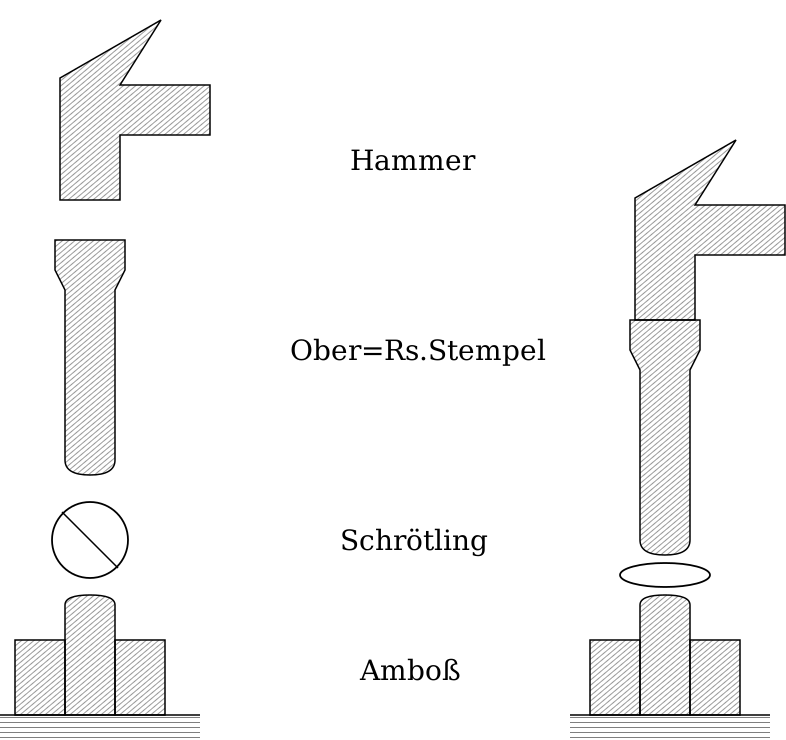
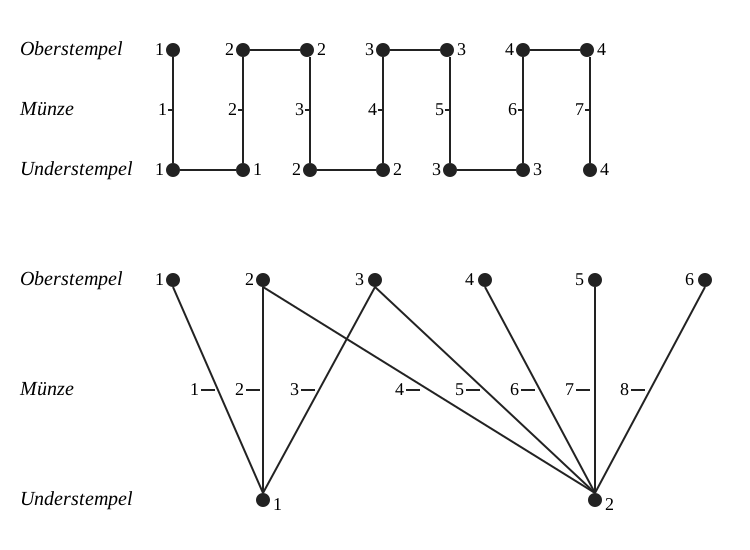
In coin minting of that time, as we can now determine retrospectively, the procedure was as follows. Two usually conically shaped metal pieces, about twenty centimeters long, were cut, and on one of the transversely cut surfaces a negative image was engraved in each. One of these metal pieces, one of these dies, was set in an anvil in such a way that the engraved image faced upward. On this die one placed, probably with tongs, a prepared, heated metal piece that was to become the coin, the "flan," and above it the second die. With a hammer one struck the upper die a violent blow, so that both die images impressed themselves into the flan (see Fig. 1). Through this violent procedure the upper die was destroyed more quickly than the lower one; it had to be replaced often. Thus it happens that we possess coins that have a common lower anvil die and two, three, four, or even more different upper punch dies; we call these coins die-linked with one another. After some time of striking, the lower die would meanwhile also break, often when the upper die that had been taken into use last was still usable. Now the anvil die was in turn replaced, but the punch die was still used further. Thus it happens that we also possess coins that have a common upper die but different lower dies; these too are therefore die-linked. If we now take both facts together, we are, provided the coins of a city are abundantly preserved, in a position to establish closed meandering coinage sequences. If we possess such sequences, it is in and of itself not yet possible to say in which directional order the dies were used, whether from right to left or vice versa, and thus we cannot yet establish a relative chronology. Stylistic characteristics will often point the way, but errors may easily arise here. We can only establish the temporal succession with certainty when injuries appear in a die, that is, when injuries appear on the coins that must have already been present in the die. If we have, for example, three coins in which the reverses each bear the same image, once without an injury, then with a minor one and then with a severe one, we know with absolute certainty that 2 follows coin 1, and 3 follows 2.
The Greeks often continued working for a long time with damaged dies, whether out of thrift, negligence, or necessity, when money was urgently needed and there was no time or artists available to produce new dies. In addition, smaller injuries could hardly be noticed during rapid work.
On the basis of the technical production of coins, it is therefore possible, with abundantly preserved material, to establish closed chronological sequences. However, such abundant preservation is only rarely the case. From the early period of coinage in Syracuse, for example, on average only 2 to 3 specimens per die pair are known to us. It is clear that regular sequences cannot be established in such cases. Even later, when we possess considerably more coins with the same dies, it is not possible to establish completely closed sequences, especially when for some reason the coinage was interrupted, whether because there was war or because there was no need for money. In such cases, if there is no die-linkage whatsoever, style alone must decide.
The period of Syracusan coinage to be treated here is, as mentioned, divided into six groups. The coins themselves will provide the justification for this. The groups are in turn subdivided into series, also according to stylistic criteria. Depending on the tempo of artistic development, more or fewer series fall within a group. For practical reasons they are numbered consecutively. Group I contains Series I and II, Group II contains Series III, IV, V, and so forth. Sometimes it has been possible to subdivide a series again, for example the large Series XII into Series XII a, b, c, d, and e. The coins treated are also numbered consecutively, in such a way that each occurring die pair receives a number of its own. In the same way the sides are numbered, the obverse dies with a prefixed V, the reverse dies with a prefixed R. Number 16, for example, has V 12 and R 8. On the plates, regrettable as the multiplication of letters is, both catalogue and die numbers are recorded. Under number xE with or without VxE and RxE (cf. numbers 15 E, 104 E, 239 E) are inserted coins that arrived belatedly or were subsequently added. Under number x a are grouped those specimens that could not be identified due to poor preservation, furthermore obverses or reverses appearing only singly in publications, or small denominations that were not worth illustrating completely. The obverses and reverses of the coins are placed side by side on the plates. When die connections, linkages, occur, then the coins in question are connected with one another by small lines that are attached to the die numbers and indicate the direction. The arrangement is generally made so that what is chronologically earlier, whether provable or presumed, stands at the front. If an obverse appears with several reverses, the obverse is placed once at the head of the linkage, and then all reverses follow one after another. If the coin image has not been completely represented on the flan, a supplementary specimen is added where possible. Number 10 has die V 8 as obverse, R 6 as reverse. Number 11 has V 8 again as obverse, but R 7 as reverse. On the plate this looks as follows:
that is, R 6 and R 7 have V 8 in common. If reverse dies that have already appeared earlier reappear later with a new obverse die and then again in first position, they are placed before the obverse die and have two lines before the die number, so that the eye can immediately read the situation. If they reappear but not in first position with the new obverse die, they are arranged like the others, only provided with the double line from the die number like those placed at the front. Number 12 has R 6, which we had already encountered at number 10; number 13 has R 7, which is already known from number 11. But new in both cases is the obverse die V 9. This looks as follows:
During striking, injuries frequently occur that establish or facilitate establishing the sequence. As a test, in this case the obverse of that coin on which the injuries are particularly clear is sometimes illustrated once more at the end of the linkage. The reverse die of number 14, R 7, had already appeared once, consequently it is placed before the obverse. Number 15 also has R 7, but here a fine injury on the ridge that separates the two lower squares is larger; moreover, a small injury has newly appeared before the nose. Therefore R 7 is illustrated again at number 15.
In the catalogue, on the left, first comes the running number, then that of the obverse, and lastly that of the reverse. Then follows the description of the obverse, below it in smaller letters under "Remarks" any information about die injuries. The reverse follows the obverse. The description generally proceeds in a fixed sequence. For the obverse: horses, gait, body, heads, Nike, charioteer, reins, chariot box, wheel, pole, exergue line, pearl circle; for the reverse: head, face, hair, necklace, ear and ear ornament, neck section, dolphins (the first dolphin is designated as the one standing above the crown, counting is clockwise). Legend with indication of beginning and distribution. If nothing special is mentioned, the legend is to be read from the inside clockwise. Letters that are not visible on the illustrated coin are placed in square brackets [ ], those that were not visible on any of the specimens that were available in plaster cast in round brackets ( ). Where these occur, there is therefore no guarantee for the letter form.
Below the description are listed the specimens that have become known to me; first those that were available in plaster cast, in alphabetical order. After a double line — || — follow those specimens that became known to me only in publications. It may be that among these there are sometimes specimens that are already listed in the plaster cast series. If a number was known for a specimen, whether of a publication or an inventory, it is given; likewise the weight. Some numismatists will object that this is so frequently missing and that the diameters of the coins are not indicated. The present work could not have been done if consideration had been given to this. Even so, a great measure of patience and accommodation had to be demanded from the curators and owners of public and private collections. The public collections are listed under the city names. The private collectors are listed under their names without city designation, as is the Vatican. If earlier mentions or locations of the coins have become known, these are indicated in each case. The publication specimens could not be taken into account when observing die injuries. Even with originals it is often difficult to establish an injury with certainty as that of the die; with plaster casts even more so, since here slight changes easily occur during production that look like die flaws. By turning the cast so that sharp light cuts across the injury, a judgment is frequently possible. With illustrations, however, it is best to refrain from a determination. Coin descriptions without illustrations are not utilized.
In the description of dies, for the sake of simplicity, reference is frequently made to similar ones already described. Depending on the degree of relationship, it is indicated: almost like, similar, similarity with, hardly distinguishable, etc. This cross-referencing has the advantage that similar coins and thus frequently the artists' hands are grouped together. On the other hand, for the collector it is indicated wherein the dies differ; often a difficult determination. Now it may be that with a larger number of coins compared with one another, the last has very little similarity left with the first. This is of no significance, because this comparison is not meant to prove that number 20 is similar to number 1, but only that number 2 is similar to number 1 and number 20 is similar to number 19.
At the beginning of a new series, each time—unless there is a die-linkage or a very great similarity with an earlier coin—a complete description is given; likewise, when a new type appears within a series. At the beginning of individual descriptions, the running numbers where the die in question occurs are listed in parentheses. The indicated divisions in the legend will usually be understood when compared with the image. As a rule, the ventral fin of the dolphins was decisive. The abbreviations appearing in the catalogue are explained in the index.
Series I of the coins of Syracuse is introduced by a piece that stands out both for its distinctive character and its rarity. To date, only one specimen of this die pair has become known. The reverse differs in its design from all later ones in that there is no female head on it. The division of the square is also different from that in the immediately following period. While with dies R 2 to R 17 the square is articulated in such a way that each of the four subdivisions sinks toward one of its corners, and all together look like the blades of a windmill, here the square is divided only by a band cross into four squares sloping slightly and evenly downward on all sides. The entire surface of the flan is kept smooth and slightly concave.
The obverse V 1 bears a quadriga. This image remains the theme of one side on the tetradrachms and decadrachms for over two hundred years. While the female head changes in its meaning, as we can see from the changing attributes, the quadriga as such remains unchanged. A Nike flying above the team is added for closer motivation; the charioteer is sometimes female instead of male in later times and carries torches in her hands; twice Nike herself drives. The team of the first Syracusan coin is heavy and coarse. The horses resemble draft horses rather than racehorses. At first glance one believes one has a biga before one. On closer inspection, however, one recognizes that a quadriga is represented. The artist indicates this partly by increasing the number of legs, partly also only by single or multiple contouring of the one fully visible leg, the one chest, and the one head. We customarily call this contour doubling. It will be better seen on later coins. This doubling is also frequently not limited only to the simple outline; eye, nose, ears, and mane are sometimes also indicated, but not yet here on the first coin. The horses pull a two-wheeled chariot, one wheel of which with its diagonal spoke cross and hub is clearly emphasized. The charioteer stands in a box (δίφρος), whose front wall (ἀντυξ) is carried up high, to arm height. The side rail only goes to the knee and is partially closed, but leaves two ring-shaped openings under the horizontal handle. This side antyx stands perpendicular to the front rail. To the rear the chariot box is open. This is evident from the fact that the charioteer's garment, falling loosely from the buttocks, is visible down to the height of the box floor. A pole is not indicated. What looks like one in continuation of one spoke is a contour doubling of the lower leg. Above the horse's back, at the point where the withers begin, there is a vertical line thickened at top and bottom, which we do not initially understand. From its tip a connecting line runs backward to the front rail of the chariot, whose meaning remains to be explained.
The charioteer stands with his upper body bent forward, but overall leaning back in the chariot; in his hands he holds taut three reins each, which run neatly side by side. They fall down from the hands and in a carefully drawn deep arc over the front rail into the chariot box. Between the head of the charioteer and the heads of the horses the remains of an inscription can be recognized. One still sees a , which by comparison with the later coins is to be completed to , the ethnikon, the so-called legend. The vehicle strides forward to the right at a walk on a simple ground line. The part of the circle cut off by this line, the exergue, is left empty. The entire image was surrounded by a pearl circle; on the right clearly and on the left faintly a part of it can still be seen. The surface of the flan, the blank, is flat here as on the reverse.
The racing chariot type represented on V 1 is the so-called Helladic. Based on vase paintings we are in a position to form an exact conception of the individual parts of such a chariot[1]. We find the technical expressions for it in Homer and Pollux. An Attic vase from the second quarter of the sixth century, the Klitias vase in Florence, may serve us as a model[2].
The chariot box rests on an invisible axle. The wheel consists of four spokes widening toward the hub. Around the spoke crossing a band is woven multiple times and firmly, a strap or a rod. The thin spoke ends set into the double rim are reinforced on right and left by triangular blocks, the cleats. The side rail is closed up to half height. One has the impression that the casing consists of a leather that is pulled up in the middle by a sewn-on flap laid around the side handles. The front rail goes up to arm height as on our coin. The pole, which is attached under the chariot box, passes between the two middle horses and up high to the horses' necks. There it is bent upward and backward; at this point the yoke is tied on[3]. From the tip of the pole a connection runs horizontally backward to the front rail of the chariot. The middle horses are not harnessed to the chariot box; only the two outer ones, the trace horses, are connected right and left by a trace to the chariot box. As a rule this trace is missing. The entire load of the chariot rests on the backs of the horses, and the pull is effected only by means of the yoke laid on. Now, in order to transfer part of the pressure back to the chariot and to prevent the horses from becoming completely free in case of a pole break, the pole tip is connected to the front rail, probably by a strap.
The yoke tied to the pole is wrapped with a softer material so that the harnessed horses do not chafe their withers. Outside right and left of the yoke, rods (οἴηκες) extend upward, which prevent the yoke padding from slipping off and perhaps are also meant to prevent loosely released reins from hanging down. On another team of the same vase the painter, in order to show both rods, has directed one diagonally downward.
The horses are harnessed to the yoke itself with a breast girth, in which the pull lies. So that in a sudden transition from faster to shorter travel the pole does not jerk upward and pull up the breast girth, the breast girth is held fast by a belly strap knotted on the side. The bridle arrangement of the halter consists of a neck piece, forehead, cheek and nose piece, and a chin strap. Where cheek and nose piece and chin strap meet, two straps extend from which the bit hangs. A curb bit is not present and was apparently unknown in antiquity. But the bits were prepared in such a way that they sufficed to keep the horses in check[4]. The mouthpiece is so sharp and rough that the horse had to yield at the slightest pull. The middle thin discs pressed into the tongue. The assumption is plausible that because of this cruel but effective tool the horses always kept their mouths open; this is what the artworks teach (Pernice), and in Greece nothing was done for stylistic reasons alone[5]. So that the trace horses would not lean against the yoke horses, so that they would not "stick," a cross with pointed ends was tied laterally onto the belly girth of the yoke horses[6]. The trace horse is harnessed to the chariot with a trace. This trace first runs through a ring suspended from the side rail, disappears into the chariot box and is wrapped around what is probably a peg-like lateral extension of the chariot floor at the back, pulled upward and knotted to the handle.
The mane of the horses is long, the forelock is tied in such a way that it stands high; the tail end is pulled up and likewise tied. The reins run from the bit to the yoke and then go right and left of the pole connection to the hands of the charioteer. How they gathered before the yoke is shown by another vase painting[7]. Before the yoke there is a ring that appears to be attached to the breast girth and through which a rein of the trace horse runs. Perhaps we can see such a rein gatherer in a bronze piece from the Karlsruhe collection[8]. The reins themselves are sometimes knotted in their first or second third, whereby dragging was to be prevented. Admittedly one thereby gave up influence on the individual horse, but for that the goad, the kentron, might suffice.
After these explanations we understand the representation of the chariot on V 1 better. The vertical line above the withers is either the bent pole end or the rod (οἶηξ) of the yoke on this side. From it the connection to the antyx extends. The ring-shaped openings on the side rail were created by pulling up the casing.
Number 2 has two new dies. The horses of the obverse V 2 are smaller and more restless, and the charioteer is likewise smaller, although the proportion to the horses is the same as with V 1. The legend stands in the same place but is written more carefully; the vehicle stands on a triple exergue line, the middle one of which is pearled. On the reverse R 2 there appears here for the first time, set in recessed in the middle, a small female head, simple in design but expressive in character.
V 3 is little different from V 2. The two sides belong together stylistically. This can already be clearly read externally from the similar exergue line; formed in this way it appears nowhere else again. The little head of the reverse die R 3, however, is clearly different from that of R 2. Another head is represented here; the facial features are more refined. In the technical, artistic design, however, it resembles the preceding one. In both, the eye is given as a dot. Remarkably, R 3 is connected with four other obverses: V 4, V 5, V 6, and V 7. The differences among these obverses are very slight and can only be determined after longer observation, but they stand in clear contrast to the two preceding dies in three respects. The wheel, which there lies flat in the image surface, is here emphasized in strong relief; in place of the three-line demarcation of the exergue a simple line has appeared; the exergue itself is no longer empty but filled in, as if one had hastily carved it out in the negative die. These details now remain in use almost to the end of Group I. Only the last coins, dies V 21, V 22, and V 24, make an exception in this regard.
The sequence of use of the mentioned obverse dies V 4 to V 7 is not established. V 7 may belong at the end because it appears again at number 9. Here the die is damaged before the horse's neck and connected with a reverse die, R 5, whose little head points to a later date in its stylistic execution. The eye is more clearly formed, the lids are carried all the way around, and the former dot has become an eyeball.
Coin number 8 has the obverse V 5 again. The reverse with it bears a little head that resembles R 2 and R 3 in design, only coarser. With V 8 the wheel is flatter than usual, but not formed like that of V 2 and V 3. The reverses R 6 and R 7 connected with it show no essential differences; R 7 is somewhat more pronounced in modeling but nevertheless softer, the head is set evenly into the round. These two reverses appear again at numbers 12 and 13 with V 9. R 6 has here a slight injury in the upper right square that is not yet present at number 10; consequently V 9 must have been taken into use after V 8. The vigorous reverse die R 7 is not at an end even here; it appears with two more new obverses, V 10 and V 11, at numbers 14 and 15. From the enlargement of the injuries present and appearing on it, the sequence of use can be determined with certainty. At number 15 we see that the edge that separates the two lower squares has broken out slightly to the right, and before the nose and mouth there are small swellings. In number 15 E, however, a reverse die R 8 is connected with V 11 that differs substantially from the preceding one. The profile of the little head here is remarkably steeply positioned and the hair strands enclose the head like a helmet. But for another reason this die is significant. It appears four more times, namely with V 13 at number 17, and then with three dies that belong to the following series; it thereby forms the bridge between Series I and II. We will return to this. V 12 at numbers 16 and 16 E resembles V 11; the two associated reverses R 9 and R 9E are similar to each other and are not far from R 7.
Number 17 is the last coin in our first series. With its obverse V 13, the head of the third horse—counted from the one nearest the viewer—comes out further. The rein guidance at an acute angle, as it appears here, is encountered more often and is nothing special. If we survey the coins given so far, we see a noticeable stylistic step between obverse die 1 and the next following one, but among the others there is hardly an essential difference, unless it be of an external nature, like that discussed above between V 3 and V 4.
The little heads on the reverses already show greater deviations. This also lies in the nature of the matter. Indeed, R 3 has a head that seems so advanced that one would most like to place it at the end of the entire series. But that is not possible. Between R 5 and R 7 there is a great kinship that certainly points to the same hand and probably also to the same model. If one attempts to distinguish hands, number 1 should probably derive from an artist who does not appear again, and V 2 with V 3 should be by another; V 4 to V 13 are so similar to one another that they can again be attributed to yet another. R 5 to R 8 belong to the same hand. I suspect the die engraver of R 3 again later.
The second series differs from the first mainly through the form of the ethnikon. On its coins, numbers 18 to 31, everywhere only appears. The artist or mint master who took or prompted the step to this change was aware that the cobbled-together is artistically not very effective and that the small letters do not fit with the other broadly conceived lines. The appearance of the coins also changes a little otherwise, because the charioteer now stands in more correct proportion to the horses and is usually somewhat more removed from the pearl circle. The exergue becomes smaller, but correspondingly also the line available for the vehicle, so that the artist sometimes resorts to placing the wheel entirely on the pearl circle.
V 14 at number 18, one of the most beautiful dies of the entire first group, is connected with a reverse that had already appeared twice in the preceding series, with R 8. But R 8 is connected two more times with a new obverse, with V 15 at number 19 and V 16 at number 22. V 15 will have been used after V 14 because R 8 has injuries at specimen 3 of number 19 that are not yet present at number 18. V 15 appears with another die R 11 again at number 20. The little head of this reverse is, along with that of R 3, the best produced so far. The windmill blades are cut deeper here than usual. R 11 connects again with V 16, and this in turn again with the damaged die R 8.
We gather the following from this linkage: Number 18 was struck. After some time the obverse die broke; it was replaced and that of number 19 was inserted in its place. While one now struck, two more dies were immediately prepared, an obverse and a reverse die, R 11 and V 16. R 11 was taken into use still with V 15 until this obverse die was also unusable; R 8 was still serviceable, and now one struck with it and R 11 on V 16 numbers 21 and 22.
V 17 of number 23 has similarity with V 16, but the distinction is easy to make. The charioteer of V 17 is further removed from the pearl circle and the reins are clearly divided into two groups. R 12 and R 13, which are connected with V 17, appear again with V 18, and this in turn with R 14. An earlier or later cannot be determined here on the basis of injuries, nor with the following numbers 27 to 30, in which one and the same reverse die, namely R 14, has been used. But stylistic reference points are present. With R 11 the tendency appears to make the incised circle and the little head larger than before; R 14 is the largest. V 17 to V 20 differ little among themselves; V 21 and V 22, however, bring an essential innovation. As we mentioned earlier, here the exergue is not recessed and the ground line is formed as a simple line, similar to that of V 1. Even the wheels, which from V 4 onward were always given in very strong relief, recede here as with the earlier V 1 to V 3. The artist of the two new dies clearly reaches back to advantageous old elements. V 22 also carries another reverse die with it, R 15 at number 31.
If one considers the first group as a whole, one can ask oneself whether Series II should not come before Series I. Do the coins with the simple form of the legend not belong to an earlier time? Or can one not at least insert Series II between number 1 and number 2, since V 21 and V 22 have solutions so similar to V 1, V 2, and V 3?
But that is not possible. Apart from the fact that Series I is connected to Series II through its most mature die R 8, no one will want to tear apart Series I with the full legend , and between R 14 and R 2 there is a clear development. A further support for placing Series II after Series I is the appearing in the next Series III also on the obverse as in Series II. The more differentiated form is not always the later one, and that an artist reaches back to earlier work is a frequently recurring phenomenon.
To these two series of tetradrachms there is little small change, as far as known only didrachms, and these only in two dies. Number 32 has on the obverse V 23 a rider who leads a hand horse at his left side. The associated reverse R 16 is designed exactly like the reverse of the tetradrachms. The incised little head completely resembles that of R 2, so that the didrachm must be assigned to this tetradrachm. The nose is raised a tiny bit higher. We have here a uniform emission of different monetary denominations.
Number 33 with V 24 differs from V 23 in the same way as the obverses of Series II from those of Series I. The rider is smaller, as there the charioteer; the legend is abbreviated to . The ground line is formed here as with obverses V 21 and V 22. The reverse R 17 is similar to R 11 and R 12 and comes from the same hand. Number 33 will, as the obverse teaches, have been produced only toward the end of Series II, but on the whole all the dies of Group I cannot be far apart chronologically.
The two didrachms are the only smaller denominations of this period. The small number of dies is striking; the ratio of preserved coins to dies is the same for tetradrachms and didrachms.
If one looks around in Greek art for where stylistically and materially similar representations are to be found, one will think of the clay tablets produced in Corinth in the course of the sixth century[9]. Since Syracuse is a colony of Corinth, a comparison with it is all the more natural. The quadrigae to be found there show a kinship with those of our first group, even though Corinth is more elegant. The arrangement of the horses is the same; to show all the horses, the contours are doubled.
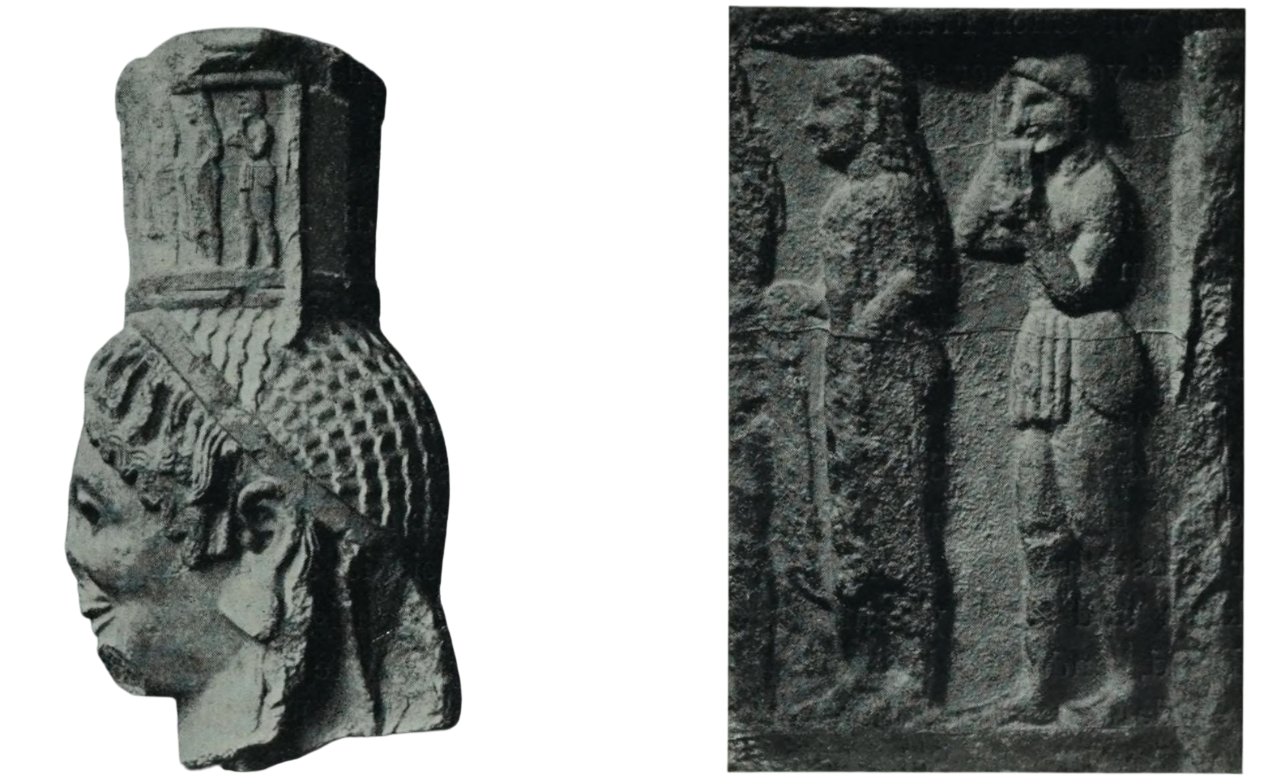
The heads of the deities of the Corinthian tablets Poseidon and Amphitrite have little similarity with the heads of Syracuse. The profile line is not so steep with them, the facial expression more uniform. The clay tablets also lie chronologically earlier. The head of the Croesus column also shows an earlier and also substantially different style. We would gladly draw on it because of its temporal fixability. Most comparable with the Syracusan heads are the heads of the figures that are attached to the polos, the headdress of the caryatid of the so-called Knidian Treasury[10] in Delphi (see Fig. 3).
In the second series it was clearly established that during its duration the little heads of the reverses became steadily larger. In the first series this tendency is already observable, albeit to a lesser degree. With the new group a change now occurs that remains permanently dominant. The quadratum incusum disappears; the head bursts the confining frame and extends over the largest part of the field. This itself is formed slightly concave. All around, four dolphins swim in a circle one behind the other, perhaps indicating in their number the monetary denomination, the four-drachma piece[11]. The ethnikon, again given in its full form, comes onto the reverse. The representation on the obverse also changes substantially in one point, not only stylistically. From now on Nike hovers above the team, having descended to crown the victorious vehicle. She usually flies in the direction in which the horses are running and prepares to crown one or two of them; more rarely she comes toward the charioteer. The victors were precisely the horses. Whoever could maintain and possessed them also received the victory and glory. The charioteer receded in his person[12].
Series III consists of only one obverse, V 25, and four reverses connected with it, R 18, R 19, R 20, and R 21. The stylistic peculiarities of these few dies are so great that a separation from all coins of the earlier and later periods is appropriate. The monumentally conceived head[13] of the reverse R 18 differs from the earlier heads not only in its extent. The earlier ones were refined, delicate, or else boring and dull. This one here is of a positively divine robustness. This nose! What tension lies in the chin! The lips are kept closed with difficulty. The ear is immoderately large. The hair encloses the skull like a tight net. And let us remember that we have a woman's head before us. It is not lacking in refinement and the skin areas are of a rare softness. As if to soften, two wavy thin curls fall from under the ear past a necklace down to the pearl-decorated lower neck line. The powerful dolphins intensify this impression still further. The obverse die shows similar tensions as the reverse. The accents are placed here in the charioteer and in Nike beside the smooth lines of the horses. With all this skill, it means little that the intention to show all the horse heads individually has not quite succeeded. The chariot shows curved forms. The side handle emerges in a curved line from the front rail; at the height of the tail base the pole connection extends. The charioteer is shown from the back. With Nike one might ask whether the second wing is folded downward, in a manner of representation that we find more often with birds, for example on coins of Olympia and Sicyon and otherwise occasionally, as on a black-figured vase in Würzburg with a horse[14]. The well-preserved specimen illustrated on the coin plate shows, however, that the wings are contoured at the top, so that both wings stand upward. The piece hanging to the side under Nike must be a small cloak laid over the shoulder and upper arm. The exergue is left higher than the rest of the field, so that an edge is obtained that serves as a ground line. It is peculiar that on the obverse the abbreviated legend is placed in the exergue, where on the reverse the full ethnikon already stands. It looks as if here the artist, like that of Series II, for reasons of disposition has placed only the abbreviated ethnikon on the obverse, and for clarity's sake has placed the full one again on the reverse, where he could arrange things more freely[15]. In Selinous in a somewhat later period an inscription likewise appears on both sides of the coin, on the obverse Σελινοντίων and on the reverse Σελῖνος. Here, however, the inscription Σελῖνος refers to the depicted river god; a tautology as in Syracuse does not exist there.
The following reverses R 19 to R 21 are variations of R 18. That they follow is evident from die injuries noted in the catalogue. The last one, reverse R 21, has its hair dissolved into rows of pearls, a type of hair representation that is typical for the following period.
Series IV has more dies than Series III. Several artists are active in it. The majority of the dies, above all those of the obverses, are still provided by the same artist who made the dies of the third series. A glance at the coins teaches this without further ado. The team on V 26 and V 27 now appears again directed to the right, as in the first two series; the relief is strong, the horses are restless and vicious. The Nikes are particularly striking. On V 26 a heavy one rows in, laying itself cloud-like over the team; on V 27 one approaches who seems to stamp through the air rather than fly. That the two obverses come from the same hand needs no words. Droll in its solution is R 22. R 23 is more uniform. Both dies have a small head. They come from the same artist who made the two obverses and the reverses R 18 to R 21. With innovations he seeks to expand his art; between the initial and final letters of the legend he places one or two points, so that the eye can more easily make a separation. We know this type of word separation from stone inscriptions. Other artists, like those of R 27 and R 29, imitate this. With R 23 the legend stands outside the more elongated dolphins. R 24 externally connects again to Series III, but the expression is different. R 25 seeks to render the head of R 24 in another way, while R 26 draws from new resources. With the head one might doubt whether this die comes from the previous artist, but the dolphins and above all the legend set with familiar force betray him without further ado. R 27 brings a head that does not display the forms otherwise usual in Syracuse, round, somewhat saccharine and with painfully thin hair. Like an answer to this type the following die R 28 appears; R 29 no less so.
The sequence from R 22 to R 29 is not entirely certain. That R 22 to R 24 belong at the beginning is proved by the absence of injuries on V 26. R 25 to R 27 are fixed in succession. R 28 and R 29 belong at the end for stylistic reasons. The dies R 30 and R 32 connected with V 27 again belong to the familiar master. Through R 24 the new linkage is connected with the preceding one; since R 24 appears here with V 27, where V 27 still has minor injuries, but was used with V 26 when V 26 was still undamaged, the two obverses were in use simultaneously, V 27 however a little later. Striking must have occurred at two minting benches. R 30 and R 32 are dull in comparison to R 24. The excellently preserved specimen number 46, 7 illustrated on Plate 3 gives clear evidence of this. R 31 summarizes all the tendencies of the series.
The smaller denominations belonging to Series IV, didrachms and drachms, are interesting for several reasons. V 28 with its reverses provides proof that the arrangement of the tetradrachms of this series is correct. The regular increase of injuries on it under the elbow, above the croup, and under the tail base establishes the sequence from R 33 to R 36 with certainty, which in turn can be clearly assigned to specific tetradrachms; by inference we must then allow the same order to apply to these. R 35, however, is without counterpart. Perhaps the corresponding tetradrachm will turn up again. R 36 already points ahead to the series after next, for the style of its head only appears there, with R 41, R 45, and R 46. We have in the reverses connected with V 28 the proof that the smaller denominations were struck in much smaller quantities. The coins and dies preserved to us may be accidental in their number, especially the smaller denominations, which like to hide away; and without die comparison we would not know for certain how much small change was struck. But from the fact that V 28 was in use during such a long temporal and stylistic span, we can deduce that fractional pieces were issued only in spurts. Interesting in turn is that a die was kept at all for so long, for several years must lie between R 33 and R 36. One can object that very different artists may have worked simultaneously; this is often the case and will also meet us in the clearest way. But with coins the greatest caution is required, because for special reasons dies can be in use for a long time. V 28, it should be noted, has the same exergue line formation as V 26. The drachm number 54 stands alone. Its obverse V 29 has in the exergue line the same artistic peculiarity as V 26 and 28, but the rider already belongs to another time. The head of the reverse, R 37, is in its blunt style without counterpart among the tetradrachms.
If one surveys Series IV in the given arrangement, one may ask whether V 27 does not belong before V 26. That this does not work, however, is proved by the reverses of V 28. The obverse die V 26 was created a little earlier; however, it remained in use longer than V 27; its reverses R 28 and R 29 already incline toward a later series.
The now following Series V is original in the formation of the obverses. The reverses with the one obverse V 30 all come from the preceding series; with the other, V 31, likewise one, and the remaining could almost already belong to the next following. V 30 and V 31 are very similar to each other. The Nike on V 30 has smaller wings with more delicate plumage; the head of the charioteer is not as oversized as on V 31. The sequence of use of the reverses R 26, R 27, and R 28 with V 30 is not established by injuries; therefore that is retained which we know from V 26. R 26 has at number 55 an injury to the head that is still missing from several specimens of number 42; likewise also at number 58, where connected with V 31 it appears a third time. The other dies connected with obverse V 31 yield a type. R 40 has the hair tied up like R 28, but a comparison with this head is also otherwise obvious. R 39 has as ethnikon Συρακόσιος. Previously this had only appeared, if not abbreviated, as Συρακοσιον. This form could be adjectival and be expanded with νόμισμα; Συρακόσιος in turn with νόμος. As the coins of the late fifth century, the so-called flowering period, prove, however, where after the appearance of Ω the legend is written Συρακοσιων, the ethnikon was understood, at least at that time, as a genitive plural, whereby we would have to supplement νόμισμα or χαρακτήρ or σῆμα or νόμος Συρακοσίων.
With the artist Eukleides from the said period the form Συρακόσιος frequently appears, and it has been suggested that the artist chose the nominative in order to eliminate from the outset that he could make a mistake in the choice of O or Ω[16]. In our period this problem was not yet at issue at all. The Σ at the end of the ethnikon is perhaps to be explained differently. Spelling errors generally arise from two reasons. Either because the writer still has in his ear a sound combination just written and with a coming similar one sets the previously written sequence of letters again, or because he flies ahead in thought and the hand already sets down letters of the coming word. The first case seems to be present with our coin R 39. The die engraver had just cut , cut further Ι, then Ο, repeated for himself the legend up to saw an Ο before him and set another . It may work here that with concentration on the cutting and with the slow progress thereby such an error could arise all the more easily. In Leontini, however, a already appears around 460, and here we do not have the possibility of interpreting this form as a spelling error. In the period around 490 we also find there the form ΛΕΟΝΤΙΝΟ (= Λεοντίνου?), but this may come from the fact that through poor disposition there was no more space for the Ν and the artist preferred to stop writing rather than crowd his letters.
With the end of the preceding series we have arrived at the year 485. The coins from now on belong to the time in which Gelon ruled over Syracuse. A coin will provide proof of this, but more on that later. The previous coins clearly revealed the intention and effort of the artists to produce an appropriate achievement each time. From now on, however, the die engravers fall into a great indifference. One feeds longer on a formulation once found, imitation sets in and with it monotony. Series VI and Series VII still bring more significant individual achievements; in Series VIII, IX, X, and XI, however, one must positively search for such. There mass production prevails. With a greater accumulation of material it would certainly be possible to arrive at clearer separations and groupings in this period, but it would not be worthwhile.
The few historical, numismatic historical, and minting technical conclusions to be drawn from the mass of these mostly indifferently worked coins are all the more interesting for that. To these let attention be directed more, while we want to hurry through the individual dies as quickly as possible. What the coins themselves yield for the sequence through die injuries is listed in the catalogue.
This series begins with a coin whose reverse die R 41 immediately brings something new. The obverse connects both in disposition and in individual execution to earlier works, but the reverse gives a head whose delicate design signifies a break with the preceding conception. With great care the relationship of relief height to die width, of head size to field surface is balanced. The features are striking but nowhere angular; and like the whole, so too is the sweep of the dolphins and the line of the hair. R 41 is followed by R 42, which is designed quite differently. The relief is kept much flatter; the features are rather incised than worked out. The die engraver is somewhat petty; this emerges in the hair with its too fine strands. This die is followed by R 39, which we had already encountered at number 60. That it comes only here is evident from die injuries to the obverse; one will have begun striking with V 32 when one had not yet stopped with V 31. Peculiar in its relief is R 43. There is something obtrusive in this head, something robust; the sweep with which the letters are drawn fits the whole. R 44 is petty in contrast; the over-delicacy in the skin treatment does not help overcome this. The sequence of use from R 41 to R 39 is established on the basis of injuries to the obverse die V 32 and through changes made to it. Whether R 43 or R 44 came into use first is uncertain; both appear again with V 36. V 33 also brings a new die, R 45, which clearly comes from the same hand as R 41. The artist of these two has a peculiarity that quickly catches the eye. The preciousness of his heads also comes into play in the letters, in their delicacy and smallness. His dies dominate the entire Series VIa. From him come R 46, R 47, R 51, and probably also R 49. This last one, however, if it comes from him, must have been produced with obvious reluctance. The head is thin. V 34 seeks in the uniform filling of the image field to evoke a certain calm that V 32, V 33, and V 35 do not have. V 36 seems to be by the same hand as V 32. The mobility in the horses is the same in both; the Nike on V 36, however, positively swims. With her the lines are too fluid.
Regarding the sequence, it must also be said that with V 35, R 47 certainly comes first, for only during its use does an injury appear before the horse heads and horse legs that is then always present with the other reverses. With V 36 too the sequence is secured. Noteworthy is that here R 46 and R 44 came into use only after R 50 and R 51. From this it can be gathered that V 36 was already being used when striking was still being done with V 32. When V 32 was used up, the reverses R 46, R 44, and R 43 were still usable and came to other already existing minting benches.
The heads of the two dies R 48 and R 50 differ in their expression from the others that we have together attributed to one artist, although the design is the same. Perhaps his art created a school.
Just as subdivision a of Series VI is determined by the one prominent artist, the subsection b following here is determined by another who made at least five dies belonging here. R 52 at number 80 still fully belongs to the preceding dies, so that we would gladly place the coin in Series VIa, but V 37 is typical of a type of obverse formation that appears most frequently here in subseries b: The horses go to the right at a walking pace and, since they are always pacers, also with raised and advanced hind legs. Artistically this motif is less favorable; a well-working solution is difficult to achieve with it. While with the other type, for example with V 43, the lower leg of the first planted leg seen by the viewer gathers together all the other legs, here each must be developed from the joint. This becomes an excess of lines. The Nike in diagonal direction with spread wings has a burdening effect. With V 38 the Nike is even larger. That this is so, however, one hardly notices, since she has more space around her and the horses here go at a left-footed walk. V 39 again shows the design of V 37. V 41 and V 42 bring the team in the same gait, but here the die engraver seeks to avoid the unfortunate moment by letting the horses stride out more strongly and grouping the legs into closed groups. V 40 completely resembles V 36 and comes from the same hand. V 43 belongs to the artist of V 35. The reverses of this Series VIb have in common the high relief. This emerges particularly strikingly in the profile. Die R 54 forms an exception; it has the peculiarities of the entire series without being exactly the same as R 48 and R 50. The individual parts are here presented with a certainty as we have already encountered once with R 43, number 65. R 57 E bears the features of reverses R 53 to R 57, but seeks in the hair formation a solution as R 52 shows. Unfortunately the cast of this coin is such that further conclusions cannot be drawn; it appears, however, that here the artist of this series has appropriated representational means of the preceding one.
The same type as the preceding die has R 59, which appears connected with an obverse whose style belongs to a further series, Series VII. The new die V 44 shows an attempt to bring all four horse heads into representation. The first horse and the second or fourth bring their heads in, while the other two throw theirs high and far back. In the narrow space between horse head and charioteer the Nike is wedged, repeating in her legs the restlessness of the animals. The charioteer bends far forward, as if to absorb the jerk that the rearing of the horses must have caused. V 45 is more successful. The exaggeration of V 44 is avoided and the intention to bring all four horse heads into representation is nevertheless executed. Before R 59, R 58 was in use; an injury teaches this. It is here as often the case that one series does not directly follow the other, but that both interweave and overlap. Its head is a new solution. The whole is compressed, the neck left short and made broad below so that the head can be inscribed in a circle. The dolphins pursue the same tendency; they are long, almost touch one another, and yet always remain at a certain distance from the head. Typical are the letters in their arrangement and form. The artist likes to develop the legend before the face; first he writes in one stroke , then he stops, turns his die, and puts down a strong . From him come R 61 and R 64. R 60, in its manner like R 59, still comes from Series VIb. The sequence of use of the reverses with V 45 is established through the appearance and enlargement of an injury to the roll and to the exergue line.
To the tetradrachms of the treated Series V to VII there is again, as with Series IV, a small change coinage, namely as there a didrachm with one obverse and various reverses distributed over the entire time span. A drachm piece, however, is missing. The obverse die V 46 is even linked with the obverse die of the didrachm of Series IV through R 36; indeed the reverse R 65 connected with it belongs so obviously to reverse R 31 at number 48 that we must go up with the beginning of the use of V 46 all the way into Series IV. Which of these two reverses R 36 and R 65 was first taken into use with V 46 cannot be determined by any injury, but it was more likely R 65, although R 36 already appears with V 28. R 66 bears the features of R 40; the obverse receives here during striking a fine injury to the horse's belly; the use of R 66 certainly occurred after R 36 and R 65. R 67, R 68, and R 69 are assignable to R 59; especially R 68 has the characteristic type of profile formation with high relief edge; R 67 could have its counterpart in Series VIa, but it is not present there.
Through the didrachm coinage is confirmed what was explained above regarding V 28. New is that now a much richer tetradrachm coinage begins and that each of the series must have begun immediately after the beginning of the respective preceding series. Series V already runs partially alongside IV. Series VI connects not only to V through linkage, R 39, but also immediately to IV; R 36 proves this with its first use at number 53.
In Series V to VII coins had been recorded that prompted us to examine the style somewhat more closely. Now some series will be treated in which little that is pleasing can be found. The effort to create an individual work of art or to give a specific head disappears; the disposition becomes careless and the distribution of lines unharmonious. With an often rigid indifference one head after another is produced. The obverses are no better. Uniformity, indeed monotony, prevails with them even more than with the reverses; often it is only the victory ribbon that falls a little deeper, or an arm of Nike that stands a little higher, that distinguishes one die from another. Where might this decline come from?
To find one's way through these dies, or better, to find a specific path in these countless dies, is only possible if one holds to the obverses and divides them according to external criteria. First one distinguishes between those that have a simple or double ground line, then between those whose horses go at a right-footed or left-footed walk, then whether Nike has her wings in contour or spread. Finally the victory ribbon in its form will give the decision between very similar-looking dies. Thus the reverses connected with an obverse will come together automatically. Now the reverses must be drawn upon; the external system applied to the obverses is torn apart again and those coins are grouped together that have a common reverse. With that we have arrived at linkages, and the skeleton for the order is given.
As we will see, here again several series run simultaneously alongside one another; linkages prove this unequivocally. Series VIII began with its earliest coins at least simultaneously with, if not even a little before, Series VI. It extends, however, over a longer period; its last coins go beyond the most mature achievements of Series VI and VII.
In Series V to VII coins had been recorded that prompted us to examine the style somewhat more closely. Now some series will be treated in which little that is pleasing can be found. The effort to create an individual work of art or to give a specific head disappears; the disposition becomes careless and the distribution of lines unharmonious. With an often rigid indifference one head after another is produced. The obverses are no better. Uniformity, indeed monotony, prevails with them even more than with the reverses; often it is only the victory ribbon that falls a little deeper, or an arm of Nike that stands a little higher, that distinguishes one die from another. Where might this decline come from?
To find one's way through these dies, or better, to find a specific path in these countless dies, is only possible if one holds to the obverses and divides them according to external criteria. First one distinguishes between those that have a simple or double ground line, then between those whose horses go at a right-footed or left-footed walk, then whether Nike has her wings in contour or spread. Finally the victory ribbon in its form will give the decision between very similar-looking dies. Thus the reverses connected with an obverse will come together automatically. Now the reverses must be drawn upon; the external system applied to the obverses is torn apart again and those coins are grouped together that have a common reverse. With that we have arrived at linkages, and the skeleton for the order is given.
As we will see, here again several series run simultaneously alongside one another; linkages prove this unequivocally. Series VIII began with its earliest coins at least simultaneously with, if not even a little before, Series VI. It extends, however, over a longer period; its last coins go beyond the most mature achievements of Series VI and VII.
The heads in Series VIIIb show a somewhat more developed style, especially toward the end. The teams of the obverses are freer compared to those of VIIIa; the horses are larger and more powerful. A peculiarity emerges with one type of die that will be traceable to one and the same artist: with V 55, V 56, V 65, V 66, V 72, and V 74 the horses are held back, as if the charioteer had pulled the reins to bring the team to a stop.
R 82 with its head still completely resembles the dies of similar type in VIIIa, and one of its obverses also has its model there, V 55 E in V 53, while R 83 already is, compared to the similarly designed one in VIIIa, a further development. The head has something compact about it. V 56 is exactly like V 55, but its reverses show another style. These two, R 84 and R 85, have a head that points to a later period. Of a new type is the quadriga on V 57; the horses are in posture and temperament as on V 53; the charioteer is placed entirely in profile. The associated die R 85 E is substantially more balanced than the previous similar dies; R 86 with the small head appears once more, with V 58, and this in turn also carries two new dies with it: R 87, a further development of dies R 83 and R 42; and R 88, a reminiscence from Series VIIIa. The sequence of this linkage is established. R 89 with V 59 connects to R 87. It has the same treatment of the hair, although it is put up at the nape, and the same type of formation of the bridge of the nose as a sharp edge. R 90 comes from the artist who cut dies R 61 to R 64. V 60 has four reverse dies connected with it: R 91, R 92, R 93, and moreover from the previous die also R 90. On the basis of injuries it is established that R 90 was taken into use here only after R 91; after it come R 92 and R 93. R 91 resembles R 86 in its delicacy; R 92 and R 93 belong together like R 84 and R 85, the smaller head as there with hair pearled over the forehead, the large one with hair combed to the side. V 60 was used up when these two dies were still good; they therefore appear again, namely with V 61. This brings a new die, R 94, which in turn is connected with V 62. That V 62 was taken into use after V 61 is proved by R 94 with its injury on the head enlarged at number 137; R 95 is a variant of R 94; R 96 and R 97 are variants of R 93. The sequence of use is not established here; R 94 may belong at the beginning since it had already appeared before, R 97 at the end because it appears again at number 141 with V 63. That its use here is later is proved by an injury at specimen 141, 1. V 63 and V 64 are of the same type as V 61 and V 60. The horses go at a right-footed walk with heads thrown forward; the accents in the image are at the same places. How uniform the cut of these dies is may be proved by an injury that V 60 and V 63 have at the same place under the advanced hind legs at the exergue line. With obverse V 64 the use of dies with right-footed walking teams ceases for a while. R 98 comes after R 97; R 99 is clearly a further development of R 87.
After this linkage comprising eleven numbers follows another, shorter one of only seven numbers, which is connected with the preceding one through R 94. This die appears here once more together with V 65; the injuries on the head are the same as at number 137. With R 100 an injury appears on the obverse at the exergue line. R 100, 101, R 102, and R 103 are secured in sequence. R 100 to R 102 should be by the artist of dies R 61 to R 64; R 103, however, belongs to R 97. R 104, which appears alongside R 103 with V 66, resembles R 102. The two obverses V 67 and V 68 connect to V 65, while the common reverse R 105 is a further variation of R 97.
If one surveys the coins so far of subdivision b of our Series VIII and compares them with those of a, a minimal change is perceptible. An attempt is present to get out of the monotony, and with a couple of heads one senses that the artist has taken time, for example with R 99 and R 104. Later the level improves on the whole. The obverses, however, do not differ particularly; whether Nike appears with spread wings or with wings in contour, or the horses again occasionally go at a right-footed walk, there is no stylistic difference in that. The heads, however, show a progressive development. R 111, R 115, and R 122 later are good achievements, even if one may take offense at their hardness.
With V 69 the horses are further from the chariot than usual. The image thereby becomes calmer, and the die engraver gains space to represent the pole, which in Series VIII had previously been the case only once, with V 51. Reverse R 106 again bears the characteristics of the artist of R 61 to R 64. New with R 107 is the size of the head.
With V 70, number 156, begins a closed linkage that extends over ten numbers; with obverse V 69 a connection is established through reverse R 107, and through R 112 at number 165 E with V 73. V 70 resembles V 69; V 71 and V 72 in the way the horses are held back, more like V 66. R 108 touches in design upon R 107, but the head is better despite the twisted neck. R 109 has the features of R 94 and R 95; R 110 is again a die by the known artist of R 106, as is R 112. R 111 is in cut like R 99; it has the same soft surface treatment, nose formation, and wave of the hair. The legend, however, has the peculiarities of the artist of R 110 and R 112, so that I would like to suppose that he engraved it. One should compare the reverses R 99, R 98, and R 87, which are by the artist who cut our head, and then the legends as they look there. A certain restraint and timidity prevails; with R 98 and R 87 the stiff form of the initial letter Σ is common. Whether R 107 was first used here at numbers 161 and 162 or at number 155 cannot be decided with certainty. It appears that at number 161 under the first dolphin there are some die injuries that are not yet present at number 155. That R 113 and R 114, in the given sequence, come after R 112 is established on the basis of injuries. R 113 should be by the same hand as R 100, and R 114 probably by the hand of die R 108. With the legend here the same question must be posed as with R 111. The letters are indeed small, but the certainty with which, for example, the is placed before the nose recalls the die engraver of R 112. A significant achievement, even if strange and extreme in its lines, is R 115. The eye is positioned so that upper lid and eyebrow arch assume the same direction as the head contour. From the crown a side part descends over the hair down behind the ear; in the nape hair this line continues. From the upper edge of the hair bundle a line can be drawn across that finds its continuation in the chin. To root the head as it were firmly in the legend, the N is placed retrograde. Like a fan the lateral temple hair lays itself down on the cheek. R 116 appears thin beside it. Yet it seems to be by the same hand as R 115; an earlier or later is not established.
V 74 and V 77 have in common that the horses are placed higher in front than behind, as if the forelegs were longer or the horses were just pulling with a powerful jerk. V 75 and V 78 bring for the first time the horses at a right-footed walk with head brought in. Otherwise the heads are always stretched forward. V 76 resembles V 73 and V 70. R 117 and R 119 are alike and boring like R 113. R 118 is related to R 111 but unharmonious; R 120 attempts expressive possibilities that come into play with R 122. Through R 119, V 76 is linked with V 74. There the sequence is established except for numbers 170 and 171, where the injuries are equally strong in both, but stronger than at number 169. R 121 comes after R 119 at number 173, and R 122 finds use with two other obverses, V 77 and V 78. Remarkably, no further reverses are known for these two dies. Such isolation has not appeared since the first group. V 79 and V 80 have the common reverse R 123, which stands out so much in its style that one could consider it barbarous. The hairs lie and stand on the head in stiff strands, and the legend is designed in wild stubble. The looks backward, the N comes around to the level of the beginning of the legend. But V 79 completely resembles obverses V 60 and V 63; and V 80, which is almost identical with V 76, has two more reverses that do not fall out of character. R 124 resembles R 112, though somewhat coarsened. We already know R 84 from the beginning of Series VIIIb. R 123 was first used with V 79. The other reverse dies with V 80 are not established in the sequence of their use.
If one now compares Series VIIIb with Series VIIIa, a stylistic progress—and here there is such—can be clearly felt. With the succession of individual dies this was not the case. If one takes the step back, one becomes aware of it.
The same laws as in Series VIII prevail in Series IX. The horses on the obverses become a little larger toward the end, and Nike is represented on the predominant number of dies with spread wings. Otherwise the same monotony of right-footed walk, left-footed walk, heads brought in and heads stretched forward exists. The heads of the reverses are at the beginning indifferent and cut over the same last; soon, however, it changes. The careful works as with VIIIb, however, do not occur.
Just as Series VIII and VIa are linked through a common reverse die, R 42, so Series IX is connected with VIb through R 56 at numbers 87 and 181. The obverses V 81 to V 88 are thoroughly similar to one another in design as in type, sometimes so much so that a difference can only be established with difficulty. The teams of these dies have their model in the team of obverse V 39, the Nike standing above it in the Nike of V 38.
With the heads it is the same. R 125 and R 126 are like R 56. R 127 to R 131 are variants of the preceding dies. Through the shorter nape hair the head appears only even less harmonious here. R 125 was certainly struck after R 56. R 126 appears not only with V 81 but also with V 82, while R 125 drops out here but appears once more with V 84 together with a new companion piece, R 128. R 127 was certainly in use after R 126, but whether V 83 followed or preceded obverse V 82 must remain open. Between the previous mutually linked dies of the new series and the following ones, V 85 and R 129 mediate.
Numbers 190 to 196 are all connected with one another. The sequence of the reverses is established with V 87 through die injuries. But even without these one should arrive at the same order for stylistic reasons. R 136 directly follows R 135. Both look confusingly similar. What V 88 brings with it is again established. R 138 shows the same style as R 133 and R 134 and should be by the same artist, perhaps also R 137; R 139 betrays only too well the hand of R 131. It has been used not only with V 88 but with V 89 and later, number 207 E, also with V 93. With V 89 now begins a series of four obverses continuing through successive linkages that, like the preceding dies, form a unity among themselves. On three of them the exergue line is drawn double.
R 140 is a more independent solution. R 141 and R 142 are clearly displaced here from Series VIIIa. One should compare them with dies R 79 and R 77 there. At numbers 210 and 211 the two reverses R 134 and R 132, which we know from numbers 195 and 193, appear again, in the given sequence. After them a third die came into use with obverse V 94, R 145, which has a delicate little head in stronger relief than usual. The hair falls down at the nape but is tied there below the neck line in the form of a small ball. R 132 has a similar hairstyle. In relief, in arrangement, and in style exactly like R 145 is R 143, perhaps a little more archaic. Beside it, also connected with V 93, R 144 appears; here the hairstyle is like that of R 133 and R 134. Together with R 134, which now finds use a third time, this die appears with V 95 for the second time. Noteworthy is how with V 95 the reverse dies follow: first R 146, by the same hand as R 145, then the known die R 134, and only then R 144; following these come in turn two freshly made ones, R 147 and, as a further development of R 145, R 148. This is also connected with V 96. The conclusion of Series IX a is formed by a short linkage, numbers 219 to 222, linked with the preceding one through R 147. R 149 is similar to R 148. R 150, which is also connected with V 98, again falls out of the series and comes from VIII a or b.
The dies grouped under IX b do not clearly belong to IXa, but also not to VIII, although linked with this series through R 74. V 99 and V 100 have similarity with obverses from IX. V 99E is hardly distinguishable from V 79, and V 100 hardly from V 57; both models come from Series VIII. R 151 stands alone; R 152 and R 153 are different in arrangement but similar in cut, and in this directly comparable with no other die; the sequence is not established.
Different and more original heads than before appear on the dies of Series X. Numbers 228 to 234 are self-contained through the almost confusingly similar obverses. V 102 has die R 154, which echoes Series VIIIa a little, then R 155, comparable in the line flow to R 153 but more rounded, and R 156, which recalls the heads with similar hair arrangement. V 103 is connected with the drastic heads of dies R 157 and R 158. This last is used once more with V 104. The reverse die of number 234, R 159, brings a head type that will become dominant in the following series. V 105 is very similar to V 104. The sequence with V 102 and V 103 with V 104 is secured through injuries.
Numbers 235 to 239E are likewise self-contained. The Nike on V 106 has something eye-catching through her light posture and the casual movement in her arms. The reverses R 160, R 161, and R 162 connected with it each time bring an unusual head; R 162 one with hair that we have already encountered similarly once before. But the hands are probably not the same. How uniform the quadrigae were that we have seen recently comes to our consciousness with a closer examination of V 107. Here is nothing of the conventional, or let us say better, the unlovingly imitated of the last dies. Just as the die presents itself to us as a whole, so too the charioteer presents himself in his military bearing, as if he wanted to say: I am different. With incomparable exactitude every object is executed here, a blessing beside all the others. R 162 was in use with V 106 after R 161, with V 107 however beforehand. V 107E is a conscious imitation of V 107. R 162E points like R 159 to the coming series.
As different as the heads on the reverse dies of Series VIII, IX, and X were, common only in the lack of harmony, so related are those of XI. If one wants to assign a coin to Series VIII to X and find a die here, one must remember each individual image; with Series XI the type suffices. Characteristic here is the square construction of the head, the exaggeratedly steep profile, and the strong chin. Various hands are involved, but the majority of the dies seem to be cut by the artist who made R 58 and R 61 to R 64 in Series VII and who has appeared occasionally elsewhere. What the other masters achieve stands under the influence of this one. Also with the obverses features can be noted that are characteristic of this series. First, double exergue lines appear here more frequently than otherwise, and then above all with the horses the contour of the rear lowered head is executed more clearly than otherwise, sometimes so much that the eye still comes into representation. The mane is very bushy. In the first period, except with V 108 and V 110, Nike has spread wings and a large, horizontally positioned body; finally she is uniformly curved.
V 108 has in common with V 110 its own solution for Nike. Even if a bridge had not been built between these two through V 109 and R 165, we would have to bring them together. V 110 lets the second horse head become fully visible above the neck of the first, for which V 107 and V 107E from the previous series are to be compared. R 163 does not deny its kinship with R 161; R 164, which follows and is still connected with V 109, recalls R 108 at number 156.
Only with R 165 does the series of heads typical here begin. R 166 and R 167 seem to come in the given sequence, since with them the obverse is worn. V 111 now is typical for the obverses appearing here. With Nike the wings were forgotten; the associated reverse R 168 falls out of the series. Six specimens are known of this die pair; such a large number rarely appears in this period. We must assume with it that the dies were in use for some time. Presumably one would also have had the opportunity to establish the error with Nike. Up to now, however, no coin has appeared where this is corrected. Was one so indifferent in these matters? Probably the die was already hardened, so that one could not or would not undertake an engraving correction.
V 112 to V 116 are like V 109; the connected heads show in part an increased skill. R 170 has something open in the face; R 172, not purely the type dominating here, awakens the memory of R 158. R 176 and R 179 are precious in their similar expression and cut. R 177, R 177E, and R 178 resemble R 159 and should be by the same hand as R 162E. The remaining reverses R 169, R 171, R 173, R 174, and R 175 are mediocre achievements. With V 112 the sequence is open; with V 114, V 115, and V 116 secured through the usual characteristics, only R 177 and R 177E could be exchanged. Through R 173, V 115 is linked with V 114. V 118 will have been used after V 117. R 179 is apparently scalded with it. With V 119 Nike is formed almost like V 106, and the horses strut as there on high legs. R 180 is virtually the archetype of this series, with its beauties and exaggerations. The reverses R 181 and R 182 following it are again insignificant. V 120 has three remarkable reverses in beautiful preservation: R 183, R 180, and R 184. R 183 with its delicate head is important because it recurs in Series XII; R 180 is already known from before; and R 184, standing out from the others in its confident cut, has a succulent relief and similarity with the dies of XIIa; it has the same letter form and also the arrangement prevailing there. It may be that the master of Series XIIa worked once here and in another manner.
Die V 121, extremely similar to V 120, is connected not only with R 180 but with a reverse, R 185, that presents the peculiarities of the series in stuffy form. Again similar among themselves are V 122 to V 128; only V 123 and V 127 form the high transverse Nike that V 120 has; likewise it is with R 186 to R 190. Only R 189 deviates somewhat in the flatter relief and the uniformly larger head, and R 187E in the expression of the face. It seems to be by the same hand as R 168. Obverse die V 129, as its style proves, is displaced here from VIIIb; its reverse die R 191, however, clearly belongs to the present series.
Small change exists again in extraordinarily small proportion to the tetradrachms. No didrachms are known; in drachms only three obverse and three reverse dies in sixfold connection. The first obverse die V 130 shows coarse forms; the associated reverse R 192 no less so. This resembles in design entirely die R 37 of the earlier drachm number 54. Indeed, one would even consider obverse V 130 to be older than V 29, were it not for that reverse at number 54 with its so clearly earlier style. R 193 finds its corresponding large piece in R 176 and R 179. R 194 resembles Series XI in general. It is connected a second time with another obverse, with V 131, under number 282, and a third time under number 283 with V 132. Here it was used in first position with obverse V 132, and R 193 only in second, as the injuries on the obverse at the breast and between the horse's legs prove. How long small change dies were preserved we can see from V 29, which is already found at number 54 and is now once more connected with R 193, when this was in damaged condition, thus certainly after number 280.
Besides drachms, obols were struck for the first time in this period. They have on the obverse a little head that can easily be assigned to the corresponding large piece, but without legend and accessory mark, only surrounded by a pearl circle. The reverse bears a four-spoked wheel with hub, simple or double rim, and with cleats. Among themselves these dies are not linked, as far as the specimens that have become known and are listed reveal.
If we briefly survey the coins of Series VI to XI as a whole, at the beginning several dies were recorded that were produced with great care and artistic ability. The mass striking of Series VIII, IX, X, and XI signifies a great decline. The decay of style will find an explanation through historical events. But more on that later. The beginning of VIII and IX lies, as we have seen, chronologically no later than that of Series VI. Series X goes together with the end of Series IX; XI should follow X, but also not be far from VII, for the artist mainly active in it is the one known to us from R 61 to R 64.
Alongside all these series, however, runs yet another, Series XII, whose style is now quite different, above all in relief. The forms with the heads as on the chariot sides are vigorously driven out; they swell forth, often even somewhat forcefully; the lines are short and sometimes choppy. Clear, almost bold, is the cut. What the artist has to give, he gives; he does not ponder long and also does not hesitate to make an ugly feature one time or another, as long as the whole has character, and it does. The heads are fresh and vigorous, often of somewhat roguish appearance, which is not attributable to the workmanship alone. In the preceding last series it is often difficult to find a die, and sometimes also boring; here it is easy, and with these heads one can hardly suppress a smile. From every mouth could come a malicious remark—it seems these die engravers did not live far from the Temenites. Five subseries are distinguishable on the basis of the arrangement of the obverses; the last of them, XIIe, will be treated separately as the Damareteion class. With the first, XIIa, the horses go at a left-footed walk; the head of the first horse is brought in, that of the second largely hidden. With the second, XIIb, the horses go at a right-footed walk; the head of the first horse is stretched forward and that of the second largely hidden, as with XIIa. With XIIc the horses go at a left-footed walk; the head of the first horse is sharply brought in, that of the second is always visible in its entire length above the neck of the first. With XIId the horses go at a left-footed walk as with XIIa and c, but the heads are stretched forward as with XIIb. These distinctions in the arrangement of the horses are not accidental here. They work like signatures. It appears that four artists working together have agreed to use separate representational forms.
If one now divides the coins of Series XII—XIIe set aside as mentioned—into these four categories and then compares the reverses, one becomes aware that here too various nuances are to be distinguished. The artist of XIIa likes a full face with exaggerated features; that of XIIb a substantially gentler one; that of XIIc makes larger heads with steeper profiles and with hair that sticks out stiffly over the forehead; that of XIId, probably the most significant of the four, brings first heads of strong forcefulness, then somewhat softened and spiritualized ones. For a while I believed the artist of this subseries d was the same one who had also cut the Damareteia; there external forms appear that are also present here, and moreover in the Damareteion class a die turns up once that certainly comes from this master here, but more on that later.
Attention must be drawn to something else. The form of the letters is uniform, also the type of arrangement. XIIa to XIIc have, with four exceptions, R 207, R 210, R 230, and R 231, the R placed upside down, looking to the right. V and A prove that the legend is to be read from the inside. This abnormality, so consistently carried through, equals a workshop mark. XIId together with the four exceptions has a retrograde legend to be read from the outside. It appears that the artist of XIId was the master of the workshop. The superiority of his dies suggests this, and the deviating legend arrangement with him looks like a reserved right.
In Series XII, similarly to before, one, two, three to four reverse dies appear with one obverse die. Very frequently, however, an obverse die has only one reverse. Linkages of such a kind that a reverse appears with two different obverses are rare here.
Number 292, with which we begin Series XIIa, brings in the clearest form what is new about the new workshop. On the obverse one sees nothing at all at first glance. Everything sits so close together that one can only distinguish the individual parts with closer study. One properly hears the heavy legs clatter on the pavement, and the charioteer looks as if he could stuff team and Nike together in one grip into his pocket. The reins are held extremely short, by a fist that has half the size of a head. Nike comes along as if she were merely doing her damned duty, and the wrapped pearls of the enclosing circle hold the whole thing firmly together. One senses with what pleasure this artist has worked his die. The reverse is freer. Here at least enough air is left to the head that it can breathe. Nevertheless, the dolphins circle around here like sturdy guardians, as if there were no escaping them. But with a calm smile and clear eye this countenance looks on, as if it wanted to say, I am your prisoner, but you are my slaves.
The enlargement of a die injury and the addition of a new one at number 293 proves that reverse R 202 was taken into use after R 201. V 140 is like V 139; V 141 seeks to leave more space. The common reverse R 203 tells the same story as R 201. Somewhat different from the previous obverses are V 142 and V 143; the heads of the reverse show somewhat softened features. R 207 with V 143 certainly came into use after R 205 and R 206; R 208 after 207. For R 208E nothing definite can be decided. The artist gives up the rich filling of the image field with V 144. Between the individual parts space is left; that the right hind leg is planted one sees immediately. With earlier dies one had to follow along the leg to notice it. The use of R 210 with V 145 occurred after the use with V 144.
V 146 completely resembles V 145. V 147 again leaves more space between the individual parts, so that it appears the freest in this entire subseries. R 210 is a mature work with the lower-set inner corner of the eye; R 214 a little mannered. The sequence of the last four reverses in their connection with the obverses is secured only at numbers 305 and 306. Here with the second use R 212 is more worn.
XIIb seems, judging by the style of its first coin, number 309, to have begun approximately simultaneously with Series XIIa. The obverse V 148 shows the same exaggerations and the same immoderateness as V 139. The reverse, somewhat distorted in its expression by double strike, has a head that looks different from the one usual in XIIa. V 149 externally resembles V 148, but the cut is different; the relief is flatter, the horses are larger but lighter. Just as V 149 deviates from V 148, R 216 also deviates from R 215. We find the style of the series again with V 150 with a Nike that could be borrowed from V 143. Die R 217 is cut by the artist of Series XIIa. Its obverse die is indeed also directly connected with subseries a through R 206. With it the legend is miswritten as . We had observed the same type of spelling error earlier with the legend form Συρακόσιος.
The tendency to leave more space between individual objects over time, which we encountered with XIIa in the course of striking, can also be observed here. The horses on V 151 are smaller; they appear wooden here. The exergue line is double. V 154 resembles V 151; V 152, V 153, V 155, V 156, and V 157 are similar among themselves; one cannot observe a stylistic change with them, as also not with the associated reverses R 218 to R 225.
That obverse die V 153 comes before V 154 and V 155 is proved by reverse die R 222, which with it still bears weak injuries. Thus R 223 also certainly comes after R 222. Number 320 with R 214 brings the only linkage that appears within the subdivisions of Series XII apart from number 310 E with R 206. This is significant; with this we have proof that here the dies were separated more carefully than otherwise; this was probably achieved by having an artist always supply a specific minting bench. With R 225 a curious technical observation can be made. One could believe that through a double strike the facial profile, as it appears here, was distorted. A second specimen from the same die, however, bears exactly the same traces. One could also think there that perhaps someone worked at the minting bench who was careless or unskillful, and that only by chance the same misalignment occurred twice. The dolphins, however, show not the slightest trace of double strike. It must therefore be a die injury here. How it originated I am unable to explain. Perhaps a technician can deduce from this type of injury the material of the die.
V 158 and V 159 deviate from the other obverses insofar as with them the head of the first horse is brought in. With V 159 the wheel is provided with a double rim. R 226 with V 158 completely resembles R 224, while R 227 is so changed that one doubts whether the same hand that otherwise works with XII b is present here at all. With V 160 and V 161 the artist returns again to the old form of his horse representation; the connected reverse R 228 resembles R 227 but also has features otherwise characteristic of Series XIIb: a shorter neck, nose projecting further forward, and short, thick, almost rectilinear dolphins.
XIIc begins with an obverse die V 162 that is typical for the entire subseries. Carefully, almost somewhat monotonously, the team is drawn with regular legs. The head of the first horse is sharply brought in, the neck curved in a soft arc; the head of the second becomes, as on all dies of this subseries, fully visible. Strikingly strongly bent is Nike, as if she were broken at her waist. Up to the hips she stands vertically; from the hips to the feet she lies horizontally. In and of itself this type of Nike representation is typical for the entire Series XII, so much so that one could aptly speak of a workshop with the bent Nike; here with XIIc, however, this type comes into play in the extreme. Significant is the first reverse that is connected together with this obverse, R 183. We have already encountered it once, at number 265 in Series XI. With the first O of the legend there is here an injury in the direction toward upper right; this establishes that R 183 was in use here at the later time, that thus number 327 certainly comes after number 265. This reverse R 183 is up to now the only one that appears in Series XII and simultaneously in another. Proof of how carefully the workshops or at least the minting rooms must have been separated. The second reverse used with V 162, R 229, clearly recalls in its design R 184, which appeared earlier alongside R 183 with V 120. But not in that alone. One need only compare the sigmas on the two dies in their open form with the almost converging middle strokes: . These are more than just coincidental similarities. It seems to me that the artist of that die R 184 is identical with the one who made R 229, and that this artist came under the spell of the art of the new workshop, Series XII, and then drew the consequences by completely switching over. It is possible that he brought his dies with him during a relocation. Whether R 183 is also by him I do not dare to decide. The third die connected with V 162, R 230, is a middle thing between R 183 and R 229. R 229 survived the striking with V 162 and appears again as the first reverse with V 163. R 231 is again a middle thing between R 183 and R 229, but in another direction than R 230. V 164, V 165, and V 166 deviate from the other obverse dies of the series. With them the horses go at a right-footed walk as with XII b. The position of the heads, however, is the one usual here. The reverses R 232 and 233 connected with V 164 seem to derive from the artist of Series XII b; for the one of this series they are too gentle. The dolphins on them are formed as with R 227. With R 234 a new type appears. From now on the head begins to become continuously larger. The hair at the nape acquires a wonderful fullness; over the forehead it stands out vigorously, and the hair bundle positively bursts forth over the hairband. The dolphins are represented as on the first reverses of this Series XIIc, likewise the strands at the nape, which do not lie crosswise and end short as with a and b, but descend on one side and ascend again on the other. With V 165 splinter-like injuries and with V 166 other injuries secure the sequence of the reverses. In second position R 236 appears here, which had already appeared with V 165, and there in third position.
With V 167 and V 168 the gait of the horses usual in our subseries c continues again. R 239 belongs to R 236, R 237, and R 238. With R 240 begins an intensification of the peculiarities of the type usual here; the head becomes even larger and the hair is so full that the hairband hardly seems to suffice anymore; R 242 appears at the end and is undoubtedly the most mature die. V 169 has a Nike who, compared to the earlier ones, appears playful. Under the horse's belly a point is visible here. It sits exactly in the middle of the pearl circle. There is hardly a doubt that at this place the artist had set his compass with which he drew the surrounding circle[17], whether in a preliminary drawing on the die or also during the work.
We possess fewer dies, but all the more valuable ones, from the artist of Series XIId. The series of his obverses is self-contained; the reverses show a consistent course of development. V 170, with which we begin, brings all details with delicate, confident drawing: clearly disposed horses, with soft, roundish belly, guided by a man whose size stands in natural proportion to the team; Nike in gently curved line; the lateral, flat handle placed crosswise already beginning at the front rail; and the horse tails tied so that the resulting triangles fill like accents the slightly barren-appearing space before the chariot box.
V 171, V 172, V 173, and V 174 are no different, even if one regards the double rim with V 171 and the tails brought down almost to the exergue line as deviations. With V 175 and V 176 the charioteer is placed entirely in profile; the horses are further removed from the chariot, so that there is space to draw through in double line the tails, here moreover tied higher, down to the bottom. With V 170 and V 174 we see again the point under the horse's belly observed with V 169 and also appearing more frequently elsewhere. If it is also often missing, this does not derive from the artist not using this means, but from the fact that the circle center came to lie where the horse's body now is. When the artist bored this out of his die, the point disappeared. From this we can conclude that the die engraver first composed the round as a whole and only then went to the individual execution.
R 243 is the earliest head of this Series XIId. With it the features are still most archaic. The eye is not set deep; the corner of the mouth is drawn up. The dolphins are not as thick as with XIIa and b, but also not as thin as with XIIc. The legend is, and this characteristically remains so throughout the subseries, to be read from the outside and retrograde. Die R 243 present here is very similar to R 216 at number 310, which we have inserted into Series XIIb because of the arrangement of its obverse; its obverse, V 149, also had horses that in their form fit better with those present here in V 170. It seems that the artist of XIId worked once for that of Series XIIb, whether by substituting for him or for another reason. R 244 has archaic features in common with R 243, but, as it may seem, somewhat more developed ones. All the more drastic is the cut; one could hardly go further. The whole expression culminates in the bold nose. After R 244, as injuries prove, comes R 245. Here everything is softened, but the loss of forcefulness is compensated by a greater refinement. R 245E is connected as the last and most mature die with V 170.
R 244 appears with a second obverse die, with V 171; R 245 with a second and third, with V 172 and V 173. The sequence is established through the usual characteristics. R 246 points in its style beyond all previous dies of XII d. It is the most accomplished and best that our artist has created. The coarseness is given up without the confidence being lost. Besides R 246, another reverse appears with V 174, R 247, which however is more archaic and should have originated not far from R 244. Stylistically one would unconditionally place it before R 246, but numerous injuries that increase in the course of its striking prove unequivocally that the specimens of number 352 are struck after the one specimen known so far of number 351. That perhaps another artist who could still have worked in archaic style made R 247, we can hardly assume. Against this speaks the typical similarity with the other reverses of the subseries. But one also does not want to think that our artist fell back again into his earlier style. Two possibilities of explanation remain. First, our picture is clouded by the fact that of number 351 only one coin happens to be available to us, without the numerous injuries, where there may have been other specimens with these too, and that of number 352 only specimens with injuries are available to us, where there may also have been some that do not have these. Or second, that R 247 was cut earlier, perhaps in reserve, and only came into use belatedly. These two possibilities exist not only here but always. It is well to recall this with the given example. Here the limits set to the die comparison method are clearly recognizable.
R 246 is connected a second and third time with another obverse, with V 175 and V 176. This last brings another reverse, R 248, which is related in style to reverse dies R 232 and R 233 and to Series XIIb.
If one surveys the four first subseries of XII and asks how they relate chronologically, one can date the beginning of XIIa, b, and d fairly simultaneously. Series XIIc begins later; the style of its coins forbids developing it from a preceding one or thinking of it as their continuation; it will have begun approximately when XIIa and b stood in their second third.
Through R 183, as explained below, the connection with the earlier Series XI is established. Series XII will be simultaneous with Series XI. That its style is the only one that should propagate, while the whole other mint house in which Series VII to XI originated is extinguished, we will see later.
Some small change again belongs here: drachms and obols in greater number, and some even smaller denominations that we have not encountered until now: pentonkion and hexas. The six die connections with the drachms are composed of two obverses and three reverses. With the second obverse, V 178, the sequence of the reverses is established; by inference it is also applied to V 177. The female heads appearing here belong stylistically to XIIc; R 250, however, has no direct companion piece among the tetradrachms. Of the obols only a selection has been given, since it was not worthwhile to list them all. The image choice is with them the same as with the earlier specimens of the same denomination. Characteristically they belong mostly to Series XII d. Only a few can be assigned to the other subseries: V 179 to Series XIIa, V 185 and V 186 to die R 248, which we believe we can attribute to the artist of XIIb, and V 187 to Series XIIc. Linkages were not observed, as far as was possible with the smallness of the object. Only once could a second specimen with the same die be identified (cf. in the catalogue number 370 a: obols to XIIa to d: spec. 16 and spec. 25). The two pentonkia[18]numbers 371 and 372 have, like the obols, on the obverse an ordinary little head surrounded by a pearl circle, on the reverse however only an incuse round with 5 balls. Correspondingly the hexas as ²⁄₁₂ of the litra has only 2 balls.
When the tyrant Gelon came into financial difficulties during his preparations for the great war with the Carthaginians that was to be expected, he compelled the inhabitants to provide him with funds. He caused his wife Damarete, the daughter of the Acragantine tyrant Theron, to surrender her personal jewelry for the mint; the other Syracusan women followed this example. After the great victory at Himera, Gelon faithfully returned everything. Damarete, who had interceded during the peace negotiations for the prisoners and other Carthaginians, received upon conclusion, in thanks for her help, a golden crown worth 100 talents from the Carthaginian embassy. From this crown she had coins struck, later called "Damareteia" after her, with a value of 50 litrae or 10 Attic drachms[19]. For a long time people searched for these coins until in the past century, approximately simultaneously and independently of one another, two scholars came upon the idea that one might perhaps recognize them in the large silver coins that were known from Syracuse from earlier times and that were struck from the proceeds of the crown[20]. In fact these decadrachms with their weight of on average 43.10 g correspond exactly to fifty litrae, and a comparison with other firmly dated artworks, for example the head of Harmodius 477 B.C., shows that these are approximately contemporary works. Since from this period no other Syracusan decadrachms are known, but thirteen pieces of these Damareteia exist, one may conclude that in these coins the πεντηκοντάλιτρα transmitted to us in literature are really to be recognized. The extraordinarily beautiful and rare coins with their elegance that almost exceeds the permissible measure demand a detailed examination. The image choice is with the decadrachms the same as with the tetradrachms: on the obverse a quadriga guided by a man, crowned by a Nike, with exergue line and pearl circle; on the reverse a female head with hair put up at the nape, adorned with earring and necklace, around it four dolphins, and the whole in a slightly concave, incuse round. This is astonishing, for with the smaller denominations a difference is made in the representation each time down to the hexas. Deviating from the previous coins, however, there appears on the obverse under the exergue line a lion rushing to the right, striding far, in a leap; on the reverse the head is crowned with a wrapped olive branch[21]. A fine circular line that encloses the head we have already encountered earlier, reverse 24 and 30. These distinguishing features are not limited to the decadrachms alone, however. The tetradrachms of this period and this style have experienced the same ornamentation. Even small denominations appearing here, obols, are changed in the same way, in that the female head on the obverse there is likewise crowned. The reverse bears the wheel like the earlier obols, but with the first four letters of the ethnikon, with ΣVRA distributed into the four fields between spokes and rim. That the mentioned denominations belong together and are to be considered as one emission is shown by the style. This, however, stands out clearly from that of the earlier and later coins. One should examine closely obverse V 191 with its fragile charioteer, the delicate Nike, and the graceful horses. Here the artist has space to develop his skill; he does not need to abbreviate, as with the tetradrachms, where the restricted space forbids from the outset too much communication. He may model the horse through in the most careful manner. Whoever has the opportunity should observe once on an original, precisely with this one horse, the incredibly rich forms. For example the Berlin specimen V 191: the flattening above the cheek, the indication of the groove, the indentation above the shoulder, how it is softly led over into the neck, and stretched over it to the right beside the yoke the four strong folds and the fine ones at the throat. Or its reverse. The breath of the most delicate movements that goes over the cheek, so that one believes one sees the complexion and is tempted to feel the coin to test the consistency and firmness of the flesh.
The thirteen Damareteion specimens are distributed over three obverses and four reverses, which on the whole are connected with one another in five different ways. Linkages that we had the opportunity to observe with the tetradrachms also appear here, and fine die injuries lead us through the dies here as there. On the basis of stylistic characteristics alone no one should probably dare to establish a secure order; the striking will hardly have extended over a year, probably only over a few months. Through the help of two Damareteion owners it has been possible to establish the first four die pairs to some extent in their order.
In first position comes number 374 with V 191 and R 264. The deviation in image choice has already been discussed. With the team the second horse is pushed a good bit forward over the first, so that it becomes freely visible up to the shoulder; the head is stretched forward and accompanies the pearl circle. The representation of the fourth horse is foregone; only two short lines indicate that it is there: before the stretched-forward head of the second horse appears a very fine, thread-thin line, and between the first and second foreleg the contour of a fourth is indicated. Whether the horse with the head thrown high is the right or left yoke horse is not certain to decide. The rein leading to it is drawn over the pole tip, thus to the right of it, which suggests that the artist wanted to characterize the horse as the right one. But even if it is the left one, the rein can have run thus, since it lies in the right hand of the charioteer. Reverse R 264 has letters whose corners and ends are emphasized by points. One encounters this script form frequently in later times on coins and inscriptions, but in so early a time, as far as I know, apart from Syracuse only in the approximately contemporary strikings of the city Leontini. The legend to be read from the outside runs as countermovement toward the dolphins. Artfully the circular line separates the head from the outer field. Sophisticated is the gaze of the half-veiled eye that wants to see without being seen. At the base of the nose there is a small injury that apparently originated when the artist drew the eyebrow arch and slipped with his graver. Similar traces that explain the working method to us we can observe with R 269 at the and I of the legend. Our reverse die R 264 appears only with the one obverse, but simultaneously with it go two other dies, R 265 and R 266. R 265 has a substantially different expression from R 264, so that one can doubt whether it comes from the same hand. The face is more masculine, the eye clearly open, and the letters are significantly smaller, apart from the deviating arrangement.
R 266 strikes again the tone of R 264 but has even fuller forms. Almost over-abundant here are the cheeks; the eyebrow arch is further removed from the eye, thereby creating an enthusiastic expression. Of the injuries on V 191, those between the fetlocks of the last hind legs are the clearest. The die is torn through there from one leg to the other. From the enlargement of these traces it can be proved that certainly specimen number 374, 2 was struck before number 375, and this again before number 376, 3. Moreover there is a barely visible injury above the head of the charioteer and between the second and third fore fetlock, but the casts no longer suffice for finer distinctions. On the plates nothing of all this can unfortunately be seen.
R 265 appears with yet another obverse die, with V 192, which differs from V 191 in several points. The charioteer stands in a different posture, further back and parrying with his right hand the throwing up of the horse's head; the second horse is not pushed so far forward, and the head goes parallel to that of the first. Of the presence of a fourth horse only the tail appearing between fourth and fifth hind leg testifies. R 265 bears two injuries that were already present at number 375. Here, however, they are stronger; with the Jameson specimen we find moreover another very fine one at the outer corner of the eye that was still missing at number 375. Thus we now have the secure sequence: number 374, number 375, number 376. Certainly after number 375 comes number 377, but it can be simultaneous with number 376. Besides these dies connected among themselves through linkage there is another obverse and reverse die, V 193 and R 267. V 193 connects in the horse representation to V 191; the charioteer is as there bent far forward, here even further; Nike is varied. R 267 most closely resembles R 264 in expression. Otherwise there are several differences.
With the tetradrachms the artist wisely refrained from representing the head of a third horse in its entire length. A narrower or broader contour suffices for him there; to attach three heads here, as with the decadrachms, would have produced an unwelcome restlessness. Of these tetradrachm dies, strikingly, only one pair can be directly assigned to a Damareteion, number 386 with V 197 and R 274. With it the charioteer is similar to that of V 193, and Nike descends equally deep. R 274 has the same expression as R 267 and in common with it four letters behind the head and the N before the neck. The N at this place indeed other tetradrachm reverses also have, R 271, R 272, and R 273, but otherwise there are no closer similarities. Since with R 274 the inner corner of the eye is already clearly opened and the eye begins to be represented in side view, this piece is placed at the end of the newly appearing tetradrachm dies that directly belong to the Damareteia. By inference the Damareteion number 378 looking similar to it is then placed at the end of the large pieces.
The heads of the first tetradrachm reverses, R 268, R 269, R 270, and R 271, have in comparison to the Damareteia and the following dies, R 272, R 273, and R 274, something frozen, cold. It is as if the artist had grown weary in his fire; the production of so many uniform dies could be too great an exertion even for a man of such rank. We had suspected that R 265 derives from another hand than the other decadrachm dies; with R 271 and perhaps also R 268 one may ask oneself the same; but even if we deny these dies to the Damareteion artist, there still remains such a number that must have been a burden for one person alone. Only with R 272 does this frost cease again. Number 379, number 380, and number 381 will have been taken into use approximately simultaneously. With number 382, V 196 has a small injury that was missing from it at number 381; thus R 269 was used with it after R 270, and R 269 is worn here, not yet at number 380; thus number 380 was struck before number 382. With R 271, R 272, and R 273, V 196 has the same injury as already with R 269; no further ones are to be observed.
We would know the artist of the Damareteion only halfway if some more coins had not come down to us, with dies that let us know this man in unrestrained creation, number 387 with V 198 and R 275. What was imposed as duty with the official victory coin is here cast off, and what was acquired through duty is fully given. Here is a head as we find even in the best works of high Greek art only occasionally. The approximation to the masculine has occurred to such a degree that we doubt which sex encounters us here. It is as if creation had turned back to that time when no separation into the two principles yet prevailed.
It requires no proof that our coin is made by the Damareteion artist; a fleeting glance suffices. That it is made chronologically after the Damareteia is proved by closer inspection. One may be convinced by the eye formation and by the three reverses R 269, R 272, and R 273, which appear here, indeed secured, in this sequence with injuries that they did not yet have in their earlier use. But one thing more is significant for art history. With V 198, alongside R 275, appears a reverse—whether earlier or later is not established—that clearly reveals from where the Damareteion artist comes: die R 276. Cut, style, and legend arrangement immediately reveal the artist of Series XIId known to us, here in a work that leads beyond the dies of XIId, but yet in a manner that betrays that the artist has not yet transformed himself. All effort avails him nothing; his die is mannered. The Damareteion artist went to school with him. We understand this when we compare Series XIIe with XIId. But we also see wherein he goes beyond him and how he stands above him. Through R 276, Series XIId is anchored in the Damareteion class, and this conversely brought into connection with the entire earlier coinage.
Isolated dies among the numerous obols, number 392 to number 407E, which were issued simultaneously with the Damareteion, are also cut by our artist, for example V 200, V 202, V 203, and V 208. Whether besides these also others is very questionable; the style appears coarser there. These prove themselves as belonging, however, through their ornament, the olive wreath, the hair form, and in general through the entire appearance. On the reverses the letters betray the same in their form with the point corners. V 210 stands out in cut and through the absence of the wreath; also on the associated reverses the letters are written around in a circle deviating from the earlier arrangement and oriented toward the hub. The pieces seem to have been issued together with number 387, but the imitating hand is another.
Anticipating, it may be said here that later, as far as we surmise, the Damareteion artist no longer appears in Syracuse, but we would like to attribute to him one more coin that he made for another city: the tetradrachm of Aitna, Z 1 on Plate 15. This rare and magnificent coin with the luxuriant Silenus head on the obverse and the enthroned Zeus Aitnaios on the reverse is known so far only in one specimen. Here prevails the same power and the same skill as with the coins of the Damareteion class. One should compare the beard hairs of the Silenus with the hair of the Damareteion head, the line of the eyebrow arch and the handwriting of the legend, or the delicacy of Zeus with that of the entire Syracusan obverse. It is also very probable that Hieron after the founding of his Aitna in the year 475 called the man to produce a magnificent coin who several years before had accomplished such greatness. Were decadrachms perhaps also once issued for Aitna? It is hardly to be assumed. For that the city was too small.
The intellectual upheavals that gripped all of Greece in the years of the Persian Wars also extended to Syracuse. It was not the wars with their brilliant victories that brought the new to break loose; the victories themselves are already the result of the new spirit. In poetry we believe we already sense the change at the turn of the century; in the visual arts we can recognize the first manifestation of it in the decade between Marathon and Salamis. If we look back at the path that Syracuse has traversed in recent years in art, if we look at the coins with their heads, where the expressions become ever more serious and the features tauter, we see that in Syracuse no less a complete transformation sets in. But the breakthrough does not yet come, as in Athens. The Damareteion itself is still rooted in the old art. The coin that the Damareteion artist created after the commemorative coin, number 387, is ageless. The spiritual eye of this head looks into the past world as into the new. A going back no longer existed after this work. Forward, however, it did not yet go either. In the years before the battle at Himera, in the feverish work of founding our great city, of the state growing around it, and in the mighty preparations for the almost hopeless struggle against the Carthaginians, art had obviously been neglected, and with full justification. Now one had time to look around for it again. But that was not easy.
As the coins now following teach, there prevailed then a confusion in art that has no equal[22]. The first coins that follow here show heads that are completely empty and lifeless. How is this even possible in Syracuse? The brilliant technical cut only makes us feel the absence of genuine art all the more. One sees that the artistic world then went through a revolution that threw together all previous laws.
The two heads of R 288 and R 289, which appear first with V 211, show this all too clearly. The cut is confident, the relief in its high curvature even something new, but the faces are so meaningless in their expression that the lack of unified conception emerges frighteningly. The obverse artistically lives completely from the old; here the artist was not forced to change; but with the human head he could not do otherwise. The appearance of these coins, the style, the arrangement of the legend, the formation of the neck section, the form of the letters teach that here one of the artists of Series XII is at work; which one, however, cannot be decided.
On the obverse there appears here for the first time in the exergue at the place where previously the lion was—with V 198 this had already been dropped—an animal that the Greeks called ketos. The Syracusan Epicharmus called it kampe. About its meaning, its nature, and its representational forms there will be discussion later (pp. 84 ff.).
R 289 appears with another obverse, V 212. This seeks to adapt itself in the style of the reverse to the new art. The stilted horses are awkward, but the effort is already gratifying. In the following head on R 290 the artist has found a way out of his conflict. The head still appears somewhat academic, but a breath of grace passes over it. R 291 and R 292 are cut after it with more or less zeal. With the last die, R 292, another obverse is connected, V 213, which is similar to V 212, only more relaxed.
Die injuries point no way here. From now on they will also no longer be treated here in the text. They are, if present, as with the earlier dies already, always listed in the catalogue. Whoever has meanwhile become familiar with the type of investigation can gather from the report on the condition of the die everything that is to be gathered from it. Only when injuries are missing and the order is established according to only stylistic characteristics will the sequence be examined more closely.
R 289 forms in relief treatment the transition from R 288 to R 290. One would gladly place R 290 as the most mature work of this subseries XIII a at the end, but it is connected with V 211 through R 289, and R 291 and R 292 look not like precursors but like stragglers of its type; likewise die R 291, although it shows similarities with R 288 and R 289.
The following litrae, number 415 to number 430, with a little head on the obverse surrounded by a pearl circle and an octopus on the reverse, people have hitherto been accustomed to incorporate into the archaic epoch, but a closer comparison of these pieces with reverses R 288 to R 292 and such a comparison with earlier dies proves that they belong here. With some the same boredom prevails as with the first heads of our series. Most clearly one sees the similarity in the characteristic line from nose to mouth. It is as if the upper lip proceeded from the tip of the nose. That the hair above the forehead is combed into the face, as with earlier heads, and not to the side, as with the contemporary tetradrachms, is no counter-evidence against the placement here. The artist chose for the smaller heads a hairstyle that was more advantageous for them.
The litrae can be divided into two groups. One has the abbreviated legend on the obverse before the face; the other on the reverse, distributed in such a way that the V comes on one side of the octopus, on the other, and the A between the first and second tentacle, if one counts from bottom left in a circle clockwise. The tentacles are, depending on whether the die belongs to one or the other group, differently ordered; with the first, numbers 415 to 422, the fourth arm strikes over to the right, with the other, numbers 423 to 430, to the left, and moreover here the animal always has only seven of them.
To illustrate all litra dies would be too tedious; therefore only a selection is given. Only in rare cases can specimens with the same die be demonstrated. How large the litra coinage then was may emerge from the fact that of 29 specimens that could once be cast from a hoard of about forty pieces, no specimen had the same die as another. Of the first sort, besides the specimens listed and illustrated under individual numbers, 50 more pieces have become known; of the second, 36 pieces. To these litrae belong three more pentonkia not having the same die among themselves, numbers 431 to 433, which on the obverse have, as earlier numbers 371 and 372, the simple head surrounded by a pearl circle, but on the reverse bear a wheel with four spokes and four balls that are distributed into the fields; a fifth ball is formed as the wheel hub[23].
Like XIIIa, XIIIb begins with two reverses, R 310 and R 311, that are devoid of any artistic solidity. In an external manner the Damareteion is here imitated to the point of intolerability: the mouth, the profile, the hair, down to the letter form. With obverse V 232 the artist has not dared to copy; this is his own, but it is no less thin. The unarticulated horses with the tube-like belly betray the artistic incapacity, and the perspective applied with Nike and the chariot, the peculiarly puffed chiton of the charioteer, do not help overcome this. Head suspected[24] that the ketos alluded to the victory of Cumae 474/73. Stylistically these first ketos coins lie so distant from the coins of the Damareteion class that we can well assume a period of 5 to 6 years and find support for the date from this side. That art should be so lost in these years, however, is astonishing. Certainly the die engravers may have gotten out of practice in a couple of years' pause, but this is not explanation enough. This perplexity did not last long, however. As with XIIIa with R 290, here with R 312 a consolidation sets in, though, one does not lose this feeling, at the cost of artistic sensitivity. The imitation has disappeared; by engaging with earlier means of expression the artist has even learned something. Clarity prevails over this die, but a somewhat forced one. It is as if the die engraver needed a stiffening to get away from the Damareteion. Perhaps, however, he was also directly forbidden to continue alluding with his art to that coin. The obverse with it, V 233, is not much better than V 232. One does not understand how this playful cart—one may not speak of a chariot—could have served any purposes. The charioteer has no goad in his hands as otherwise; the front rail is drawn from an obliquely backward view in attempted foreshortening. Strikingly, eight different reverses appear with this one obverse. It is highly noteworthy how on these the head changes, how it becomes ever rounder and the legend ever more delicate. If one compares the last of these eight dies, R 319, with the first, R 312, one would not believe that both can derive from the same hand. If one compares one after another, however, it becomes clear. The sequence here is established on the basis of this development. With the first three dies, R 312, R 313, and R 314, the profile is long, the chin drawn downward, and with the legend the is placed backward. The first two of these have a circular line drawn through between the letters around the head; from R 314 onward this is dropped. The heads of R 315 and R 316 are a middle thing between the abandoned head type and the newly sought one. R 317 to R 319 are related among themselves, like R 312 to R 314. With them the chin is full.
Besides these reverses only one more die appears in this series, R 320, which brings nothing new but is connected with another obverse, V 234. Before it, R 315 and R 319 are used in second use with this one. R 313 and R 319 each appear again with a new obverse, with V 235 and V 236. Number 447 should have originated in the course of the use of V 233. Number 448 certainly follows after 445. It is striking that the two last obverses, as far as known today, exist only with these two already once-used reverses; to all appearances only a specific amount was thrown up for coinage, beyond which one did not go.
As with Series XIIIa, a large series of litrae also belongs to XIIIb, which can be grouped into three narrower groups by specific characteristics. With all of them, however, the legend stands on the obverse, and the reverse has, with one exception, R 335, the fourth arm of the octopus directed to the right.
The first group, numbers 449 to 461, belongs to tetradrachms numbers 436 to 438. With it the head is designed as there, and the runs retrograde. Once, with V 243, the hair is exceptionally drawn to the side. The second group, numbers 462 to 464, and the third, numbers 465 to 467, belongs to tetradrachms numbers 439 to 448. With both the head is roundish as there, the with one exception runs forward, with one the hair is combed into the face, with the other to the side. Besides the litrae communicated under numbers 449 to 467, 48 more specimens belonging here have become known. In the catalogue they are listed separated according to the three groups.
If we survey Series XIII and compare it with the earlier coinages, we see that XIIIa developed from XII. Its artist seems to be the only one who was still left from the old stock. XIIIb will have to be attributed to a new one. On the whole the present series forms the transition from the archaic style to the severe; it alone deserved the name transitional style, for in it two periods cross, let us say it more clearly, two worldviews. The complete break is brought by Series XIV.
With it we are entirely in the severe style. Of the archaic nothing can be sensed anymore. Purely externally the coins already announce that they belong to a new time and a new world. The head grows all at once gigantic in its extent; the relief is full and succulent, and the flan increases in its diameter by a quarter. Whoever stands before these heads can only declare himself for them or against them, so definite and insistent are they. Clear and simple is the construction. Strong to the point of brutality are the chin and the closure of the lips; the eye looks straight ahead without circumlocution; the forehead arches far forward above it. Through the hair always runs a slight movement, but no more than the whole can bear. Only the dolphins skip around the head in elegant sweep. To the legend falls to a lesser degree than before the task of acting ornamentally and space-filling. Unified is the quadriga. The horse legs, kept as small in number as possible, are grouped into clear groups. The large charioteer nestles into the curvature of the pearl circle; the high wheels of the light chariot are placed diagonally in their spoke cross. Nike is carefully separated from the horses or from the charioteer, so that no unclarity can arise.
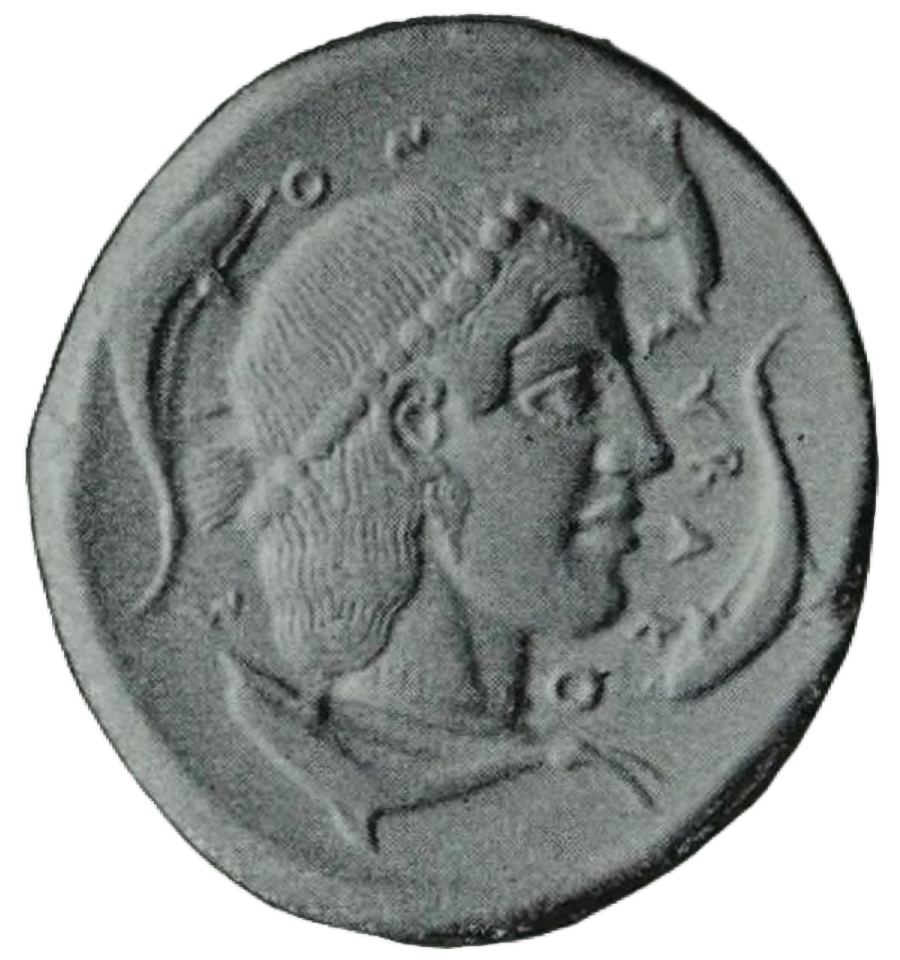
V 252 is remarkably always preserved only in flat worn relief. It seems that something happened to the die, for the image is always faint. With all dies in XIV a the second horse lifts its head high above that of the first. Nike crowns the horses. V 253, V 254, V 255, and V 256 are uniform. Only the slight shifts in the figure of Nike or in the position of the goad allow one to perceive a difference between the individual dies. R 337 has the smallest head of subseries a. Two lashes on the upper lid and one on the lower lid protect the eye. Ten large dots must suffice to represent the pearl hairband; the hair is combed in straight strands over the head; the hair bundle protrudes stiffly. The tail fin of the dolphins is drawn in a double line as on most reverses of XIV a. R 338 brings the head typical here with the long face and the gentle hair. Rarely a fine circular line is drawn outside around the image field at the place where on the obverse the pearl circle sits; the of the legend is formed in two slightly curved lines. Between these two first heads R 337 and R 338 stands in the middle R 339. With them one clearly sees the row of lashes frequently appearing in our series on the lower eyelid. On the plate it does not always come out completely, since the casts are photographed lit from above. Here alongside (Fig. 4) the head is illustrated once more, and this time with side lighting, so that the details emerge clearly. R 340 is the purest die of subseries a. R 341 is different in its construction; it certainly represents another head. These two last-mentioned dies connect with a second obverse, with V 254, and R 340 also with a third, with V 255. At number 475, R 341 is represented in a better preserved specimen than at number 473. Only here do the refinements come fully into their own, the sophisticated succulent relief, the harmonious face with the slightly downward-directed gaze. Unpleasant is R 342 with its bloated cheek. The unattractiveness is perhaps attributable to a material change in the die. Later, with R 360, numbers 503 and 508, we can observe a similar defect. At the beginning of the use of this die everything was in order, until then during striking such a bulging as we can observe with R 342 arose, though connected with a break. An obverse, V 261, number 495, has something similar. Can we perhaps read from these phenomena that the die was first formed positive (patrix) and then sunk, and that in this process the softer mass in which the patrix was sunk bent, so that thereby the bulge in the die arose? With R 342 there already appears for the third time in our series a break diagonally across the head. With R 338 and R 340 we had likewise been able to observe it. These uniform injuries, however, cannot be explained here as earlier from the similar cut. It seems that a new hardening process for the metals emerged at that time, which permitted bringing out more specimens from a die—from now on namely in general more coins appear under one number—but that one made the dies too hard, so that they broke easily. Perhaps, however, one had to strike the die harder when striking in order to bring the entire coin image onto the flan. Thereby these breaks may also have arisen. Strikingly they appear only with the largest heads. Typical is that the splinter-like injuries that we had encountered so frequently in the archaic period are nowhere to be found here anymore. R 344 is flatter in relief than the previous dies, and the head is again smaller. R 345 is hardly different from R 338, R 340, and R 343; hard with it is the throat hollow. The nape hair is graduated in triple undulation, and this hair form remains valid for several of the following dies. R 344 had already had a similar formulation. It is of particular charm how the die engraver of R 346 has let a slight smile pass over the mouth.
The bridge from Series XIVa to Series XIVb is built by die R 345, which we have already encountered at numbers 380 and 381. Here it bears that typical injury diagonally across the head that has appeared in similar manner with preceding dies. This is the fourth example. Among the five obverses of tetradrachms appearing in the new subseries, with four, with V 258, V 259, V 261, and V 263, Nike flies toward the charioteer to crown him. Stronger than with XIV a the chariot box with the spoke cross is tilted to the right; thereby one senses the driving more clearly. The head of the second horse slides lower down in the course of the series. At the beginning it is still to be seen completely free; at the end only in part. The ketos is sometimes more strongly, sometimes less strongly curved. V 260 differs from the other obverses through the Nike flying to the right, the heavy chariot with the handle striking rectangularly against the front rail, and through the horses held back, striding out less strongly.
Among the heads of equal size of the reverses, three different hairstyles prevail. The one that we encounter with R 347 and R 354 is the one familiar to us from Series XIVa. The other, second, is complicated. Here the hair at the nape is tied with a cord drawn multiple times, in two different ways. With one, R 348 and R 349, the descending piece of the cord goes from the nape downward to the left; the hair end is rolled up without a protruding hair bundle and tied once. With the other, R 350, R 351, and R 356, the cord goes from upper left to lower right; with dies R 350 and R 351 the hair end is tied twice, and the bundle emerges. With the third hairstyle, R 353, the hair is rolled multiple times around the head cord, and curls fall down before and behind the ear.
For the first time since Series VII, as far as we know, a didrachm turns up here again, number 497. The image choice is the same as earlier: on the obverse a naked, bearded man rides to the right, leading a hand horse with him. New is only the appearance of Nike, who flies along behind the charioteer, and corresponding to the group the ketos. On the reverse stands the usual head surrounded by dolphins. With the didrachms of Series VII always only three swim around, but here four. Four, however, had already been represented with the early didrachm R 34, number 51 from Series IV. With the later following piece number 548 with R 380 there are again four; with R 401, number 591, these are completely missing; with R 412, number 606, there are again four. From this change we can gather that the gradation of the dolphins in their number from regularly four with the tetradrachms to mostly three with the didrachms did not occur for easier distinction of the value level; the artists had free hand in this. The die surface with the didrachm was too small for four dolphins. In order not to make the image restless, one chose a smaller number. As if to indicate that our didrachm, number 497, is to be valid for the entire series, all three hairstyles of the series are playfully united on it. The head cord is pearled as with the first; the hair is tied as with the second; and before and behind the ear the curls fall down as with the third. That reverse R 353 with its obverses V 261 and V 263 and reverse R 356 must come after the long striking of V 258 and V 259 follows from the fact that V 258 is connected with XIV a at the beginning of its use, and furthermore that the hairstyle of R 353 is still in vogue at the beginning of the next series.
Series XV, which with its first dies connects directly to the preceding one, specifically to R 353, is longer than the preceding one and formally richer. Various individual stages are also to be distinguished with it, as in earlier series; R 364 should be a pivotal point, but the dies are on the whole so firmly linked among themselves that it is not expedient to separate subseries. As different as the reverses are with their often changing heads—no fewer than ten hairstyles appear after, beside, and among one another—artistically here is a resting pause. The great decisions are made; of groping or struggles one senses little. For this, however, one goes deeper into the fusion of the whole and more minutely into the individual formation, in such a way that nothing is damaged by the other. R 364, for example, has the thinnest hair conceivable, which is layered like the gills of a mushroom cap; the large, gently formed smooth surface of cheek and neck beside it does not clash with it. R 358 conversely has strong, long, almost hard features in the whole, and these do not prevent the artist from turning delicate curls, and both fit. Only one type stands out, with which one has difficulty becoming friends: R 375, R 376, R 377, and R 379.
Greater than with the reverses is the progress with the obverses, if there is such a thing in art at all. Let us say better progression. From V 264 to V 275 is a greater path than from R 357 to R 378. If one compares V 264 with V 275, one senses the difference. With one the strong team pulling with effort, placed in the harness, above it an airy, long Nike; with the other the light, almost prancing horse pair, with the tails waving backward. All weight is here loaded on Nike.
R 357 connects entirely to R 353 and is hardly to be distinguished from it. R 358, using with its obverse V 265 related to V 260 the same artistic means as R 357, brings a head of substantially different type. R 362 and R 363 continue it. Peculiar here is the slanted neck, the receding, insignificant lower face, the languishing upward-directed gaze, and the simpler form of rho appearing for the first time with R 360 and applied both times here, which is given here as P. The later reverses R 375, R 376, R 377, and R 379 show so clearly the same characteristics that they must be attributed to the same artist. He has not changed advantageously. V 266 continues V 264 directly, and V 267 is not substantially different. The chariot here is tilted slightly back together with the spoke cross. As if this chariot position had arisen through a jerky movement of the horses, the charioteer bends forward, absorbing the shock. Worth mentioning is how Nike in her upper body imitates the posture of the charioteer. With this beautifully preserved specimen the dress of the charioteer is clearly recognizable. He wears a long chiton girded above the chest. The fabric seems to be of soft material; the hem at the neck is especially set off. Of the reins that the charioteer holds in one hand, the two lower ones are knotted together below the goad. With V 268 twice three reins each are brought together in the same way shortly before the hands; with V 269 and V 270 there are again other knots, and on later dies again others repeated in the most diverse manner. As had been said at the beginning in the explanations about the chariot, the charioteer thereby gave up individual influence on the horse. One could also think that loops were sewn onto two reins and that the other reins ran freely through these, but it is not very probable.
R 359, R 359E, and R 360 bring for the first time a hairstyle that afterward frequently recurs with slight modifications—four rolls at the nape instead of three. In expression the faces still have something of the doggedness of individual heads of Series XIVb. R 360, R 361, and R 362 appear again with V 268; R 360 with an injury that poses a question in its nature. At number 503 it is not yet to be seen. At number 504 the relief is bent up across the face; at number 507 a break is added at this place. How is this to be explained? If one had only numbers 504 and 507 alone, one would assume an error had been made in cutting the die. Number 503 teaches, however, that this was not so. But how can such a bending arise in a die of hard material? Even if one assumes bronze, one could explain it only through great heating, but then the relief would have had to flow completely. I know no answer. The quadrigae of our series can be divided into two types: one with the horses firmly placed in the harness, whereby the first brings in its head (V 264, V 266, V 267, V 270, V 271, V 272, V 273, and somewhat deviating V 274); the second with horses striding more lightly, whereby the first stretches forward its head (V 265, V 268, V 269, V 275, and V 276). The dies of the first type all seem to derive from one hand; those of the second are very different among themselves. V 268 points back to V 265; V 269 stands alone; V 275 and V 276 belong together. Characteristic of V 270 is the charioteer seen from obliquely backward with the crossing arms. Nike repeats in the arrangement of the peplos that of his chiton.
The reverses R 365 to R 371 form a closed whole. At first glance only the differences in hair arrangement stand out, but the facial features are the same. It seems that all are made after a specific human model. But the shading of the individual die heads together with the hair treatment is richer than one thinks. R 365 has a thin face and the hair combed down from the crown; R 366 has full features, a wide-open eye and the hair distributed down from the crown, and moreover a fourth hair roll. R 368 is similar in disposition but much more delicate; R 369 is broader in presentation, and the hairs are distributed over the head in broader strands with a middle notch, like R 367, R 370, and R 371, only that with these the nape hair is waved and forms a single roll. Here the head has something coarse through the long lower face. The sequence is mostly given by die injuries, and where these are missing, by linkages. Thus it is not certain, for example, whether R 369 or R 370 was used previously with V 271; with V 272, however, R 370 certainly stands in first or second position, and R 369, number 524, certainly after it. One can explain this by R 370 having passed from V 272 to V 271, while R 369 came from V 271 to V 272. V 271 may have begun simultaneously with V 270, for the reverse R 366 already used previously comes with it in third position.
Almost simultaneously with these three obverses together V 273 was in use, for with it comes in first position R 365, number 525, which had already appeared at numbers 513 and 514, and in second R 367, which was first with V 271. In general six of the last seven dies gather with it, only in different order. Specimens as well preserved as the illustrated numbers 515, 517, 525, and 530, where hardly any of the hair strands has disappeared through wear, are rare; it is worthwhile to linger with them for a while.
R 373 bears the most compact head of our series; R 378, of which we spoke, is an intensification of its type.
Again a new hairstyle brings number 533 with a head, R 374, that ordinary style observation would not have suspected here. Around the soft hair is wrapped a band that goes twice around the head, ends above the eye, and continues in a cord that must either be tucked under the band or thought to be knotted somewhere. At the nape the hair is taken up within the band and curled outward. In a fine, doubly curved line the neck is cut off. R 375 with its similar successors is already known to us.
V 274 with the transverse Nike and the free second horse head appears with two already used dies, R 370 and R 374, and two new ones, R 376 and R 377, in no establishable order. R 370, as the oldest, will probably belong at the beginning. But with all four numbers 535 to 538 specimens appear with equally well and equally poorly preserved dies. Secure in their arrangement, however, are the dies with V 275. Noteworthy here is that in first position stands an already used die, R 373, then a new one, then again two old ones, R 375 and R 376, then again a new one, R 379, which imitates the costume of R 374 with the artistic means of its predecessors R 375 and R 376. The three ends of the cord at the nape show that the band is knotted here. Last comes a die we long believed dead, R 368, in worn condition. While with V 273 the old dies used with it all come first and only afterward the new ones, here is an alternation of old, new, old, old, new, and again old. V 276 is connected with three old reverses, with R 373, R 378, and R 375. Since the sequence is not established here, the dies are given in the order that we could establish with V 275. Mixed up in our series goes the use of R and P even with one and the same artist from whom R 373 and R 378 come. With the smaller denominations, numbers 548 to 533, with the didrachm number 548 stands the R; with the litrae and obols the P. The reverse of the didrachm, R 380, has no direct counterpart among the tetradrachms. The facial type belongs to R 369. The hair is smoothly rolled at the nape into a bulge. The litrae and obols are clearly to be attributed to R 373. Striking with R 381 is how the entire tentacles with the swimming membrane provide the background for the octopus body. The legend here runs retrograde. R 383 and R 384 are clearly to be distinguished from one another by the cleats that are present with R 384.
The artistic laws of Series XV also prevail in Series XVI. In it the expression of the heads is equally clear and definite, and the quadrigae all show a self-evident confidence. Even more strongly than with the preceding series the individual coins are linked with one another. Despite this intimate interweaving it is possible here to distinguish two subseries a and b. In the first prevails, with the exception of the one die R 379 taken over from the preceding series, exclusively the costume of the first die R 385; in the second another predominates. A thin cord goes here twice from the front of the head in diagonal direction around the hair; the third time over the crown and crossing the other two into the nape, and there ties the gathered artful braid firmly and doubly or triply. Only one die of type a, R 394, appears here newly, and toward the end a completely deviating one, R 395. The obverses can also be divided into two types, but the differences are of a lesser nature here. With Series XVIa the horses are light and lively; with XVIb somewhat heavier; a specific feature is characteristic here: the artist has the need to indicate more clearly that four horses are marching here. With V 286 he spreads the legs fan-like and pushes the head of the second and fourth horse a good bit forward. With V 287 and V 288 he brings in the head of the first horse, and he staggers the heads of the others behind it. He fortunately no longer unrolls the legs. With V 289 the representation has returned to the usual manner; Nike has turned out somewhat large.
The obverses with XVIa look confusingly similar to one another. Most quickly one can distinguish the dies if one compares the position of Nike's arms. With V 283 the head of the first horse is deviating brought in, and the one raised hind leg is pushed further forward. With V 282 Nike has two wreaths in her hands, and with V 285 a wreath and an open ribbon. The chariot is here as in the entire series high and light; the handle of the side rail emerges as before in one line from the front rail. The spoke cross preferably remains placed diagonally. When possible, the die engraver attaches the pole. With the reverses of XVIa two hands are clearly distinguishable. The one, that of R 385, R 385E, and R 387, forms the head in very flat relief, with narrow cheeks and somewhat exalted facial features; mouth and eye are somewhat convulsive. The other, insignificant hand, that of R 386, R 388, and from XVIb R 394, has with two, with R 386 and R 388, a higher relief; the features are more rounded. The artful hair in XVIb with dies R 389 to R 393 with the gentle wave strands and the delicate coiffure is apt to deceive us and to seduce us to assume a quite different artist than with XVIa. But if one covers the hair with a finger, one and the same face remains to us. Also the legend and the dolphins are no different. As it seems, R 389, R 391, and R 393 are cut by the artist who formed the more agitated face with XVIa. The artist of R 392 stands in the middle between this one and that other from whom R 394 with the retrograde is made.
The head of R 395 at number 582 has a hardly changed face, but how differently it appears through the other costume. The hair flowing down from the crown in fine waves is wrapped sevenfold around a cord and pressed firmly to the head at the nape at its second turn; dolphins, legend, neck section, and ornamental objects are unchanged.
In our series the R completely prevails; the P no longer appears anywhere.
Various things are to be said about the sequence, for the appearing injuries are not so unequivocal here. With V 282, R 385 appears in first position. Among the following coins with the same obverse, numbers 555, 556, 557 with R 385E, R 386, and R 387, number 557, 4 has the strongest injury at the wheel; therefore its reverse, R 387, may be placed at the end, and forms the linkage with the next obverse V 283. This has besides R 387 again R 385 and R 385E with it, but in no establishable sequence. V 284 is secure with its reverses. The sequence with V 285 is also secure; only where it is to be placed is not established. R 386 and R 385 are present here without and with the same injuries; R 379 has injuries here that are still missing at number 543; number 564 thus certainly originated after number 543. R 379 is significant for us because it establishes the connection between Series XV and XVI and because it teaches us that Series XVI already ran alongside Series XV for a longer time. R 382E is at number 567 certainly later than at number 563, and R 386 has at number 577 an injury that is missing from it at number 565; thus XVIb is later than XVIa. XVIb could have begun, however, when XVI a was still in progress, but not before number 563. With XVIb the conditions are simpler; injuries point the way. Only with V 287 could R 392 be exchanged with R 393; but since with V 288 R 392 certainly comes before R 393, the same sequence is applied here. With V 289 the first three numbers (579, 580, 581) are interchangeable among themselves, and number 582 with 583. That V 289 belongs at the end, however, is proved by the greater injuries of R 391 and R 394 at numbers 583 and 584, and die R 395, which builds the bridge to the next Series XVII.
But not only this die alone leads over to it. The first two obverses of the new series, V 290 and V 291, bear so clearly the characteristics of the preceding one that even an artistic difference cannot be spoken of. As with V 286, V 287, and V 288, the artist endeavors to make the quadriga vivid; the exergue line is pearled as there, apart from the similarity in the appearance of the horses and Nike. With V 290 the heads are staggered as with V 287 and 288, only the head of the fourth horse disappears somewhat more. V 291 takes up the intention of V 286 and takes two heads together each. Here, however, the raised heads of the pole horses—and that these are they is taught by the head of the third, which covers the neck of the fourth with its mouth—come out freely, which the artist achieves easily by pushing the first horse far forward. The chariot is pushed close to the horses, so that the rim covers one hind leg of the second horse. Playfully and carefully one tail falls down, overlapping the wheel, and the other, overlapped by it.
The reverses of Series XVIIa go stylistically alongside the heads of XVIb. In Series XV a head encountered us that occurs to us again here, R 374, at numbers 533 and 536. Reverses R 396, R 399, R 400, and R 401 have much in common with it, such as the size and position of the head, the hair, the hairband with its braid squeezed out above, the neck section formation with the pearl-set band laid firmly over it, so that we must suspect one hand. Admittedly, the relief with R 396 stands in its animation far above R 374. It shows the most sophisticated art that we encounter in Syracuse. Here one forgets for a moment to ask about custom and ethical value in art and enjoys the great skill of a nameless hand. Almost invisible the breath-like legend is inscribed.
R 399 is weaker; R 400 too delicate. The head of this last die would fit on a didrachm; with this, number 591, it is in fact hardly smaller. What R 396 is among the reverses, V 292 is among the obverses. R 398 comes from the known artist of Series XVI, but with the grace usual here. The illustrated cast unfortunately does not reveal the beauty. Of another type is R 397; it is so similar to R 396 that despite the deviating letter size one would like to attribute it to the same artist. One should compare in details the lashes, the sweep of the lips, the broad, set necklace and the legend beginning above the head, the neck section drawn in more strongly with R 397 however, and the rho with the almost horizontal cross stroke: . The letters are smaller and thicker, but that, like the changed hairstyle, can be intentional. R 402 in Series XVIIb belongs directly here; there the braid is wrapped at the back of the head and the hair held fast by a crosswise drawn band whose ends fall down long. With R 403 the character of the head is similar to that of R 402, and the legend similar to that of R 396. The hair is completely loosened and held together by a band visible only above the forehead; from this head to the next series is only a small step.
The obverses with XVIIb deviate from those of subseries a. With both it is no longer attempted to bring four horse heads into representation. With V 293 with the peculiar Nike it is noteworthy that during its use a secondary symbol, namely a grain of corn, was inscribed under the horse's body. One could think only a die injury is present, but the form is too regular for that. V 294 is probably created by the same artist, despite all deviations. Since the archaic epoch a quadriga to the left appears here for the first time. Nike with her soft, fluttering garment is opposite to the previous one. The charioteer takes up in his body posture the direction of the spoke cross; the exergue is formed not by a delimiting line but merely by leaving the field higher, quite as with V 25, number 36. A conscious borrowing is probably present. Whether die R 395 at number 592 has injuries that are still missing from it at number 582 cannot be determined on the basis of the cast. The illustration on the plate has become faint because a plaster cast of another plaster had to be used. But a linkage is at least established through it.
With the individual obverses the sequence of the reverses is established, and V 291 certainly comes after V 290. Whether V 294 runs alongside V 293 or follows it cannot be determined through injuries, but R 403 is the most mature of the three reverses R 397, R 402, and R 403, and the treatment of the hair as fabric with it is so related to that of the immediately following reverses that V 294 must be placed at the end. XVIIa will come before XVIIb because R 396 recalls R 374, but not much earlier, as the common use of R 397 at numbers 587 and 594 proves.
In Series XVIIb coins frequently appear where the field on the reverses has sunk in trough-like toward the edge; among the illustrated specimens, for example, numbers 593 and 595. It seems that the flans came under the hammer in too soft a condition, so that the metal flowed off slightly or positively away during the blow.
If one considers the heads of the last series, one asks oneself whether an intensification and refinement of the artistic means is still possible after these. An increase of the delicate tones would bring a fragmentation and would volatilize the art. Only in a formal sense, through an extravagance, could a "more" still be attempted. This the artist did whom we have already admired in the past series. With astonishing boldness, but with equally astonishing confidence, he reached for two innovations that promised him what was desired. The gradation of the surfaces is consciously no longer kept as rich as earlier; the expression of the face rises from metropolitan elegance to girlish innocence and freshness. On the obverse of the coin of which we spoke, V 295, the quadriga is set at a gallop; large surfaces are carelessly left free, and on the reverse, R 404, the artist gives the hair movement and lets it flutter loosely over the head. That we are dealing with the same man is proved by two things that cannot be imitated and cannot be transmitted as workshop property: the line of the lashes and the mobility in the mouth. The massiveness in the hair braid is the same; likewise the arrangement of the legend. Easier than the common features are the deviations to find. At the nape short curls fall down at the hairline. Worth mentioning are also the wrinkles under the chin and the neck line that continues onto the dolphin.
Until now no written communications have encountered us on the coins besides the ethnikon; here appears for the first time behind the head at the height of the high-sitting necklace an A. As we will see, such a letter appears frequently later. What it is supposed to mean is disputed; some think of an artist's signature, others of Α(ΘΛΑ)[25]. New is the form of the earring. In place of a complicated pendant has come a simple wire bent three times and drawn through the ear, a hook ring. This form of earring remains dominant from now on until the end of the coins treated in this investigation; only R 444 forms an exception.
R 406 reproduces the same head as R 404; R 405 and R 408 each a different one, but with equal artistic means. They come from the same hand. In quite another manner works the die engraver who made R 407. Perhaps he wants to bring the same head onto the coin that R 405 has, but he presents his view in almost clumsy relief. Die R 409 has similarities in cut with R 407. It seems to have to be attributed to the same artist, despite the so deviating legend arrangement. The letters are here small and irregularly stuffed between head and dolphins; the end of the ethnikon seems to be completely missing. On none of the specimens is a trace of it to be found. The dolphins sitting so close to the face give the explanation for this. The artist first had the plan to lead the letters of the legend around outside the dolphin wreath. For some reason he gave this up and placed them, as well as possible, now within it. A third artist made dies R 410 and R 411; in the softness of the relief he touches the second artist, but on the whole he submits himself to the superior weight of the first. At the beginning of the next series we meet him again. Typical with him are the eyelashes, the neck section, and the of the legend. On die R 411 he makes an innovation. The dolphins do not swim as before in one direction one behind the other; two go clockwise and two counterclockwise. They are divided into two pairs, in such a way that the dolphins of each pair always swim toward one another. V 296 is hardly to be distinguished from V 295; the head of the first horse is more harshly brought in and the ketos more stretched out, as if it were shooting through the water. The rider of the didrachm with its reverse die R 412 related to R 408 teaches us that we are no longer far from the time of the Parthenon. Besides the rider figures of the frieze, the lost galloping team in its west pediment may be compared here with our obverses without further conclusions[26].
The reverse R 413 of the drachm number 607 belongs with that of the didrachm directly to the tetradrachm with die R 408. The legend written around the entire head on the small denomination because of lack of space proves with what artistically always lively spirit our first die engraver works.
The hemilitria appearing here, numbers 608 to 612, are interesting because of their die connections. V 300, V 301, and V 302 all have only one common reverse. If the image of the upper die was kept simple and flatter than the obverse, it simply lasted considerably longer. We had already been able to observe this in the first group with the tetradrachms. The balls of the reverses in the four fields designate the denomination, the hemilitrion, as ⁶⁄₁₂ of the litra. V 303 strikingly bears a head to the left. Among the larger pieces no companion piece has appeared for this, only among the copper coins belonging here for stylistic reasons, namely V 314.
As among the tetradrachms, among the copper coins now appearing for the first time, the triantes and unciae, various hands are distinguishable. The usual sharpness in cut could not be striven for here on the dies because of the other metal that was to be struck; nevertheless we recognize that V 305 unmistakably belongs to R 406 and that V 311 has a relief treatment like R 407. The reverses of the triantes bear between the restless arms of fat octopuses for value determination 3 balls; those of the unciae 1 ball and, as it seems, sometimes also none. V 305 has with the following obverses V 306 to V 312 before and behind the head one dolphin each directed downward, swimming around clockwise and counterclockwise. Since with the tetradrachms only at the end, with R 411, the same directional division appears, one could think the copper coins are chronologically also only to be dated with R 411. To assume this is not necessary. On the contrary, this change in disposition seems to have been invented precisely for the small coin with its restricted space, and only then transferred from here to the tetradrachm.
The sequence with the tetradrachms is not established everywhere. R 404 with V 295 certainly stands in first position; R 405 and R 406 incline in their art toward R 404. Die R 408 is placed at the end since it certainly comes in first position with V 296. R 407 is thereby assigned its place. R 411 certainly belongs at the end of V 296; for R 409 and R 410 the order then results by itself.
Among the copper coins remarkably no linkage has appeared. In the entire series the hair tuft costume exclusively prevails, and with the legend the P.
In the British Museum is a gold ring originating from Syracuse—illustrated here on Plate 30, Z 3—with an engraved little head that in style and design extraordinarily resembles the heads of Series XVIII. The ring belongs to the same period. It may well be that a die engraver of our series also made gold works.
Like a reaction to the style of the past series appears the new one of Series XIX. Toward the end of the tetradrachms in XVIII we have already encountered two heads that indicate a reversal—this cannot be attributed solely to the difference of another artist—; here it is accomplished. The precious is no longer sought; the hair tuft disappears, and the execution of the individual parts is not driven further than the great whole permits. Characteristic is how the hair braids draw quietly over the head, how the curls at the nape are made so small that one looks past them, and how the two folds under the chin are indicated so clearly that one notices them without having to establish them particularly.
The full consequence in the new striving is drawn by the artist with the purest of his works, with R 435. Here he wraps the hair in a cloth in order to be able to dispense as much as possible with its individual representation. The broad curl over forehead and temple has the task of bridging the contrast of smooth band and mobile hair, which can easily have an unpleasant effect; the individual strokes here and with the strands partially visible at the nape are so fine that they are not noticed individually at all. Broadly conceived is the wide surface of the luxuriant face over cheek and neck. Despite the blunt nose this profile appears beautiful; despite the lowered lids this eye looks clearly. The often rigidly appearing neck and nape line is interrupted by the thick necklace, the two wrinkles, and the one curl detaching itself beside the ear; it is fused with the background through the falling cloth whose folds are again interrupted for the same artistic reasons, that is, partially tucked away. Gently inscribed is the careful legend; the dolphins swing no more than fits their function. We have here the most balanced work that has been cut into a modest die in Syracuse. The obverse die connected with this reverse, V 320, shows similar intentions. If one compares it with the two other obverses of this series, with V 319 and V 321, one will find the same artistic contrast that prevails between its reverse and reverses R 432, R 433, R 434, and R 436. Nike hovers high; all parts of her garment are recognizable without effort. Through the crowning of the charioteer and her flight to the left a countermovement to the pull of the horses has arisen. The rein-holding leaves no unclarity.
Despite all differences, all dies of this series are nevertheless so related among themselves that we must attribute them to one hand. V 319 is hardly to be distinguished from V 321, likewise R 434 from R 432. By the arrangement of the horse tails and the dolphins with the adjacent legend, by the execution of the neck section line connected with the band located above it, we recognize the individual dies most quickly. V 319 brings, compared with the earlier horse representations, an innovation. The first horse has its head not stretched forward but in three-quarter view turned out of the image field toward the viewer. Thereby the artist saves space and gains room to develop his entire vehicle more freely. If we examine the build of the horses and the fine veining on the belly more closely, the lightness of the chariot and the manner of Nike, we are reminded of two obverses that lie far ahead, of V 275 and V 276 in Series XV. The similarity is so great that we must assume the same hand. Perhaps nowhere is the kinship more clearly felt than in the incidental horse tails. The dashing line that we can observe in them arose under the pressure of a hand that could not change its handwriting. With the heads of dies R 403 and R 404 we had been able to notice a similar inimitable handwriting in the lashes.
Series XIX is linked with the preceding series through R 411 and with the following one through R 435. R 411 appears in the preceding one among the tetradrachms certainly in last position, and here in second position because of some injuries that only appeared during striking at number 605. R 435 has at its first use, number 632, fine injuries that do not yet appear at numbers 635 and 640.
Some small silver money was also issued alongside the large pieces, as far as known only hemilitria, numbers 636 to 639. The belonging to the corresponding tetradrachms is immediately visible. On the reverses appear, as in Series XVIII with R 414, R 415, and R 416, 6 balls. Here they are distributed so that the two united in one field, measured from the hub, stand not beside but above one another. With R 440 only 4 balls are to be seen; that the two others simply did not "come" during striking a glance at the similar dies R 437 and R 438, where there are precisely 6 balls, suggests, and that balls sometimes do not come will later number 714, with die R 487, really teach. At number 713 we namely encounter the same reverse die, but here with all the dots[27]. The hairstyle prevailing with R 432 and the similar dies we have already encountered several times earlier, with R 374, R 379, R 396, R 399, and with R 400. The ketos in the exergue has disappeared and now no longer appears.
Quite novel is immediately the first obverse with which Series XX begins. The team here no longer goes at an ambling pace; the right foreleg strides out ceremonially; the right hind leg is firmly planted. The first horse holds its head straight ahead and stretched forward; the second, drawn far forward and drawn somewhat larger, brings in its head. Upright stands the charioteer with outstretched arms; a slender stretched Nike shoots as it were through the air. The exergue line is drawn double and the upper line thickened.
The remaining obverses, V 327, V 328, and V 329, connect to those of the preceding series. The horses are given in the same arrangement; only the head of the fourth appears in broader contour. V 328 is somewhat bumpy.
The bridge between the series is formed by R 435, which was used first with V 326. Then follows a die of quite different type, R 441. The head is small; the face insignificant. The hair is tucked into a close-fitting cap, into a σάκκος, whose point ends in two fringes. Across it runs a meander, accompanied right and left by a fine line. It seems that the edge of the cap, on which the ornament is to be thought embroidered, was turned up and then halfway down again (see Fig. 5). Above the forehead lies a headband, the ampyx, from under which the hair wells forth and on which is laid an olive branch with three times three whorled leaves. The wreathing remains as long as the sakkos appears. The neck looks tube-like and is bent outward downward; parallel to the neck section line runs a smooth band closed at the side. The legend closes off the head downward. Dolphins are not divided into two opposing pairs each as with R 435 and the entire preceding series, but run around in a circle again as earlier. Dies R 442 and R 443 recall in the letter form, especially that of V and K, and in the liberties with the dolphins R 433. R 443 lets three dolphins run clockwise and one counterclockwise. The cap edge is with it bordered by an open zigzag row, with R 442 by an edged one.
R 444 and R 445 bring a new striking head. The features are drawn almost too sharply, and with R 445 the relief is decidedly driven too high. On both dies the chin line drawn through to the ear, the lean and sinewy neck, and the eye socket appear hard. In place of the fringes at the top of the sakkos sits here a button. Strikingly the rho appears here again with a side stroke as R.
With increasing injuries and in the established sequence these two reverse dies appear two more times, with V 328 at numbers 647 and 648 and with V 329 at numbers 649 and 650. This last obverse V 329 is moreover connected with a reverse, R 446, that breathes a new artistic air in its style and shows us a way through the dies through its repeated appearance. Soft flesh covers the firm facial structure. The round line of the full chin is taken up by the luxuriant lips; the eye lies softly and deeply bedded. Through the shadow that the deeply drilled forehead casts in the inner corner of the eye something dark arises in the face. In general it is the disposition, the mixture of softness and seriousness, that distinguishes this head and its successors in Series XXII. In design the head recalls R 441. Perhaps it comes from the same hand. The type of neck formation is the same with both dies. The hair laid back is wrapped with a fourfold drawn incising band. Delicately the letters of the legend are placed. The dolphins meet before the face, in that two swim from above downward clockwise, two from below upward counterclockwise. It is difficult to come to a judgment here about the hands, although or precisely because the heads are so very different. The sequence is established.
In Series XIX the exergue, which from XIII to XVIII was filled by the ketos, had become empty. In Series XX the olive branch on the ampyx appeared as a secondary symbol, for as such one can designate it in its allusion unknown to us, however. In the now following Series XXI, where the sakkos exclusively prevails, this wreathing remains, but in addition comes an open branch that is placed in the exergue on the obverse.
V 330, with which the series begins, is immediately familiar to us in its type. Charioteer and team recall the obverse V 319, V 320, and V 321 from Series XIX, and Nike that of V 276 from Series XV. The head of reverses R 447 and R 447E resembles that of R 444 and R 445. The artist has here as there taken no consideration for the overall harmony and laid a similar movement on the mouth. The cap likewise has a button, but this could be an external appearance. Deviating is that the edge of the cap here, as on all later dies of the same type, is no longer turned over and that the ornamental band, consisting of edged meander and zigzag row, runs freely over the cap. The four obverses belonging to the series differ little from one another. The teams are similar and the charioteers on the whole also. V 331 has the Nike of V 330; V 332 and V 333 the one that we encountered in the previous series with V 326. In contrast to Series XIX and XX the horses here again wear a belly strap, and the image is framed by a circular line instead of a pearl circle. With V 333 the head of the first horse is not turned out.
Like the obverses, the reverses are also very similar among themselves, although various artists have worked here. With all we encounter the dolphins in the arrangement we have already encountered with R 446; the legend always stands entirely before the face. V 331 unites with itself four reverses, of which three recur with V 332 and two with V 333. V 333 brings with it a new die, R 452.
Dies R 447 and R 447E can come from the artist who cut R 444 and R 445. R 448, R 450, R 451, and R 452 are by another hand; R 449 apparently by yet another. With it the overfull face stands out; the necklace sits with it high in comparison to the others.
The beautifully preserved hemilitrion number 663 resembles with its obverse V 334 die R 448; reverse R 453 brings the usual wheel, this time with V in one field and filled in the remaining ones with 2 balls each. V 335 and V 336 are only with difficulty to be distinguished from one another; with them the head has a cap on whose point is set with a button, as on R 447; in style the dies do not resemble this, however, but entirely R 449. It may be that the artist because of the smallness preferred to choose a clear button rather than two tassels, which, as V 334 proves, could hardly become visible. The common reverse R 454 bears in the fields rotated around the hub retrograde the usual dots are missing.
The sequence of the reverses with the individual obverses is established only with V 333 not firmly, but is chosen here as it appears both times with V 331 and V 332. The injuries on reverses R 448 and R 450 are with V 333 on the whole not stronger than with V 332; V 333 is placed at the end, however, since with it a new obverse still appears. Numbers 652 and 652E with V 330, R 447, and R 447E are placed at the beginning because of the similarity of the heads mentioned above with dies of the preceding series. Remarkably they are not linked in any direction.
On the reverses it is frequently to be observed that the die has broken out under the neck. The same is also the case in Series XX with R 444 and R 445. Doubtless this came through the peculiar cut at the bottom of the neck. One should think of the relief of the coin transposed into the negative of the die. If the lower neck line was drilled very deep and close to the die edge, a narrow ridge remained that could easily break out, especially if the die was held clumsily during striking and in such a way that the metal mass penetrating into it sought to yield in the direction toward this ridge during the blow. It seems that one recognized the technical weaknesses of these dies and in the chronologically following Series XXIII for this reason bent the neck section line inward again.
With Series XXII, which chronologically runs alongside XXI and is linked with XX through reverse R 446 appearing for the second time immediately in second position at its beginning, the neck section is still bent outward downward in the same way. An injury of the discussed type appears, however, only once, with R 467. The explanation for the lesser breaking out is probably to be found in the fact that here the neck is given in flatter relief and consequently in the die this ridge was not so high, that thus no such strong pressure of the metal could arise and the ridge was equal to the lesser mass. Another type of injury, however, is characteristic of this and the next series. During the striking of the reverses the deeply cut corner of the mouth frequently fills with a grain. Transposed into the negative: the piston projecting high up forming the corner of the mouth breaks off on the die, and metal takes its place.
The obverses V 337 to V 340 appearing here no longer have an olive branch in the exergue; the teams are similar to those of XXI. With V 339 the horses go at a right-footed walk with the right rear planted, as with V 326; with V 340, however, again at a left-footed walk, and with both dies Nike flies toward the charioteer.
Unified is the design of the reverses. In the penultimate series die R 446, which is exemplary for all others here, has already encountered us under number 651. As uniform as the dies appear when one surveys them cursorily, so non-uniform are they when one studies the face, the cut, and the expression more carefully. They are so different that we must assume several artists active here. How the dies are distributed among the individual hands, however, is hardly possible to decide. R 455 and R 446 are similar to one another in expression and in the arrangement of the legend. The heads of R 457 and R 458 have in common the almost languishing gaze. R 459, R 460, and R 467 could go together with R 456; with R 462 and R 463 the fresh face stands out; R 461 resembles R 463 in cut; the heads of R 464 and R 465 both have something petty in contrast. R 446 falls furthest out of character. The lines are here softer, while the relief is more compact. In the face a certain intensity is expressed. We will hardly be able to assume six artists here within one series where simultaneously another runs alongside. But we arrive at this number if we make the main differences in the heads valid for different hands. R 459 with R 460 and R 467 could, however, have developed from R 457 and R 459, and die R 456, which deviates somewhat in expression from R 459, would have to be explained differently. But enough of conjectures.
The sequence with V 338 and V 340 is not established throughout. With V 338, R 456 certainly belongs in first position; after it come dies R 457 and R 458, interchangeable among themselves, and then in the same way exchangeable R 459, R 460, and R 461. R 463 was taken into use when V 338 was still in tolerable condition but remained in use until the obverse was almost unrecognizable. Since the ethnikon was on the reverse, one could permit excessive exploitation of the obverse. That a die remained in use so long is, however, remarkable. With V 340 it is not certain to decide whether the injuries are greater at number 685 or number 686.
The type of neck formation that encounters us here is not pleasant. Through the neck section ascending obliquely to the left and through the downward sliding of the head contour toward the back, a circular movement arises that creates the impression that the head is turning away from the viewer, just as if the model had evaded the artist's gaze. The slightly curved neck supports the tendency toward this; likewise the clasp of the necklace sitting laterally, which one easily erroneously takes for a pendant. Most strongly R 458 works thus. The artist of die R 466 seeks to counteract this impression by drawing in the neck section line here again, as happened in earlier times. Almost throughout it is also so in the now following Series XXIII.
Exceptions form only four dies: R 465 right at the beginning, which forms the linkage with the preceding series and in style belongs entirely there; R 470 and R 473, which are both cut by an artist who did not yet understand much of his profession and was irresponsibly already allowed to make dies; and R 472, which perhaps comes from Series XXI. With it we encounter an important technical problem. As it seems at first glance, it is identical with die R 448 at numbers 653, 657, and 660. That at numbers 653, 657, and 660 R 448 really is present in common, may a juxtaposition of the three reverses with R 472 make clear here once more (Fig. 6). At number 653, R 448 has injuries at the first dolphin; at number 657 further ones appear that can only have arisen in the course of striking: in the ear a break and under the earring a large dot, moreover slight dots at the nape. At number 660, R 448 is in the same condition. If one now compares R 472 precisely with R 448, however, one sees that the legend is different. The letters are larger; the is written in open form, and the neck folds sit lower under the chin.
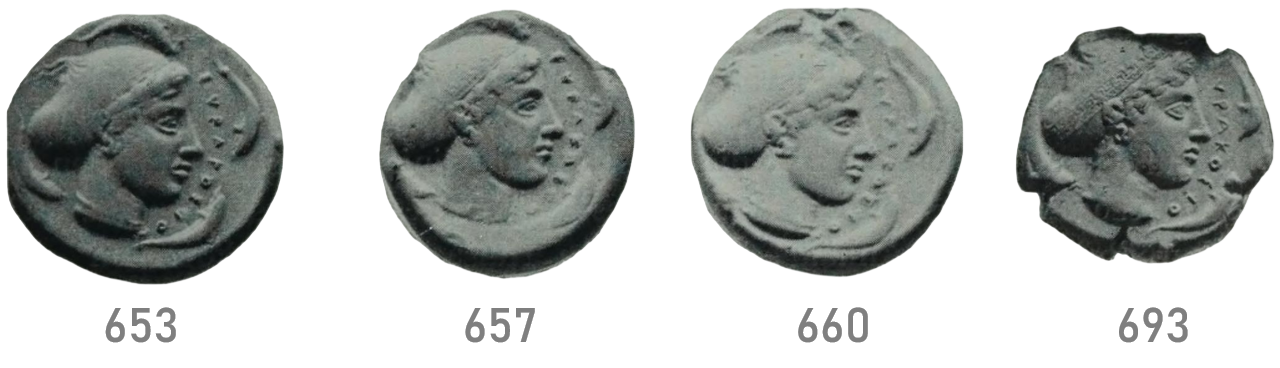
One generally assumes that the coin image was made by direct cutting into the die, as with a gem. Here one could suspect because of the deviations that first a patrix was made, with head and dolphins, but without closer details like legend and neck fold. Then several negative dies were sunk from this positive form (see above p. 46) and only into these were the details cut. But this does not work for the following reasons: Namely, R 472 with the deviating legend has exactly the same injuries as R 448. How is this possible? One could think die R 472 is identical with the reverse die that we encounter at numbers 657 and 660, only with freshly re-engraved legend. But of a re-engraving no trace is to be seen. With the sigma this could not have been fully wiped away. Should we assume that from a common patrix without legend 1. for number 653 a reverse die was made, 2. for numbers 657 and 660 a second, whereby the patrix would already have had the mentioned injuries, and 3. for number 693 a third, whereby again the same injuries would have come into the die? Then we would have to explain how the newly inscribed legend and the neck folds at number 653 turned out so similar to those of numbers 657 and 660, and how these injuries came into the positive form, the patrix. This type of injury, as the reverse dies of numbers 657, 660, and 693 have in the ear, customarily arises through striking use. We had earlier, especially in Group III, often had the opportunity to observe that similar die cutting produces similar injuries. As similar as here they have never been, however; it would also be unthinkable. On the basis of the casts I see no possibility of a decision. Perhaps through comparing originals further common injuries and new perspectives are to be found. Thus, for example, the London specimen number 693 has from the third upper leaf of the wreath a small injury into the zigzag row. The Cambridge specimen number 657, 1 seems to have this too. The question is important, for here it could well be possible once to come to a conclusion about the production of the dies. Strikingly a similar problem has not turned up in Syracuse until now.
With the four dies R 465, R 470, R 472, and R 473, to return again to Series XXIII, the neck section line is thus bent outward; with the others it is drawn in. The lateral closure of the necklace has disappeared; in its place appears mostly as a pendant in front on the neck a little lion head with jaws agape and tongue hanging out, with R 469, R 471, R 474, R 475, R 476, R 477, R 480, R 481, R 482, R 483, R 484, and R 485. The sakkos prevails in this series, and with the tetradrachms exclusively that with two tassels. Toward the end of the large pieces three dies appear with a new costume. Here the hair is taken up at the nape, laid in a band widening toward the back (ὀπισθοσφενδόνη), and tied fast by its ends, which are wound around the forehead over the head and around the hair bulge.
The obverse dies are all uniform. The charioteer stands upright with outstretched or slightly lowered arms; he is crowned by Nike always flying toward him. With the team, which appears at a right-footed walk with right hindquarters planted, the first horse is pushed a good bit forward over the second and turns its head in three-quarter view; the second lets the neck and head be seen up to the eye in flat relief. Nike descends in the course of the die sequence lower down on the horses, becomes smaller and more richly moved in her body; the exergue remains empty, and the image field is enclosed as in the preceding series by a pearl circle. The chariot type has not changed; the front rail does not go up over the lap of the charioteer. The pole is always indicated, the pole tip also, while the yoke is neglected. Noteworthy with V 341, V 342, V 344, and V 347 is the appearance of the pole connection familiar to us from archaic times. Here, however, this does not extend as there from the upper end of the front rail, but from the place where the side rail together with handle meets this. The chariot box is kept narrow as in the preceding series, though not so much as in Series XX. With V 347 an A appears on the lower half of the box within the wheel rim. Other obverses, as far as we can determine, do not have the alpha; only in the next series V 355 at the same point. On the other hand it appears on a large number of reverses at the most diverse places: with R 469 (specimen 689, 1 lets it be seen clearly), R 474 and R 475 at the top of the head above the meander, with R 478 and R 480 on the neck, with R 479 behind on the sakkos.
Individual artists are here clearly to be distinguished. We already mentioned R 470 because of its crude style, and R 473 with its old-fashioned retrograde legend, the R and likewise. Die R 476 seems to belong to the hand of R 470. The head has the same eye and lip formation. The heads of R 477 and R 485 have an unpleasant fullness in the cheek area in common. But the most significant artist in the series is the one to whom R 468, R 469, R 471, R 474, R 475, R 478, R 479, R 480, R 484, and R 486 must be attributed. Reverses R 481, R 482, and R 483 stand in their style in the middle between the penultimate and last-named hand. Whether they belong to one of these two or to another is in question. It has been suspected of the alpha that it has an agonistic meaning; an artist's signature has also been thought of, but with little courage[28]. One could also think instead of the abbreviation of Α(ΘΛΑ) of or , of an allusion to the festival of the goddess represented. Thus I first suspected. But since all dies with an alpha except for the one in Series XVIII, R 404, and in the immediately following Series XXIV, V 355, had to be placed in the present series because of similarity and linkages, and since in an investigation into artists' hands, without taking into account the attachment of this letter, all dies, as turns out afterward, must be attributed to one hand with the alpha, I have come to the conviction that it is an artist's signature. The proof of the pudding is easy to make. Obverse V 355 in the next series now likewise seems to belong to the hand of V 347. R 404 in Series XVIII, however, does not. But how many names can have begun with alpha, even if one does not resort to the archaeologically familiar expedient of doubling in grandfather and grandson!
The hemilitria that are assigned here under numbers 713 to 718 attest their belonging through their style. One could think the pieces where the sakkos appears with a button belonged to V 335 and V 336 in Series XXI. This is impossible, however. A comparison teaches it. Like the obverses, the reverses are also kept varied. R 487 brings the arrangement that we have already encountered with R 453; with R 488 the Y runs retrograde. R 490 differs from the delicate reverse R 489 through larger letters and a double rim wreath. Here the expanded legend VPA runs clockwise both times, while in the earlier Series XIX and XXI it went counterclockwise. In all three Series XIX, XXI, and XXIII, however, hemilitria with value balls go alongside those that have only the abbreviated legend without balls, a noteworthy coexistence.
The sequence of the tetradrachms results mostly from linkages and die injuries. R 468 is damaged with V 342, number 690, not yet with V 341. Whether R 470 or R 468 comes in first position with V 342 is not established. With V 343, die R 475 is placed in second position because it establishes the linkage with V 344. With V 345 it cannot be proved on the basis of injuries to the obverse that R 481 was taken into use after R 480, but something else will do it.
R 480 is used not only with V 345, number 702, but also with V 346, number 706, and here, as results from the greater injuries, at the later time. It introduces here a new linkage numbers 706 to 712. The further reverse, R 485, which has V 346 as obverse in common with R 480, comes, as the injuries suggest, apparently later. It moreover forms the linkage to the new obverse V 347. It is certain that R 485 with V 347 was used later than with V 346. Reverses R 482 and R 481 at numbers 711 and 712 again follow secured only after R 485 and R 486; stronger injuries of obverse V 347 prove it. Now comes the remarkable thing. Die R 481 has here at number 712 two injuries that it already has at number 703, not yet. Consequently 712 was struck before 703, and since R 482 and R 483 at numbers 704 and 705 certainly follow after R 481 at number 703, also struck before numbers 704 and 705. The whole linkage numbers 706 to 712 thus inserts itself between numbers 702 and 703. From this we must gather that one had stopped at number 702 striking with obverse die V 345, and that one took the die into use again a considerable time later. It is so damaged at its use at the end that one can hardly recognize it anymore. We may conclude from the resumption and great exploitation of the die that one did not reach for it again without necessity. Why, we cannot say. Noteworthy is that dies, indeed also obverse dies, have been preserved for so long. This admonishes us to be cautious with conclusions with the method applied here.
The new Group VI with its two, namely the last, Series XXIV and XXV is connected with the preceding one through R 482 and the here severely damaged die R 483. The two short series differ from one another in style and through chosen secondary symbols. In XXIV appears once, with V 354, in the exergue an olive leaf with fruit, and the teams all go at a left-footed walk; three of the reverses have the little lion head known to us from the preceding series as a pendant on the necklace. In XXV there appears on the obverses looking confusingly similar always a grasshopper in the exergue, and the team at a right-footed walk with right hindquarters planted. The reverses of Series XXIV, R 491, R 492, and R 493, develop out of the latter dies of Series XXIII, out of R 481, R 482, and R 483 among the large pieces. R 493 with its luxuriant, soft, almost bloated head is the utmost that this style was capable of achieving. R 491 and R 493 are related to R 483; R 492 seems to be made by the artist who in the preceding series cut most of the dies frequently marked with A. The associated obverse V 355, on which the A indeed also stands on the chariot box as with V 347, comes from the same artist. V 354, however, has a conception of the horses like the dies in XXV. The hemilitrion number 725 has on the obverse the head type prevailing in XXIV; the reverse brings, as usual, the wheel and the ounce balls deviating in arrangement here united with the expanded retrograde legend . R 494, connected with V 356, known to us only in one specimen, forms the bridge to the next series.
Here the face is substantially different in expression. The lips are taut; the eye is not so softly bedded; over the hair at the back of the head is drawn a net with diamond-shaped meshes, knot nodes, and a tripartite band that is drawn over the forehead and joined together with the net above the ear through a clasp. Above the forehead, at the crown, and at the nape small curls become free. Of quite different appearance from R 494 with the same hair arrangement is R 495. The face with the narrow upper lip is unattractive, and the die disposition with the letters imitated from the Damareteion not pleasing. To this die belong a number of litrae, numbers 729 to 733, which have the same head on the obverse, accompanied by a dolphin, and which are provided on the reverse with the usual octopus. Between the tentacles is the legend . Since Series XV this denomination has no longer encountered us.
The three tetradrachm obverses are so similar to one another and bear such similar injuries that we might be tempted to assume again a common patrix (see above pp. 46 and 63 f.). One should compare the traces appearing with all before the face of the charioteer, or the cracks common to V 358 and V 359 over Nike's legs. A precise examination of the chariots with their handles and the chiton of the charioteer spreading out here teaches, however, that these are different dies. With V 358 the chiton closes with the handle; with V 359 it goes beyond it, and with V 360 passes within it. That these details would have been inscribed only into sunk dies, but the Nike similar in relief already into the patrix, is not possible. It is here precisely, as often earlier, that similar cutting brings with it similar injuries.
With this last series we have arrived at the end of the period that interests us here and now stand immediately before the beginning of the one that people call the flowering period and recently the period of the signing artists[29]. Because the die engravers considered it necessary and worthwhile to place their names on the artworks, the dies of this period have always been particularly noticed. The names Kimon and Euainetos are unknown to few researchers and friends of antiquity. But through signing the value of an artwork does not yet rise. What appears to one as flowering is to another perhaps already beginning decline. The now following heads with their soft, often bloated face, the curls freeing themselves here and there and soon everywhere, the obverses with the excess of lines and movements of the at first boring, then too restless teams arouse in their artistic, great virtuosity perhaps the interest of the researcher; in artistic content they are not rarely poor. The harmony that can only be achieved in a uniform and coherent division of the field is missing except for a few examples; the self-evidence that first produces that calm and satisfaction that we wish to experience when viewing artworks, no less so. We admire the magnificent skill and the use of artistic means of expression, but which of these works do we call beautiful?
The period of the signing artists is followed at changing intervals by coin periods that closely connect to the historical periods. Through the chosen coin image or through inscriptions, such as names of reigning kings, it is more easily possible here to separate the individual sections. While the art drawing from imagination declines, that of portraiture increases. In the year 212 B.C. Syracuse fell into the hands of the Romans. From then on it struck only inferior copper.
The coins that we have considered so far are, insofar as it has emerged from the entire style and insofar as this could be confirmed by the partially established weights, originals, are genuine coins issued by order of the city of Syracuse[30]. But as today, so in antiquity there were imitations, and with the in and of itself simple striking procedure understandably forgeries. We call imitations those coins that with the same image choice, same legend, and normal weight seek to approximate the originals, but through their style betray that they cannot have originated in Syracuse in the state mint; and forgeries those that seek to match the originals but are made inferior from profit-seeking intent, mostly by laying a thin silver layer around a bronze core. These can have been made in Syracuse or also outside. With individual coins it is not always easy to come to a conclusion whether it is an imitation or a legitimate coin with only extravagant style, and with others again whether it is an imitation or a forgery, namely when the coins in their appearance look like imitations but have too low a weight, perhaps unintentionally, with otherwise clean consistency. A backward Sicel city in the interior of Sicily could have had the intention to strike good, not inferior coins and thereby perhaps not be in a position to produce correctly adjusted flans.
Of forgeries the specimens illustrated on Plate 28 under numbers S 1-10 have become known to me. They connect well or poorly, but in any case more closely than the barbarous imitations to be discussed later, to the originals. As far as could be established, these are only subaerate pieces. S 1 and S 2 imitate in style coins of Series XII, and indeed so skillfully that one is almost tempted to take them for originals. With the head the lack of artistic ability is very well concealed; with the quadriga, however, it comes to light. A clearer language than the style speaks the weight; with S 1 it amounts to 13.85 g, and with S 2 15.9 g. S 3, S 4, S 5, and S 6 can be compared with other coins of Group III but are so obviously barbarous that a closer discussion is not necessary. The weight is everywhere too low. Sophisticatedly forged are S 7 and S 8, in such a way that only a practiced eye notices the deception. That S 7 is subaerate could be established because at two points the copper core shimmers through. The weight is unfortunately unknown. Stylistically this coin connects entirely to the pieces of Series XIV b. With the obverse, as there, Nike flies toward the charioteer; deviating, however, are the horses held back; the reverse completely resembles dies R 347, R 350, and R 351. As skillfully as S 7 is S 8 made. The reverse does not suggest a forgery; the style of the head is too pure. On the obverse only the clumsy Nike is suspicious. The weight of this piece amounts to 14.85 g. The reverse, held together with reverse R 366, instructs us about the accuracy with which this coin is imitated. S 9, however, which also approaches dies of Series XIV b, has turned out and struck well only in the obverse. The die is extraordinarily similar to the obverse of S 7 except for Nike flying in another direction. The reverse, on the other hand, is brutal and clumsy. As unpleasant as this is the didrachm S 10. The model for this is to be sought in Group III. The scrawny nag is hardly able to carry the rider with the large head.
It is striking that among the subaerate coins from each die pair only one specimen has become known, and that moreover no piece is ever linked with another. In the period of the signing artists we know from one die pair (Tudeer, number 110) once 8 subaerate specimens, but otherwise also only one each. In Athens it is no different up to the year 480[31]. Only once (numbers 6 and 7) does a linkage appear there.
In Syracuse, in Athens, and also in Terina a die of a subaerate coin has never been used simultaneously also for a genuine one. We may conclude from this that the forgeries were mostly produced by private persons[32].
The forgers will have proceeded cautiously in that time when one risked one's life doing it[33] and not produced too many specimens at once and brought them into circulation, so that attention was not drawn to them. Thus the small number per die pair can be explained once. But it is also conceivable that the forgeries were generally quickly recognized and that thereby the pieces then quickly disappeared from circulation. How mistrustful one always was is proved to us by the many violent cuts[34] on the coins that were made for testing the core[35].
Striking is in how great a number barbarous imitations from the time treated in this investigation are present; from the archaic period didrachms, B 1 and 2, drachms, B 3 and 4, obols, B 25-36 and hemiobols, B 39-51; from the following period tetradrachms, B 5-14, litrae B 15-24, hemiobols, B 37-38 and B 52-76; B 55 will be a pentonkion because of the five value balls.
B 1 and B 2 are didrachms of relatively good weight, 8.00 g and 8.28 g. The weakest specimen from the originals, number 101,2, weighs 7.36 g. B 1 is of cruder style than B 2 and imitated from the didrachms of Series IV, numbers 50 to 53. The rider has as with V 28 the right arm bent at a right angle and drawn back. The dolphins of the reverse connect in their elongated form to the threefold number and retrograde movement to R 35, while the head seeks to imitate die R 34. Of the wildly scattered legend only individual letters are to be recognized. B 2 fits closely and more skillfully to number 100. The rider has the arms attached as with V 46; the reverse is imitated down to the details from R 68. Among the drachms one could doubt with B 3 whether it is a barbarous coinage or not. The obverse looks extraordinarily similar to V 177. The reverse bears an impeccable legend. Nevertheless this coin is not to be assigned to Syracuse; the female head is too crude. Die R 249 seems to be its model. B 4 is easier to recognize as the work of a barbarian. The nag invites a comparison with S 10.
The tetradrachms B 5 to B 14 all fall into post-archaic time. B 5 with the good weight of 17.23 g connects in its tediousness closely to the tedious pieces of Series XIII. Also with it one can doubt whether it is genuine or imitated. As with R 312 and R 313 a circular line is drawn around the head distributed between the letters; the dolphins are made exaggeratedly large as with individual dies of Series XIIIb; the female head belongs more to XIIIa. The horses of the obverse show a similar monotonous juxtaposition of the legs as the obverses of XIII; the elongated fat ketos resembles that of V 213. The discords in the die and the crude, suggestive indication of individual parts betray the imitation, however, for certain.
Not far from B 5 was the coin B 6 originated, possibly shortly before; both perhaps came from the same hand. In the exergue the ketos is missing. B 7 is cruder than B 5 and 6, but in presentation similar to these two. The quadriga draws here to the left.
Of greater interest than pieces B 1-B 7 are the now following B 8-B 13. With the previous ones we could not suspect where they originated; with these we are in a position to come to a certain judgment. It has the appearance as if B 8 and B 9 have a common obverse; unfortunately nothing certain can be decided given the state of preservation of B 8. That both coins must have originated at the same place, however, is taught by the completely similar style. The legend inscribed on both in the reverse die is peculiar in its ending. With B 8 before the face clearly an ΟΣΣΑ is to be recognized, and with B 9 around the head . The various forms of the city name of Syracuse (listed in Holm I, 386 and Lupus Syrakus ⁶³⁄₆₄) are Συράκουσαι, Συράκοσαι, poetically also Συράκοσσαι and partially in the singular: Συράκουσα, Συράκουσσα and Συράκοσα. Συράκοσσα is not transmitted, but since in the time when the coins originated ου and ο and ω were not yet distinguished in spelling, Συράκοσσα will stand for Συράκουσσα. The reverse of B 9 is connected with yet another obverse, with B 10, and this obverse again with a second reverse in number B 11. This last reverse now has the regular legend Συρακοσιον and a head that can hardly be called barbarous anymore. Striking with the reverses of B 8 to B 11 is that they cannot be traced back to specific models within the Syracusan series, that thus the imitator does not even take the trouble to conform his dies to those of Syracuse. The head of reverse die B 11 now has such similarity with heads of Segestan and Panorman coins that we must suspect the present imitations originated in Segesta or Palermo, and probably produced by the state, not by private hand, since these are well-adjusted specimens. A localization in Palermo seems to find further support in the following imitations B 12 and B 13, which both have the obverse in common with a Panorman coin, Z I. This obverse is confusingly similar to that of B 10 and B 11. How autocratically and independently one proceeded in this cultural circle with the imitation is shown again by specimens B 11 and 12 in the combination of obverse and reverse. The obverse awakens the memory of dies of Syracusan Group V. The reverse of B 12 is, as Tudeer has clearly demonstrated (pp. 102-104, numbers 107 and 108, obv. die 38; rev. die 74 and 75, on Plate VI), recut from a die of Eumenes and thus imitates a Syracusan die from the time of the signing artists.
The coin B 14 falls, as the style of the non-imitated obverse proves, into much later time, perhaps only into the third pre-Christian century. The reverse alludes directly to the heads of Series XXII. On the whole this piece is so crude that I doubt its authenticity.
The litrae B 15-24 are all dependent on Series XIII; B 15-23 have the legend on the obverse, like dies V 214-V 221; B 24 has it on the reverse. The obols B 25-36 allude to coins of Series XII; B 35 and 36 clearly to the Damareteion class. The hemiobols B 37 and 38 belong to later time. B 37 is related to V 281; B 38 in more distant manner likewise. The reverse of B 38 has the same die as the reverse of B 75; both coins must have been produced at the same place.
Of very crude style, partially almost unrecognizable, are the hemiobols B 39 to 51. They allude to coins of archaic time but may well have been produced only later. B 52 with its striking weight of 0.609 g (obol?) recalls obols of the Damareteion class; B 53 heads of Series XIIIa; B 54 and 55 those of Series XIV; B 56-59 again heads of Series XV; and B 60-64 finally those of Series XVIa. B 65-70 cannot be compared with specific coins and hairstyles, but the style speaks for their belonging. The hemiobols B 71-76 with a male head or bull protome on the obverse are barbarous imitations, like the previous ones with the female head[36]. The legend appearing twice, with B 71 and 75, is added for deception as with the imitated tetradrachms. Both coins were cut by a skillful die engraver. That these are imitations may be further confirmed by the linkage of B 75 with B 38, whose obverse moves far from what is possible in Syracuse.
The time of production of these imitations extends over several decades, the second and third quarters of the fifth century. More difficult is the question of the place of production. We localize the tetradrachms B 8-13 in Panormos. The remaining coins will probably have been struck in individual more significant cities of the at that time powerful and independent Sicel kingdom, such as Henna, Herbessus, and Menai. The remarkable female statue from Grammichele in the Syracuse Museum shows a similar perverse style[37].
In the present investigation the quadriga side has been designated obverse and the head side reverse. This requires justification once more. Why the quadriga is to be understood as the main image we had explained earlier. The field, the rear relief surface, is with it always kept flat and level, while with the head side it is sunken, deepened, concave. The head side die was consequently bent outward, convex. Certainly this was made to prevent the flan from sliding away during striking but rather to hold it fast. Outside the image field the metal, when it has flowed beyond the die edge, rises still further. But it does this naturally only in the direction opposite to the striking blow. From the condition of the head sides of the coins we can now conclude that the head side die was the upper die held in the hand.
In our usage we customarily use upper side, head side, and main side in the same way. For Greek coins we must revise this usage[38]. The image produced with the upper die is always the reverse; that with the lower die the obverse. In Syracuse in our period the female head stands on the reverse; in the time of the signing artists it appears sporadically on the obverse[39], but remains on the whole still on the reverse; later[40] it stands, like the other heads, on the obverse. Doubtless one placed that image that one considered more essential on the obverse.
The reverse die went as a rule more quickly to pieces than the obverse die as a result of the stronger stress, since it was struck. It could be placed obliquely, be more heavily loaded on one side and thereby break, or since it was loose, while the lower side die was firmly wedged in an anvil, accidentally fall down. Also the heat of the metal probably communicated itself more to it than to the other die. The one thing in any case we can establish is that significantly more reverses than obverses were used and made; the total number of examined obverses in relation to the reverses, 364:500, speaks a clear language. As we can read from die injuries, the mint masters must have soon found out that the obverses lasted longer. They therefore often had several reverses made immediately and used these simultaneously alternating with one obverse. Striking is that in the first group with the coins with quadratum incusum and partially with the litrae of Series XIII the relationship of obverses and reverses is reversed. In Group I, for example, we find twenty-four obverses and seventeen reverses. This seems to overturn our thesis. But it can be explained from the fact that the particularly flatly held reverses could last longer despite the stronger load than the obverses worked in very high, rather deeper relief.
The size of the diameter of the coins, the width of the flan, is differently large at different times[41]. In the time of Gelon, especially in the workshop of Series XIIa to d, the coin is small and thick; in the time of the beginning severe style, Series XIV, especially large. Corresponding to the size the image is naturally also held. Sometimes it happens that the relief is not completely filled. This could easily arise when the silver mass was still too soft, and for yet another reason, as I was instructed[42]. The obverse die requires most metal in horizontal direction with the horizontal horse bodies, while the reverse die with the head extended downward through the neck requires more in vertical direction. If now obverse and reverse dies were placed one above the other so that the greatest hollows lay in the same direction, the metal could easily not suffice at this place. It seems that for this reason where possible the reverse was placed obliquely or transversely in its axis to the obverse[43]. The investigation could unfortunately in detail be extended only to Berlin and Petersburg; a regularity was not to be observed[44].
If we ask ourselves from what material the dies were made, we perhaps find an answer with the help of the injuries[45]. Most clear is a known decadrachm of Kimon[46] with the heavily broken-out edge, Z 5 on Plate 30. According to the character of this fracture surface the die consisted of steel or iron. Bronze would have broken more softly. The fine cracks that we frequently observed in our period also suggest that a hard material was used. The large rust traces with die V 338 are only thus explainable[47]. The oldest die known so far[48] originating from the time between 430 and 322 B.C., is however made of bronze (22.51 ⁰⁄₀ tin; 69.85 ⁰⁄₀ copper) but produced by a counterfeiter! The next one known to us from Philip of Macedon is made of iron[49].
About the manner of production of the dies we already tried to become clear with individual problem-posing coins, especially in Series XXIII at number 693. Only three times, with V 26, R 42, and V 293, has a change in already completed dies been perceived with certainty. Probably the dies were hardened in a careful procedure after cutting before striking, and after this process one could change nothing more unnoticed. How poorly the secondary symbol turned out with V 293 is taught by a glance at the plate. One can hardly establish what it is supposed to mean. A clear engraving in a hardened die was simply no longer possible.
Let us consider the number of specimens that fall to the individual numbers. It is noteworthy how few there are in the first time and in the time of Gelon. For the earliest time we can assume that an effective hardening process was not yet known. For the time of Gelon, Group III, however, we must seek another explanation, for in the preceding Group II on average a whole number of coins fall to each die pair. That from some chance coins of Group III have been preserved or become known to us less is not to be assumed. Because of the quantity of material consulted one can suspect that the relationship of preserved specimens to dies corresponds approximately to what the dies produced in antiquity[50]. A cursory glance through the plates now teaches us in what great quantity coins were produced in the time from 485 to 480, for approximately half of all dies and running numbers, numbers 62 to 407E, fall in this short section. A lack of money need has thus not existed[51]. This could indeed be a reason for the observed phenomenon, by one having only a specific quantum of metal to strike and destroying the dies before they were used up. The great quantity lets us conclude on the contrary, however, that an enormous money need existed. The small number of number specimens teaches us moreover that the need was too urgent to allow hardening the dies and that one threw every die into the mint as soon as it was just somehow usable. How long the hardening took at that time we naturally do not know. Even today one needs approximately three weeks for it.
It is appropriate here to insert a few economic-historical observations. In its first period Syracuse struck mainly large pieces; didrachms, however, few. Only in the Gelonic period was small change, drachms and obols, issued in greater number, and on a quite large scale only around 474; in the following period until the end of our period relatively very little silver small change was struck; since about 450 doubtless because of the emerging copper. We must conclude from this lack of further strikings that the small change need was covered for a long time by the Gelon and Hieron small change emissions and that the small change for the most part remained in Syracuse. A small city customarily strikes small change, and when it once has somewhat more money, or in special cases wants to issue more, also large pieces. A larger city naturally requires more large money, especially for foreign trade. A quite large city, as we can see here, again needs much small change for internal commerce. The coin images chosen in Syracuse for obol and litra, wheel and octopus, fit quite well for a sea city (octopus) that simultaneously has strong inland traffic (wheel)[52].
It could appear striking that Syracuse in its first coinage period could get by so without small change. But we know from history that until shortly before 485 the families of the first settlers, the Gamoroi, ruled the city. As the name proves, they were those who had the inherited landed property in their hands. From the lack of small change in this period we can probably conclude that at the end of the sixth century in Syracuse agricultural economy still largely prevailed and that the Gamoroi were self-sufficient.
About commodity prices in Syracuse we know as good as nothing. An indication that we possess from the time around 480 in two fragments of the comic poet Epicharmus, according to which a fantasist would like to buy for the price of 10 litrae, thus 2 drachms, a sheep and then even a beautiful calf, tells us nothing, because to all appearances with this number the man in question was supposed to make himself ridiculous[53]. About prices in Athens we are better informed, but the conditions there cannot be decisive for Syracuse. About revenues and expenditures of the Syracusan state we likewise know hardly anything. The war with Athens in the years 415 to 413 B.C. cost more than 2000 talents[54] and an oppressive debt burden moreover still remained. In the year 463 the Syracusans paid 600 soldiers, a select band, for their decisive bravery in the battle against the mercenaries settled in Syracuse by Hieron and remaining resident there, one mina each[55]. One mina consists of 100 drachms. For Syracuse this gesture thus meant an expenditure of 10 talents. A vivid impression of these sums we can form if we consider that 100 drachms are 25 tetradrachms, thus approximately as much as is illustrated on one plate, and that 1 talent contains 6000 drachms, or 1500 tetradrachms. On all plates together approximately half a talent is illustrated, and in the entire catalogue approximately 2 talents are listed. After the fall of the Deinomenids Syracuse introduced a grain tithe that brought it a proverbially high profit. Beloch estimates the sum according to Attic prices at about 100 talents[56]. Athens in the middle of the 5th century received approximately 500 talents annually. Let us assume that Syracuse—as a city larger than Athens, as a state smaller, as a trading center and transshipment station probably more important—had ²⁄₅ of Athens' revenues and of this sum converted only one tenth into money, thus we arrive at 20 talents annually. Let us further assume by estimation that the material still present above ground today is three times as large as the sum of what is investigated here, thus still approximately half the amount of an annual expenditure lies before us, in any case very little. New finds can therefore still always bring new material or, what interests us, new dies.
How many specimens have been struck from a die eludes our judgment. Evans[57] believes he can calculate the sum for the Damareteion, but we do not know whether we possess all dies, and the amount of the sum issued that we use as a basis depends on an interpretation of two texts that report different things to us[58].
How the operation in the mint house must have been one can imagine to some extent if one thinks through the countless and diverse coin linkages in all consequences. In the first period, so it has the appearance, work was done only at one mint table. The linkages run smoothly forward and die injuries bring no special problems. With Series IV it becomes different. A greater activity sets in there; two mint tables come into use and the die connections begin to become complicated. At how many tables work was then done shortly thereafter we cannot measure. A greater accumulation of material could, as already said earlier, perhaps create even more clarity. On the basis of stylistic differences of a greater mass of coins, Series XII, we have come to the supposition that in the years shortly before the battle at Himera 480 B.C. a second mint house was opened in which four die engravers were active. One could think that Gelon, with his intention consistently carried out with all expedient cruelties to make Syracuse a great city, erected this new mint house in a newly laid out city district. Dynastic considerations will have forbidden him this, however. In the tyranny all means of power were concentrated in the easily defended old city of Syracuse on the island of Ortygia; we must think the mint houses also there.
As it seems, after the victory at Himera the old mint house closed while the new one remained. The two subseries XIIIa and XIIIb to be dated around 474 continue the art of Series XII; XIIIa directly that of subseries XIIa to d; XIIIb loosely connecting to the Damareteion that of XIIe. One could think XIIIa and XIIIb might perhaps be distributed to different mint houses because they are too different in style and have nowhere been linked with one another so far. The coinage is numerically too small, however, for us to populate two houses with it, and with the next following series a continuous coinage sets in that because of the continuous numerous linkages must be placed in one building, if not in one room. It is striking how uniformly, with all artistic differences of the dies, the coin striking proceeds. Pauses of several years seem not to have occurred, at most between Series XX and XXI. Series XXII immediately following Series XX seems to have run alongside Series XXI. If the observation is correct, do we perhaps have in the coins with the heads whose sakkos is adorned with an olive branch coins officially issued for festivals, and in those of Series XXII such that were made alongside for ordinary money need? In the following series, however, at the beginning only adorned sakkos heads appear; we cannot establish an ordinary parallel series here. Striking is that the last three tetradrachms belonging to our period, the pieces of Series XXV, are not linked among themselves and that the obverses each have only one reverse; probably a sign of a more restricted striking activity.
The artistic workshop operation we can research less clearly. Doubtless the die engravers will have worked in the mint house and not at home or in private workshops. A great state could not permit that its dies were produced somewhere else, for otherwise door and gate would have been opened for forgeries and imitations. We must assume that as in later time the artists represented a closed association[59], a συνεργεσία τῶν ἀργυροκόπων καὶ χρυσοχόων, stood under strict mutual and state supervision, and perhaps even lived together in or by the mint house. The on the whole careful, not random connections of obverse and reverse or of several reverses with one obverse suggest that the artists still had influence on the use of their dies during striking, be it that they had to lead the technical supervision simultaneously or by arrangement regularly had to supply a mint table and the corresponding personnel.
We could observe this clearly with Series XII. At the beginning of Series XIIc we encountered a die engraver with a die that had already turned up in the preceding series. It is probable that this artist moved from the one old mint house to the other new one and thereby had permission to take along his still usable dies.
Although the die engravers shortly before 480 were mostly hardly craftsmen to be called artists[60] and perhaps partially slaves, in general they had like others the right to go where they wanted or where they were called.
Toward the end of the fifth century the known artist Euainetos worked for Syracuse, Catana, Kamarina, and lower Italian Terina, as we can establish on the basis of his signature. Phrygillos, perhaps an artist from Thurioi, seems to have worked not only in Syracuse but also in Thurioi and Terina[61]. A Syracusan chariot side die from the same time with the signature has such similarity with the last chariot dies produced in Selinunte shortly before the destruction[62] that we can hardly do otherwise than assume the same hand. Not different from that time it was previously. On Plate 30 we illustrate a coin of Gela, A 1, whose obverse so much resembles our Syracusan obverse V 26 that the eye notices a difference only upon closer examination. It is beyond doubt that both dies are made by one artist. Under A 2 is again given a coin of Gela whose obverse with the militarily stiffly standing charioteer recalls to us obverse V 107 (number 238). The position of the horses is similar with both despite the deviation in stance. Here too it cannot be merely an imitation. It seems that the two mentioned artists first worked in Gela and only later in Syracuse. Involuntarily we think of the historical events of the year 485, in which Gelon as tyrant of Gela conquered Syracuse and forcibly transplanted half the citizens of his hometown there. With the artist of coin A 2 and die V 107 this resettlement could temporally fit. But not with that of A 1 and V 26. These dies lie earlier judging by style. But we do not at all need to ask for an external occasion. The artist could well work once here and another time there in the neighboring city only a few days' journey away; also the fact that before 485 Syracuse and Gela lived with one another in a state of war cannot cancel the evident connection. The wars were too much contests in the Greek world for one not to have let an artist of a hostile city work for oneself if it was sensible or advantageous. On the contrary one will have gladly damaged the opponent by taking away his art.
As we have explained above, p. 22, the Syracusan reverse die R 42 after its use with obverse V 54 (number 118) was struck again in retouched condition with a Leontine obverse, A 3. That this questionable obverse comes from Leontini we know because it has been used with three more Leontine reverses[63]. As mentioned above, we believe that coin A 3 was struck in Syracuse, namely in the year 485. As striking place naturally only Syracuse or Leontini can be considered. In and of itself one would like to think of Leontini because the Syracusan reverse R 42 was used both after and before a Leontine reverse. But it is as good as excluded that one struck there a coin whose one side comes from a Leontine obverse die, which is however without ethnikon, and whose reverse comes from a Syracusan reverse die with ethnikon. In Syracuse, however, one could use the inscription-less Leontine obverse without concern. We know that this city together with the other cities Naxos, Kallipolis, and Zankle was besieged and conquered by Gelon's predecessor in Gela, the tyrant Hipparchos (Herodotus VII, 154). Syracuse, which had also been attacked, had escaped a similar fate through help from Corinth and Corcyra. Hipparchos ruled seven years from 498 to 491 B.C. When he fell in the year 491 in battle against the Sicels near Hybla[64], his first general Gelon made himself successor through cunning and ruthless action. He succeeded in carrying out the plans of Hipparchos. In the year 485 he entered the long-fought Syracuse without a sword stroke.
It is not to be assumed that between Syracuse and Leontini, as long as both cities stood hostile toward one another—and this was certainly the case since Leontini belonged to the realm of Hipparchos—an exchange[65] of dies occurred. Before the rule of Hipparchos we cannot possibly place the coin because of the style. That the Leontine die reached Syracuse, however, as soon as Gelon became master there and made the whole Gelan realm a Syracusan one, has nothing improbable at all. We had established above that in the time before the Damareteion in Syracuse coins were struck in enormous number and dies were produced in hasty manner. We could gather from this that Gelon in these years, when he was consolidating the Hipparchian realm, making new conquests, and preparing with far-sightedness for the coming confrontation with Carthage, acted in a permanent state of emergency. From this one significant coin A 3 we believe we may read that Gelon, placed immediately after the conquest of Syracuse in the necessity to produce quickly a large amount of money, sent over to nearby Leontini, had dies and die engravers packed up and brought to Syracuse, and for the moment commanded to strike what was to be struck, and that in this turmoil our coin originated.
Only this one specimen has turned up; we must therefore assume that such coins were struck little, that Gelon quickly became master of the situation and people and dies could soon return to Leontini again. That Gelon had not only the dies but also the personnel brought over from Leontini we can gather from a minor matter. The letters of the die R 42 in question were retouched, in such a way that the corners and ends were set with dots. In Syracuse we find such letter formation nowhere at this time, only with the Damareteion, while it was already customary in Leontini at that time. It is clear that only a Leontine die engraver could have thought of it.
An artist who worked in Syracuse in the time shortly before the Damareteion, namely in the workshop from which the Damareteion artist emerged, Series XII a-d, cut in the year 480, as we see from the secondary symbol, the lion in the exergue of the obverse, in the year 480 for Leontini a coin die pair, coin A 4[66]. Which of the four of Series XIIa to d it is seems not possible to decide. The horses resemble those of Series XIIa. The reverse bears a delicate fine head, surrounded by four grains, with the retrograde legend NONITNOEΛ. Is this head male or female? Since simultaneously with this coin the Apollo head appears in Leontini and later becomes prevailing throughout, one would most like to think of an Apollo. The delicacy of the face alone does not give us permission to declare the head female, not even earrings and necklace. We cannot decide anything certain here, however. It is as so often in Greek art that we do not know which sex we have before us. On the obverse appears before the horses on the right in the field retrograde an RA. What does it mean? Leontini must have been involved as a city subject to Gelon in the battle of Himera and, as we may conclude from the powerful coin A 5 with its permitted allusion to the Damareteion, to all appearances bravely. If we hold the head of coin A4 to be female and interpret that of the Syracusan coins as Artemis[67], it would be possible that Gelon after his victory introduced the Artemis cult in Leontini or brought it to greater significance and on this occasion commissioned a Syracusan artist to cut the said coin, with the instruction to refer through the letters ΘA to Artemis or Artemisia. An emergence and appearance of Artemis beside her brother Apollo would be natural. If the head is male, however—and that seems to me the more probable—then probably Apollo is represented. Then we have—this too is the more probable—to interpret the letters as an artist's signature[68]. If this interpretation is correct, we would have to see in it the first artist's signature on Greek coins.
One of the artists of Syracusan Series XV, most likely the one from whom die R 366 comes, must also have made the Leontine Apollo head of coin A 6. Not only the hair with the similar nape roll is similar, but also the face and the manner of the cut.
The kinships between Leontine and Syracusan coins have often been emphasized[69]; taken as a whole they are not so great. Besides these two examples A 4 and A 6 I would not know coins to name where one would think of the same hand. A closer acquaintance first sees the similarities; a close one, however, again the differences.
The artists of the Syracusan dies V 264 and V 266 themselves, however, we encounter again in Gela, A 7 and A 8, and indeed, as the style of the Gelan reverses clearly and that of the balanced obverses likewise proves, chronologically somewhat later. The horses place themselves exactly so in the traces; the charioteer has the same posture, and Nike holds on all an opened, playfully fluttering victory ribbon in her hand. With the Gelan coins the exergue is filled by a palmette scroll. It is as if the artist could not separate himself from the ornamental sweep of the Syracusan ketos.
We have seen that in the middle of the coin striking there, in the middle of the representations with quietly striding quadriga, suddenly a series with galloping horses appeared. In Catana there also appear unexpectedly once two galloping quadrigae looking confusingly similar like V 295 and V 296 in Syracuse, A 9 and 10. By their style and especially that of the reverses we can see that they are some time later. The horses are no longer so exaggeratedly placed long as with the Syracusans; Nike—by the way with the hair tuft of our Series XVIII—is freer, and the head of the second horse protrudes completely; in the overall composition more consideration is given to the round. As great as the differences are, so great are also the similarities. One should just once compare the position of the fore and hind legs. It seems that the Catanian and Syracusan obverses come from the same artist.
At a greater distance from Syracuse, in the tribally equal and allied Selinunte an artist worked who was also active in Syracuse. The obverse of A 11 (Schwabacher O 8) is so much like our obverse V 326 that we must suspect one and the same hand. The teams are so similar that we cannot read out a time difference from their style. The type, however, remained in use in Selinunte for a long time and was then connected there with river god dies that we would like to place after the reverses of our Syracusan coins numbers 640 to 644, so that we must assume the artist first worked in Syracuse. His activity here is so isolated, however, that he also possibly only undertook a short journey to Syracuse, perhaps in the middle of his Selinuntine employment.
A further link between Selinunte and Syracuse exists in coins A 12 and A 13 with those of Series XXIII. The Selinuntine coins both bear an A on the reverses; A 12 has it on the base of the bull; A 13 in the exergue immediately under the right heel of the god. About the Syracusan coins with the A was spoken above p. 64. There we had reluctantly come to the view that it is an artist's signature. The manner of attachment of the A in Selinunte is similar to there, once direct and over-conspicuous, the other time hidden and modest. It seems to me after the interpretation of the Syracusan to be subject to no doubt that the Selinuntine A is also a signature[70]; and if we compare the quality of the Syracusan dies with those of Selinunte and sharply the face on the dies of both cities, we can even assume one hand. Naturally, as in Syracuse, there may have been many names in the rest of Sicily also that began with A; but if an artist already signs, then he signs as much as possible so that confusion cannot arise. Judging by style, the Selinuntine works lie before those of Syracuse. We are invited to compare the A appearing at this time with the earlier RA of Leontini lying at 480 B.C. and are reminded again of the archaeological expedient of doubling in grandfather and grandson.
With these Selinuntine coins we conclude the discussion about the dissemination of art through Syracusan artists of our period.
Now we still have to investigate the imitations of Syracusan art, whose dissemination, because it was exemplary or, to express it also conversely, because it was imitated.
In first place stands Segesta, which in the first period of its striking activity was an eager admirer of Syracusan heads. The reverses of coins N 1 to N 9 speak an unambiguous language. Not all Segestan dies that have these related heads are listed here; a selection suffices. The head of N 1, as such so well succeeded that one reluctantly speaks of imitation, awakens the memory of the Syracusan coins of the archaic period of the same design. The heads of N 2, N 3, and N 4 directly imitate the corresponding ones in Series XV; the head of N 5 those of Series XVIb. N 6 recalls the hairstyle of R 374 and R 379, numbers 533 and 543, but is chronologically significantly later. N 7 and 8 bring types taken from Series XXII.
In the period occupying us, in Sicily besides Segesta, Motya also, N 9, N 10, and 11, imitated Syracuse almost resembling a theft, namely the heads with the free hair tuft above the crown of Series XVIII. The reverses of N 9 and 10 come from one die; the obverses are different.
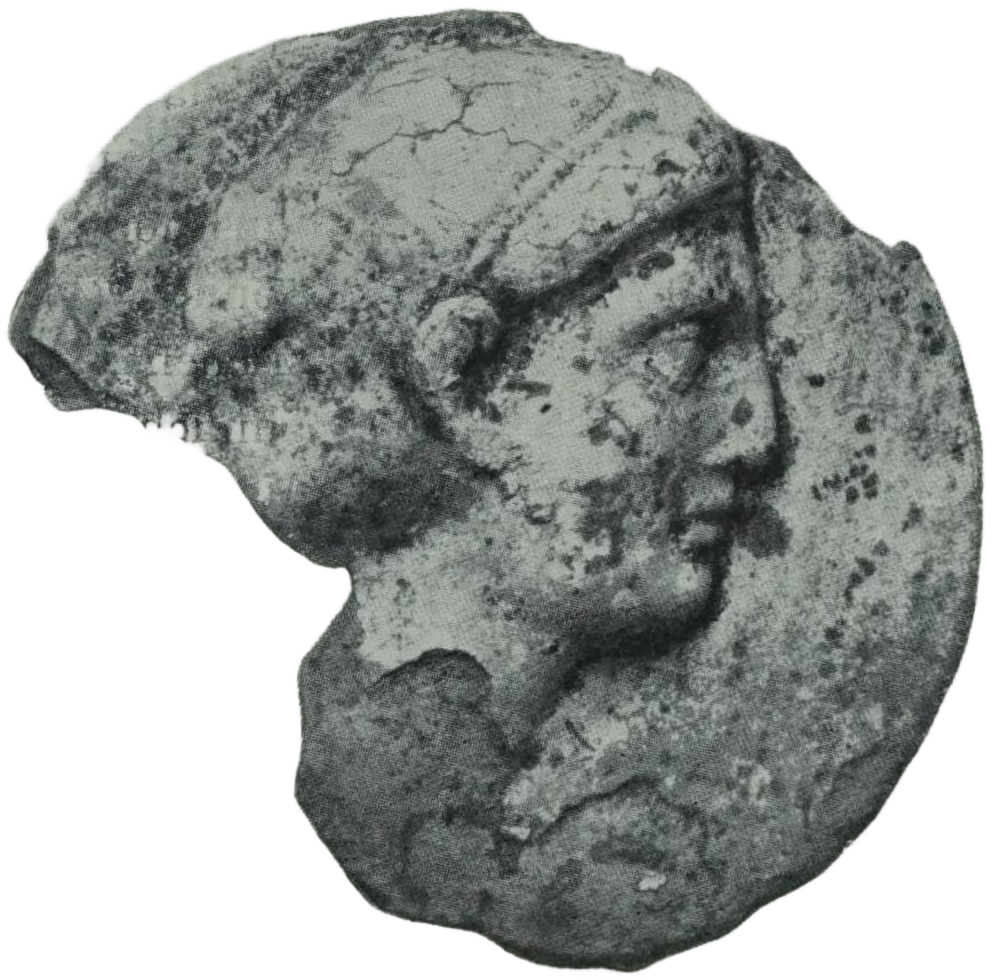
Not only in Sicily, but also outside of it Syracuse had its effect. From Macedonian Neapolis comes a coin, N 12, which clearly used the artistic means of reverses R 396, R 398, R 399, and R 400. In Asia Minor Cyzicus, which could easily get into embarrassment because of its constantly changing image choice[71], an electrum stater originated, N 13, which imitates the sakkos types.
Closer than these two cities, on Italian mainland, lies Pandosia, which with N 14, like Macedonian Neapolis, imitates a head of Series XVII, and Neapolis in Campania, which with N 15 imitates one of Series XV. In greater number again we find Syracusan heads used as models in Cumae, the mother city of Neapolis. The head of N 16 and N 17 alludes directly to the Damareteion; that of N 18 in freer and that of N 19 in crude manner to R 396 to R 400. How close the artistic connection between Syracuse and Cumae was is also taught by the adjacent terracotta relief, which comes from Cumae and in style as in external presentation directly recalls the heads of Series XXIII[72]. That Cumae after the assistance by Syracuse in the great sea battle against the Etruscans 474 B.C. felt particularly moved to allude in its coin heads to Syracusan types is not surprising. In later time it also once placed a ketos on one of its coins. The supposition has been expressed that Syracuse placed this sea creature on its coins because it had already been present in Cumae as a secondary symbol[73]. The one Cumaean coin that bears this animal, K 3 on Plate 32, is however much later than the first Syracusan ones with it, indeed later than all Syracusan ones at all that bear it. It belongs at the earliest to the time around 440 to 430 B.C. An adoption by Syracuse can therefore not be present.
Why Syracuse, Cumae, and other cities placed the ketos on their coins we can only judge if we make clear to ourselves what the animal has to mean at all, and this is again only possible if we briefly recall its representations. Unfortunately it has not yet found a due unified treatment, although we can observe in it as in no other fabulous creature the transforming imagination of the Greeks[74]. The ketos, as we see it on the Syracusan coins, is an animal with a dog-like head and a snake-like body. The mouth, however, is larger and the ears are longer and broader than with a dog; on the lower jaw usually hangs down a long beard; the body is scaled on the belly and provided on the back with a continuous spiny mane; small fins are attached to the body windings, in the whole usually three; the tail fin is narrow and split. Most clearly the ketos is to be seen on the obverses of numbers 411, 444, 470, 495, 511, and 521. It so much resembles the seahorse known to us today[75]—we illustrate a dried specimen here alongside—that we must assume the Greeks shaped their fabulous animal after its appearance, unless they fell back on an animal that was even more similar but no longer exists today.
A pyxis in Würzburg—Figure 9 a-c—from the time shortly after 400 B.C., probably Boeotian, teaches us where mythologically the ketos belongs. On this vessel three fabulous creatures are represented: a Scylla, a hippokamp, and a ketos. We have become accustomed to call this third animal ketos, but the justification of this name must first be demonstrated. In Paris in the Louvre there is an Etruscan cista from the time of the fourth century[76]. On this is represented how Perseus fights with a sea creature that approaches to devour Andromeda. This sea creature looks exactly like the animal that we find on our Syracusan coins, and this monster that wants to devour Andromeda is called ketos[77]:
In the Heracles-Hesione saga the ketos also appears[78] and it is mentioned multiple times in Homer. Here in the Iliad, Book 20, 144 ff., Poseidon once advises Hera to desist from battle and withdraws to that rampart which the Trojans and Athena had thrown up for Heracles as protection against the ketos coming from the sea. Odysseus fears, Odyssey Book 5, 421, when he wants to land at the Phaeacian island, that a storm will drive him out again onto the sea or that upon him
Circe describes, Odyssey Book 12, 96f., reclining beside Odysseus, the dangers that will meet him; she describes Scylla as she looks, and that she, half hidden in the rock, half peering out,
The earliest pictorial representation of the ketos known to us we find on a Cretan potsherd[79], the next on a Melian gem[80]. In the sixth century it appears in various and unclear formulations on the Corinthian black-figured clay tablets[81].
In antiquity there were also ships that were named after the ketos: κητήνη πλοῖον μέγα ὡς κῆτος, Hesych. In Latin pistrix is the name for the ketos as for a specific ship[82]. If we compare the Corinthian vase painting, Mon. Inst. X, 52, I, where Perseus fights the ketos with its head here as much boar as dog, with the Corinthian pinakes on which ship prows are represented in the same form, we understand why ships were so named[83]. For the ram one chose the form of the sea monster.
Represented in sculpture was the ketos in the pediment of the Megarian treasury in Olympia[84], but the found fragments are so destroyed that we can no longer form an impression of its appearance.
In the fifth century the ketos representations appear especially on the coins; we will speak of this presently. In the fourth century we frequently encounter vases on which a procession of sea creatures with Nereids on their backs is represented[85]. Mostly it is Thetis who arrives with her companions to bring Achilles the new weapons. People have believed they could connect these representations with Scopas and trace them back to him because he created a large group about which Pliny reports the following to us: sed in maxima dignatione delubro Cn. Domiti in circo Flaminio Neptunus ipse et Thetis atque Achilles, Nereides supra delphinos et cete aut hippocampos sedentes, idem tritones chorusque phorci et pistricees ac multa alia marina, omnia eiusdem manu praeclarum[86]. But in Palermo there is a terracotta table from Selinunte, on whose top outside on the vertical edge a frieze is attached where Nereids with weapons swim along on sea creatures κητείοις νώτοισιν ἐφήμενοι, Moschus II, 115, and this representation comes from the middle of the fifth century[87]. It is absolutely to be assumed that in this period large sculptural works already existed in which the ketos must have been present, especially since poetry at that time occupied itself with themes where the ketos cannot have been absent. Thus Aeschylus wrote a trilogy Νηρηίδες in which the delivery of the weapons was the main thing[88]. The Syracusan poet and contemporary of Epicharmus, Phormis, wrote a piece that had the title Ἵππος Κηφεύς (ἠ κεφάλαια) ἢ Περσεύς[89]. He is probably identical with the successful general of the same name[90]. With Epicharmus the ketos directly appeared, though under another name Κάμπη, κῆτος παρὰ Ἐπιχάρμωι, Hesych, Kaibel, Fr. C. Gr. 194, p. 127. The name Kampe does not surprise us given the close relationship of ketos and hippokamp. But Kampe was also called a caterpillar[91]; perhaps it was Epicharmus' intention to give the large sea creature the name of the small caterpillar, thereby to provoke the listeners to laughter.
What functions the ketos could all assume is explained to us by the head strip illustrated alongside—Figure 10—of the epinetron of the Eretria painter dating from the time between 425 and 420 B.C.[91a], where in the battle between Peleus and Thetis the ketos is directly one of the transformation forms of the sea goddess.
In the representations of the fourth and third centuries the ketos conforms more closely than otherwise to the form of the seahorse. In Roman times a bombastic imagination plays; it forms creatures with lion paws, large swimming fins, and thick bodies[92]. In infinitely great number the ketos then appears in early Christian and medieval representations of the Jonah legend. Here it is the animal that swallows Jonah and spews him out again. Outside the Greco-Roman world the ketos encounters us frequently in Etruria. Here it is a sign that is frequently used in tomb symbolism, especially on stelae in the pediment field. What it is supposed to mean here is doubtful. One cannot decide on the basis of the monuments whether the animal like other sea creatures that carry the soul across to the realm of the dead is used, whether it is supposed to express a relationship of the deceased to the sea, or whether it is used only purely decoratively[93].
As in Etruscan, so also in Greek we can establish no religious function for the ketos, but its general meaning is clear. It is one of the many sea creatures that the Greek shaped with intensive imagination in manifold forms to animate the sea and to speak impressively of the dangers of sea voyages. We comprehend the animal on coins of Syracuse as a sign for the sea battle at Cumae, in which Hieron threw the Tyrrhenian youth from the swift ships into the sea, drawing Hellas from heavy bondage, Pindar, Pyth. I.
A striking phenomenon is now that the ketos also appears on other than only Syracusan coins in Sicily at approximately the same time. This is the case in Gela and in Catana, K 1 and K 2. The Gelan coins one can well connect with the same historical event, since the city belonged to the Deinomenid realm and as a sea city certainly participated with its fleet in the battle. With Catana, however, it cannot be so. This city, as far as we know, was independent until the conquest by Hieron in the year 476, in which the old population had to vacate the city and was forcibly settled in Leontini. In the emptied city Hieron founded a new organism, the city of Aetna. The coin K 2 illustrated on Plate 32 is placed with the strikings of similar style, where Nike also appears on the reverse, in the time before 476[94]. For the ketos appearing here earlier than in Syracuse the explanation has been given that it has here no historical meaning[95]. The style of these coins is so mature, however, that we must absolutely doubt the given dating. According to style these strikings belong to the time immediately after the expulsion of the Aetnaeans settled by Hieron, thus precisely after 461 B.C. One should once examine exactly the formation of the bulls, the design of their heads, and above all the Nikai with the mature head formation and on the other hand the archaisms in posture and gait. The later appearing Apollo head in its earliest specimens is so developed that we cannot push it up to the year 461. Compared with the Leontine Apollo head it would be dated about the time from 450 to 445. In the pause from 461 to 450 the Nike series can be well placed. To a certain proof one will be able to arrive through more exact stylistic comparisons and through a die processing[96].
In later time, end of the fifth century and in the fourth, the ketos appears variously again in Sicily, in Acragas, Himera, and on Siculo-Punic strikings[97], for reasons that elude our judgment. Outside of Sicily we find in the fifth century the ketos still frequently in Cumae, K 3, in Lucanian Poseidonia four times, K 4 to 7, and here on the earliest piece K 4, as in Syracuse, in the time around 480 B.C.; perhaps Poseidonia participated substantially in the battle against the Etruscans—it would have lain in its interest—and placed the ketos on the coins in memory of this together with Syracuse. Since the city as a speaking emblem, however, bears Poseidon on the coins, the ketos can also merely have been added as a companion of the god. The trident is once called κητοφόνος in Christian times[98]. Coins K 6, K 7, and K 8 bring no longer like K 4 and K 5 the whole animal but only the head.
On non-Italian soil, in Crete the monster appears on coins of the city of Itanos, Plate 32 K 9 and K 10; here in the upright posture characteristic of the seahorse. The obverse of these coins bears a male sea daemon, a Triton or Glaucus with fish body and trident. On a Corinthian stater of the fourth century, K 11, the ketos head appears as a secondary symbol behind the head of Athena in the field. The closer meaning we do not know here.
In the course of the investigations we have already had to address several times the question in what time the treated coins can have originated; here it shall be dealt with once more as a whole and in connection with the other secondary symbols appearing on the coins.
The fixed point for us is the Damareteion. We know that it was struck after the victory at Himera from the proceeds of the gold that Damarete received from the Carthaginians for essential help in the peace negotiations[99]. The dating of the Damareteion thus depends on the dating of the battle at Himera. As Herodotus transmits, the story went in Sicily that the battle was fought on the same day as that of Salamis: Πρὸς δὲ καὶ τάδε λέγουσι, ὡς συνέβη τῆς αὐτῆς ἡμέρης ἔν τε τῇ Σικελίῃ Γέλωνα καὶ Θήρωνα νικᾶν Ἀμίλκαν τὸν Καρχηδόνιον καὶ ἐν Σαλαμῖνι τοὺς Ἕλληνας τὸν Πέρσην (VII, 166). Diodorus, as a Sicilian probably following a native source, sets it equal with the day of the battle at Thermopylae: συνέβη γὰρ τῇ αὐτῇ ἡμέρᾳ τὸν Γέλωνα νικῆσαι καὶ τοὺς περὶ Θερμοπύλας μετὰ Λεωνίδου διαγωνίσασθαι πρὸς Ξέρξην, ὥσπερ ... κτλ. The dating of Himera now depends on when these two battles were fought and which of the two traditions one gives credence.
Salamis falls in the second half of September, on the 20th Boedromion, as Polyaenus III, 11,2 transmits in agreement with the generally held indications of Herodotus, and the battle at Thermopylae in high summer: Ὡς δὲ εὐφρόνη ἐγεγόνεε, ἦν μὲν τῆς ὥρης μέσον θέρος, Herodotus VIII, 12. We thus obtain the time span from mid-July to end of September for the battle at Himera and want to content ourselves with this limit. The conception that the battle of Himera was fought simultaneously with one of these two others could not have arisen if temporally the battles had not fallen together to some extent[100].
If we now assume that the peace negotiations in Syracuse lasted several more months and then Gelon with accustomed swiftness proceeded to have the commemorative coin struck, we obtain as the earliest date for the production the turn from 480 to 479, and, since the coinage, as we have seen, lasted some time, as the time for the remaining pieces the first half of the year 479.
The lion appearing twice on the Damareteion we must connect with the battle of Himera. To interpret it differently than Holm does, according to whom the animal relegated to the exergue symbolizes subjugated Carthage, is hardly possible. As we have explained above[101], Leontini struck coins simultaneously with the Damareteion, A 4 and A 5, on which the lion is formed exactly as on the Damareteia; with A 5 on the obverse and reverse, with A 4 on the obverse alone. That between Syracuse and Leontini in that time a closer connection existed, apart from belonging to the Gelonic state, we have been able to establish on the basis of the common style. It is striking that with the strikings of the remaining Sicilian cities that must have been involved in the battle this secondary symbol does not appear. It seems that Leontini together with Syracuse had the main share in the victory and that Gelon for this reason commanded these two cities to produce the strikings with the common signs.
Through coins numbers 388 and 391E it has been possible to anchor the archaic coinage stylistically in the Damareteion class. With coin A 3 with the Leontine obverse we believe ourselves to be in the year 485, and with the first coins with the ketos in the year 474. The battle at Cumae is placed by Diodorus[102]in the year of the Attic archon Akestorides, Olympiad 76, 3 = 474/73 B.C. It is not to be assumed that the campaign was undertaken in winter; we would thus have to assume as possible time July to October 474 or March to June 473 for the battle, if Diodorus did not report for the years 480 to 472 about Sicilian events only every other year[103]. What he recounts in Olympiad 76, 3 can have occurred both in Ol. 76, 2 and Ol. 76, 3. We thus have for the dating of the battle at Cumae a time span of 3 years, from 475 to 473 B.C., and for the coins relating to it a corresponding one, only placed a few months later.
The remaining secondary symbols appearing during our period cannot be connected with full certainty to a specific event. The appearance of Nike on Syracusan coins cannot, as has been suspected[104], be connected with Gelon's victory at Olympia 488 B.C. 485 B.C., as far as one would have to go down, is too late for the first coins with Nike. According to style they belong, as far as the vases teach us, to the time around 510 B.C.[105].
On the basis of the conception that we likewise form from the vases about the sculpture of the second half of the sixth century, the first coins in Syracuse originated around 530. The dating of the so-called Cnidian treasury in Delphi, with whose one polos relief of the caryatid at the beginning the first Syracusan little head was compared, is not established, however; it cannot be much older than the Siphnian treasury originated shortly before 525[106].
With which event the wreathing of the female head with the sakkos, Series XX, XXI, and XXIII, is connected we cannot prove with certainty. The investigations about this depend on when we place the end of our period and the beginning of the next period with the signed coins. A precise determination is not possible there either, however. If we consider that in those cities of Sicily that were destroyed by the Carthaginians in the years 408 to 405 B.C.—408 Selinunte, 406 Acragas, 405 Gela and Kamarina—the Syracusan strikings with the galloping quadriga from the so-called flowering period were already imitated, and that in Syracuse a large number of dies with galloping quadriga were produced before these Syracusan dies serving the other cities as models, we arrive at the time around 435 to 430 B.C.[107]. Most clear in this is the coin of Syracuse mentioned above on page 78 with the signature and the Scylla in the exergue, and the Selinuntine coin with the last tetradrachm die used there[108], the only one in this city with galloping horses. It seems to me that both dies come from one hand and that the Selinuntine die is dependent on the Syracusan one; in any case both belong to the same years. The temporal fixing of the coin is disputed. Evans sees in the Scylla an allusion to the sea victory that the Syracusans with their allies won in the year 425 B.C. at Messana over the Athenians[109]; Tudeer, however, would like to assert the great victory in the great harbor of Syracuse in the year 413 for it. An attachment of Scylla for a victory in the strait of Messina has more in its favor with the localization of the monster in this area, but the time span from 425 to about 412, in which latter year approximately the Selinuntine die must have been produced as the last before the catastrophe, is then too large. However, independent of the dating of the coin we cannot go above 435 with the beginning of the so-called flowering, for the mass of the preceding strikings presses mightily. It is in itself already difficult to force the enormous number of dies with the great stylistic changes into the half century from 480 to ca. 435 B.C., even if we assume a rapid tempo of artistic development.
But let us come back to the question when the sakkos wreathing can have emerged. Five historical events stand at our disposal, each of them suitable to motivate a wreathing of the city goddess: 466/65 the fall of the tyranny, 461/60 the defeat and expulsion of the mercenaries previously settled in Syracuse, 451 in spring the victory at Noae over the mightily expanding Sicel king Ducetius, summer 446 the victory over the Acragantines at the southern Himeras where over a thousand enemies fell, and 440/39 the final victory over the Sicel kingdom[110]. The years 466 and 461 cannot be considered, for it is impossible to cram the whole Series XIII to XIX, which come after the Damareteion and lie before Series XX with its first-time sakkos wreathing, into eight or even fourteen years. 439 B.C. is excluded because this year is too close to the beginning of the so-called flowering period; only 451 and 446 remain. For 451 decides Lederer[111]because he assumes the city goddess was wreathed only with victories over the barbarians. That a wreathing for the victory at the Assinarus 413 B.C. is missing on the decadrachms referring to this event does not yet give us permission to draw this general conclusion.
Perhaps something else brings us closer to the decision. Besides the wreath on the sakkos a couple of other secondary symbols appear; in Series XVII once subsequently cut a grain of barley, in XXI an olive branch in the exergue, in XXIV an olive leaf with fruit, and in XXV a grasshopper. Grain of barley and grasshopper will have been applied for particularly good and bad harvests[112]and fall away for a historical allusion. The olive leaf of Series XXIV can, according to the dating we assume for the end of our period, refer to the victory of 440/39. If this assignment is correct, then we also have the possibility to accommodate the two other signs: 451 after the for Syracuse so vitally important victory over the Sicels the wreathing was placed on the sakkos; it was retained long, and 446 for the decisive but less glorious victory over the Greek neighbors the olive branch, and this therefore remained only a short time.
One thing may be asserted against the division. Series XXI with the olive branch in the exergue follows according to our arrangement immediately on XX, while XXIV is significantly further removed from XXI. With the given secondary symbol interpretation, however, approximately equal distances of five years would be to be assumed both times. The dies of Series XX have now been in use strikingly long; this is proved by the large die injuries. We can well fill several years with the coins struck from them. Series XXII goes, as we suspected, alongside Series XXI, so that thus between XXI and XXIV chronologically only one series, namely XXIII, is to be inserted. Clarity about this point will probably only be created if coins should still turn up that bring new linkages, such that are suitable to place Series XXI, XXII, and XXIII more firmly.
The inscriptions of Syracusan votive offerings found until today teach us nothing for the date of the coins. Conversely, however, we can make a remarkable epigraphic observation through the coin legends. Two datable inscriptions that are of some significance have come down to us. The one[113] was found in Delphi and refers to the dedication of a golden tripod and a golden Nike by Gelon after the battle at Himera: χρυσοῦν δὲ τρίποδα ποιήσας ἀπὸ ταλάντων ἐκκαίδεκα ἀνέθηκεν εἰς τὸ τέμενος τὸ ἐν Δελφοῖς Ἀπόλλωνι χαριστήριον. (Diodorus XI, 26, 7); it reads:
In this inscription we encounter the letters and ϙ; on the contemporary Damareteion, however, already stand A and K. The K has even already prevailed on the coins for some decades.
The inscription on votive offerings customarily tends to be composed in the dialect of the dedicator and written in the native letters. We see here that for sacred purposes archaic letters were used, while for state money the new ones already had validity.
The second inscription was found in Olympia in 1817. It stands on an Etruscan bronze helmet and identifies this as a votive offering of Hieron and the Syracusans for the victory at Cumae. It reads:
On the adjacent Figure 11 the letters are clearly recognizable[114]. Here now the A is crossed transversely and the K is given as kappa and no longer as koppa, ϙ. A difference between the letters here and those of the contemporary coins no longer exists.
The remaining inscriptions relating to Syracuse or found in Syracuse are of lesser interest. The inscription found in Olympia of a Praxiteles calling himself Syracusan and Camarinaean is written in Arcadian letters because Arcadia was the original homeland of the dedicator[115]. An inscription relating to the Syracusan Olympic treasury, a fragment of the ethnikon, has the four-stroke sigma[116]. With the coins this appears with Series III.
Still worth mentioning is the inscription engraved in Syracuse on the stepped structure of the Artemis(?)-temple[117]. We find there letters that we would not suspect, judging by the coins, at such an early time as the inscription is dated. Alongside the three-stroke sigma appears the four-stroke one; in the lower line in that strikingly soft form that we encountered with dies R 22 and R 23. The Ionic ending in the name of the dedicator[118] suggests that we perhaps have to deal here with a foreigner.
After we have investigated the coins for style and time, we must still address the interpretation of the representational. In the foreground of interest stands the designation of the female head, about which much has been disputed; the opinions diverge widely, and something certain will hardly be found, unless new, determining material once turns up. Nevertheless we must not shy away from the attempt.
Most recently Tudeer has dealt extensively with the question. We may presuppose knowledge of his arguments[119]. In summary let it be said once more that, proceeding from the coins of the signing period, Artemis, Arethusa, Demeter, Kore, and Cyane have been proposed for the head of the coins of our period. Whence comes it that such uncertainty prevails?
The obverses with their ordinary quadriga driven by a bearded or unbearded man seem to yield nothing for the interpretation of the head. For the quadriga stands on the coins of no fewer than seventeen[120] Sicilian cities and always connected with a differently formed reverse, so that one can speak of a Siceliot community type of the obverse[121]. This does not prevent, however, that the obverse can stand in some connection with the reverse in each case. In our time the main deities of the striking cities are generally brought onto the coins, or their symbols. Since these were celebrated in larger festivals that mostly were connected with contests of various types, we can interpret the chariot as a race chariot, thus agonistically. In Sicily horse breeding was especially cultivated, and the Sicilian chariots were famous far and wide[122].
We can now establish that on this island those deities who embodied the locality enjoyed a special veneration; this is proved by the numerous coins on which they are unambiguously represented. This may well stem from the fact that the Sicilian cities were mostly named after rivers; 'Ακράγαντος· πόλεις πέντε Σικελίας ἀπὸ ποταμοῦ παραρρέοντος. φησὶ γὰρ Δοῦρις, ὅτι αἱ πλεῖσται τῶν Σικελῶν πόλεων ἐκ τῶν ποταμῶν ὀνομάζονται, Συρακούσας. Γέλαν, κτλ. (Stephanus of Byzantium). If we cannot readily recognize a deity here by the type or through an added sign, we must first ask ourselves whether the main god or its symbol has not been represented; this is commanded by the generally Greek image choice[123].
Let us now consider a couple of cities where we know the main deity through literary testimonies. Those must be excluded where we can only conclude the main deity from the coins. Athens has Athena, Corinth the Pegasus, Argos the wolf and later the Hera head, Elis the eagle. In Sicily Acragas the eagle, Himera the cock, Zancle-Messana the dolphin. The coins of Syracuse are not unambiguous. We encounter on them a female head without further insignia, only surrounded by four dolphins. For their sake one would like to think of an express sea deity, for example Amphitrite, but the veneration of such a one is not attested to us.
Now in the period of the signing artists the most diverse heads appear on the coins, which make themselves recognizable through their adornment: Demeter, Kore, Athena; once a head is inscriptionally designated as Arethusa, and all are accompanied by dolphins. For the judgment of the coins of that time one must thus leave the dolphins out of consideration. They seem to be intended to say that Syracuse is a sea city, nothing more. But it may be that at their first appearance they had a symbolic meaning that has only faded with time. One had become accustomed to the female head always being surrounded by dolphins. With a change in the chosen type one did not want to give these up. Unambiguous is indeed the coin with the inscriptional Arethusa. The head is here stylized differently than with the other coins; the face is given frontally. A distinction through symbols or secondary signs is not attempted, however. People have believed that through this inscription it was to be indicated that this is a different goddess than the one previously represented. Tudeer has on the other hand drawn attention to the fact that in Catana Apollo and in Terina Nike appear on the coins generally without, but once with name inscription. We thus do not need to make a separation. But let us leave the coins of the later period, which bring nothing decisive, and seek to come closer to the question by another way.
The Greek states invented, in order to make mutual intercourse possible given the exclusivity of life within the individual polis, an institution that in its state effectiveness may have corresponded to today's consulate, the proxeny[124]. The proxenoi were for the most part elected. Following the election stelae were produced on which the people's decree with the name of the appointee was announced. Above on the stele the state emblem of the city to be represented, the δημοσία σφραγίς or the παράσημον, was moreover attached. We now possess two such stelae that were erected for representatives of the city of Syracuse; one was found in Athens, the other in Epidaurus[125]. On the piece found in Athens—here Figure 12—a riderless horse is represented, and on that in Epidaurus a female head surrounded by three dolphins. Macdonald has pointed out that the head has most similarity with the Artemis head on coins from the time of Agathocles.
As city and state emblem, one will naturally have chosen the head of the deity who was in first place in the respective city. Who was this in Syracuse? From Livy we learn, Book XXV, 23, that in Syracuse a great, three-day festival in honor of Artemis was celebrated with much wine. Cicero reports of Ortygia, Verr. IV, 53, 118, the island and original settlement: in ea sunt aedes sacrae complures, sed duae, quae longe ceteris antecellant, Dianae una, et altera ... Minervae. Pindar calls Ortygia: Ποταμίας ἕδος Ἀρτέμιδος, Pyth. II, 7, and δέμνιον Ἀρτέμιδος, Nem. I, 3. In the scholion to Nem. I, 1, 1 stands explanatorily: τὴν δὲ θεὸν ἱππικὴν εἶναι, and with Pindar himself again in the celebration of Hieron's chariot victory at Delphi: τηλαυγέσιν ἀνέδησεν (Hiaron) Ὀρτυγίαν στεφάνους ποταμὸς ἕδος Ἀρτέμιδος· ἇς οὐ ἄτερ κείνας ἀγαναῖσιν ἐν χερσὶν ποικιλανίους ἐδάμασσε πώλους, Pyth. II, 6 ff. In no fewer than five different kinds we know Artemis in Syracuse: As Ἀγροτέρα, as Λυαῖα, as Σώτειρα, as Χιτώνη or Χιτωνία, as Ἀλφειόα apart from the identification with Hecate-Angelos, which is first to be demonstrated in Theocritus[126]
In the year 1900 the Italian scholar Orsi excavated in Syracuse on the mainland, not on Ortygia, a small sanctuary that on the basis of the found terracottas belonged to Artemis [127]. According to style the found objects are to be placed in the time from 400 to 200 B.C. Significant is what all came to light here. Artemis with bow, with lance, axe, palms, hares; connected with the goddess or alone: torches, dog, deer, goat, horse, griffin, pig, bird, panther, and lions. At the procession of Artemis besides other animals a lioness was also led: ἐν τῇ πομπῇ φησὶν ἄλλα τε θηρία ἐπόμπευσε καὶ λέαινα (Schol. Theocr. II, to verse 66).
Not yet have we considered the last-mentioned kind of the Syracusan Artemis, that of Artemis Alpheioa. The scholiast to Pindar's first Nemean ode mentions to verse 3: δέμνιον Ἀρτέμιδος, that in Syracuse an Artemis Alpheioa was also venerated. Alpheius is a river in the Peloponnese that springs in Arcadia, flows past Olympia, and empties precisely in the direction toward Syracuse into the sea. At its mouth an Artemis was venerated who had the epithet Alpheiaia from it, as Pausanias VI, 22, 8 transmits to us [128]. That in Elis Artemis enjoyed a veneration betraying her original vegetative nature is taught again by Pausanias, according to whom she had a common altar with Alpheius in Olympia [129]. In general she was venerated on the Peloponnese and especially in Arcadia as a water deity [130].
At some point, according to the cult rather early, the veneration of Artemis Alpheioa must have come to Syracuse. Through the settlers from Corinth the transfer will hardly have taken place; there Artemis had no significance. Perhaps already at the first founding or soon thereafter colonists from Arcadia and Elis came along. At the beginning of the fifth century B.C. the connection between Arcadia and Syracuse was particularly active. Gelon drew from there several capable leaders and men, such as Agesias, Phormis, Praxiteles. From Thucydides VII, 57 we learn that Arcadia always provided many mercenaries. Agesias was related on his mother's side to the family of the Iamidae, who held the priestly dignity at the Zeus altar in Olympia. Pindar calls him: συνοικιστήρ τε τᾶν κλεινᾶν Συρακοσσᾶν [131].
Artemis now enjoyed veneration in Syracuse as Artemis Alpheioa. For her joy the nymphs had let the oversized spring Arethusa spring up [132]. At this spring stood a statue of her [133], and in the spring were fish sacred to her [134]. If one of these was consumed, divine displeasure made itself known [135]. That in general the entire island of Ortygia belonged to Artemis we learn besides from the name Ortygia [136] from Diodorus: τὴν δ' Ἄρτεμιν τὴν ἐν ταῖς Συρακούσαις νῆσον λαβεῖν παρὰ τῶν θεῶν ἀπ' ἐκείνης Ὀρτυγίαν ὑπό τε τῶν χρησμῶν καὶ τῶν ἀνθρώπων ὀνομασθεῖσαν. All this has only one meaning if Artemis took possession of the spring Arethusa.
Generally known is the saga still gladly told in Syracuse today, according to which the river Alpheius comes over from Greece, he once pursued a spring nymph Arethusa fleeing from him, hurried after her under the sea without mixing with the salt water up to the island of Ortygia, and now he flows, uniting with the nymph, continuously forth here. But how is this? The spring nymph must indeed have been bound to the place where the water sprang forth; she cannot first have come over from Greece and thus Alpheius also cannot have hurried after her to Syracuse. How may the saga originally have sounded?
In Syracuse the Artemis Alpheioa was venerated by settlers from the Peloponnese. They had brought her from their homeland. But they could only think of their goddess in connection with the Alpheius beloved by her. On the island of Ortygia now was a spring that mysteriously yielded sweet water in great quantity, so much that one could almost see a river in it: κρήνην δ' ἔχει (Ortygia) τὴν Ἀρέθουσαν ἐξιεῖσαν ποταμὸν εὐθὺς εἰς τὴν θάλασσαν. Strabo VI, 270 f. What was more natural than to recognize in the spring the missed Alpheius, than to believe he comes over to Ortygia and appears in the Arethusa? In such form we see the saga in the oracle that is supposed to have been given to the founder of Syracuse, Archias:
With Ibycus it has, as much as one can gather from the brief report, probably sounded the same:
But what this phiale had to do with it we learn from Strabo: τεκμηριοῦνται δὲ τοιούτοις τισί. καὶ γὰρ φιάλην τινὰ ἐκπεσοῦσαν εἰς τὸν ποταμὸν ἐνόμισαν ἐν Ὀλυμπίᾳ δεῦρο (Syrakus) ἀνενεχθῆναι εἰς τὴν κρήνην καὶ θολοῦσθαι ἀπὸ τῶν ἐν Ὀλυμπίᾳ βουθυσίων. VI 270 f.
How Pindar knew or thought of the saga is not quite recognizable. The first Nemean ode begins:
Alpheius finds rest on Ortygia, the seat of Artemis. But δέμνιον actually means couch and bed. If Ortygia is the couch of Artemis and resting place for Alpheius, one can think what Pindar thought. When now the virginity of Artemis came more and more to the foreground and the old vegetative nature was pushed back, the connection of Artemis and Alpheius could not remain as before. One turned the saga around. Now Artemis fled, and Alpheius pursued her. Thus the saga meets us with the Argive poetess Telesilla [139], around 500 B.C.:
As long as the saga now sounded of this type, Artemis must inevitably be the spring itself.
How in the further course of the fifth century the myth was formed we can no longer establish. We mentioned Pindar before. His suggestive language is significant enough, however. The first literary testimony we find again in Timaeus of Tauromenium, middle of the fourth to middle of the third century [140]. φησὶ τοιγαροῦν (Timaios) τὴν Ἀρέθουσαν κρήνην τὴν ἐν ταῖς Συρακούσαις ἔχειν τὰς πηγὰς ἐκ τοῦ κατὰ Πελοπόννησον διά τε τῆς Ἀρκαδίας καὶ διὰ τῆς Ὀλυμπίας ῥέοντος ποταμοῦ Ἀλφειοῦ. In between, however, the coin enters with the inscription Arethusa [141], and perhaps yet another testimony. Stephanus of Byzantium and Hesychius report to us namely that the spring Arethusa was also called Cypara [142]. Since the linguistic remains with these two, insofar as they concern uniformly Sicilian matters, almost throughout go back to the Syracusan comedians of the fifth century, Epicharmus, Phormis, and Sophron, the supposition is near that this Cypara was also drawn from there. The comedians may have used this name and brought it back into vogue.
For what reason now was Arethusa inscribed on the coin? Had perhaps the name Cypara come into such use that one needed to make the citizens again attentive to the religiously and officially alone permissible name, at that time when the Carthaginians directed their new great attack on Sicily and conquered one Greek city after another? Cypara seems to be Phoenician[143]. The coin belongs to the said time in any case for stylistic reasons[144]. Perhaps at that time it also simply sufficed to say Arethusa, and everyone knew that it concerns Artemis-Arethusa, just as one wrote Nika in Terina, where one knew that it concerns Terina-Nika[145]. A last possibility is still that Arethusa as individual deity precisely then detached herself from Artemis. To show that one now means Arethusa with the new coin image and not Artemis, one added the name; everyone would otherwise have taken the represented one as before for Artemis. How it really was can hardly be decided.
Moschus mentions in the eighth Idyll the connection of Alpheius and Arethusa, verses 4 and 5:
καὶ βαθὺς ἐμβαίνει τοῖς κύμασι, τὴν δὲ θάλασσαν νέρθεν ὑποτροχάει· κοὐ μίγνυται ὕδασιν ὕδωρ. Polybius polemicizes at the indicated place[146] against Timaeus. He says it would be completely impossible for the river to flow through the sea. The communication of this saga is again a proof of the mendacity of Timaeus. Equally unpoetically Strabo fights against this view; but he brings on this occasion other priceless poems and sagas for us, thus for example: Ἴβυκος δὲ τὸν ἐν Σικυῶνι Ἀσωπὸν ἐκ Φρυγίας ρεῖν φησὶ ... [147]. Pausanias, even more harmlessly, says one must believe[148]. In these poetic connections one customarily made religious-spiritual connections sensuously clear[149].
In Aegium on the north coast of the Peloponnese in Achaia was a sanctuary of a goddess Σωτηρία. The cult image only initiates were allowed to see in the time of Pausanias. As custom there was among other things also the following:
The Syracusan Artemis, Alpheioa, was according to the testimony of Pindar a river goddess, and the scholiasts say the following on it: ποταμίας ἔδος: τῆς Ἀλφειώας. φασὶ γάρ τινες Ἀλφειὸν ἐρασθέντα τῆς θεοῦ καὶ διώξαντα ἄχρι τῆς Ὀρτυγίας παύσασθαι. ὅθεν Ἀλφειώας Ἀρτέμιδος ἐκεῖ φασὶν εἶναι ἱερόν, ἣν νῦν ποταμίαν εἶπεν.
b. ἄλλως· ἔδος Ἀρτέμιδος: ἵδρυται γὰρ ἄγαλμα Ἀρτέμιδος ἐπὶ τῇ Ἀρεθούσῃ, ἡ δὲ Ἀρέθουσα ἐξ Ἀλφειοῦ τοῦ ποταμοῦ δέχεται τὰ ῥεύματα· ποταμίαν οὖν [Ἄρτεμιν] αὐτὴν διὰ τοῦτο ὠνόμασεν. [151]. What we had inferred before, namely that Alpheius must have pursued Artemis all the way to Ortygia, is attested here by a scholiast.
Finally a word about Artemis as river and water goddess. In Teuthrone[152] she is attested as such; and a spring was there proper to her; as such she is furthermore venerated in Stymphalus[153], in Troizen[154], and in Sparta[155], as Artemis Λιμναῖα. As sea deity she is no less known. As such the sacrifice of Iphigenia was valid for her, and Agamemnon founded a cult for her: ὅτ' ἐς Τροίην ἔπλεε νηυσὶν θοαῖς[156]. With Callimachus she binds the winds[157], elsewhere she is νησσόος[158]. In Rhodes she is εὐπορία[159], with Callimachus again λιμενέσσιν ἐπίσκοπος and λιμενόσκοπος[160].
Should Artemis not also have been venerated in Syracuse, in this great harbor city, as sea goddess, we who have learned to know her there in so many functions? As Δελφινία? Do the bronze votive boats found on Ortygia not far from the spring Arethusa perhaps point to this[161]?
Artemis as Ἱππική[162], as Ποταμία and Λιμενόσκοπος, as such we must think of her on the Syracusan coins with quadriga, head, and dolphin.
We have in this treatise attempted to establish the chronological sequence of the coins of Syracuse from a century of richest coinage and to develop and solve the resulting problems. We endeavored to demonstrate that the represented deity is Artemis; before a specific question, and perhaps the most important one in this, we have always stopped, however.
If one namely goes a step back or further in one's problem formulation and no longer asks about that which is meant by the coin image, but searches for what is really represented, one finds, to express it simply, the head of a female being in the age from twenty to thirty years, a head without idealizing generalization or synthesis, with coarse, often ugly, but always characteristic and decidedly portrait-like features. The description precisely of these features is so unambiguous that one, although reluctantly, is forced to assume the artists represented quite specific people on the coins. But who could these have been?
As first one would like to think that the artist chose his model and formed the face after its countenance. With this interpretation it is indifferent whether he himself determined the living model or proceeded from a sculptural artwork. It would be the most natural solution and an explanation for the frequent change of the represented heads. Such a working method we cannot assume, however, because it is completely excluded that any state ever leaves it to a die engraver to choose himself the object to be depicted. Such freedom would contradict the ancient nature in general.
It must have been so that from the state certain women were designated whom the artists had to depict on the coins. The question thereby is only where and how these women were determined. We cannot assume that one made the selection in a contest of beauty, which we know for boys and men, for only few of these faces are beautiful. Also it is not to be assumed that in each case ruling personalities arbitrarily designated the women, even if they will have had a certain influence. But one thing is possible, that the priestesses of the chosen deity served the artists as subject, especially because the priest not only represents and presents his god but is mostly identified with him, for which we have countless proofs from antiquity. If we assume this, we have on our plates not only a register of the coins but also a catalog of the Artemis priestesses of Syracuse.
Footnotes
Literature on the Damareteion: Boeckh, Metrol. Quaest. 295 et 304. Busolt, Griechische Geschichte 2², p. 789. Daremberg-Saglio, Demaretion. Evans, Num. Chron. 1894, 189 ff. Giesecke, Sicilia Numismatica, p. 8. Hill, Coins of Sicily, p. 78. Holm, Die Geschichte Siziliens 1,416 and 3, 570. Hultsch, De Damareteo Syracus. nummo and articles Damarete and Damareteion in RE. Imhoof-Blumer, Journ. Inter. 1908, p. 48. Lederer, Kleingeld, p. 7. Duc de Luynes, Annali dell' Ist. 2, 81. K. O. Müller, Etrusker¹ 327. Tudeer, op. cit., p. 266. ↩
b) Λυαῖα: Diomedes, Ars grammatica, 486, 29; Keil, Gr. lat.
c) Σώτειρα: on coins of Syracuse from the end of the 4th cent. B.C. B. M. C. Sicily p. 200 number 426. --- Head, Hist. Num.^2, p. 198, Fig. 102.
d) Χιτώνη: Stephanus of Byzantium: Χιτώνη p. 694. M: οὕτως ἡ Ἄρτεμις λέγεται καὶ Χιτωνία· ὡς Ἐπιχάρμος ἐν Σφιγγί."καὶ τὸ τᾶς Χιτωνέας αὐλησάτω τίς μοι μέλος" (Kaibel, Fr. C. Gr. I, 127, p. 114) and Athen. XIV 629 e: παρὰ δὲ Συρακοσίοις καὶ Χιτωνέας Ἀρτέμιδος ὀχρησίστις ἐστὶ καὶ αὔλησις.
e) Αλφειόα: see below p. 98 ff.
f) Hecate-Angelos: Schol. Theocr. II, 11, 12 (Kaibel, Fr. C. Gr. I, 161) and Theocr. II, 39. Τὴν Ἑκάτην χθονίας φασὶ θεὸν καὶ νερτέρων πρύτανιν καθὰ καὶ Σώφρων. Ἥραν μιχθεῖσαν Διὶ γεννῆσαι παρθένον, ὄνομα δὲ αὐτῇι θέσθαι Ἄγγελον ... κτλ. Hesych: Ἄγγελος. Ἄγγελον Συρακούσιοι τὴν Ἄρτεμιν λέγουσιν. Callimachus, Frg. 556 (Schneider): τῇ Δήμητρι μιχθεὶς ὁ Ζεὺς τεκνοῖ Ἑκάτῃν διαφέρουσαν ἰσχυῒ καὶ μεγέθει τῶν θεῶν. ἣν γῆν πεμφθῆναι ὑπὸ τοῦ πατρὸς πρὸς Περσεφόνης ζήτησιν ⟨... διὸ⟩ καὶ νῦν Ἄρτεμις καλεῖται καὶ Φύλαξ. ↩